Feb 11, 2018 | News
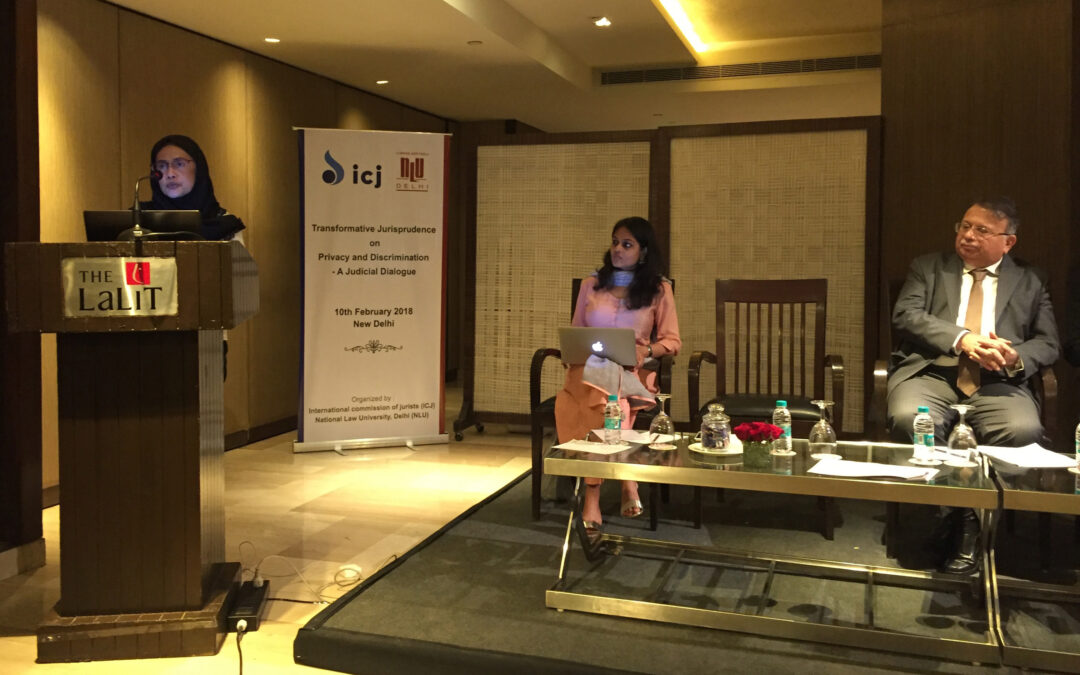
On 10 February 2018, the ICJ, in partnership with the National Law University, Delhi (NLU), organized a judicial dialogue on transformative jurisprudence on privacy and discrimination.
Participants included judges from the Supreme Court of India, the High Court of Delhi, and the District Courts of Delhi; ICJ Commissioners: Justice Ajit Prakash Shah, from India, who made the event possible through his support, Justice Kalyan Shrestha, from Nepal, Justice Adolfo Azcuna, from the Philippines; a Commissioner of Thailand’s National Human Rights Commission; and lawyers and activists from India. The judicial dialogue examined the relationship between the right to privacy, the principle of non-discrimination, and the right to equality before the law, in the context of one’s sexual orientation and/or gender identity, as well as in light of the jurisprudence of the Indian Courts.
It pursued the ICJ’s larger goal of addressing the need for sustained, ongoing engagement with the Indian judiciary on LGBTI rights, to facilitate better access to justice for the LGBTI community, with the help of a sensitized judiciary.
The discussions lent support to domestic advocacy efforts directed at other State and non-State actors to get them to better address and reduce discriminatory treatment and homophobic and transphobic attitudes towards LGBTI communities by challenging discriminatory laws and practices.
The dialogue underscored the different facets of the dynamic right of privacy in relation to the human rights of disenfranchised communities, and discussed sexual orientation and gender identity as essential attributes of one’s identity deserving of and entitled to protection.
The conversation touched upon emergent challenges in the privacy debate, in light of technological advances, critiquing the Indian Government’s unique identification project whereby the Government’s programme of issuing a 12-digit unique identity number to all Indian residents based on their biometric and demographic data, and which will be needed to access government and private sector services, is currently being contested in the Supreme Court on account of privacy concerns.
The speakers emphasized the importance of the right to be forgotten and the right to limit one’s audience as essential to a right to privacy, given the increasing importance of the internet.
The speakers also highlighted the need for the judiciary to uphold fundamental rights enumerated in the constitution instead of pandering to populist beliefs and mores
There was unanimous agreement among the judges and the extended legal community that Section 377, Indian Penal Code, which criminalizes “voluntary carnal intercourse against the order of nature” needs to be struck down, to facilitate progress in developing a rights framework for sexual minorities.
There was criticism of other discriminatory laws, including draft legislation, such as the current Indian Transgender Persons (Protection of Rights) Bill, 2016 for its denial of an individual’s right to self-identify one’s gender.
The speakers reiterated the need for a comprehensive effort from the Indian judiciary, and other State actors with a focus on judicial training and sensitization, as well as police reform, to ensure that India is able to fulfill its international and constitutional obligations to respect, protect, and fulfill the rights of the LGBTI community.
A common theme was the importance of comparative and international law in the development of Indian jurisprudence.
The speakers discussed the ‘Yogyakarta Principles on the Application of International Law in Relation to Issues of Sexual Orientation and Gender Identity’ at length, and the growing prominence of these Principles in Indian jurisprudence, as reflected in the Puttuswamy and National Legal Services Authority v. Union of India judgments, both of which quoted the Yogyakarta Principles extensively.
The dialogue focused on the role of the judiciary, the need for sensitization regarding the human rights violations of the LGBTI community among the judiciary in India and South and South East Asia and, in that context, the importance of judicial dialogues.
ICJ Commissioner Justice Shrestha emphasized that South Asian judges have typically played a more important role than the legislature in advancing human rights.
He discussed the importance of judicial creativity in providing remedies, and emphasized that training programs must include best practices and that judicial training programs must be imparted regularly.
The dialogue stressed the importance of judicial trainings highlighting the role that Justice Cameron and Justice Kirby, both former ICJ Commissioners, have played in raising awareness about the relationship between human rights and issues of sexuality, HIV/AIDS and gender identity in India.
It reiterated the importance of judges being in touch with people’s lived realities, and thus the importance of encouraging judiciary’s interaction with the LGBTI community.
For more information: maitreyi.gupta(a)icj.org
Feb 8, 2018 | News
A proposed new law regulating public assembly adopted by the Philippine House of Representatives would allow for unlawful restrictions on the right to peaceful assembly, the ICJ said today.
On 5 February 2018, the House of Representatives passed on third reading House Bill 6834, which proposes to repeal the Public Assembly Act of 1985.
The law would prohibit persons below the age of 15 from organizing a public assembly and would subject participants or organizers to potential criminal liability for holding a peaceful assembly without the approval of local executives.
“This legislation deceives us into thinking that there is no more need to obtain prior permission to holding a public assembly,” said Emerlynne Gil, ICJ’s Senior International Legal Adviser for Southeast Asia.
“But in effect, organizers will still need to secure the approval of the local executive before holding a public assembly,” she added.
The proposed law states that any person or group intending to organize a public assembly will only need to serve notice to the city or municipal mayor at least three days prior to the assembly without having to secure a permit.
However, at the same time it prohibits the “holding of a public assembly at a time and place other than that approved by the city or municipal mayor.”
“The proposed law does not improve on the old one. It now increases the penalty for holding a public assembly without approval of local authorities to six (6) years,” Emerlynne Gil said.
“The law is also silent as to who may be penalized. Hence, the ICJ fears that organizers and participants alike could be held liable,” she added.
Under international standards, freedom of people to assemble should generally not require prior permission.
The law would also contravene the rights of children that are protected under the Philippines’ legal obligations.
“The provision incorporates into law the arcane and discredited attitude that ‘children should be seen but not be heard’,” said Emerlynne Gil.
“If children are prohibited from organizing a peaceful assembly, this prevents them from exercising their right to impart information freely,” she added.
Under the Convention on the Rights of the Child, children must be guaranteed the right to freedom of assembly.
The bill now goes to the Philippine Senate for its consideration.
The ICJ calls on lawmakers in the Philippines not to adopt the proposed law in its current form.
Any new legislation should conform to international standards, including on the right to freedom of assembly without prior permission and the rights of children to assemble freely, the ICJ adds.
Contact
Emerlynne Gil, Senior International Legal Adviser for Southeast Asia, tel. no. +662 619 8477 (ext. 206); e: emerlynne.gil(a)icj.org
Philippines-Public assembly act 1985-News-Web stories-2018-ENG (Full story in PDF)
Feb 7, 2018 | News
The judgment yesterday by three Supreme judges of a rump Supreme Court that overturned order of the full Supreme Court to release nine members of opposition political parties lacks legitimacy, the ICJ said today.
On 1 February, the Supreme Court had ordered the release of nine members of the opposition parties, who had been convicted for or charged with a wide range of offences, and held the cases required “retrial and judgments pursuant to the law”.
The petitioners had alleged the criminal proceedings against them were based on “political motivations” and were in violation of the Constitution of the Maldives and its international human rights obligations.
Instead of implementing the judgment, the Government responded by declaring a state of emergency and suspending a range of human rights protections.
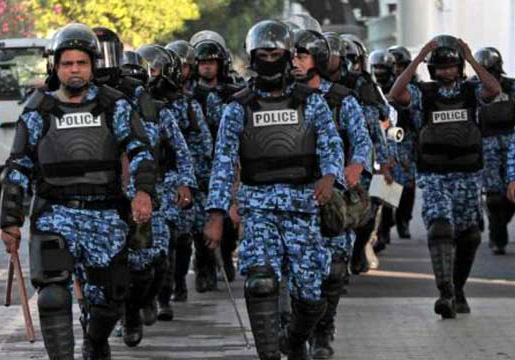
On the night of 5 February, the national defense forces and the police forcefully entered the Supreme Court.
The Chief Justice held members of the forces in contempt of court, after which they dragged the Chief Justice out of the Court premises.
The Chief Justice and Justice Ali Hameed were later arrested on charges of corruption and “obstructing administration of law or other government function”.
On 6 February 2018, the remaining three judges of the Supreme Court overturned parts of the 1 February judgment, including the directions to release members of the opposition parties, “in light of the concerns raised by the President.”
“The judgment by three judges on Tuesday, reversing an order by the full court, lacks legitimacy. By unlawfully arresting two members of the Court, including the Chief Justice, the Government has effectively stripped the Supreme Court of all its independence and impartiality,” said Ian Seiderman, ICJ’s Legal and Policy Director.
“The arrest of judges Abdulla Saeed and Justice Ali Hameed for carrying out their proper and legitimate judicial functions would have sent a clear message to the remaining judges that any exercise of independence that was contrary to wishes of the governments would not be tolerated,” Seiderman added.
The ICJ also highlighted that conduct of the remaining judges of the Supreme Court suggests a risk that they themselves could become complicit in ongoing human rights violations.
The ICJ also expressed concern at the health of Justice Ali Hameed, who was taken to the hospital on Tuesday night and is feared to be in critical condition.
His family has reportedly been denied access to him.
The ICJ has also learned that Justice Ali Hameed’s family members have been detained and are being denied access to lawyers.
There are also credible reports that suggest Justice Ali Hameed is being detained in very small cells with poor ventilation that get very hot because of direct sun exposure for prolonged periods – which could be a possible cause of his health condition.
“The detention of judges and their family members and their possible ill-treatment smacks of retribution, which is prohibited under Maldivian and international law,” said Seiderman.
The ICJ urged the Government to immediately lift the state of emergency, release judges of the Supreme Court and all other political prisoners, implement the 1 February ruling of the Supreme Court and ensure the independence of the judiciary.
Contact:
Ian Seiderman, ICJ Legal and Policy Director, e: ian.seiderman(at)icj.org
Reema Omer, ICJ International Legal Adviser for South Asia (London), t: +447889565691; e: reema.omer(at)icj.org
Additional information
Under international standards, including the UN Basic Principles on the Independence of the Judiciary, it is the duty of all governmental and other institutions to respect and observe the independence of the judiciary.
This means that there shall not be any inappropriate or unwarranted interference with the judicial process and judges shall be free to decide cases without any restrictions, pressures, threats or interferences.
Furthermore, international standards provide that all complaints against judges in their judicial and professional capacity shall be processed expeditiously and fairly under an appropriate procedure; they shall have the right to a fair hearing; and they shall be subject to suspension or removal only for reasons of incapacity or behaviour that renders them unfit to discharge their duties.
Feb 6, 2018 | News
The ICJ today condemned the Maldivian Government’s assault on the Supreme Court and its judges and the suspension of human rights protections under the state of emergency.
“President Yameen and his Government have dealt a grave blow to the rule of law and independence of the judiciary in the Maldives,” said Ian Seiderman, ICJ’s Legal and Policy Director.
“The actions by the government are a wildly unjustifiable and disproportionate response to the decision of the Supreme Court”, he added.
On 5 February, the Maldivian Government declared a 15-day state of emergency under Article 253 of the Constitution, suspending a range of human rights protections.
The declaration of emergency followed a Supreme Court judgment on 1 February that ordered the release of at least nine members of opposition parties, who were in detention on a number of charges.
The Government, however, refused to implement the Supreme Court’s judgment, which resulted in the outbreak of protests in the country.
The national defense forces also reportedly entered the premises of the Supreme Court and arrested at least two senior judges, including Chief Justice Abdulla Saeed.
“Summarily suspending basic rights protections and arresting judges whose decisions the President disagrees with is itself a display of sweeping lawlessness in the country,” Seiderman said.
According to the President’s office, the state of emergency was imposed because the Supreme Court order resulted in “disruption of the functions of the executive power, disruption of the functions of the state institutions…and infringement of national security and public interest.”
According to an unofficial translation of the emergency decree received by the ICJ, the constitutionally and internationally protected rights that have been suspended in part or in full during the state of emergency include, among others, the right to liberty; the right to freedom of assembly; the right to privacy; and the right to obtain remedy from the courts.
Basic safeguards surrounding arrest, detention, search and seizures have also been suspended.
In addition, laws providing certain immunities to judges and the right of judges to be informed if any action is taken against them have also been suspended.
“The complete suspension of constitutional protections for human rights such as the right to liberty and right to free assembly goes far beyond anything that could be justified by the alleged grounds cited by the government,” Seiderman added.
The ICJ notes that international law strictly regulates attempts by governments to suspend or otherwise derogate from human rights on the grounds of emergency.
The International Covenant on Civil and Political Rights (ICCPR), to which the Maldives is a State Party, expressly permits derogations only for certain human rights, and then only ‘in time of public emergency which threatens the life of the nation’.
Measures of derogation may only be taken to the extent necessary to meet a specific threat to the life of the nation.
“Maldivian authorities have not even come close to explaining how the current situation constitutes a threat to the ‘life of the nation’, the high threshold set by international law for the derogation of rights in times of emergency,” Seiderman said.
The ICJ urges the Government to immediately lift the state of emergency, release judges of the Supreme Court, implement the ruling of the Supreme Court and ensure the independence of the judiciary.
Contact
Ian Seiderman, ICJ Legal and Policy Director, T: +41 22 979 38 37 ; e: ian.seiderman@icj.org
Reema Omer, ICJ International Legal Adviser for South Asia (London), t: +447889565691; e: reema.omer@icj.org
Additional information
Under international standards, including the UN Basic Principles on the Independence of the Judiciary, it is the duty of all governmental and other institutions to respect and observe the independence of the judiciary.
This means that there shall not be any inappropriate or unwarranted interference with the judicial process and judges shall be free to decide cases without any restrictions, pressures, threats or interferences.
In August 2015, following a joint fact-finding mission to the Maldives, the ICJ and South Asians for Human Rights (SAHR) documented the breakdown of the rule of law and human rights in the Maldives in a 35-page report, Justice Adrift: Rule of Law and the Political Crisis in the Maldives.
Feb 3, 2018 | Agendas, Events, News
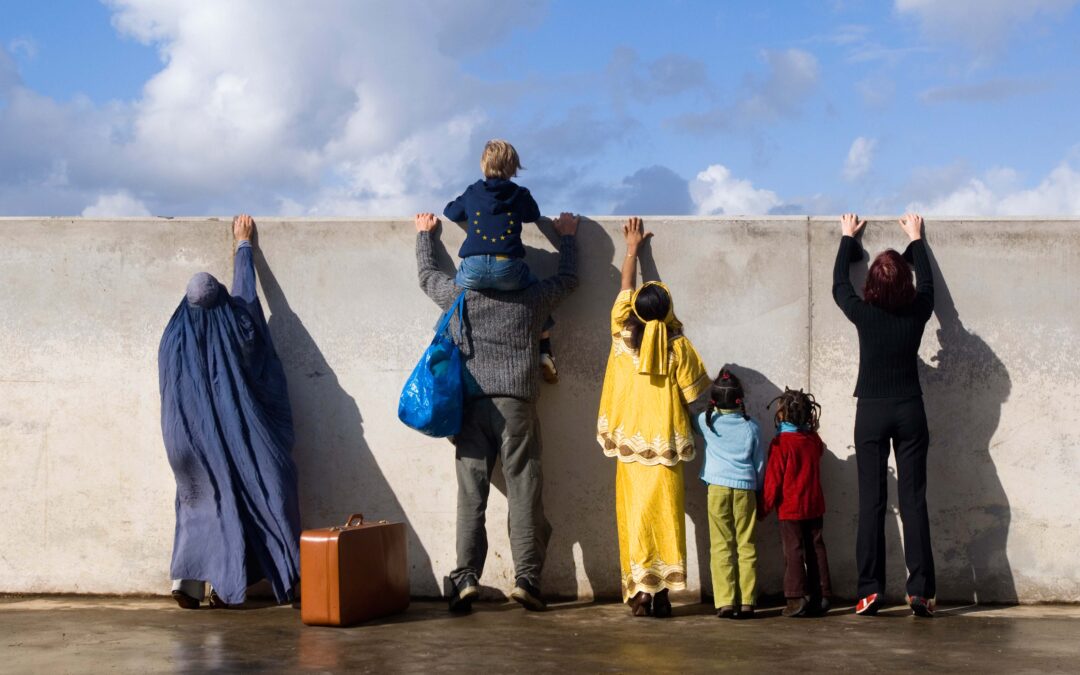
Today begins in Ankara (Turkey) a two-day training for lawyers and CSO practitioners representing and working with migrants, refugees and asylum-seekers.
This event is organized by ICJ, in cooperation with its partners Refugee Rights Turkey, the European Council on Refugees and Exiles (ECRE), Mülteci-Der (MD) and ICJ-EI, as part of the EU co-financed project Fostering Access to Rights for Migrants, Refugees and Asylum-Seekers in Turkey.
30 lawyers and civil society practitioners – representing nine different bar associations and relevant organisations from the Ankara area and other nearby key migration and asylum locations – are taking part in the training on 3 and 4 February.
The training aims to update lawyers and CSOs on the international and national law on the rights of refugees, migrants and asylum-seekers in order to be effective in their work at both the national and international levels. It aims at an effective implementation of the Turkish legal framework on asylum and migration.
The main thematic areas to be discussed will be the principle of non-refoulement, international protection, detention and access to economic, social and cultural rights.
The training will use as a basis the draft training materials prepared by the ICJ and its partners (to be published an the end of 2019) and, among other sources, the ICJ Practitioners Guide no. 6: Migration and International Human Rights Law.
The project “Fostering Access to Rights for Migrants, Refugees and Asylum-Seekers in Turkey” is funded by the European Instrument for Democracy and Human Rights (EIDHR) of the European Union.
Turkey-Training-Ankara-MigrationAsylum-Agenda-2018-tur-eng (download the agenda in Turkish and English)
Feb 2, 2018 | News
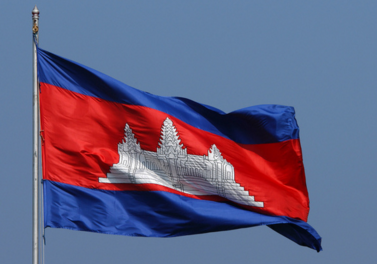
Cambodia should halt efforts to radically limit the right to freedom of expression through adoption of lèse-majesté legislation which would criminalize the exercise of some expression, said the ICJ today.
The Spokesperson for the Cambodian Council of Ministers, Phay Siphan, reportedly announced on Facebook today that the Council of Ministers had approved an amendment to the Cambodian Criminal Code which would make it a crime to insult the Cambodian King, carrying a penalty of one to five years imprisonment and/or a fine of two million Riel (USD 500) to ten million Riel (USD 2,500).
“The Cabinet’s approval of a lèse-majesté law appears to be a further attempt by the Government to ‘weaponize’ the country’s legislation against its perceived opponents,” said Kingsley Abbott, ICJ’s Senior International Legal Adviser.
“The Government’s ongoing misuse of the law is particularly concerning given the lack of independent and impartial judges to provide appropriate checks and balances on its power,” he added.
The ICJ has previously raised concerns about abuses arising from the lèse-majesté law in neighboring Thailand to curb freedom of expression.
Exercises of expression which are critical to a democratic society under the rule of law, including commenting on public policy and political questions, are sometimes stifled and punished under these laws.
The right to freedom of expression is protected under international law and should never be subject to criminal penalties, let alone imprisonment, which is a manifestly disproportionate penalty for the exercise of the fundamental right to free expression, the ICJ said.
Contact
Kingsley Abbott, Senior International Legal Adviser, ICJ Asia Pacific Regional Office, t: +66 94 470 1345, e: kingsley.abbott(a)icj.org
Background
Article 19 of the International Covenant on Civil and Political Rights (ICCPR), to which Cambodia is a State party, protects the right to freedom of expression. This right includes the “freedom to seek, receive, and impart information and ideas of all kinds.”
In its General Comment No. 34 on article 19, the United Nations Human Rights Committee (HRC), the body that monitors compliance of State parties with the ICCPR, expressed concern about the use of lèse-majesté laws and asserted that “imprisonment is never an appropriate penalty” for defamation.
The HRC further clarified that “all public figures, including those exercising the highest political authority such as heads of state and government, are legitimately subject to criticism and political opposition” and that “laws should not provide for more severe penalties solely on the basis of the identity of the person that may have been impugned”.
In February 2017, the United Nations Special Rapporteur on the promotion of freedom of opinion and expression, David Kaye, urged Thailand to refrain from using the lèse-majesté law as a “political tool to stifle critical speech” and asserted that “(l)esè-majesté provisions have no place in a democratic country”.
The legislative amendments ratified by the Council of Ministers will now be sent to the National Assembly, the lower house of the Parliament of Cambodia, for approval.
Upon approval by Parliament, the amendments would come into force when signed by the King.
At the same time as approving a lèse-majesté law, the Council of Ministers reportedly approved other constitutional amendments which appear to impose impermissible restrictions on the rights to free association and freedom of assembly, also protected under the ICCPR.
These legislative amendments reportedly include provisions that (i) the right to vote or the right to stand as an election candidate can be restricted by domestic legislation, (ii) the right to form a political party would require “placing the nation’s interests first”, (iii) prohibit individuals from “undermining the interests of the nation” and (iv) allow Secretaries of the State to be appointed by Royal Decree rather than by Parliamentary vote.
Read also
ICJ’s October 2017 Report: Achieving Justice for Gross Human Rights Violations in Cambodia