Sep 10, 2018 | Events, News
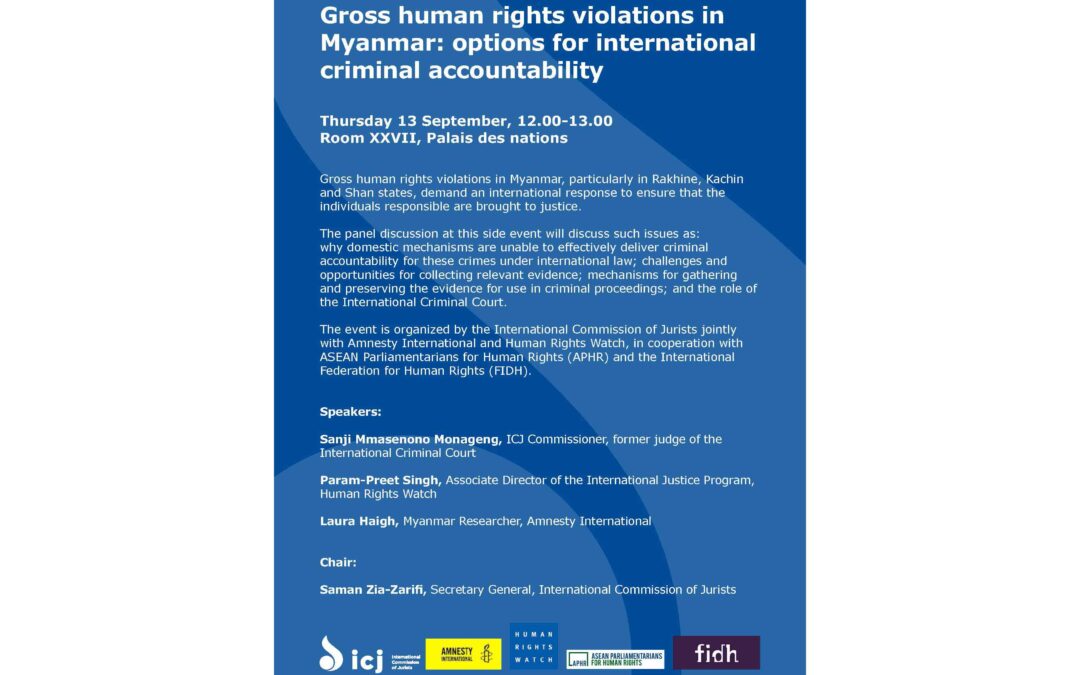
The ICJ will host the side event “Gross human rights violations in Myanmar: options for international criminal accountability” at the Human Rights Council on Thursday 13 September 2018 from 12:00 – 13.00 in Room XXVII of the Palais des Nations.
It is organized by the ICJ, Amnesty International and Human Rights Watch in cooperation with ASEAN Parliamentarians for Human Rights (APHR), the International Federation for Human Rights (FIDH) and Physicians for Human Rights (PHR).
The issues of documenting violations, possible evidence-gathering mechanisms and the role of the International Criminal Court will be discussed.
Speakers:
- Justice Sanji Mmasenono Monageng, Commissioner of the ICJ and former judge of the International Criminal Court
- Param-Preet Singh, Associate Director of the International Justice Program, Human Rights Watch
- Laura Haigh, Myanmar Researchers, Amnesty International
Moderator:
Saman Zia-Zarifi, Secretary General, International Commission of Jurists
Myanmar side event 13 Sept flyer (flyer of the event in PDF)

Sep 6, 2018 | News
The ICJ welcomed the Supreme Court’s judgment in Navtej Singh Johar et al v. Union of India and others, which effectively ends the threat to a large segment of the Indian population that they will be held criminally liable for exercising their human rights.
The Court has issued a long-overdue ruling that the criminalization of consensual same-sex relationships under Section 377 violates the Indian Constitution, and is in breach of India’s obligations under international law. This long-awaited judgment testifies to the work of activists and lawyers in India, who have shown the potential of the law to affirm human rights and equality.
“This judgment will not only have an impact in India. Its influence should extend across the world. The ICJ hopes that it will provide an impetus for other countries, especially those of the Commonwealth of Nations, to revoke similar provisions that criminalize consensual sexual relations,” ICJ Asia Pacific Director Frederick Rawski stated.
The Court underscored that provisions of Section 377 contravened international law and standards on equality, privacy, non-discrimination and dignity guaranteed in international human rights treaties to which India is a party. These include the International Covenant Civil and Political Rights and International Covenant on Economic Social and Cultural Rights.
The Court also noted that the Yogyakarta Principles, which address sexual orientation and gender identity in international law, reinforce these protections. This is a vital jurisprudential recognition that LGBTI persons are entitled to full equality, and protection of their rights under India’s Constitutional and international human rights law.
In the judgement, which reverses the December 2013 Koushal decision, the Court held that discrimination based on sexual orientation is a violation of fundamental rights to autonomy, privacy, equality, dignity, and non-discrimination. It underscored that decriminalization of homosexuality is only the first step and that LGBTI persons are entitled to equal citizenship in all its manifestations. The Court also recommended that wide publicity be given to judgment to ensure de-stigmatization of identity through sensitization training on barriers to access to justice faced by LGBTI persons.
“Even a landmark decision by the Indian Supreme Court cannot alone end the discrimination against people based on their sexual orientation or gender identity. It is time for the Indian Parliament to conduct wide-ranging review of existing legal framework, repeal discriminatory laws, and address other gaps in the law that prevent LGBT persons from fully exercising their rights,” Rawski added.
Background
For background, see the ICJ’s July 2018 Briefing Paper on Navtej Singh Johar et al. v. Union of India and Others, and its February 2017 report, “Unnatural Offences”: Obstacles to Justice in India Based on Sexual Orientation and Gender Identity.
Contact
Maitreyi Gupta (Delhi), ICJ International Legal Advisor for India
e: maitreyi.gupta(a)icj.org, t: +91 7756028369
Sep 4, 2018 | News
The ICJ today condemned the public caning of two women, a punishment imposed upon them by the Terengganu High Court after conviction on charges of ‘attempting to have sexual intercourse’.
The ICJ called on the Government of Malaysia to immediately abolish the practice of caning as it constitutes a form of cruel, inhuman or degrading punishment prohibited under international human rights law and standards.
Furthermore, it also called on the Government to ensure that its laws, policies and practices at the local, state, and federal levels are in full compliance with its international legal obligations, including under the Convention on the Elimination of all forms of Discrimination against Women (CEDAW).
On 3 September 2018, two women, aged 23 and 33, were publicly caned in front of a hundred people in Terengganu, a coastal state of Malaysia, located northeast of Kuala Lumpur.
The two women were convicted under Section 30 of the Syariah Criminal Offences (Terengganu) Enactment 2001, for the crime of ‘Musahaqah’ (sexual relations between female persons).
“This punishment is a clear violation of Malaysia’s obligations to prevent, prohibit and prosecute all forms of torture and other cruel, inhuman or degrading treatment or punishment. The Government of Malaysia should immediately abolish the practice of corporal punishment, which has been condemned by international authorities such as the UN Human Rights Council’s Special Rapporteur on torture,” said Emerlynne Gil, ICJ’s Senior International Legal Adviser.
“It is equally deplorable that Malaysia continues to criminalize consensual same sex relations. The criminalization of private consensual sexual activities – whatever the sex, gender identity and sexual proclivities of those involved, and whatever the actual sexual practices – violates international human rights law. It also undermines women’s enjoyment of their rights to privacy, personal integrity, and equality,” she added.
The Human Rights Committee has said that criminalizing private sexual acts between consenting adults constitutes an arbitrary interference with privacy and cannot be justified.
It has also observed in a number of Concluding Observations that the criminalization of private consensual sexual activities between adults of the same sex violates the prohibition of discrimination, and the right of equality before the law.
The ICJ also notes that early this year, the CEDAW Committee recommended to Malaysia to “take effective measures to ensure that civil law and Syariah law are in full compliance with the provisions of the Convention at local, state, and federal levels” so as to guarantee the rights of all women throughout the country.
The ICJ calls on the Government of Malaysia to abide by its obligations under international law and follow through with its commitment to human rights, non-discrimination and equality by abolishing the sentence of caning and the criminalization of consensual same sex relations in the country.
Contact
Emerlynne Gil, ICJ Senior International Legal Adviser, t: +66 840923575, e: emerlynne.gil(a)icj.org
Background
On 8 April 2018, religious state authorities arrested the two women who were in a car and accused them of preparing to ‘commit sexual acts’, which is an offense in the State of Terengganu, under the Syariah Criminal Offences (Terengganu) Enactment 2001. The women pleaded guilty to the offence without being represented by a lawyer and did not appeal their case.
On 12 August 2018, the two women pleaded guilty and were sentenced by the Terengganu Shariah to a fine of RM3,300 ($800 USD) and six strokes of caning for attempting to have sexual intercourse.
This is the first case of caning of women for ‘Musahaqah’ (sexual relations between female persons) crime and its attempt in Malaysia and it marks a steady decline in Malaysia’s commitment to protect the rights of its sexual minorities and the members of the LGBTIQA community.
In Malaysia’s Criminal Procedure Code, under Federal law, it states that
“No sentence of whipping shall be executed by installments, and none of the following persons shall be punishable with whipping: (a) females;”
Malaysia’s Federal Constitution provides that Islamic law falls under the matters of State law, with the exception of the Federal States.
It is concerning that the Syariah legal system in Malaysia continues to carry out caning in a manner that is discriminatory against women, and women sexual minorities, as seen in the 2010 case, where three women were found guilty of ‘illicit sex’ by the Kuala Lumpur Syariah Court, as well as the continuing use of Syariah legal enactments to harass, intimidate and prosecute the transgender community in Malaysia.
Sep 3, 2018 | News
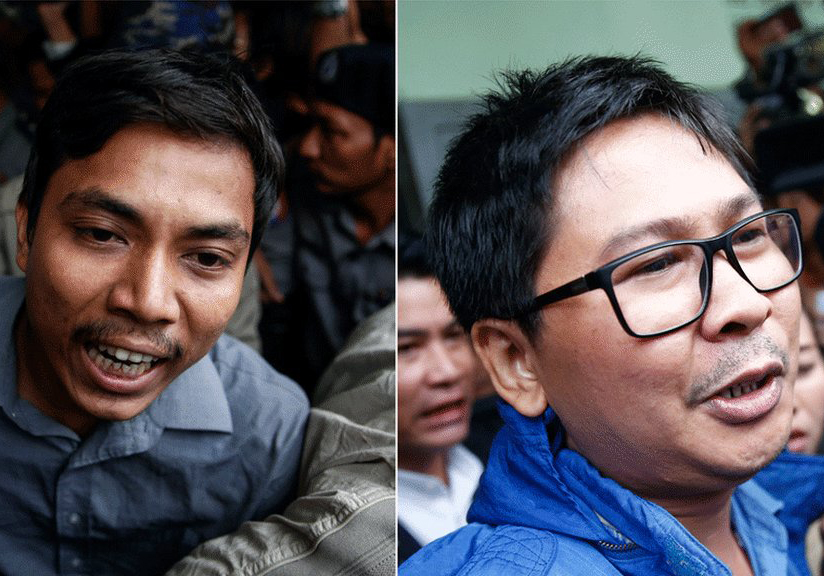
The Yangon District Court’s decision today to sentence Reuters journalists Wa Lone and Kyaw Soe Oo to seven years’ imprisonment for violating the Official Secrets Act deals a massive blow to human rights and the rule of law in Myanmar, said the ICJ.
“The Court’s decision effectively punishes these two courageous journalists for exposing human rights violations, following a grossly unfair trial,” said Frederick Rawski, Asia Pacific Director for the ICJ.
“The decision is a miscarriage of justice that inflicts needless suffering on them and their families, threatens freedom of expression, damages Myanmar’s global standing, and undermines its justice institutions all at once,” he added.
The ICJ has monitored the case since the journalists’ initial detention in December 2017.
As previously noted by the ICJ, the detention and trial has violated numerous basic fair trial guarantees.
The prosecutors had a duty to drop charges and the judge should have dismissed the case given the lack of evidence and the unlawfulness of detention because of fair trail rights violations.
“The case is emblematic of how the justice system ends up reinforcing rather than challenging military impunity,” said Rawski.
“The result undermines government claims that it can deliver accountability for human rights violations on its own, and does nothing to build trust that justice system can act independently and impartially after emerging from decades of military rule,” he added.
Members of security forces generally enjoy impunity for the perpetration of human rights violations, including for crimes under international law.
The ICJ has previously reported that victims and their families, as well as journalists, often face retaliation for publicizing human rights violations by the military.
Wa Lone and Kyaw Soe Oo were arrested in December 2017, and held incommunicado for nearly two weeks, before being charged under the colonial-era Official Secrets Act for allegedly possessing documents related to the operations of security forces in northern Rakhine State, during “clearance operations.”
The two reporters had been reporting on human rights violations in Rakhine State, including the killing of Rohingya by the military in Inn Dinn Village.
In a report issued just last week, the UN Independent International Fact Finding Mission found that security forces had perpetrated crimes under international law during these operations, including crimes against humanity and possibly the crime of genocide.
The detention and prosecution of anyone, including journalists, based solely on the collection and publication of evidence relevant to serious human rights violations, is a violation of international law and standards on freedom of expression, the right to participation in public affairs and on the role of human rights defenders.
Legal options remaining for the journalists include appealing of today’s decision, and requesting a Presidential amnesty.
Sep 2, 2018 | News
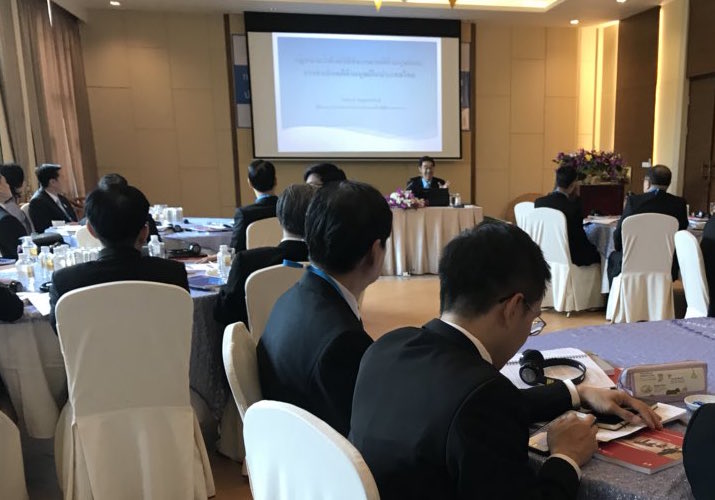
On 1 and 2 September, the ICJ held a “Workshop on the Independence of the Judiciary in the Context of the Inquisitorial Judicial System in Thailand” for members of the Thai judiciary in the north of the country.
Some 31 judges from 21 courts and the Administrative Office of the Court of Justice, Region V, attended the workshop, which was held in Chiang Mai.
The objective of the workshop was to discuss the role of judges and exercise of judicial power within the inquisitorial system, particularly in the context of adjudicating cases of human trafficking.
In an effort to combat human trafficking in Thailand, the Procedures for Human Trafficking Cases Act B.E. 2559 (2016) established inquisitorial system procedures for adjudication of cases of human trafficking.
With an increasing number of cases of human trafficking in Northern Thailand, judges in Northern Thailand are increasingly required to utilize inquisitorial processes in human trafficking cases.
Courts in Thailand generally adjudicate cases based on the adversarial judicial system.
In this context, the ICJ held the workshop in collaboration with the Administrative Office of the Court of Justice, Region V, in the North of Thailand, to share information and expand collaboration between Thai and international judges about inquisitorial processes.
Justice Aree Thecharuwichit, Chief Justice of the Office of the Chief Justice, Region V, Frederick Rawski, Regional Director of ICJ Asia and the Pacific, and Justice Radmila Dragicevic-Dicic, Vice-President of the ICJ, ICJ Commissioner, Acting President of the Belgrade Court of Appeals and Judge of the Supreme Court of Serbia delivered opening statements at the Workshop.
Justice Sittipong Tanyaponprach, Chief Judge of the Office of the Chief Justice, Region I, spoke about existing procedures in Thailand’s justice system to deal with human trafficking cases under the Procedures for Human Trafficking Cases Act 2016.
Justice Marcel Lemonde, Honorary President of Chamber in France’s Court of Appeal and an International Consultant in Judicial Matters, delivered an introduction to the inquisitorial system based on the French judicial system and spoke about existing challenges in inquisitorial processes.
Justice Radmila Dragicevic-Dicic, of the Supreme Court of Serbia and ICJ Vice-President spoke about judicial practice in cases involving human trafficking and shared her experience in adjudicating human trafficking cases in Serbia.
ICJ’s Senior Legal Adviser Kingsley Abbott moderated the workshop and provided an introduction to the ICJ’s resource materials on the independence of the judiciary and judicial accountability, including the ICJ’s Practitioners’ Guide No. 13 on Judicial Accountability.
The ICJ ended the Workshop with a statement reiterating its commitment towards working with Thailand’s judiciary to strengthen the rule of law and administration of justice in Thailand.
This Workshop is the second workshop held by the ICJ for Thailand’s judiciary in the North of Thailand.
Aug 30, 2018 | News
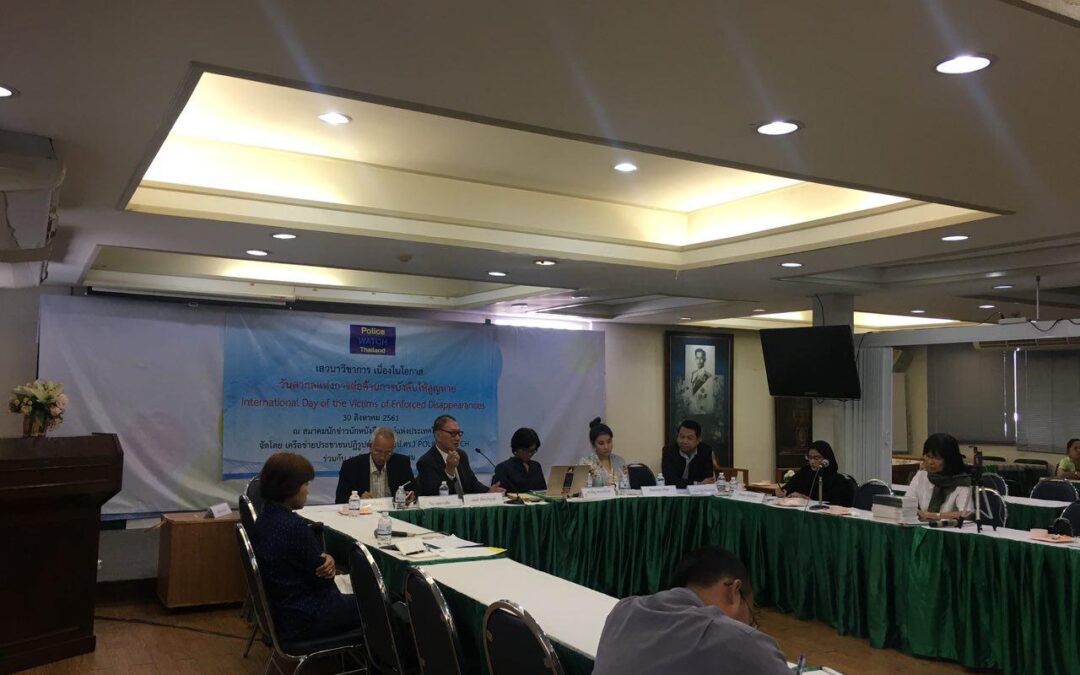
The ICJ participated in a panel discussion to commemorate International Day of the Victims of Enforced Disappearances, organized by Police Watch Thailand and Cross Cultural Foundation.
The discussion was held at the premises of the Thai Journalists’ Association.
The event began with opening remarks by Surapong Kongchantuk, Chairperson of the Cross Cultural Foundation, who called on the Thai Government to ratify the International Convention for the Protection of All Persons from Enforced Disappearance (ICPPED) and for the existing Draft Prevention and Suppression of Torture and Enforced Disappearance Act (‘Draft Act’) to come into force without undue delay.
He also emphasized that perpetrators of the crime of enforced disappearance needed to be brought to justice, and victims and relatives of victims of enforced disappearance must be provided with effective remedies and reparation.
A panel discussion followed the opening remarks, moderated by Pornpen Khongkachonkiet, Director of Cross Cultural Foundation. Panelists included Sanhawan Srisod, ICJ’s National Legal Adviser, Veera Somkomkid, from People Anti-Corruption Network, Pol.Col. Wirut Sirisawadibuth, Columnist and police reform activist, and Adul Kiewboribon, Chair of a committee of persons whose relatives disappeared during May 1992 protests against the government of General Suchinda Kraprayoon.
In her remarks, Sanhawan Srisod expressed concern at the absence of domestic legislation making torture and enforced disappearance specific crimes in Thai law and gaps in the existing Draft Act.
She also called for prompt, independent, impartial and effective investigations into the fate and whereabouts of disappeared persons consistent with international law and standards.
Human Rights Commissioner, and wife of disappeared lawyer and human rights defender Somchai Neelapaijit, Angkhana Neelapaijit, made closing remarks for the event.
The panel discussion followed a forum the ICJ co-hosted in March this year, commemorating the 14th year anniversary of the enforced disappearance of Somchai Neelapaijit, which also raised awareness about amendments to the Draft Act.
During the forum, the ICJ raised concerns about the independence of the ‘Committee managing complaints of torture and enforced disappearance cases’, which was established in May 2017, and expressed the need for further clarification on the legal framework – domestic and/or international – that will ground the Committee’s operation.
Background
The International Day of the Victims of Enforced Disappearances falls on 30 August every year.
Thailand is bound by international legal obligations under the International Covenant on Civil and Political Rights (ICCPR) and Convention against Torture and Other Cruel, Inhuman or Degrading Treatment or Punishment (CAT) – both of which it has acceded to – to investigate, prosecute, punish and provide remedies and reparation for the crimes of torture, other acts of ill-treatment, and enforced disappearance.
However, Thailand has not enacted domestic legislation recognizing enforced disappearance as a criminal offence. Thailand is also yet to ratify the ICPPED, despite signing the Convention in January 2012.
Thailand’s Ministry of Justice concluded a second round of public consultation on the Draft Act and is now reportedly in the process of evaluating the results of the consultation.
On 30 August 2017, 23 November 2017 and 12 March 2018, civil society organizations, including the ICJ, Amnesty International and Human Rights Watch, sent open letters to the Government, including to Thailand’s Minister of Justice, outlining amendments that would be necessary to bring the Draft Act in line with Thailand’s international human rights obligations.
In the absence of domestic legislation criminalizing torture and enforced disappearance, on 23 May 2017, a ‘Committee managing complaints for torture and enforced disappearance cases’ was established by the Prime Minister, pursuant to Prime Minister’s Office Order No. 131/2560 (2017).
The Committee, chaired by the Minister of Justice, consists of 15 officials drawn from different ministries,including the Ministry of Defence, the Royal Thai Police and the Internal Security Operations Command (ISOC).