May 26, 2021 | News
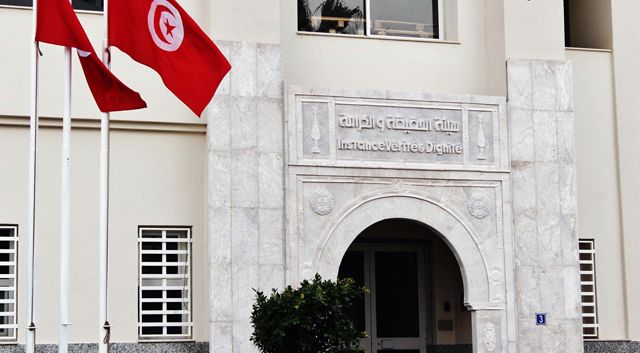
Prosecutors must perform an active role in proceedings before Tunisia’s Specialized Criminal Chambers (SCC), including by prosecuting the cases referred by the Truth and Dignity Commission (IVD) without indictment, and by ensuring the effective and timely execution of court decisions, such as judicial summons and other orders to compel the presence of the accused in court, the ICJ said today.
هذا البيان الصحفي متوفر باللغة العربية أيضاً
To date, prosecutors have automatically transferred around 200 cases, to the SCC pursuant to the Law on Transitional Justice. Beyond this, however, they have played little or no part in the conduct of trials thus far.
“Prosecutors are abdicating their primary responsibility to uphold the rule of law and the rights of victims, and, in so doing, they are contributing to perpetuate decades of impunity in Tunisia,” said Said Benarbia, ICJ MENA Director.
Accused are absent in most of the SCC trials. Measures ordered by the courts to compel their presence have remained mere ink on paper.
“The systematic absence of the accused defeats the very purpose of setting up the SCC as transitional justice mechanisms, including their role in establishing the truth about past abuses, and in granting victims their long overdue day in court,” added Benarbia.
Tunisian prosecutors and law enforcement officers acting under their authority must ensure that court summons and related orders be implemented in a timely manner.
Prosecutors should also ensure that effective investigations be conducted, evidence collected, and prosecutions instituted, when warranted, in those cases that the IVD referred to the SCC without indictment.
“The automatic transfer of cases to the SCC does not absolve prosecutors from their obligations under Tunisian and international law, including in respect of their duties as public interest representatives,” Benarbia added. “It’s high time for the prosecutorial authorities to live up to these obligations and uphold the rights of victims to truth, justice and effective remedies.”
Background information
The Specialized Criminal Chambers were established in 2014 to adjudicate cases involving alleged “gross human rights violations” perpetrated between 1955 and 2013 and referred by the Truth and Dignity Commission (Instance Verité et Dignité, IVD) to the SCC.
The 2013 Transitional Justice Law empowered the IVD to investigate crimes, collect evidence and refer cases to the SCC for prosecution.
At the end of its mandate in December 2018, the IVD’s referred to the SCC 200 cases of arbitrary deprivations of life, arbitrary deprivations of liberty, torture and other ill-treatment, enforced disappearance, rape and sexual assault and crimes against humanity committed by the past regime.
For more information see the ICJ Practical Guide Series on Accountability Through the Specialized Criminal Chambersand findings on the role of international law and standards in proceedings before the SCC (Practical Guide 1), the investigation and prosecution of gross human rights violations under Tunisian and international law (Practical Guide 2), and the application of principles and best practices on evidence in the administration of justice before the SCC (Practical Guide 3).
Download this press release in PDF form here.
Contact:
Said Benarbia, Director, ICJ Middle East and North Africa Programme, t: +41-22-979-3817; e: said.benarbia(a)icj.org
Valentina Cadelo, Legal Adviser, ICJ Middle East and North Africa Programme, e: valentina.cadelo(a)icj.org
Asser Khattab, Research and Communications’ Officer, ICJ Middle East and North Africa Programme, e: asser.khattab(a)icj.org
May 25, 2021 | News
As the third anniversary of the opening of trials before Tunisia’s Specialized Criminal Chambers (SCC) is approaching, the ICJ denounces the Tunisian authorities’ failure to adopt reforms necessary to advance accountability and justice for victims of gross human rights violations.
هذا البيان الصحفي متوفر باللغة العربية أيضاً
Trials before the SCC started on 29 May 2018. Since that first hearing, evident gaps and shortcomings in the Tunisian Criminal Code, the Code of Criminal Procedure and the Transitional Justice law have undermined efforts to hold perpetrators to account, bring justice to victims and prevent recurrence of gross human rights violations in the future.
“The Tunisian authorities have abdicated their responsibility to ensure the effective functioning of the SCC, depriving judges of basic tools to ensure that trials are conducted without undue delay and consistent with international fair trial standards,” said Said Benarbia, the ICJ’s MENA Programme Director.
Many offences referred by the Truth and Dignity Commission to the SCC are not adequately defined in the Tunisian law. Judicial rotation occurs mid-way through SCC trials, impacting the continuity of trials. Prosecutors are not effectively engaged in the conduct of trials. Accused are absent in most of the SCC trials, and the transitional justice framework does not provide for appeal chambers.
“By failing to address these obstacles, the Tunisian authorities are undermining the right of victims to truth and to effective remedies, and betraying the very promise of the transitional justice process to end impunity,” added Benarbia.” It’s high time for them to reverse course and live up to that promise.”
Background information
The ICJ has recommended reform to ensure the compliance of SCC proceedings with international law and standards, including through:
- Ensuring the adequate criminalization of gross human rights violations amounting to crimes under international law;
- Fully ensuring the rights of the accused to a fair trial;
- Ensuring the rights of victims, including their families, to an effective remedy and reparation;
- Ensuring the protection of victims and witnesses;
- Ensuring that the collection, admissibility and assessment of evidence guarantee the right of the accused to a fair trial and the victims’ right to an effective remedy.
In addition to the above reforms, the Tunisian authorities should remove all obstacles preventing the SCC and other judicial authorities from exercising their function in a manner that complies with international standards. To this end, the authorities should:
- Ensure that the Office of the Public Prosecutor and other investigative authorities carry out their mandate in an independent and impartial manner, as defined under the Code of Criminal Procedure;
- Ensure that the annual judicial rotation, as regulated by Organic Law No. 34 on the High Judicial Council, be consistent with the right of the accused to a fair trial
- Ensure that newly appointed SCC judges and prosecutors receive timely and adequate training in transitional justice as provided for by Organic Law No. 53 on Establishing and Organizing Transitional Justice;
- Ensure that, if the annual judicial rotation occurs mid-way through trials, safeguards be implemented with the view to ensuring that newly appointed judges hearing the case have the appropriate understanding of the evidence and arguments.
These recommendations are informed by the ICJ Practical Guide Series on Accountability Through the Specialized Criminal Chambers and findings on the role of international law and standards in proceedings before the SCC (Practical Guide 1), the investigation and prosecution of gross human rights violations under Tunisian and international law (Practical Guide 2), and the application of principles and best practices on evidence in the administration of justice before the SCC (Practical Guide 3).
The SCC were established in 2014 to adjudicate cases involving alleged “gross human rights violations” perpetrated between 1955 and 2013 and referred by the Truth and Dignity Commission (Instance Verité et Dignité, IVD) to the SCC.
At the end of its mandate in December 2018, the IVD’s referred to the SCC 200 cases of arbitrary deprivations of life, arbitrary deprivations of liberty, torture and other ill-treatment, enforced disappearance, rape and sexual assault and crimes against humanity committed by the former government.
In a briefing paper published in October 2020, the ICJ called on the Tunisian authorities to undertake substantial legal and policy reforms with a view to strengthening accountability and removing all obstacles preventing the SCC from functioning effectively.
Download this press release in PDF form here.
Contact:
Said Benarbia, Director, ICJ Middle East and North Africa Programme, t: +41-22-979-3817; e: said.benarbia(a)icj.org
Valentina Cadelo, Legal Adviser, ICJ Middle East and North Africa Programme, e: valentina.cadelo(a)icj.org
Asser Khattab, Research and Communications’ Officer, ICJ Middle East and North Africa Programme, e: asser.khattab(a)icj.org
May 19, 2021 | News
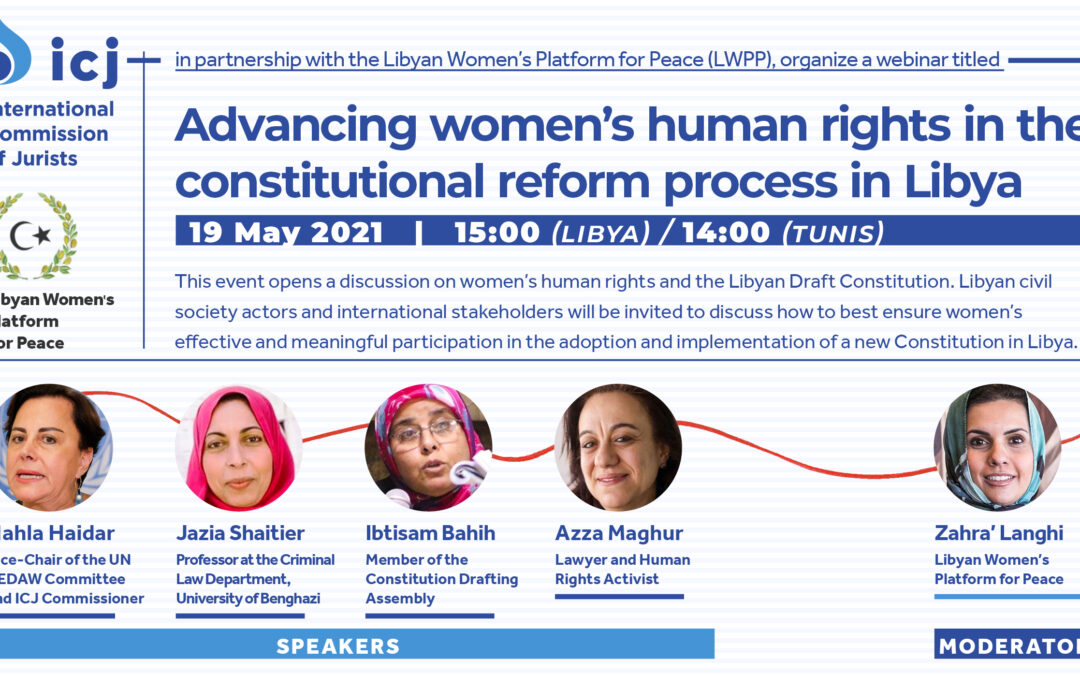
The International Commission of Jurists (ICJ) and the Libyan Women’s Platform for Peace (LWPP) on 19 May 2021 convened a webinar on ‘Advancing women’s human rights in the constitutional reform process in Libya’.
The webinar was moderated by Zahra’ Langhi, co-founder and director of LWPP, with speakers: Jaziah Shaitier, Professor at the Criminal Law Department, University of Benghazi; Ibtisam Bahih, member of the Constitution Drafting Assembly; Nahla Haidar, Vice-Chair of the UN Committee on the Elimination of Discrimination against Women and an ICJ Commissioner from Lebanon; and Azza Maghur, a Libyan lawyer.
In her opening remarks, Zahra’ Langhi stressed that advancing women’s rights in in the constitutional reform process should not be limited to the protections of women’s rights in the draft Constitution, which were any way inadequate, but also the effective the participation of women in the entire constitutional-making process
Jaziah Shaitier focused her remarks on the limitations the Constitution:
“I had hoped that the constitutional process that followed the Revolution would state clearly that any person born to a Libyan father or a Libyan mother would be Libyan.”
“Libya needs gender-inclusive constitutional provisions, and implementing laws that would protect women against all forms of violence”, Shaitier said.
Langhi pointed out that Libyan women who are married to non-Libyans cannot even access essential COVID-19 vaccines.
Nahla Haidar spoke of the importance of states to comply with their obligations under the Convention on the Elimination of All Forms of Discrimination against Women (CEDAW), a treaty to which Libya is a party:
“Sharia’s place within the Constitution should be made clear, otherwise there would be no need for a Constitution at all.”
Haidar also stressed the need to address problematic provisions in the Libyan Draft Constitution, including draft discriminatory provisions and provisions perpetuating stereotypes about the role of women and men in society and in the family. “Women may also choose not to start a family at all, and that should not have any bearing on the enjoyment of their rights.”
Azza Maghur highlighted the inadequate representation of women in the Libyan constitutional process:
“Libyans dreamed of a Constitution that is theirs, one that guarantees rights and liberties. The representation of women was not adequate.”
A member of the Constitution Drafting Assembly herself, Dr Ibtissam Bahih, highlighted how the process had failed Libyan women, and how the need for reform was as urgent as ever.
You can watch the full webinar here.
Contact:
Said Benarbia, Director, ICJ Middle East and North Africa Programme, t: +41-22-979-3817; e: said.benarbia(a)icj.org
Asser Khattab, Research and Communications Officer, ICJ Middle East and North Africa Programme, e: asser.khattab(a)icj.org
May 6, 2021 | News, Publications, Reports
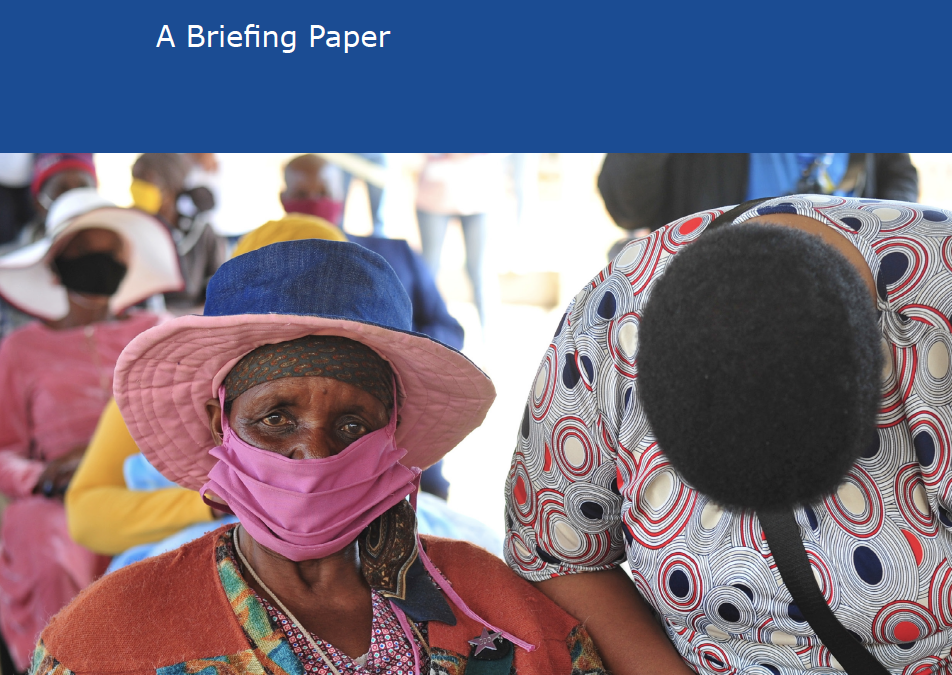
Southern African States have individually and collectively failed to provide sufficient and equitable COVID-19 vaccine access to meet their human rights obligations, the ICJ said today in a new briefing paper entitled The Unvaccinated: Equality not Charity in Southern Africa.
The paper focuses on the impact of COVID-19 on countries of the Southern African Development Community (SADC), a regional economic community comprising 16 Southern African countries whose goal is to enhance the standard and quality of life of the peoples in the region.
The publication considers SADC and its Member States’ collective failure to ensure access to COVID-19 vaccines despite more than 63,000 lives lost to the virus and countless others’ lives and livelihoods affected in the region.
This is due to a multitude of reasons, some common amongst the countries and others unique to individual Member States. While Tanzania and Madagascar denied the existence of the virus and rejected COVID-19 vaccines respectively, other countries with relatively greater resources, such as South Africa, failed to mobilize their resources adequately and equitably.
“COVID-19 is a global pandemic, but its impact was aggravated in southern Africa by the failure of governments to prepare and respond, individually or through SADC,” said Tim Fish Hodgson, ICJ’s Legal adviser on Economic, Social and Cultural Rights, in Johannesburg.
Combatting deadly communicable diseases like COVID-19 is one of the founding objectives under SADC’s founding treaty, and is also accounted for under the SADC Health Protocol. Yet, SADC has failed to provide almost any concrete guidance or coordinating role in regional procurement of COVID-19 vaccines since October 2020, prior to the availability of COVID-19 vaccines. While SADC’s chair, President Filipe Nyusi of Mozambique has encouraged a regional pooling of resources to facilitate procurement of necessary vaccines and distribution in a statement in January 2021, SADC has since taken no clear action towards this goal.
“While powerful global actors have erected roadblocks to equitable vaccine access in southern Africa, this should not conceal the burning need for SADC States to take essential measures to mobilize their collective resources towards efficient and equitable vaccine acquisition, allocation and distribution. As our research shows, they have failed to do so and SADC has been conspicuously silent,” Hodgson said.
These dire circumstances have led Fatima Hassan, South African human rights defender and director of the Health Justice Initiative, to observe that “philanthropy [and] benevolence cannot fund equality” in vaccine access. Indeed, the donation of vaccine doses through COVAX and other measures are not enough, and without rapid and adequate action to ensure equitable access to COVID-19 vaccines, it might be too late.
The ICJ’s research at a global and regional level have emphasized the urgent need for international institutions like the World Trade Organization and wealthier States to help countries to manufacture or otherwise acquire and distribute vaccines at affordable prices unimpeded by rigid intellectual property rights restrictions.
“All States should urgently heed the proposal by South Africa and India before the WTO for a waiver of the TRIPS intellectual property rules to allow faster, wider, and better distribution of COVID-19 vaccines,” Hodgson said.
“It is encouraging to see the United States end their opposition to the TRIPS waiver, and we hope that other States, in the European Union, Switzerland, Norway, and Brazil, will end their opposition and recognize that until everyone is safe, no one is truly safe.”
The ICJ emphasized that efforts by SADC and Southern African States is essential alongside ramped up global action.
“The pandemic is raging around the world even though a few countries, mostly the wealthiest, are now able to look beyond the worst of it. Most countries in Southern Africa remain unvaccinated, and in fact we are looking at new devastating waves of the illness. SADC should immediately improve efforts at collaboration and coordination to ensure compliance with their human rights obligation to provide everyone in the region with vaccine access as soon as possible,” Hodgson added.
The ICJ makes recommendations to specific States including Malawi, Tanzania, Madagascar, Zimbabwe and South Africa as well as a range of general recommendations to the SADC, including:
- The SADC Secretariat should urgently and actively facilitate and advance sub-regional COVID-19 vaccine procurement and distribution between the Member States.
- The SADC Secretariat should provide clear guidance to Member States on their human rights obligations pertaining to vaccine access. They should take effective action to address the failure of Member States to act according to their obligations under international law, including under regional agreements.
- All SADC member States should, as a matter of priority, develop, publish and publicize national vaccine acquisition and rollout plans and procurement strategies, detailing concrete measures to ensure non-discriminatory access to vaccines to all people.
Contact
Timothy Fish Hodgson, Legal Adviser on Economic, Social and Cultural Rights, timothy.hodgson(a)icj.org
Tanveer Jeewa, Legal and Communications Officer, tanveer.jeewa(a)icj.org
Download
Africa-The Unvaccinated-Publications-Reports-2021-ENG (full report, in PDF)

May 3, 2021 | Advocacy, Open letters
In a letter of 3 May, the ICJ called on the Non-Executive Chair of the Multichoice Group, and the board of directors to immediately suspend Emmanuel TV on any of the DSTV platforms for broadcasting of televangelist Pastor TB Joshua’s multiple video clips ostensibly depicting a violent ‘conversion therapy’ and hate speech against LGBT persons amounting to human rights abuses.
One of the videos, shows Joshua slapping and pushing a woman at least 16 times, and telling her: “There is a spirit disturbing you. She has transplanted herself into you. It is the spirit of woman.”
By broadcasting Joshua’s channel, which openly advocates hatred against, and causes harm to, LGBTI persons, Multichoice Group’s actions are inconsistent with human rights law and standards, the South African Constitution and domestic legislation, which all proscribe discrimination based on sexual orientation.
The ICJ therefore urged Multichoice to urgently take the following steps to remedy this situation:
1. Immediately suspend Emmanuel TV on any of the DSTV platforms including Channel 309.
2. Immediately remove the offending video clips and provide an undertaking not to air them or similar offensive materials again.
3. Offer an apology from Multichoice Group to the LGBT persons.
4. Undertake an updating of the MultiChoice Group’s internal policies to bring them in line with human rights standards, the South African Constitution, and local laws on non-discrimination.
To read the full letter, click here.
Contact
Kaajal Ramjathan-Keogh, ICJ Africa Director, Kaajal.Keogh(a)icj.org
Tanveer Jeewa, Legal and Communications Officer, Tanveer.Jeewa(a)icj.org