Sep 21, 2015 | Advocacy, Non-legal submissions
Today, the ICJ made a submission to the Human Rights Council’s Working Group on the Universal Periodic Review in advance of the Human Rights Council’s review of Swaziland in April/May 2016.
In its submission, the ICJ expressed concern about the following issues:
1) independence and impartiality of the judiciary and fair trial rights; and
2) international human rights instruments and mechanisms.
A copy of the submission can be found here:
Swaziland-ICJ-UPR-SWAZI SUBMISSION FINAL AS LODGED-Advocacy-2015-ENG (full text in PDF)
Aug 28, 2015 | News
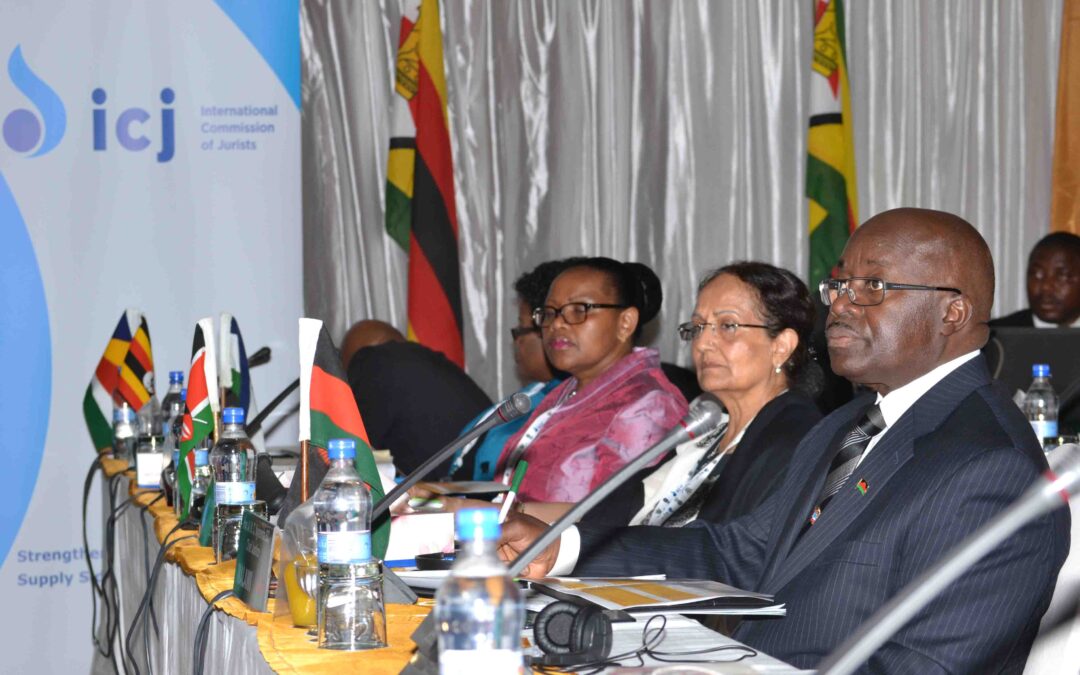
The Africa Regional Programme of the ICJ co-hosted the Southern African Chief Justices’ Forum Annual Conference in Zimbabwe, held on 27-28 August 2015 under the theme “Guaranteeing the Right to a Fair Trial in Africa; Show casing Best Practice”.
The meeting was organized in conjunction with the Southern Africa Chief Justices’ Forum (SACJF) and the Judicial Services Commission (JSC) of Zimbabwe.
This year it congregated 13 Chief Justices and 120 senior judges from East and Southern Africa.
The overall objective of the conference was to provide space for judiciaries in East and Southern Africa region to share achievements, best practices and innovations in justice delivery.
To this end, the conference sought to create a platform for judiciaries that had excelled in a variety of areas to showcase their achievements.
The programme was divided into three sub-themes, all of which had a direct relationship with the underlying theme of Fair Trial Rights in the Region.
The three sub thematic areas discussed were Appointment procedures, Judicial Training and Judicial Reform Each of the sessions was chaired by one of the Chief Justices, whose role it was to moderate the discussions and the speakers.
The panels had a presentation by a chief justice and experiences from another jurisdiction presented by a senior judge.
The presentations were then considered by discussants who were eminent academics.
Download the final declaration here:
Zimbabwe-SACJF ANNUAL CONFERENCE Declaration-Advocacy-2015-ENG (full text in PDF)
Aug 2, 2015 | News
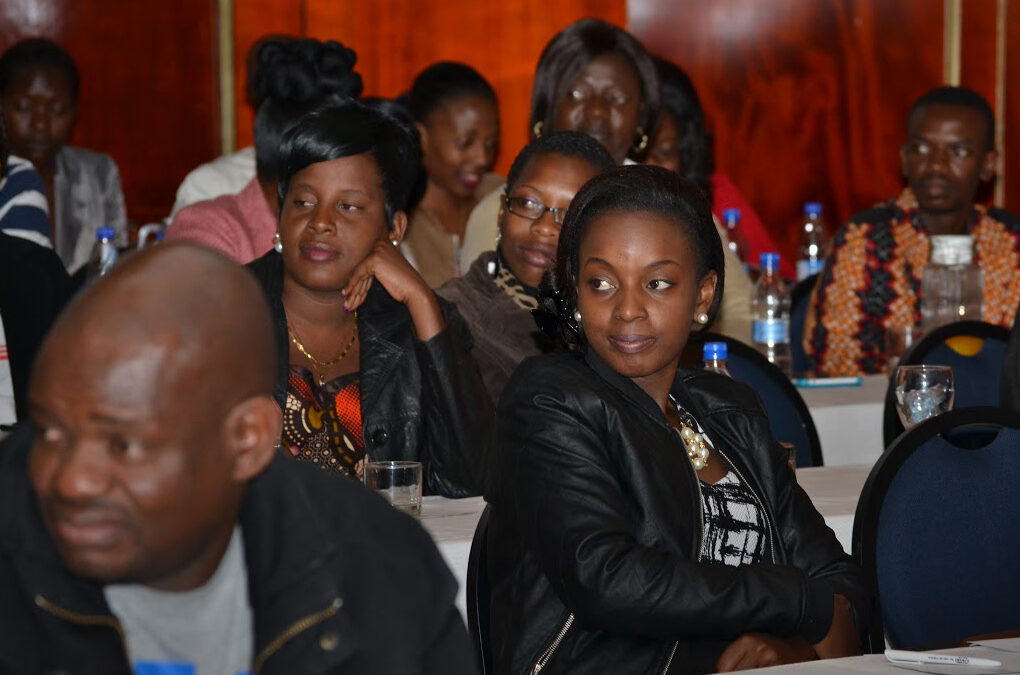
From 31 July to 2 August 2015 the ICJ supported a training and induction workshop for the Zimbabwe National Prosecuting Authority (NPA) in Harare, with over 200 participants.
The public prosecutors came from the Eastern Division comprising of Midlands, Manicaland and Masvingo provinces.
The objective of the training and induction workshop was to appraise the prosecutors of the changes brought about by the Constitution, international and regional standards in the conducting of prosecutorial duties, their independence and accountability.
The presentations also focused on the Criminal Procedure and Evidence Act as the main guiding framework for public prosecutors which has been significantly altered with the assumption of a new Constitution in respect of fair trial rights.
The NPA and the public prosecutors required a platform to collectively familiarize themselves with the changes and conducting of their duties guided by national, international and regional standards.
For purposes of infusing best regional and international practices, presentations included international principles and standards for prosecutors under United Nations Basic Principles on the Role of Prosecutors; the Principles and Guidelines on the Right to Fair Trial and Legal Assistance in Africa; the relationship of the NPA and other arms such as the Judicial Service Commission and the Police.
An array of resources persons were invited and included Justice Chinembiri Bhunu, from the Judicial Service Commission, Virginia Mabiza, Permanent Secretary Ministry of Justice Legal and Parliamentary Affairs, Andrew Chigovera, former Attorney General of Zimbabwe, former Commissioner on the African Commission on Human and Peoples Rights and Dr. Tarisai Mutangi, law lecturer Midlands State University.
As a new establishment under the Constitution, the NPA explored the available and needed continuous professional development for prosecutors to fully equip them for their mandate.
The Principal of the Judicial College of Zimbabwe (a partner of the ICJ), Mr. Shana, presented on the opportunities for continuous professional development for prosecutors for acquaintance with new legal developments.
The training follows additional support that ICJ made to the National Prosecuting Authority (NPA) under a European Union (EU) funded agreement to develop a strategic plan for the NPA in respect of which a strategic planning workshop was held from 6 to 8 July 2015,
Contact:
Arnold Tsunga, ICJ Regional Director for Africa, t: +27 73 131 8411, e: arnold.tsunga(a)icj.org
Jul 31, 2015 | News
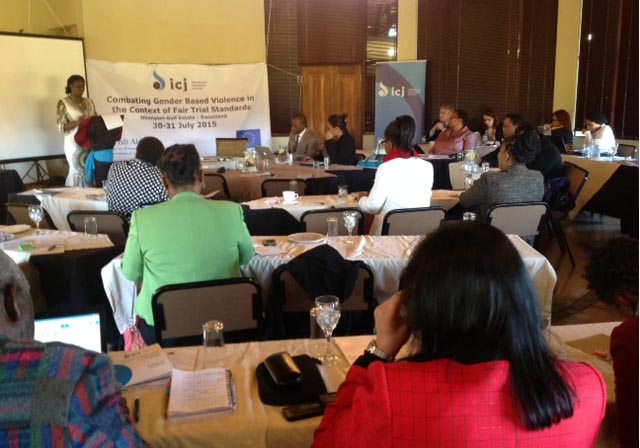
The ICJ held a colloquium on this issue on 30-31 July. Judges, magistrates, lawyers, members of academia, and civil society leaders from SADC, ECOWAS and the East African Community attended the event.
The Acting Chief Justice of the Kingdom of Swaziland, MCB Maphalala and the Secretary General of ICJ, Wilder Tayler, officially opened the colloquium.
The participants discussed the concept of gender-based violence; the efforts to combat impunity in sexual offences and gender based violence at the national, regional and international level and made recommendations to eliminate the scourge.
One of the key objectives of the workshop was to contribute to the process of enacting sexual offences and domestic violence legislation in Swaziland.
The Sexual Offences and Domestic Violence Bill of Swaziland is before the house of assembly, which has asked stakeholders to submit their views, on what should be included in the law.
The judges, lawyers and civil society leaders had robust and honest discussions touching on effective innovative strategies to combat sexual and gender based violence.
Some of the recommendations included the training of judicial officers to be gender sensitive, changing societal attitudes and prejudices, raising awareness amongst parliamentarians, creative interpretation and application of regional and international standards when adjudicating cases of sexual offences and gender based violence as well as observance of fair trial standards at the national, regional and international level.
The colloquium was made possible with funding from IrishAid.
Jul 29, 2015 | News
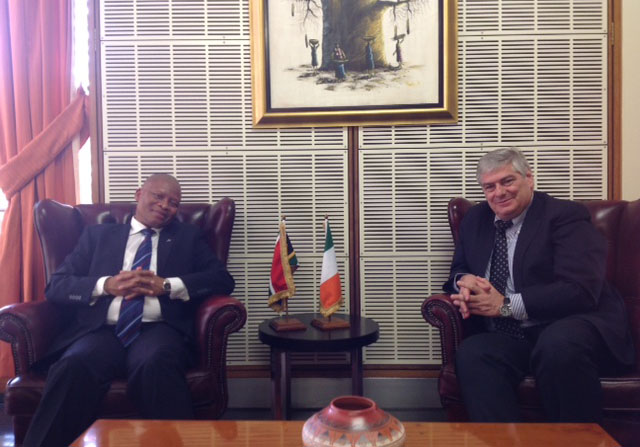
They held bilateral talks at the Constitutional Hill in Johannesburg, discussing matters of mutual interest including possible collaboration in the building of strong, independent, impartial and accountable judicial institutions on the African continent.
They also agreed in principle on the importance of establishing a platform of systematic and sustained dialogue by judicial leaders in Africa on challenges that emerge from time to time that pose threats to judicial independence.
A few country specific situations on threats to judicial independence were discussed as well.
The ICJ Secretary General is in Southern Africa where he has met several judicial leaders including Chief Justice Godfrey Chidyausiku of Zimbabwe, Justice Rita Makarau the Secretary of the Judicial Service Commission in Zimbabwe and Justice Azhar Cachalia of the Supreme Court of Appeal of South Africa who is also the Chair of the Executive Committee of the ICJ.
He will be in Swaziland on Thursday and Friday before winding up his visit to the region on the 2nd August 2015.