May 9, 2018 | News
The ICJ said today that Gina Haspel, nominated by Donald Trump to be Director of the CIA, should be subject to a full criminal investigation for her alleged involvement torture and other serious crimes, rather than elevated to serve as the country’s highest intelligence office.
The ICJ statement came as the United States Senate Intelligence was poised to beginning hearings on her confirmation to the position.
“If Gina Haspel becomes CIA Director, the United States will be sending a signal to the world that it has dropped the pretence of caring about even the most serious human rights violations,” said Sam Zarifi, ICJ Secretary General.
“It will show that torturing and disappearing people by US officials will not only be met with impunity, but will be no bar to career advancement.”
Following the terror attacks against the United States of 11 September 2001 until 2007, the CIA held at least 119 terror suspects or persons it suspected to have intelligence value in places of secret detention outside of US territory.
The black sites were situated in several countries, including Afghanistan, Lithuania, Poland Romania, and Thailand.
The detainees, who had no contact with the outside world, were placed beyond the protection of the law and subjected to torture and cruel, inhuman and degrading treatment.
The torture included near drowning (“waterboarding”), prolonged sleep deprivation, placement in painful stress positions for extended periods, forced rectal feedings, and slamming against walls.
Gina Hapel oversaw at least one “black site” detention centre in Thailand in 2002, while detainee Abd al-Rahim al Nashiri was being tortured there.
She is credibly alleged to have played a significant role in destroying video evidence of interrogations that were carried out under torture.
“The European Court of Human Rights has already condemned Poland for violating the rights of Abd al-Rahim al Nashiri, after he was transferred to secret CIA detention facility in Poland, yet nobody directly responsible CIA has ever been held accountable for these serious crimes,” said Sam Zarifi.
Contact
Ian Seiderman, ICJ Legal and Policy Director, t +41 22 979 3837 ; e: ian.seiderman(a)icj.org
Mar 22, 2018 | Advocacy, Non-legal submissions
The ICJ today highlighted at the UN the need for further action to address impunity in Sri Lanka and in Colombia.
The statement, delivered in a general debate at the UN Human Rights Council, responded to UN reports on Sri Lanka and Colombia, and read as follows:
Sri Lanka has not made sufficient progress on its commitments and obligations as reflected in Council resolution 30/1. Among the mechanisms contemplated, only the Office on Missing Persons (OMP) is operational. The process for establishing the other mechanisms, and the extent to which their composition will be based on the broad national public consultations carried out in 2016, remains unclear. The ICJ reiterates that, in line with operative paragraph 6 of resolution 30/1, the accountability mechanism cannot be seen as credible without involvement of international judges, prosecutors and investigators.
Furthermore, despite promises to repeal the Prevention of Terrorism Act (PTA), arrests still take place. As the High Commissioner recommended, the PTA should be promptly repealed without waiting for replacement legislation. Any proposed counterterrorism law must comply with international human rights standards.
In Colombia, the ICJ shares OHCHR’s deep concern about the exclusion of non-military State agents and private individuals from the scope of mandatory application of the Integrated System of Justice, Truth, Reparations and Guarantees of Non-repetition (per paragraph 90 of the Report). Furthermore, four months of unjustified delay by the Government in accrediting the new representative of the OHCHR Office, which ended only yesterday, undermined the ability of the Office to provide adequate technical assistance to guarantee victims’ rights in the Integrated System, as provided for by the Peace Agreement.”
[Paragraph 6 of Human Rights Council resolution 30/1 provides that the Council, “Welcomes the recognition by the Government of Sri Lanka that accountability is essential to uphold the rule of law and to build confidence in the people of all communities of Sri Lanka in the justice system, notes with appreciation the proposal of the Government of Sri Lanka to establish a judicial mechanism with a special counsel to investigate allegations of violations and abuses of human rights and violations of international humanitarian law, as applicable; affirms that a credible justice process should include independent judicial and prosecutorial institutions led by individuals known for their integrity and impartiality; and also affirms in this regard the importance of participation in a Sri Lankan judicial mechanism, including the special counsel’s office, of Commonwealth and other foreign judges, defence lawyers and authorized prosecutors and investigators;”]

Mar 22, 2018 | News
The ICJ has been awarded a grant from the Royal Norwegian Embassy in Mexico to continue its work in the area of independence of the judiciary in Guatemala.
This initiative titled “Strengthening the rule of law in Guatemala, Phase II” aims to strengthen domestic compliance with, and implementation of, international standards providing for judicial independence through the training of judges, raising awareness on this topic, as well as providing support to judges at risk.
The ICJ will be working together with the Mayan Association of Lawyers and Notaires of Guatemala as a partner in this action, through a sub grant of 1,622,801 NOK.
Guatemala-Grant Agreement with Norway-2018-ENG (full grant agreement, in PDF)
Mar 20, 2018 | Advocacy, Non-legal submissions
The ICJ today joined other NGOs in condemning and calling for proper investigation of the killing of human rights defender Marielle Franco in Brazil, at the Human Rights Council.
The statement read as follows:
“Protection of human rights defenders is key to the implementation of the Vienna Declaration on Human Rights.
City councilwoman Marielle Franco and Anderson Gomes were brutally killed on 14 March in Rio de Janeiro, Brazil. Her mandate focused on structural racism and police violence suffered by the poor, black and young in favelas, and on the empowering black women and the LGBTI community.
She was appointed as parliamentary rapporteur to oversee the abuses of the highly militarized federal intervention in Rio, decreed by the President, against the will of the community, and under concerns by the High Commissioner.
Many who speak truth to power in Brazil are facing unprecedented violence and stigmatization, as the country ranks at the top in defenders’ deaths. The defenders’ protection program remains underfunded and understaffed.
Marielle’s strength, engagement and sorority serve as a source of inspiration for the work on the promotion and protection of the rights of the most marginalized groups.
We urge Brazil to ensure a prompt, impartial and independent investigation, bringing those responsible to justice, by seriously exploring the hypothesis on an extrajudicial execution, and to provide effective protection to the survivors of this attack.”
The full statement together with a list of the organisations joining it, may be downloaded here: UN-HRC37-JointStatement-GD8-Brazil-2018
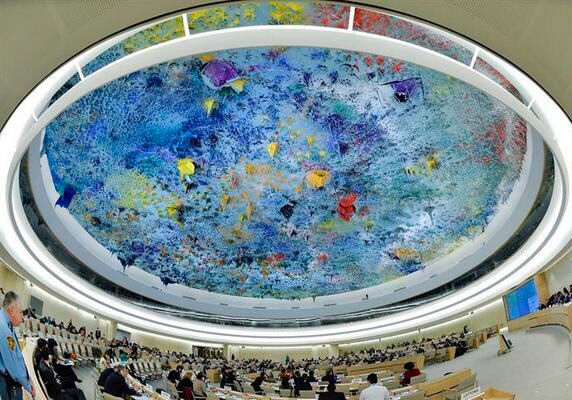
Mar 15, 2018 | Advocacy, Non-legal submissions
The ICJ today spoke at the United Nations on impunity and the situation for human rights in Peru.
The oral statement was made during the discussion at the Human Rights Council of the Universal Periodic Review outcome for Peru. It read as follows (translation from the original Spanish):
“Mr President,
The International Commission of Jurists (ICJ) recognizes the progress made by the Peruvian State in the field of human rights and its openness in relation to the recommendations made in the current cycle of the Universal Periodic Review.
The ICJ regrets, however, that the investigation and punishment of those responsible for the serious human rights violations that occurred during the internal armed conflict have not received the attention they deserve. On the contrary, the fight against impunity has receded with the granting of pardon and presidential grace to former president Alberto Fujimori who was serving a prison sentence for a series of crimes against humanity committed during his term. The presidential grace grants immunity from investigations and prosecutions in course or to be opened in the future.
One of the recommendations (111.97) that Peru accepts with qualifications refers to investigations and reparations to the thousands of women who suffered forced sterilization during the Fujimori administration. The measures of pardon and grace granted would exonerate Fujimori from investigation and punishment for this and other serious crimes. The ICJ urges the Peruvian State to implement the recommendations of the international community with full respect for international standards that prohibit impunity for serious violations of human rights.
Thank you Mr President.”
The ICJ oral statement complements a related written statement by the ICJ at the session.