
Mar 31, 2016 | News
A Delhi Court acquitted human rights defender Irom Sharmila of an “attempt to commit suicide” charge. The government of Manipur must in turn immediately drop the charges against her, said the ICJ today.
Irom Sharmila, was charged under section 309 the Indian Penal Code.
She has been on a continuous hunger strike for over 15 years, demanding repeal of the Armed Forces Special Powers Act (AFSPA).
“This order is a welcome recognition that Irom Sharmila’s hunger strike is a form of peaceful dissent and protest protected by the right to freedom of expression,” said Sam Zarifi, ICJ’s Asia Director.
This week, Iron Sharmila was acquitted of the charges against her in Delhi. The case against her in Manipur is, however, still on-going.
The decision of the Delhi court is not binding on the courts in Manipur, but the charges are analogous, and similar reasoning should prevail, the ICJ says.
“The government of Manipur should drop the other charges under section 309 against her, and release her immediately and unconditionally,” said Zarifi.
On at least two occasions previously, courts in Manipur have directed that Irom Sharmila be released, saying that charges under section 309 were not applicable.
“The use of section 309 against Sharmila highlights the outdated and absurd nature of this law,” Zarifi said.
“The government should expedite the repeal of 309 and, instead of criminalizing Irom Sharmila’s protest, focus on the reason behind it and repeal the AFSPA,” he added.
The AFSPA gives armed forces a range of “special powers” in “disturbed areas”, which include the power to arrest without warrant, to enter and search any premises, and in certain circumstances, “fire upon or otherwise use force, even to the causing of death”.
Furthermore, under the AFSPA, governmental permission, or sanction, is required before any member of the armed forces can be prosecuted for crimes in a civilian court.
These provisions are inconsistent with a range of human rights, including the right to life and right to remedy.
They have also facilitated torture, rape and enforced disappearances in areas where operational, the ICJ notes.
“This law is inconsistent with India’s human rights obligations, and has led to human rights violations, wide-spread impunity, and immense grief and suffering in the areas where it operates”, Zarifi said.
“It is high time that it was taken off the books”.
Background
Irom Sharmila began a hunger strike in November 2000, calling for the repeal of the AFSPA, following the unlawful killing of 10 civilians by security forces purportedly acting under it in Malom.
She was arrested by the Manipur government in 2000 under section 309 of the Indian Penal Code, which prohibits an “attempt to commit suicide”.
Irom Sharmila has been in custody almost continuously since her initial arrest, and has continued her hunger strike.
She is fed through a nasal tube at the Jawaharlal Nehru hospital in Imphal where she is usually held.
The Delhi government also charged her on similar grounds with respect to an incident from 2006, when she held a protest in their jurisdiction.
In 2014, a Manipur court quashed charges under section 309 against Irom Sharmila, saying “The agitation of Irom Chanu Sharmila is a political demand through lawful means of repealing a valid statute. … she may continue with the fast till her demand is met politically by the Government”.
However, since she continued her hunger strike, she was immediately re-arrested on the same grounds.
In its 210th report, the Indian Law Commission has recommended that section 309 be repealed. In 2011, the Supreme Court said: “the time has come when [section 309] should be deleted by Parliament as it has become anachronistic.”
In 2014, the government announced that it was in the process of repealing 309.
The AFSPA applies to “disturbed areas” in the states of Arunachal Pradesh, Assam, Manipur, Meghalaya, Mizoram, Nagaland and Tripura.
An almost identical law is also applicable in Jammu and Kashmir.

Mar 30, 2016 | News
The Malaysian government must immediately halt the politically motivated sedition investigation launched by the police against members of the Malaysian Bar who had called for the Attorney General’s resignation, the ICJ said today.
“The Malaysian authorities are using the archaic, colonial Sedition Act to harass and silence lawyers who are demanding that the country’s legal authorities observe international standards of propriety and independence,” said Emerlynne Gil, ICJ’s Senior Legal Adviser for Southeast Asia.
“This latest misuse of the Sedition Act constitutes a brazen political attack on the independence of the country’s lawyers,” she added.
On 29 March 2016, lawyers Charles Hector, Francis Pereira, and Shanmugam Ramasamy, received letters from police authorities summoning them to the Bukit Aman Police Headquarters on 31 March 2016 for the purpose of taking down their statements regarding a complaint filed against them under the Sedition Act (1948).
The three had proposed a motion during the Malaysian Bar’s 70th Annual General Assembly, calling for the resignation of Attorney-General Tan Sri Mohamed Apandi Ali. The motion was passed by a majority vote.
Karen Cheah Yee Lynn, Secretary of the Malaysian Bar, was also notified that her statement would likewise be taken but she was not summoned to the Bukit Aman Police Headquarters.
The Malaysian Bar demanded the resignation of Attorney-General Tan Sri Mohamed Apandi Ali after he summarily ended the investigation of alleged corruption by Prime Minister Najib Razak.
The Prime Minister appointed Attorney-General Apandi on 27 July 2015, in the midst of the corruption investigation.
Attorney General Apandi subsequently cleared Prime Minister Najib Razak of any criminal wrongdoing and instructed the Malaysian Anti-Corruption Commission to close the investigations.
“In 2012, Prime Minister Razak had promised to repeal the Sedition Act, but since then his government has increasingly relied on the law’s impermissibly vague and broad language as a useful tool of repression,” Gil said.
International standards highlight that protecting the independence of lawyers and their professional associations is essential for upholding the rule of law and the administration of justice, the ICJ says.
“This police investigation is clearly designed to challenge that independence,” Gil said.
“The Malaysian Bar has been one of the few institutions consistently defending the rule of law and human rights in Malaysia, and it is crucial to maintain the ability of its members to engage critically in upholding the standards of professional integrity and independence,” she added.
The ICJ urges the Malaysian government to repeal the archaic Sedition Act 1948 and fulfill the commitment it made in 2012 to abolish it.
Unless repealed or considerably revised so that it will be consistent with international law, the Sedition Act 1948 will continue to unduly limit and repress the freedom of expression, not only of lawyers and human rights defenders, but of all Malaysians exercising their fundamental rights, the ICJ says.
Contact
Emerlynne Gil, ICJ’s Senior International Legal Adviser, t: +66840923575, e: emerlynne.gil@icj.org
Background
Under the UN Basic Principles on the Role of Lawyers, governments have the obligation to ensure that lawyers are able to perform all of their professional functions without intimidation, hindrance, harassment or improper interference (Principle 16).
Like other citizens, lawyers are entitled to freedom of expression, belief, association, and assembly. Lawyers have the right to take part in the public discussion of matters concerning the law, the administration of justice, and the promotion and protection of human rights (Principle 23).
The UN Basic Principles on the Role of Lawyers also state that lawyers are entitled to form and join self-governing professional associations to represent their interests and protect their professional integrity (Principle 24).
Governments should ensure that these professional associations are able to function without improper interference (Principle 25).
In its 2016 resolution on human rights in the administration of justice, the UN Human Rights Council unanimously affirmed that “the independence and impartiality of the judiciary, the integrity of the judicial system and an independent legal profession are essential prerequisites for the protection of human rights, the rule of law, good governance and democracy, and for ensuring that there is no discrimination in the administration of justice, and should therefore be respected in all circumstances” (Resolution 30/7, 1 October 2015).
Malaysia’s Sedition Act 1948, originally enacted by the British colonial government and amended times over the years, criminalizes speech and publications considered to have “seditious tendencies”.
The term “seditious tendencies” is ambiguously defined to mean any kind of speech or publication that causes “hatred or contempt, or excite disaffection” against any ruler or the government or promotes “ill will and hostility between the different races or classes”.
The law also considers “seditious” any speech or publication that questions the special privileges of the Malay people, as provided in the Constitution.
Furthermore, sedition is a strict liability offence in Malaysia, which means that the intention of a person allegedly making seditious statements is irrelevant.

Mar 21, 2016 | News
The Maldives must stop undermining the independence and integrity of the judiciary through arbitrary and politically motivated actions against judges, the ICJ said today.
“The ICJ visited the Maldives last month for the second time in a year, and we were dismayed to see that the Maldives government has continued to erode the rule of law and weaken the independence of the judiciary,” said Nikhil Narayan, ICJ’s Senior Legal Adviser for South Asia.
“The government must immediately stop targeting judges and other public officials with arbitrary criminal proceedings, threats, intimidation and harassment,” he added.
On 7 February, Magistrate Judge Ahmed Nihan was arrested, along with former Prosecutor General and former Criminal Court Judge Muhthaz Muhsin, in connection with an alleged ‘forged’ arrest warrant against President Yameen.
“The arrest of a judge for issuing a warrant, a function which is well within the ordinary powers and responsibilities of the judiciary, clearly violates basic principles of judicial independence,” Narayan further said. “The fact that the alleged warrant was against the President further suggests that Judge Nihan’s arrest was politically motivated.”
“Moreover, the severity of a charge of ‘terrorism’ for such an act, even if taken at face value, cannot reasonably be viewed as proportionate to the alleged offense,” he added.
On 16 March, more than a month after his arrest, Judge Nihan was charged under sections 4(a)(1)-(2) and 5(a)(2) of the Prevention of Terrorism Act, for attempting to unduly influence the state, attempting to create fear among the public, and attempting to forcefully disappear or hold a person hostage.
The Constitution of the Maldives does not provide immunity for the president from criminal accountability even while still in office.
The ICJ was also concerned to find during its visit that Maldivian authorities have continued to undermine the independence of the judiciary by using the threat of transfer or removal of judges as a tactic of political retribution, harassment and intimidation.
On 14 February, former Criminal Court Chief Judge Abdullah Mohamed was abruptly transferred from the Criminal Court to the Family Court following a sudden and late night meeting of the Judicial Service Commission (JSC), without being given an opportunity to appear on his own behalf during the meeting.
While the JSC has given no reasons for its decision, lawyers, human rights defenders and former government officials with whom the ICJ spoke suggested that the transfer had been taken in retaliation for Judge Abdullah’s failure to remand former Prosecutor General Muhsin following his arrest.
It was also suggested by those interviewed that a further motivation for the transfer was to ensure that Judge Abdullah could not indirectly influence the three-judge bench hearing the former Vice President’s criminal case in favor of the defendant. Judge Abdullah was reported to have close ties with both defendants.
In June 2015, Judge Azmiralda Zahir, one of only three female judges in the entire Maldivian judiciary and the only woman on the High Court, was arbitrarily and unexpectedly transferred by the Supreme Court from the Malé appellate bench to the southern regional bench, a transfer that amounts to a demotion, without formal notice or opportunity to challenge her transfer.
The Supreme Court has neither established clear criteria for its decision-making process in such matters nor informed Judge Zahir of the reasons for her transfer, of which she learned through media reports, despite repeated requests by her to both the Supreme Court as well as the JSC, the ICJ says.
“President Yameen’s government must quickly take genuine steps to restore the rule of law, strengthen the independence and integrity of the judiciary and restart the democratic transition process,” said Narayan.
Contact:
Nikhil Narayan, ICJ Senior Legal Adviser for South Asia, t: +977 9813187821 ; e: nikhil.narayan(a)icj.org
Read also:
Maldives: political crisis erodes rule of law and human rights
Maldives: arrest of Judge Ahmed Nihan further erodes judicial independence

Mar 21, 2016 | News
Thailand’s National Council for Peace and Order (NCPO) must end its interference in the elections of the president and committee members of the Lawyers Council of Thailand (LCT), the ICJ and Thai Lawyers for Human Rights (TLHR), said today.
The LCT in turn must ensure the elections are conducted in a fair and impartial manner.
“International standards explicitly prohibit external interference in the elections of the executive body of a lawyers’ professional association by its members, and the association’s leadership must ensure that such elections are conducted in a fair and impartial manner” said Matt Pollard, the Head of the ICJ’s Centre for the Independence of Judges and Lawyers. “Ensuring the independence and democratic representation of the legal profession is essential to safeguarding human rights and the rule of law, especially in the current circumstances of military rule in Thailand.”
On 29 February 2016, Mr Wichien Choobtaisong, a representative of the electoral group of the current LCT President, Mr. Dej-udom Krairit, wrote to the NCPO “seeking permission” to hold meetings and campaigns for the LCT’s regularly-scheduled elections, referring to the NCPO’s ban on political gatherings of more than five persons.
On 16 March 2016, the NCPO replied, stating that the elections “contradict” the ban on political gatherings, which “must apply equally to all groups and sectors in the interest of maintaining national security during the transition period,” and taking the position that that the elections must accordingly be postponed with the current committee continuing its term until elections are held. The NCPO’s reply also notes it received a letter from the LCT on 14 December 2015, which the ICJ and TLHR have not seen.
In its letter, the NCPO referred to NCPO Announcement 7/2014, which bans the political gathering of more than five persons (Announcement 7/2014 was later replaced by Order 3/2015). The ICJ reiterates that these arbitrary and unjustified orders and announcements should be repealed, and calls on the NCPO, in any event, to immediately withdraw its letter of 16 March, replacing it with written confirmation that the LCT elections will be able to proceed as scheduled, without external interference.
The LCT must then put in place procedures to ensure the elections proceed as scheduled and in a fair and impartial manner.
“Since the military took power, we have seen a marked increase in the number of individuals requiring legal aid for sensitive and political cases,” said Yaowalak Anuphan, the Head of TLHR and member of the LCT. “In this environment, it is even more essential that the Lawyers Council of Thailand is able to exercise its functions without external interference and that everyone has effective and equal access to the legal services of lawyers.”
Contacts
In Bangkok: Kingsley Abbott, International Legal Adviser for Southeast Asia, t +66 94 470 1345 ; e: kingsley.abbott(a)icj.org
In Geneva: Matt Pollard, ICJ Senior Legal Adviser, t: +41 22 979 38 12 ; e: matt.pollard(a)icj.org
Background
The Lawyers Council of Thailand was established in 1957. Its mandate and responsibilities are set out in the Lawyers Council Act 1985.
The objectives of the Council include maintaining the ethics of lawyers, promoting legal education and providing legal assistance.
It also registers lawyers and issues them with licenses to practice law in Thailand. Members of the Council elect the president and committee members every three years.
Article 24 of the Basic Principles on the Role of Lawyers, adopted by the UN in 1990, sets out that: “Lawyers shall be entitled to form and join self-governing professional associations to represent their interests, promote their continuing education and training and protect their professional integrity.
The executive body of the professional associations shall be elected by its members and shall exercise its functions without external interference.”
Among other things, the UN Basic Principles also affirm that ensuring all persons have effective access to legal services provided by an independent legal profession is essential for adequate protection of human rights and fundamental freedoms.
They note the vital role of professional associations of lawyers including in protecting their members from persecution and improper restrictions and infringements. The Basic Principles specify that governments should respect and reflect the provisions of the Basic Principles in their national legislation and practice.
The UN Human Rights Committee has applied the Basic Principles as a necessary component of the right to a fair trial guaranteed in Article 14 of the International Covenant on Civil and Political Rights (ICCPR), to which Thailand is a State Party.
The UN Committee will review Thailand’s compliance with the ICCPR at an upcoming meeting.
Thailand-ICJ and TLHR statment on LCT-News-press releasess-2016-THA (full text in Thai, PDF)
Mar 17, 2016 | Advocacy, Non-legal submissions
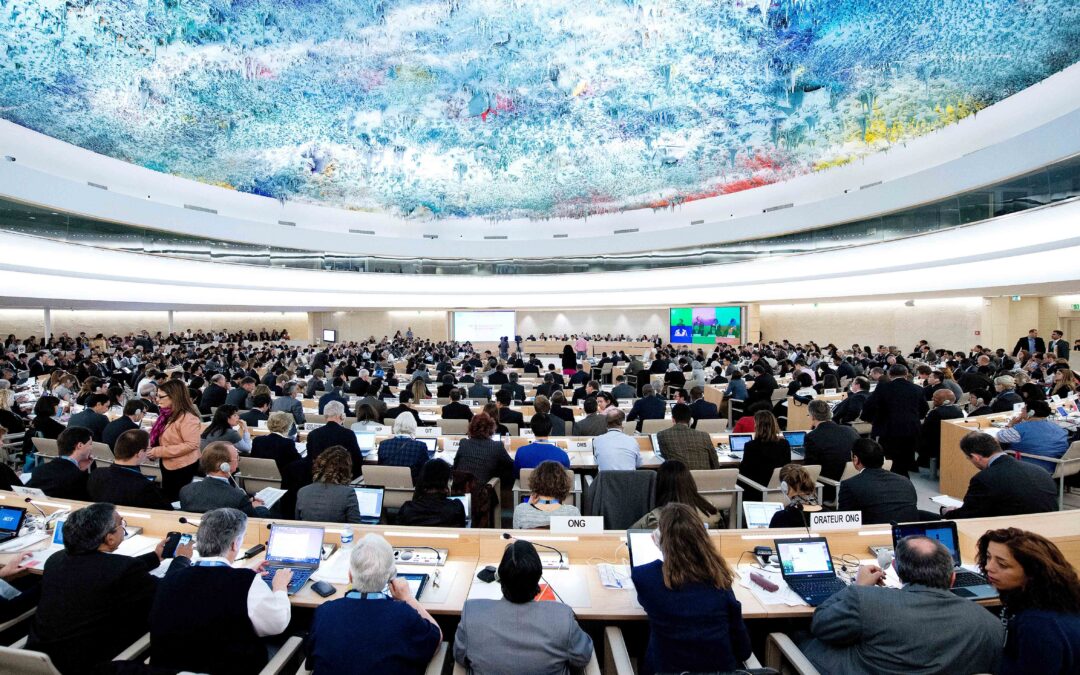
The ICJ today joined with the International Bar Association’s Human Rights Institute to make an oral statement on judges & lawyers in Myanmar, during the consideration of its Universal Periodic Review outcome by the UN Human Rights Council.
The statement:
“The International Bar Association’s Human Rights Institute (IBAHRI) and the International Commission of Jurists welcome Myanmar’s decision to accept recommendations made at the Universal Periodic Review relating to the administration of justice and the independence of the legal profession and call on the Government of Myanmar to implement the recommendations which it has accepted ‘in principle’ to reform the Bar Council Act to allow for the Bar Council to become a truly independent and self-governing association.
In order to ‘guarantee in law and practice that lawyers and judges can perform their professional functions without improper interference and legally form and join self-governing associations’, we call for the right to join such associations to be enshrined in law, and that the right of the first Independent Lawyers’ Association of Myanmar (ILAM) to register as an association be respected;
In order to ‘define professional legal standards and disciplinary procedures in conformity with the Basic Principles on the Role of Lawyers’, we call upon the government of Myanmar to engage in a consultation process with the legal profession and other stakeholders in relation to the revision of the Bar Council Act. The government should also commit sufficient funds to allow for the funding of the system created by the new Legal Aid Law.
We are encouraged by and support efforts by the Office of the Supreme Court of the Union to draft and implement a Code of Judicial Ethics.
Finally, we urge the Government to improve legal education and continue legal professional development including with regard to international human rights law and the UN human rights mechanisms.
We are glad to provide support in the realisation of these recommendations and will look for collaboration with the Government to that end.”




