
Dec 10, 2013 | News
The ICJ urgently calls on Bangladesh President Abdul Hamid to intervene to stop the execution of Abdul Quader Mollah.
The Supreme Court handed down its judgment against Abdul Quader Mollah on 5 December 2013.
The 790-page judgment was sent to the International Crimes Tribunal on 8 December 2013 and a death warrant was issued against Abdul Quader Mollah (photo) on the same day.
It was immediately sent to the Dhaka Central Jail and he may be executed at any time unless President Abdul Hamid or the Supreme Court intervenes.
Last week, the United Nations High Commissioner for Human Rights Navi Pillay issued a statement, expressing her deep concern over the rising levels of political violence in Bangladesh, calling on both sides to ‘’halt their destructive brinkmanship.’’
‘‘In an increasingly volatile situation, executing Abdul Quader Mollah risks pushing the Government towards a state of emergency, placing democracy and rule of law in peril,’’ said Ben Schonveld, ICJ South Asia Director. ‘‘The timing of the Supreme Court’s decision and the Tribunal’s subsequent death warrant raise serious questions about the political motivations behind the ICT process as well as the independence and impartiality of the judiciary.’’
The ICJ is concerned that the International Crimes Tribunal has not adhered to international standards.
As a State party to the International Covenant on Civil and Political Rights, Bangladesh is obligated to guarantee the right to a fair trial to all suspects, which includes special protections for those facing the death penalty.
The ICJ considers the death penalty to constitute a violation of the right to life and the right to be free from cruel, inhuman or degrading punishment.
It calls on the government of Bangladesh to impose a moratorium on the carrying out death sentences with a view to abolition, in compliance with repeated United Nations General Assembly resolutions on the question.
“The use of the capital punishment is particularly egregious in the Abdul Quader Mollah case, given that Parliament retroactively changed the law to enable the Supreme Court to impose a sentence of death on appeal,’’ added Schonveld. ‘‘Retroactively changing laws to influence the outcome in a case not only goes against the prohibition on retroactivity, it undermines the independence of the judiciary and the judicial function.’’
The ICJ urges President Abdul Hamid to intervene to stop the execution of Abdul Quader Mollah.
CONTACT:
Ben Schonveld, ICJ South Asia Director (Kathmandu), t:+97714432651 ; email: ben.schonveld(a)icj.org
Sheila Varadan, ICJ International Legal Advisor, South Asia Programme (Bangkok), t: +66857200723; email: sheila.varadan(a)icj.org
BACKGROUND:
Political violence has continued to escalate in Bangladesh
Abdul Quader Mollah was indicted on six counts of crimes against humanity before the International Crimes Tribunal (ICT). On 5 February 2013, the ICT rendered its verdict, finding him guilty on five counts and acquitting him on the sixth count. The ICT sentenced him to life imprisonment on two counts for his involvement in the Alubdi mass murder and the murder and rape of a family. He was sentenced to 15 years imprisonment on the remaining three counts.
At the time of the verdict, section 21(2) of the International Crimes (Tribunal) Act 1973 did not permit the Prosecution to appeal a sentence to obtain a heavier sentence.
The ICT verdict in the Mollah case sparked widespread protests, drawing tens of thousands of protesters to Shabagh Square, demanding that Mollah be sentenced to death.
Responding to public outcry, on 14 February 2013, the Parliament of Bangladesh drafted an amendment to change Section 21(2) of the International (Crimes) Tribunal Act 1973 to allow Prosecution to appeal a sentence in a conviction to seek a heavier sentence. The amendment was passed on 17 February and deemed to apply retroactively from 14 July 2009.
Acting on the basis of the Amendment to Section 21(2), the prosecution appealed the life sentences given to Mollah, seeking the death penalty. The prosecution also appealed the acquittal handed down. The defence in turn appealed the convictions on the five counts.
On 17 September 2013, the Appellate Division of the Supreme Court issued an oral decision with no reasons overturning the acquittal and entering a conviction; overturning one of the life sentences and imposing a sentence of death; dismissing the appeal made by the defence.
On 5 December 2013, the Appellate Division of the Supreme Court issued its 790-page judgment giving its reasons for overturning the life sentence and handing down the death penalty. The 790-page judgment was forwarded to the ICT-2 on 8 December 2013. The ICT-2 then issued a warrant of death against Abdul Quader Mollah and sent it to the Central Dhaka jail to be executed.

Dec 5, 2013 | Events, News
The 4th ICJ Geneva Forum of Judges and Lawyers opened today. This year’s forum promotes the role of women in the judiciary, focusing particularly on women judges and lawyers from Africa and the Middle East.Scheduled on 5-6 December, it forms part of a broader ICJ initiative on women judges, lawyers and human rights defenders as agents of change.
The Forum is convened annually by the ICJ’s Centre for Independence of Judges and Lawyers, bringing together legal practitioners from around the world to help safeguard the independence and impartiality of the judiciary and the legal profession.
The 2013 edition of the Forum is supported by the République and Canton de Genève, Australian Aid, and PeaceNexus Foundation.
ICJGeneva Forum 2013-Final Agenda-event-2013 (download in pdf)
ICJGeneva Forum 2013-Participants list-event-2013 (download in pdf)
Picture: ICJ Commissioner Sanji Monageng (Botswana) will chair the session on stories from the frontline.
Dec 3, 2013 | News, Publications, Reports, Thematic reports
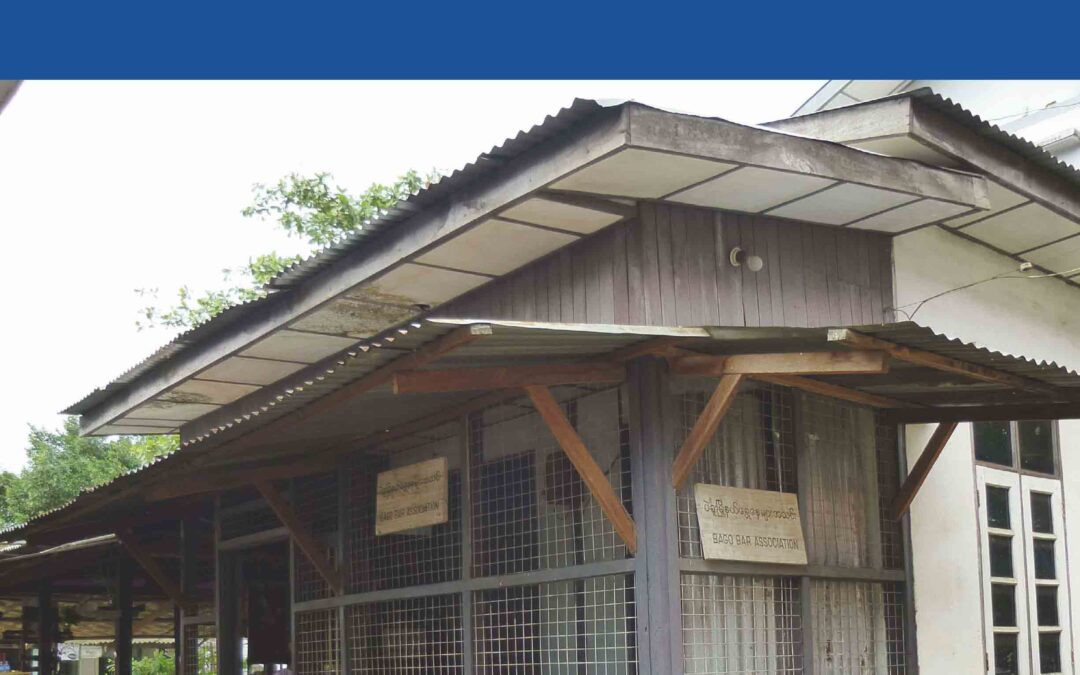
Lawyers continue to encounter impediments to the exercise of their professional functions and freedom of association, as well as pervasive corruption, although they have been able to act with greater independence, says the ICJ in a new report launched today.
Right to Counsel: The Independence of Lawyers in Myanmar – based on interviews with 60 lawyers in practice in the country – says authorities have significantly decreased their obstruction of, and interference in, legal processes since the country began political reforms in 2011.
“The progress made in terms of freedom of expression and respect for the legal process is very visible,” said Sam Zarifi, ICJ Asia-Pacific director. “But despite the improvements, lawyers still face heavy restrictions and attacks on their independence, which can result in uncertainty and fear, particularly when it comes to politically sensitive issues.”
Systemic corruption continues to affect every aspect of a lawyer’s career and, as a result, is never absent from lawyers’ calculations vis-à-vis legal fees, jurisdictions and overall strategy.
“Corruption is so embedded in the legal system that it is taken for granted,” Zarifi said. “When the public also generally assumes that corruption undermines the legal system, this severely weakens the notion of rule of law.”
“Lawyers in Myanmar, as elsewhere, play an indispensable role in the fair and effective administration of justice,” Zarifi added. “This is essential for the protection of human rights in the country and the establishment of an enabling environment for international cooperation towards investment and development.”
But lawyers in Myanmar lack an independent Bar Council, the report says, noting that the Myanmar Bar Council remains a government-controlled body that fails to adequately protect the interests of lawyers in the country and promote their role in the fair and effective administration of justice.
The ICJ report shows that other multiple long-standing and systemic problems affect the independence of lawyers, including the poor state of legal education and improper interferences on the process of licensing of lawyers.
In its report, which presents a snapshot of the independence of lawyers in private practice in Myanmar in light of international standards and in the context of the country’s rapid and on-going transition, the ICJ makes a series of recommendations:
- The Union Attorney-General and Union Parliament should significantly reform the Bar Council to ensure its independence;
- The Union Attorney-General and Union Parliament should create a specialized, independent mechanism mandated with the prompt and effective criminal investigation of allegations of corruption;
- The Ministry of Education should, in consultation with the legal profession, commit to improving legal education in Myanmar by bolstering standards of admission to law school, law school curricula, and instruction and assessment of students.
Contact:
Sam Zarifi, ICJ Asia-Pacific Regional Director, (Bangkok), t:+66 807819002 e-mail: sam.zarifi(a)icj.org
Craig Knowles, ICJ Media & Communications, (Bangkok), t:+66 819077653, e-mail: knocraig(a)gmail.com
Myanmar-Right to Counsel-publications-report-2013-ENG (download full text in pdf)
MYANMAR-Right to Counsel-Publications-report-2015-BUR (Burmese version in pdf)

Nov 26, 2013 | News
The ICJ is calling on the Malaysian Government to immediately drop the criminal charge against human rights defender Lena Hendry for screening the film ‘No Fire Zone: the Killing Fields of Sri Lanka.’
The case has been fixed for case management and the defence lawyers filed an application to set aside, permanently stay or quash the charges against Lena Hendry.
“Subjecting Lena Hendry to criminal prosecution simply for screening a documentary violates her rights and contravenes Malaysia’s obligations to uphold freedom of expression,” said Sam Zarifi, ICJ’s Asia-Pacific Regional Director.
On 3 July 2013, Pusat Komas, a Malaysian human rights advocacy organization where Lena Hendry works, and Kuala Lumpur and Selangor Chinese Assembly Hall Civil Right Committee (KLSCAH CRC) screened the film “No Fire Zone”, a documentary on the war crimes and human rights abuses allegedly committed at the end of the Sri Lankan civil war in 2009.
Immediately following the screening, 30 officers from the Malaysian Ministry of Home Affairs and the police entered the hall and recorded the identity of all persons who attended the event.
The authorities then arrested Lena Hendry and two colleagues, Anna Har and Arul Prakash, and interrogated them for three hours at Dang Wangi police station.
On 19 September 2013, Lena Hendry was charged under section 6(1)(b) of the Film Censorship Act 2002 for showing a film that had not been approved by the Board of Censors.
If found guilty, she could be fined up to RM30,000 (approximately USD 9,322) and sentenced to up to three years imprisonment.
“The Malaysian government told the UN Human Rights Council during its universal periodic review that it maintains a ‘strong commitment to the rule of law, to upholding respect for human rights, and…widening the democratic space”, said Sam Zarifi. “That commitment is inconsistent with prosecuting human rights defenders for disseminating documentary human rights information.”
Under international law and standards, Malaysia must respect the right to freedom of expression of all persons, including the right to seek and impart information of all kinds.
In the case of human rights defenders, the UN Declaration on Human Rights Defenders imposes a special duty on States not only to respect this right, but also to protect those who exercise this right through their exposure of human rights violations.
The ICJ calls on the Malaysian Government to safeguard freedom of expression and uphold the right of individuals to expose and disseminate information on human rights questions, including the documentation of human rights abuses.
Nov 15, 2013 | News
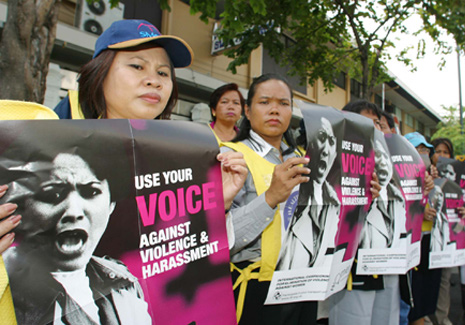
The ICJ and Amnesty International urge the Association of Southeast Asian Nations (ASEAN) to increase efforts to protect the rights of women and children.
ASEAN must act in light of the newly adopted Declaration on the Elimination of Violence against Women and Elimination of Violence against Children, which was recently adopted at the 23rd ASEAN Summit in Bandar Seri Begawan, Brunei Darussalam, the rights groups said.
The Declaration states the commitment of all 10 ASEAN member states to further “prevent and protect [women and children] from and respond to all forms of violence, abuse and exploitation of women and children particularly for those who are in vulnerable situations”.
AI and ICJ welcome this commitment, which allows for no exceptions or discrimination, while expressing concern that no explicit mention was made of lesbian, bisexual, transgender and intersex women and children in the non-exhaustive list of those requiring particular protection from discrimination and violence that follows this general statement.
The Declaration details a wide array of measures that Member States should take, within “a holistic, multi-disciplinary approach”, in order to eliminate violence against women and children.
These include changes to legislation, policies and practices; training and education; investigation, prosecution, punishment and where appropriate rehabilitation of perpetrators; creating an enabling environment for the participation of women and children; and the development of strategies for the elimination of harmful practices.
AI and ICJ pointed out that the Declaration suffers from some serious deficiencies in substance, as well as in the process of its adoption.
In terms of process, most ASEAN Member states failed to meaningfully consult with national civil society in the elaboration of the Declaration.
Only Philippines, Indonesia, Thailand and Vietnam held consultations, which in some of these states were limited.
This problem was compounded once the ACWC had finalised its draft, as the discussions and approval processes thereafter were completely shrouded in secrecy.
This final draft was never circulated to women’s and children’s groups in the region, despite written requests from several civil society groups calling for its release.
This unacceptable lack of transparency violates international guidelines on consultation with civil society, the ICJ and AI stressed.
AI and ICJ also deplore the fact that the Declaration reaffirms the General Principles of the discredited ASEAN Human Rights Declaration (AHRD), some of which are wholly incompatible with international law and allow for impermissible restrictions on human rights.
The two organizations reiterate their call to revise the AHRD, particularly by repealing or substantially amending General Principles 6-8, so as to bring it into line with international human rights law and standards.
AI and the ICJ further underline that international law allows no justification for violence against women and children and requires States to comply with their obligations to prohibit, prevent, investigate, punish and ensure reparations for victims of such violence in all circumstances.
Nothing in the Declaration may be construed to circumvent ASEAN Member States’ obligation to eliminate “prejudices and customary and all other practices” as well as “harmful and discriminatory traditional practices” that amount to, result in or perpetuate violence against women and children.
In addition, a significant omission of the Declaration is the lack of a reference to economic barriers to protection, assistance and justice faced by women and children in situations of violence.
ASEAN Member States should ensure that financial means do not impede access to justice, particularly of those living in poverty.
The rights groups also highlighted that ACWC rejected the proposal from women and children groups to have two separate declarations.
Although both women and children share similar vulnerabilities necessitating for additional protection, there remains certain rights, approaches and differing needs that are specific to each groups that could only be adequately addressed by having two separate declarations.
AI and the ICJ stated that ASEAN’s determination to end violence against women and children will ultimately be measured only by effective implementation of the Declaration in a manner which complies with their international obligations.
The Declaration tasks the ACWC to promote the implementation of the Declaration and review its progress.
AI and the ICJ call on the ACWC to actively implement this mandate, and for ASEAN Member States to cooperate with the ACWC in fulfilling this role.