Oct 14, 2019 | Multimedia items, News, Video clips
The conviction today of Catalan separatist leaders of broadly defined offences of sedition unduly restricts rights of freedom of expression, assembly and association, the ICJ said today.
“These convictions represent a serious interference with the exercise of freedom of expression, association and assembly of the leaders. The resort to the law of sedition to restrict the exercise of these rights is unnecessary, disproportionate and ultimately unjustifiable” said Massimo Frigo, ICJ Europe and Central Asia Senior Legal Adviser.
The ICJ also stressed that the overly broad definition of the crime of sedition applied in this case creates a high risk of arbitrariness.
“We are concerned that the Supreme Court does not comply with Spain’s obligations under international human rights law in the consideration of the charges against these defendants and this seriously undermines these convictions,” he added.
Nine of the twelve leaders on trial – including high-ranking Catalan government officials –were convicted of sedition in connection with their part in the administration on 1 October 2017 of a referendum on Catalonian independence. The referendum was conducted despite having been declared illegal by the Constitutional Court.
The voting process during the referendum was forcibly suppressed in many locations by the police, with credible reports of the use of unnecessary and disproportionate force in breach of Spain’s international law obligations.
“Interference with peaceful political expression and protest is not acceptable, save in limited circumstances where it is strictly necessary and proportionate for compelling purposes such as national security .” Frigo said.
Contact
Massimo Frigo, Senior Legal Adviser, ICJ Europe Programme, t: +41 22 979 38 05 ; e: massimo.frigo(a)icj.org
Background
The 12 people convicted in connection with the October 2017 referendum include Oriol Junqueras (13 years of imprisonment for sedition and abuse of power), former Catalan vice-president; Carme Forcadell, former Catalan parliament speaker (11 years and six months of imprisonment for sedition); eight former ministers in the Catalan government – Jordi Turull (12 years of imprisonment for sedition and abuse of power), Raül Romeva (12 years of imprisonment for sedition and abuse of power), Joaquim Forn (10 years and six months of imprisonment for sedition), Santiago Vila (10 months for disobedience), Meritxel Borràs (10 months for disobedience), Dolors Bassa (12 years of imprisonment for sedition and abuse of power), Josep Rull (10 years and six months of imprisonment for sedition), Carles Mundó (10 months for disobedience); Jordi Sànchez (9 years of imprisonment for sedition) the former leader of the Catalan National Assembly (ANC); and Jordi Cuixart (9 years of imprisonment for sedition), former head of the independence organisation Òmnium Cultural.
Spain has obligations to protect freedom of expression, including political expression, under Article 10 of the European Convention on Human Rights (ECHR) and Article 19 of the International Covenant on Civil and Political Rights (ICCPR); and freedom of peaceful assembly and association under Article 11 ECHR and Article 21 and 22 ICCPR.
The Human Rights Committee in its General Comment on freedom of expression has affirmed that: “extreme care must be taken by States parties to ensure that treason laws and similar provisions relating to national security, whether described as official secrets or sedition laws or otherwise, are crafted and applied in a manner that conforms to the strict requirements of paragraph 3” of article 19 ICCPR, which requires that restrictions on freedom of expression be provided for by law and must be necessary for a legitimate purpose, such as national security or public order .) Rights to participate in public life are protected under Article 25 ICCPR.
Oct 14, 2019 | Advocacy, Non-legal submissions
The ICJ has presented information to the UN Committee against Torture in preparation for the Committee’s examination of the fifth periodic report of Uzbekistan under the International Covenant on Civil and Political Rights (ICCPR).
In its submission, the ICJ addresses Uzbekistan’s legislation on extradition, its potential discrepancies with international law.
The ICJ welcomes the recent ratification of the Commonwealth of Independent States (hereafter, “CIS”) Convention on Legal Assistance and Legal Relations in Civil, Family and Criminal Matters 2002, known as the Chisinau Convention, as a positive step towards the compliance of the country’s extradition system with international standards
In it report, the ICJ formulates the following recommendations to Uzbekistan:
- Fully implement human rights and procedural safeguards and guarantees in extradition proceedings or in connection with other types of transfers, and interpret and apply such safeguards in accordance with Uzbekistan’s international human rights law obligations. In particular, Uzbekistan should take all necessary measures to fully implement the human rights guarantees featured in the Chisinau Convention into its domestic legislation.
- Implement the necessary reforms to give judicial authorities the central decision-making role in extradition proceedings, and ensure their full independence both at an institutional and personal level, in law and in practice. Extradition decisions should be taken by prosecutors only if they enjoy the same level of independence as judges, in law and in practice.
- Ensure that individuals extradited to face trial in Uzbekistan courts are awarded the full protection of the Convention.
- Take effective measures to prevent torture and other forms of ill-treatment, including by ensuring compliance with the non-refoulement principle in extradition proceedings.
- Carry out effective, independent and impartial investigations with a view to identifying persons directly and indirectly responsible for rendition operations and abduction practices, as they violate human rights and involve crimes under international law. Those responsible should be prosecuted, tried and, if convicted, sentenced to punishments commensurate with the gravity of their crimes, and to appropriate administrative sanctions to ensure non-repetition.
Uzbekistan-CAT-Advocacy-non legal submission-2019-ENG (download the submission in English)
Oct 12, 2019 | Agendas, Events
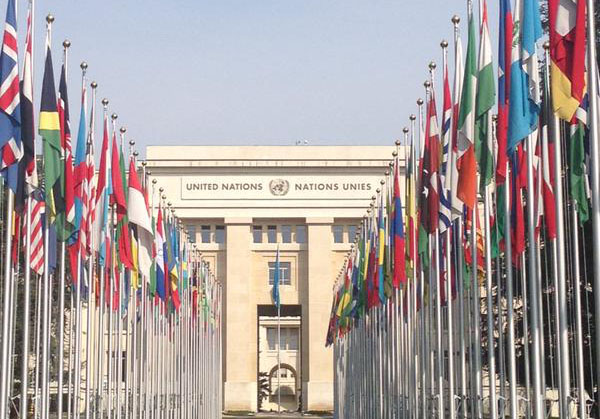
Today begins in Izmir (Turkey) a one-day workshop for lawyers and CSO practitioners on the use and strategies of UN mechanisms and of their decisions in domestic courts.
This event is organized by ICJ, in cooperation with its partners Kapasite Geliştirme Derneği and Human Rights Joint Platform, as part a/the EU co-financed project Rebuilding and Ensuring Access to justice with civil society in Turkey.
30 lawyers and civil society practitioners are taking part in the workshop on 12 October in Izmir.
The workshop aims at discussing the functioning of the UN human rights mechiansms (treaty bodies and charter-based bodies) as well as their follow up procedures and the implementation of their decisions in the domestic legal framework in Turkey.
The workshop will provide presentations on the functioning of UN mechanisms by international expert, including from OHCHR, on the value of UN decisions under Turkish law, as well as discussions and brainstorming on how to use UN decisions in Turkey.
The project is funded by the European Instrument for Democracy and Human Rights (EIDHR) of the European Union.
Turkey-Workshop-Agenda-UNmechanisms-Izmir-2019-eng (download the agenda in English)
Turkey-Workshop-Agenda-UNmechanisms-Izmir-2019-tur (download the agenda in Turkish)
Oct 8, 2019 | News
The ICJ and the International Bar Association’s Human Rights Institute (IBAHRI) have jointly sent an international observer to attend the third hearing of the criminal trial on the “Gezi Park” protest at the Silivri Prison Courthouse in Istanbul, scheduled to take place on 8 and 9 October 2019.
The ICJ and IBAHRI observer will be monitoring a trial hearing before İstanbul 30th Assize Court with prinicipal defendant Osman Kavala, and 15 others; Ali Hakan Altınay, Ayşe Mücella Yapıcı, Ayşe Pınar Alabora, Can Dündar, Çiğdem Mater Utku, Gökçe Yılmaz, Handan Meltem Arıkan, Hanzade Hikmet Germiyanoğlu, İnanç Ekmekci, Memet Ali Alabora, Mine Özerden, Şerafettin Can Atalay, Tayfun Kahraman, Yiğit Aksakoğlu and Yiğit Ali Ekmekçi.
The observer will report directly to the IBAHRI and ICJ Secretariats on the proceedings following the mission.
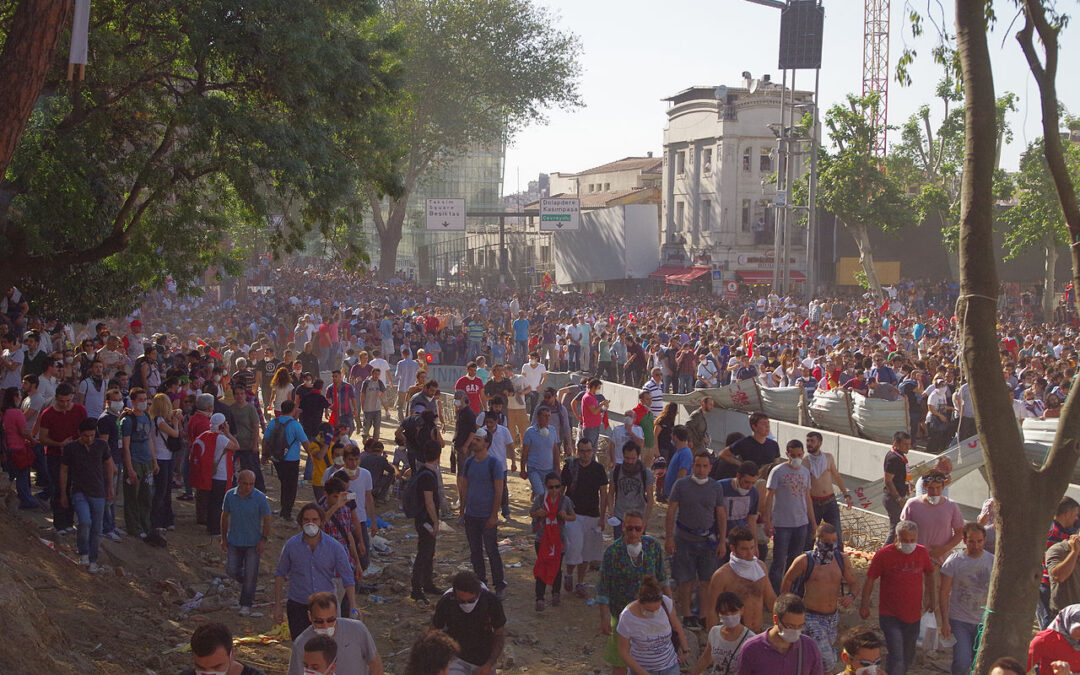
The Gezi Park protests began in May 2013 as an effort by a group of environmentalists to save a park in central Istanbul from being rezoned, but soon turned into nationwide demonstrations.
The protest was quelled by police with the use of tear gas and water cannons against the protesters in Taksim Square. Following a six-year investigation into the events, the 657-page indictment issued by the Istanbul Chief Public Prosecutor’s Office was accepted by the 30th A Court in Istanbul on 4 March 2019.
The defendants are to be charged under Turkish Criminal Code Article 312 (attempt to overthrow the Turkish Government or attempt to prevent it from fulfilling its duties), Article 151 (damage to property), Article 152 (qualified damage to property), Article 174 (possession or exchange of hazardous substances without permission), Article 153 (damaging places of worship and cemeteries), Article 149 (qualified robbery), Article 86 (intentional injury); crimes under the Law on Firearms, Knives and Other Tools no. 6136, and crimes under the Law on Protection of Cultural and Natural Assets no. 2863.
The total sentence asked for by the prosecution for these offences amounts to approximately 47,520 years imprisonment.
Contact:
Massimo Frigo, Senior Legal Adviser, t: +41 22 979 38 05 – e: massimo.frigo(a)icj.org
Oct 3, 2019 | News
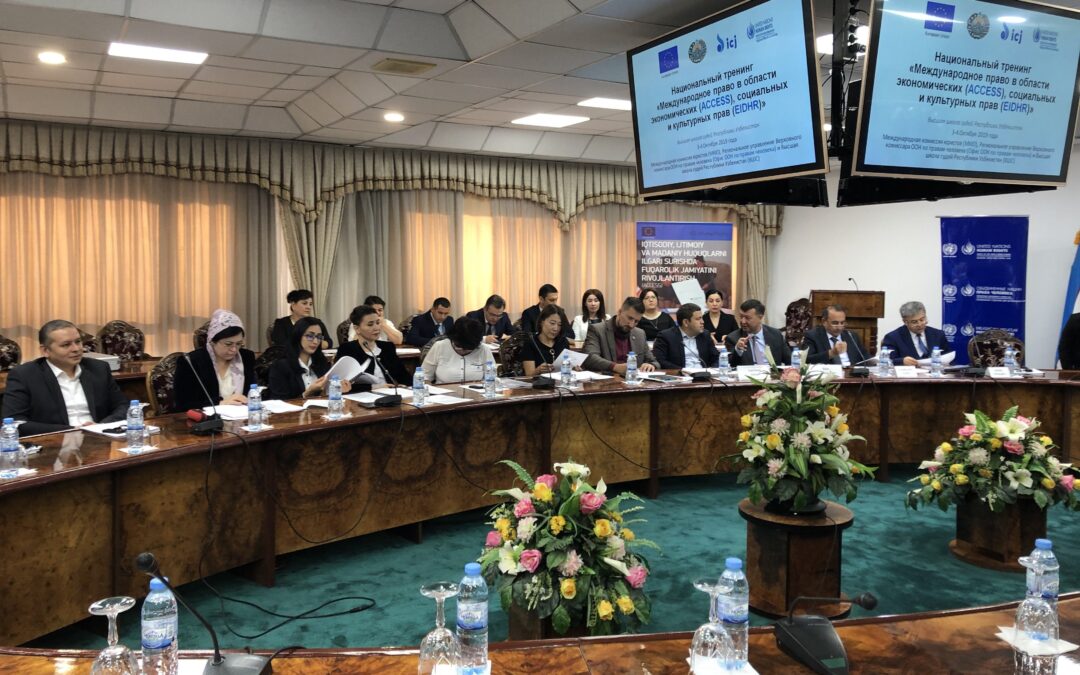
Today, the ICJ, the Regional office of the UN High Commissioner for Human Rights (OHCHR) for Central Asia and the High School of Judges of the Republic of Uzbekistan (HSJ) are organizing a national training on “International law on economic, social and cultural (ESC) rights.”
This two-day training is one of series of similar trainings, held in 2019 and 2020, that will address international law on issues including rights to healthcare, education, housing and rights in the workplace.
The training sessions aim to build the capacity of judges, lawyers, prosecutors, legal academics and other representatives of the civil society on international standards on ESC rights, to share best practices on compliance by States with their international obligations, including through judicial practices related to ensuring access to justice for ESC rights.
The training sessions ensure diversity and networking opportunities between members of the judiciary and others legal practitioners.
Each training consists of four modules on (1) introduction to international law on ESC rights; (2) International obligations concerning access to justice and remedies for ESC rights in national courts; comparative examples of good practice; (3) Children’s ESC rights and (4) Women’s ESC rights.
Head of the EU Delegation in Uzbekistan Ambassador Eduards Stiprais pointed out, “Uzbekistan is taking serious international commitments to align its legislation with international norms and practices. Under Uzbekistan Constitution, these international commitments take precedence over the national law. They will reinforce the rights of Uzbekistan citizens and international investors. This will boost the economic and social development of the nation, but it will also put high demands to the judiciary system to ensure that its decisions fully comply with international norms and offer remedies against all breaches.”
Ryszard Komenda, OHCHR Regional Representative for Central Asia, noted that “Uzbekistan since 1995 has committed itself to ensure implementation of provisions of the International Covenant on Economic, Social and Cultural Rights (ICESCR).
To date, Uzbekistan has already submitted three national periodic reports on implementation of the Covenant. The third national report was submitted in June 2019 and will be reviewed after 2020.
The UN Committee, tasked to oversee states’ compliance with their commitments under the ICESCR, has issued a number of recommendations for Uzbekistan.
Many of them highlight the instrumental role of training on economic, social and cultural rights as a means to build capacity of state actors to respect, protect and fulfil human rights.
Only through comprehensive understanding of the content of each right and realizing that all human rights are interrelated, indivisible and interdependent, it will be possible to guarantee holistic implementation of existing international human rights obligations of Uzbekistan”.
“These trainings are an important part of capacity building which is essential in ensuring the effectiveness of the reform of the judiciary,” said Róisín Pillay, Europe and Central Asia Programme Director of the ICJ.
“It is vital to build capacity of different actors of the justice system: members of the judiciary, law enforcement agencies, lawyers and civil society, to ensure a greater impact. Together with the OHCHR and the Supreme School of Judges and the great support of the EU Delegation in Uzbekistan, we could provide the space necessary for learning about international human rights law and, in particular, its various aspects related to economic, social and cultural rights,” she added.
The Director of the Higher School of Judges briefly spoke about the activities of the Supreme School of Judges (SSJ), and also noted the recent arrival of the UN Special Rapporteur on the independence of judges and lawyers, Mr. Diego Garcia Sayan, who paid special attention to the establishment of the SSJ, along with other judiciary reforms in Uzbekistan.
“The international seminar in which we have gathered today gives us the opportunity to establish networking with other organizations and bodies through promotion of economic, social and cultural rights. The exchange of ideas and experience in the necessity of the modern world, for the mutual development of the judiciary, education and the society as such,” said Khodji-Murod Isakov, the Director of the Higher School of Judges.
The national trainings are organized in the framework of project “Advancing Civil Society in Promoting ESCR Standards (ACCESS)” funded by EU through the European Instrument for Democracy and Human Rights (EIDHR).
There will be two more similar trainings in 2020 and all trainings materials at the end will be translated into Russian and Uzbek languages for further reference and use. Moreover, the trainings materials will be publicly available in 2020 for wider outreach and promotion of international law and ESC rights standards.
Contact
Dilfuza Kurolova, ICJ Legal consultant, t: +998 90 9050099 ; e: dilfuza.kurolova(a)icj.org
Download
Uzbekistan-National Training ESCR-News-2019-ENG (full story in PDF)
International law on economic, social and cultural (ESC) rights (4 training modules in Russian – PDF).