Aug 27, 2019 | News
The ICJ welcomes yesterday’s ratification by Uzbekistan of the CIS Convention on Legal Assistance and Legal Relations in Civil, Family and Criminal Matters 2002, also called the Chisinau Convention. The law on ratification was signed by President Shavkat Mirziyoyev.
The ICJ calls on the Uzbek authorities to take measures to make the Convention’s protective guarantees effective.
“This is a major step forward by Uzbekistan to get its extradition system up to standard with the rest of the world”, said Massimo Frigo, ICJ Senior Legal Adviser. “. “Its ratification of this treaty considerably steps up human rights guarantees in extradition.”
The Chisinau Convention enshrines several human rights guarantees to protect against extraditions that may breach the human rights of the transferred person, including the prohibition to transfer persons where they risk the death penalty or torture or cruel, inhuman and degrading treatment.
“The ratification of the Convention is a very important first step. An effective implementation of these guarantees in the legal and law enforcement systems is necessary now.” said Dmitry Nurumov, ICJ Central Asia Legal Consultant.
Background
Last May, the ICJ held, together with the General Prosecutor’s Office of Uzbekistan, UNODC Regional Office for Central Asia and the Regional Office for Central Asia of OHCHR, a regional and a national seminar on comparative practices in extradition in the CIS and European legal systems, including with regard to human rights guarantees in these procedures.
In 2017, the ICJ issued a report documenting the shortcomings in the Russian Federation, Central Asia and European countries in their extradition systems and other transfer procedures.
The ratification by Uzbekistan of the Chisinau Convention meets part of the recommendations formulated by the ICJ in these occasions.
Contact:
Massimo Frigo, Senior Legal Adviser, e: massimo.frigo(a)icj.org , t: +41229793805

Aug 22, 2019 | News
The ICJ calls on the Ukrainian authorities to investigate the murder of lawyer Olexandr Ivanov, killed today with an automatic weapon near SIZO (Pre-trial Dentention Centre) №6 in Kropyvnytskyi.
The shooting was carried out from a car by unknown persons. The lawyer died on the spot. Another person injured in the incident was hospitalized in critical condition.
“The killing of lawyer Oleksandr Ivanov must be independently, promptly, and thoroughly investigated and the perpetrators brought to justice,” said Temur Shakirov, ICJ Senior Legal Adviser.
“Such crimes strip any legal reforms of their positive impact if lawyers’ life is always in danger when exercising their functions,” he added.
The police have confirmed the occurrence of the killing and initiated an investigation preliminarily qualified as intentional murder under article 115-2 of the Criminal Code of Ukraine.
The Ukrainian National Bar Association (UNBA) is planning to convene an emergency meeting of the Committee on Protection of Lawyers Rights and Professional Guarantees. The UNBA has also referred to the leadership of regional prosecution and police authorities to bring the case under personal control.
“During its recent mission to Ukraine the ICJ heard of cases of killings of lawyers and this case demonstrates that little progress has been achieved in addressing the security of lawyers in Ukraine,” said Shakirov.
Additional information:
International human rights law, including the European Convention on Human Rights to which Ukraine is a party, requires that states take steps to protect the life and physical integrity of persons who they know or ought to know are at real risk of violence.
According to the UN Basic Principles on the Role of Lawyers, governments must ensure that lawyers are able to perform all of their professional functions without intimidation, hindrance, harassment or improper interference (principle 16). The UN Basic Principles specify that “[w]here the security of lawyers is threatened as a result of discharging their functions, they shall be adequately safeguarded by the authorities” (principle 17).
Aug 19, 2019 | Advocacy, Cases, Legal submissions
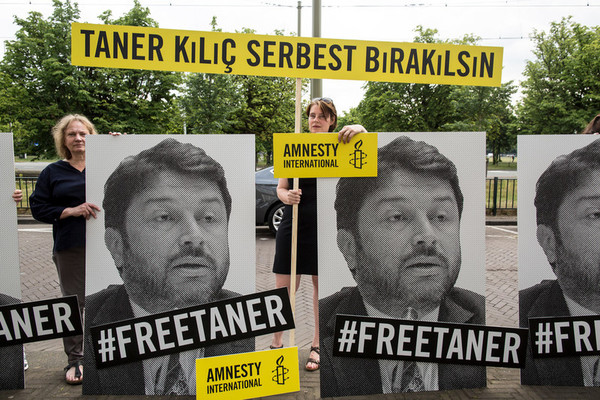
The International Commission of Jurists, the Turkey Human Rights Litigation Support Project and Human Rights Watch have jointly intervened before the European Court of Human Rights in the case of Taner Kiliç, former Chair of the Board of Amnesty International Turkey.
Taner Kiliç is a Turkish human rights defenders. He had been Chair of the Board of Amnesty International Turkey since 2014.
He was arrested on 6 June 2017 on reportedly unsubstantiated charges of “membership of a terrorist organisation” and was released on bail on 15 August 2018 after having spent 14 months in detention.
His case before the European Court of Human Rights challenges the lawfulness of his pre-trial and on remand detention, the violations of his right to judicial review of his detention, and of his freedom of expression and association, considering his arrest linked to his work as leader of a NGO.
As the interveners have written to the Court, this case epitomises some of the most fundamental human rights challenges in Turkey today.
These involve widely documented restrictions on freedom of expression, association, and assembly of human rights defenders (HRDs) and rapidly closing civil society space.
The interveners have submitted observations on:
- the factual context in respect of the situation facing HRDs in Turkey;
- international standards governing obligations towards HRDs of relevance to the Court’s interpretation of the European Convention on Human Rights, including the limits prescribed by Article 18;
- key principles necessary for a rule of law approach to the application of the criminal law, against the legal and practical pattern of excessive resort to criminal law against HRDs in Turkey today.
Turkey-ECtHR-icj&others-Kilic-Advocacy-legal submission-2019-ENG (download the third party intervention)
Photo credit: Amnesty International

Aug 8, 2019 | News
The ICJ called today on Italy and Malta to cooperate to swiftly provide a place of safety for the disembarkment of the 121 migrants, likely including asylum seekers, on board the Open Arms vessel.
Open Arms rescued 123 people that left Libya and were on a situation of distress in international waters, and has been navigating seven days on the Central Mediterranean Sea in search of a place of safety for disembarkment.
Currently Italy and Malta (the nearest States) and Spain (the flag State) have not granted access to their territorial waters.
“When a boat is conducting an operation of rescue it is the duty under international law for neighbouring States to provide a place of safety,” said Massimo Frigo, ICJ Senior Legal Adviser.
“The situation on the boat, with also 30 children and two babies, is rapidly deteriorating and it is of the utmost urgency to allow for their disembarkment,” he added.
“The refusals and lack of cooperation by Italy, Malta and Spain is in contravention of their obligations under the law of the sea,” said Frigo.
“These States should open their harbours and the EU should work hard to ensure that resettlement is ensured so as to relieve pressure from them.”
Relevant provisions of international law include: UN Convention on the Law of the Sea (Article 98); International Convention for the Safety of Life at Sea (SOLAS), Annex, Chapter V; International Convention on Maritime Search and Rescue.
Contact:
Massimo Frigo, ICJ Senior Legal Adviser, t:+41 22 979 3805 ; e: massimo.frigo(a)icj.org

Jul 18, 2019 | News
The ICJ and the International Bar Association’s Human Rights Institute (IBAHRI) have jointly sent international observers to attend the second hearing of the criminal trial on the “Gezi Park” protest at the Silivri Prison Courthouse in Istanbul, scheduled to take place on 18 and 19 July 2019.
The ICJ and IBAHRI observers will be monitoring a trial hearing before İstanbul 30th Assize Court with prinicipal defendant Osman Kavala, and 15 others; Ali Hakan Altınay, Ayşe Mücella Yapıcı, Ayşe Pınar Alabora, Can Dündar, Çiğdem Mater Utku, Gökçe Yılmaz, Handan Meltem Arıkan, Hanzade Hikmet Germiyanoğlu, İnanç Ekmekci, Memet Ali Alabora, Mine Özerden, Şerafettin Can Atalay, Tayfun Kahraman, Yiğit Aksakoğlu and Yiğit Ali Ekmekçi.
The observers will report directly to the IBAHRI and ICJ Secretariats on the proceedings following the mission.
The Gezi Park protests began in May 2013 as an effort by a group of environmentalists to save a park in central Istanbul from being rezoned, but soon turned into nationwide demonstrations.
The protest was quelled by police with the use of tear gas and water cannons against the protesters in Taksim Square. Following a six-year investigation into the events, the 657-page indictment issued by the Istanbul Chief Public Prosecutor’s Office was accepted by the 30th A Court in Istanbul on 4 March 2019.
The defendants are to be charged under Turkish Criminal Code Article 312 (attempt to overthrow the Turkish Government or attempt to prevent it from fulfilling its duties), Article 151 (damage to property), Article 152 (qualified damage to property), Article 174 (possession or exchange of hazardous substances without permission), Article 153 (damaging places of worship and cemeteries), Article 149 (qualified robbery), Article 86 (intentional injury); crimes under the Law on Firearms, Knives and Other Tools no. 6136, and crimes under the Law on Protection of Cultural and Natural Assets no. 2863.
The total sentence asked for by the prosecution for these offences amounts to approximately 47,520 years imprisonment.
Contact:
Massimo Frigo, Senior Legal Adviser, t: +41 22 979 38 05 – e: massimo.frigo(a)icj.org