Jun 22, 2018 | Events, News
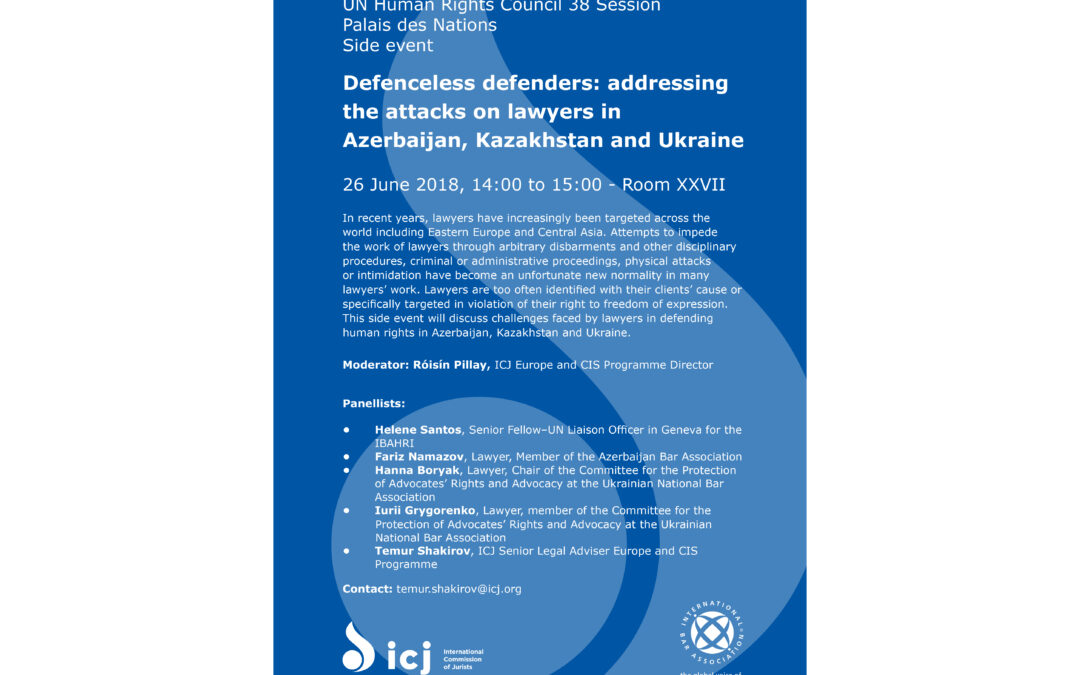
This side event at the Human Rights Council takes place on Tuesday, 26 June, 14:00-15:00, room XXVII of the Palais des Nations. It is organized by the ICJ and the International Bar Association’s Human Rights Institute (IBAHRI).
In recent years, lawyers have increasingly been targeted across the world including Eastern Europe and Central Asia. Attempts to impede the work of lawyers through arbitrary disbarments and other disciplinary procedures, criminal or administrative proceedings, physical attacks or intimidation have become an unfortunate new normality in many lawyers’ work.
Lawyers are too often identified with their clients’ cause or specifically targeted in violation of their right to freedom of expression. This side event will discuss challenges faced by lawyers in defending human rights in Azerbaijan, Kazakhstan and Ukraine.
Moderator: Róisín Pillay, ICJ Europe and CIS Programme Director
Speakers:
- Helene Santos, Senior Fellow–UN Liaison Officer in Geneva for the IBAHRI
- Fariz Namazov, Lawyer, Member of the Azerbaijan Bar Association
- Hanna Boryak, Lawyer, Chair of the Committee for the Protection of Advocates’ Rights and advocacy at the Ukrainian National Bar Association
- Iurii Grygorenko, Lawyer, member of the Committee for the Protection of Advocates’ Rights and Advocacy at the Ukrainian National Bar Association
- Temur Shakirov, ICJ Senior Legal Adviser Europe and CIS Programme
Jun 21, 2018 | Events, News
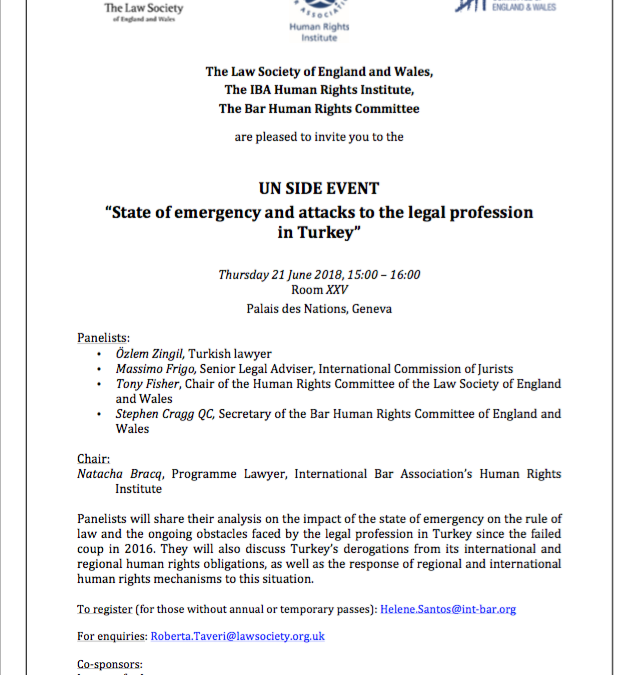
The ICJ will participate today in the side event “State of emergency and attacks on the legal profession in Turkey” organized by IBAHRI, the Law Society, and the Bar Human Rights Committee of England and Wales.
This side event at the Human Rights Council takes place on Thursday, 21 June, 15:00-16:00, room XXV of the Palais des Nations.
It is co-sponsored by Lawyers for Lawyers, Union Internationale des Avocats, Lawyers’ Rights Watch Canada.
In this side event, panelists will share their analysis on the impact of the state of emergency on the rule of law and the ongoing obstacles faced by the legal profession in Turkey since the failed coup in 2016.
They will also discuss Turkey’s derogations from its international and regional human rights obligations, as well as the response of regional and international human rights mechanisms to this situation.
Panelists:
- Özlem Zingil, Turkish lawyer;
- Massimo Frigo, International Commission of Jurists;
- Tony Fisher, Chair of the Human Rights Committee of the Law Society of England and Wales;
- Stephen Cragg QC, Secretary of the Bar Human Rights Committee of England and Wales;
- Natacha Bracq, Programme Lawyer, International Bar Association’s Human Rights Institute.
Geneva-SideEvent-StateofEmergencyLawyersTurkey-IBAHRI&others-June2018-ENG (download the flyer)
Jun 20, 2018 | Advocacy, Non-legal submissions
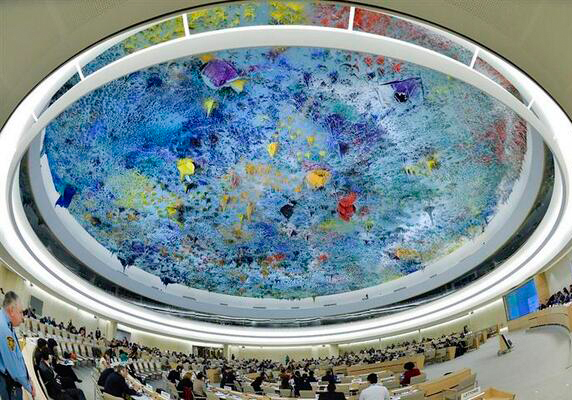
The ICJ issued a statement today on the occasion of an interactive dialogue with the UN Special Rapporteur on the human rights of migrants, on an effective accountability mechanism for the European Border and Coast Guard Agency.The ICJ was not able to read the statement during the interactive dialogue due to the limited time provided for NGO statements. The statement was as follows:
“The International Commission of Jurists (ICJ) welcomes that the report (A/HRC/38/41) of the Special Rapporteur on the human rights of migrants recognizes the importance of monitoring mechanisms, access to justice, and accountability in the context of returns (para 78).
The ICJ, which is a member of the Frontex Consultative Forum on Fundamental Rights, shares the conclusion of the Special Rapporteur that the current implementation of an individual complaints mechanism for Frontex is “rather ineffective, since it largely relies on the discretionary powers of internal oversight bodies” and deficient in its follow-up procedure (para 84).
Furthermore, the ICJ considers that giving the Executive Director of Frontex competence to decide the merits of complaints creates a reasonable perception of bias. This, together with the lack of any requirement to publish its decisions, mean the existing complaint mechanism cannot constitute an effective remedy for human rights violations.
The ICJ is particularly concerned at these shortcomings in light of, as the Special Rapporteur noted, the “externalization of States’ obligations through the actions of international or regional organizations during return procedure” (para. 82). Such externalisation prevents victims of human rights violations from accessing effective remedies.
Finally, the ICJ notes that actions such as the closure of harbours to ships rescuing migrants, including refugees, are in clear breach of the international law of the sea and effectively prevent any access to legal remedies. Such actions should be condemned by this Council.
The ICJ supports the Special Rapporteur’s recommendation that States and international and regional organisations must ensure accountability for human rights violations and invites him to explore further such organisations’ responsibility in this regard under human rights law.”
Jun 19, 2018 | Advocacy
The ICJ welcomes the proposal of the Parliamentary Assembly of the Council of Europe (PACE) in its Recommendation 2121(2018) calling for the development of a Council of Europe Convention on the Profession of Lawyer.
The ICJ believes that such a Convention could make an important contribution to strengthening the rule of law and the protection of human rights in the Council of Europe region, building on existing Council of Europe standards and jurisprudence of the European Court of Human Rights.
The ICJ particularly welcomes PACE’s call for an effective control mechanism to be put in place under a new Convention, as recent developments in a number of Council of Europe Member States show a significant gap in implementation of Council of Europe standards on the independence and security of lawyers.
Lawyers, along with judges and prosecutors, are one of the pillars on which protection of the rule of law and human rights through the justice system rests.
Recognizing this, the ICJ, since its foundation in 1952, has worked to protect lawyers under threat and to develop international standards for the independence, role and integrity of the profession.
Successive ICJ Declarations, adopted by leading jurists from all regions of the world, have affirmed that the role of the legal profession is “paramount in safeguarding human rights and the Rule of Law” (2008 Declaration on Upholding the Rule of Law and the Role of Judges and Lawyers in Times of Crisis (ICJ 2008 Declaration).
In any legal system, the legal profession plays a pivotal role in ensuring access to justice and effective remedies and accountability for violations of human rights, as well as upholding the right to fair trial, right to liberty and freedom from torture and other ill-treatment in the criminal justice process.
In defending criminal cases, in advising and representing victims of human rights violations and their relatives or in challenging before the courts national legislation or policy that is contrary to human rights , lawyers give practical effect to human rights guarantees and rule of law principles.
The importance of this role has been recognized by international standards as well as in the jurisprudence of the European Court of Human Rights, which has emphasized the “specific status of lawyers [having] a central position in the administration of justice as intermediaries between the public and the courts”.
It is thus of fundamental importance that lawyers are able to fulfill their professional duties without interference. As the European Court of Human Rights has held, “persecution and harassment of members of the legal profession strikes at the very heart of the Convention system.”
Full text in ENG (PDF): Europe-Drafting-a-EU-Convention-on-the-Profession-of-Lawyer-2018-ENG
Jun 18, 2018 | News
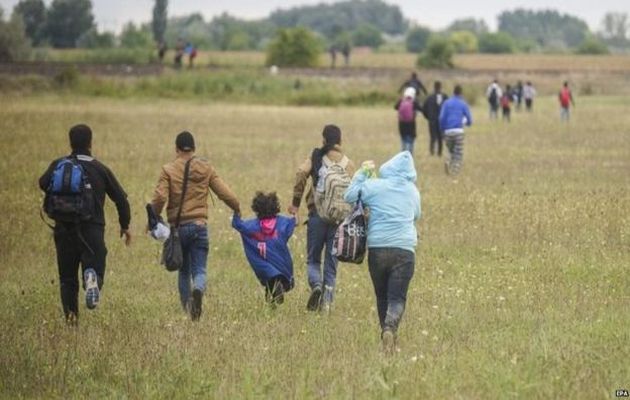
The ICJ today called on the Hungarian National Assembly to reject Bill No. T/333 that, if approved, would risk criminalizing the work of civil society, lawyers and other human rights defenders and lead to violations of the rights of migrants, especially refugees.
The National Assembly of Hungary is considering today Bill No. T/333 tabled by the Hungarian Government that amends immigration and criminal law.
“This draft law would effectively punish activities that aim to apply legal procedures” said Massimo Frigo. “This attack on the work of lawyers and human rights defenders does not constitute a legitimate aim that would allow for a permissible restriction on the rights of freedom of expression, assembly and association consistent with international human rights law.”
The ICJ warned that the draft law, if approved, would, in contravention of international standards, open the way to arrest, prosecute and convict lawyers or representatives of civil society who assist asylum seekers in filing their application for international protection. It would also make funding of such activities a crime.
The law would effectively prevent lawyers and civil society organizations, under threat of criminal punishment, from providing assistance to asylum-seekers unless they can verify that the person is entitled to international protection, even before the person has begun the refugee status determination procedure.
It would further criminalize any activity aimed at regularizing the position of an irregular migrant who had, for example, married a Hungarian citizen or became a parent of Hungarian children.
“This draft law should be rejected because it could in practice deny legal assistance to any asylum seeker, preventing them from defending their rights, ” said Massimo Frigo.
Bill T/333 has been criticized by UNHCR, the Council of Europe Commissioner for Human Rights and several national and international civil society organisations. An opinion of the Venice Commission on the law is expected to be published shortly.
Background
If approved in the current form, section 11 of the draft law would insert in the Criminal Code the offence of “facilitating illegal immigration”, as new section 353/A. This provision, if approved, would make it a criminal offence to carry out organized activities to facilitate the initiation of an asylum procedure for persons “who are not persecuted” in their country of origin or in a third country that they passed through, or “do not have a well-founded reason to fear direct persecution.”
This provision would also make it a criminal offence to carry out these activities to assist a person entering illegaly or residing illegally in Hungary to obtain a residence permit.
The draft law would also make it a criminal offence to provide financial means to carry out these activities.
Full Document in English (PDF): Hungary-Statement-National-Assembly-Criminalizing-Assistance-to-Migrants-Law-2018-ENG