Feb 13, 2018 | Advocacy
The ICJ, together with other NGOs, has expressed serious concerns about the current wording of the draft Copenhagen Declaration on the future of the European Convention on Human Rights (ECHR) system, which has been proposed by the Danish government.
In a joint response to the first draft of the Copenhagen Declaration, the group of NGOs welcomed the willingness of the Danish government to engage with civil society in developing the Declaration, which is to be finalised at an intergovernmental conference in Copenhagen in April 2018.
However the NGOs expressed concerns that some of the language of the Declaration appears to diminish the role of the European Court of Human Rights, and risks fragmenting the European human rights protection system as well as undermining the independence of the Court. The NGOs emphasised that:
- The Declaration should affirm the need to respect and preserve the independence of the European Court of Human Rights, and should omit any language or proposals that put the independence of the Court at risk;
- Effective human rights protection at the national level must be subject to the supervision of the European Court of Human Rights;
- Greater emphasis should be given to the role of civil society in implementing the ECHR at the national level, and this should be taken into account in developing proposals for more effective implementation;
- The universality of human rights protection should be respected, and the text should be worded to highlight the importance of all human rights in all situations across all of the Council of Europe states;
- The Declaration must not call into question the Court’s authority to review human rights cases concerning asylum and immigration, or those arising from international conflicts;
- Governments should not be given further opportunities to influence the Court, nor should the Declaration provide a pretext for states to exert political pressure on the Court;
- Council of Europe States should not only implement the European Convention on Human Rights, but also act promptly to execute judgments of the European Court;
- National processes for the selection and election of European Court judges should be further strengthened.
Europe-JointNGO-Response-Copenhagen-Declaration-Advocacy-2018-ENG (Full document in PDF)
Feb 3, 2018 | Agendas, Events, News
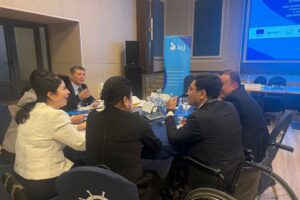
Today begins in Ankara (Turkey) a two-day training for lawyers and CSO practitioners representing and working with migrants, refugees and asylum-seekers.
This event is organized by ICJ, in cooperation with its partners Refugee Rights Turkey, the European Council on Refugees and Exiles (ECRE), Mülteci-Der (MD) and ICJ-EI, as part of the EU co-financed project Fostering Access to Rights for Migrants, Refugees and Asylum-Seekers in Turkey.
30 lawyers and civil society practitioners – representing nine different bar associations and relevant organisations from the Ankara area and other nearby key migration and asylum locations – are taking part in the training on 3 and 4 February.
The training aims to update lawyers and CSOs on the international and national law on the rights of refugees, migrants and asylum-seekers in order to be effective in their work at both the national and international levels. It aims at an effective implementation of the Turkish legal framework on asylum and migration.
The main thematic areas to be discussed will be the principle of non-refoulement, international protection, detention and access to economic, social and cultural rights.
The training will use as a basis the draft training materials prepared by the ICJ and its partners (to be published an the end of 2019) and, among other sources, the ICJ Practitioners Guide no. 6: Migration and International Human Rights Law.
The project “Fostering Access to Rights for Migrants, Refugees and Asylum-Seekers in Turkey” is funded by the European Instrument for Democracy and Human Rights (EIDHR) of the European Union.
Turkey-Training-Ankara-MigrationAsylum-Agenda-2018-tur-eng (download the agenda in Turkish and English)
Jan 30, 2018 | Agendas, Events
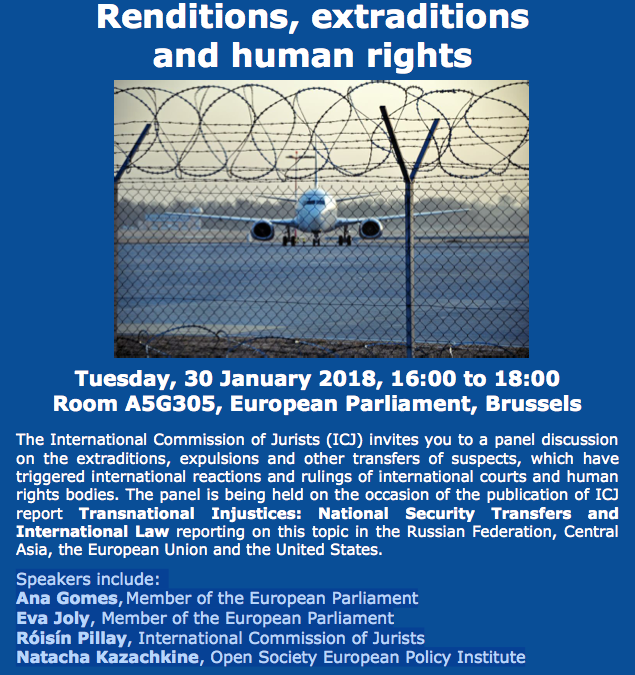
The ICJ invites you to an event to discuss challenges in prevention of, and accountability for, violations of human rights in renditions and other transfers of suspects, including through past European complicity in US-led renditions, and in ongoing transfers of suspects in the CIS region.
Join us for a discussion marking the EU launch of the International Commission of Jurists’ report, Transnational Injustices: National Security Transfers and International Law. The event is kindly hosted by Ana Gomez and Eva Joly, MEPs.
Panelists will discuss the ongoing practice of states unlawfully rendering people accused of terrorism, accountability for violations of human rights in past renditions, and how the EU institutions and EU Member States should address these.
When: Tuesday 30 January 16.00 – 18.00
Where: Room A5G305, European Parliament, Brussels
RSVP to: anamaria.gomes@europarl.europa.eu
Speakers include:
- Ana Gomes, Member of the European Parliament
- Eva Joly, Member of the European Parliament
- Róisín Pillay, International Commission of Jurists
- Natacha Kazachkine, Open Society European Policy Institute
A flyer for this event is available in PDF format by clicking here.
Jan 15, 2018 | News
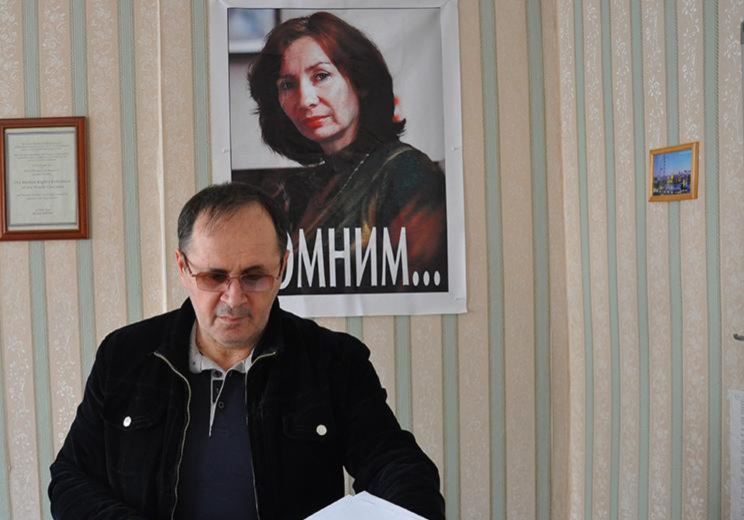
The ICJ is concerned at allegations that the recent arrest and detention of Oyub Titiev, the head of the Chechen branch of the Russian human rights organisation Memorial, were carried out as retaliation for his human rights activity.
The ICJ is particularly concerned at the more recent reports that family members of Oyub Titiev have had to leave Chechnya for security reasons following threats.
The ICJ calls on the Russian federal and local authorities to conduct a prompt, thorough and independent investigation into allegations that criminal charges against Oyub Titiev have been fabricated by police.
Oyub Titiev should be immediately released pending the outcome of this investigation, and measures should be taken to protect his security and that of his family.
On 9 January 2018, at 10.30, according to an official statement of the Ministry of Interior of Chechnya, Oyub Titiev’s car was stopped near Kurchaloy town to check his documents.
During a search of his car, a plastic bag with approximately 180 grams of a substance identified as marijuana was allegedly found.
Titiyev was charged with possession of a large quantity of narcotics under article 228 of the Criminal Code of the Russian Federation. However, he has stated that the narcotics were planted and has filed a complaint with the Prosecutor’s Office to initiate an investigation into these allegations.
Oyub Titiev, the head of Memorial in Chechnya, is one of very few human rights defenders who continue their work in Chechnya despite significant obstacles and threats.
He took over this position following the murder of the former head of Memorial in Chechnya, Natalya Estemirova in 2009.
In accordance with Article 2(a) of the Declaration on Human Rights Defenders (Declaration on the Right and Responsibility of Individuals, Groups and Organs of Society to Promote and Protect Universally Recognized Human Rights and Fundamental Freedoms), human rights defenders have a right to conduct human rights work individually and in association with others.
Under the same Declaration, States have a duty to take all necessary measures to ensure the protection of everyone against any violence, threats, retaliation, adverse discrimination, pressure or any other arbitrary action as a consequence of his or her legitimate activities as a human rights defender.
Threats of violence and the falsification of evidence by public officials constitute crimes under the Russian Criminal Code. Reliance in criminal proceedings on evidence falsely planted by the police or other State actors would violate international human rights law including fair trial guarantees under the UN Covenant on Civil and Political Rights and the European Convention of Human Rights.
Attacks on human rights defenders working in an extremely difficult human rights environment such as that of Chechnya, or attacks on their family members, have a chilling effect on work to defend human rights there. If further such attacks are to be prevented, individuals responsible for them must be brought to justice through a fair procedure, the ICJ stressed.

Jan 11, 2018 | Advocacy, Cases, Legal submissions
The ICJ responded today to the observations of the Czech Government on the merits of the collective complaint brought against it earlier last year by the ICJ and Forum for Human Rights.
The complaint to the European Committee of Social Rights (ICJ v. the Czech Republic, No. 148/2017) argues that the Czech Republic fails to ensure equal legal protection and participation of children below the age of criminal responsibility in the pre-trial stage of juvenile justice procedures.
The ICJ and Forum for Human Rights reinforced the complaint, relying on Article 17 of the Social Charter, in relation to the State party’s failure to ensure that children below the age of criminal responsibility but recognised as having infringed the penal law are treated in a manner consistent with the promotion of the child’s sense of dignity and worth, which reinforces the child’s respect for the human rights and fundamental freedoms of others and which takes into account the child’s age and the desirability of promoting the child’s reintegration and the child’s assuming a constructive role in society.
Europe-ECSR-ICJvCzechRepublic-ChildrenJustice-ICJresponse1-2018-ENG (download the ICJ reply)