Mar 1, 2018 | Advocacy, Non-legal submissions
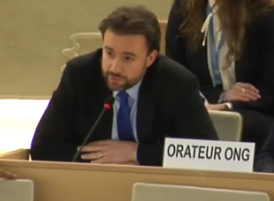
The ICJ today delivered an oral statement to the UN Human Rights Council, on attacks on lawyers and the legal profession in Turkey, Azerbaijan, Kazakhstan and China.
The statement, which was made during an interactive dialogue with the UN Special Rapporteur on human rights defenders and the UN Special Rapporteur on Torture, read as follows:
Our organizations welcome that the main report (A/HRC/37/51, para 13) and communications report (A/HRC/37/51/Add.1, e.g. paras 278-297, 431, 508-510) of the Special Rapporteur on Human Rights Defenders recognizes the role of lawyers as human rights defenders. In this regard, we would highlight the global problem of continued attacks on lawyers and threats to the independence of their profession, including for example as is well known in China (A/HRC/37/51/Add.1, paras 278-297), but also in Azerbaijan, Kazakhstan and Turkey.
In Azerbaijan, lawyers face criminal prosecution, suspension or disbarment for statements clearly constituting protected freedom of expression. The lack of independence of the Bar Association is a serious concern, even more so now that new legislation prohibits lawyers from representing clients before courts unless they become a member.
In Kazakhstan, a proposed new law threatens the independence of lawyers by providing for representatives of the executive to be included on disciplinary bodies of the legal profession, contrary to international standards.
Finally, the situation of lawyers in Turkey under the current state of emergency is of particular concern. In particular, echoing the recent statement of five UN special procedures mandate holders for his release, we expresses concern at the current detention of Taner Kılıç, lawyer and president of Amnesty International Turkey.
These arrests, trial and disbarments as well problematic legislative changes have a chilling effect on the work of lawyers. They undermine access to effective and independent legal assistance to protect human rights, in contravention of the rights of both the lawyers and their clients, including as mentioned in the report of the visit to Turkey by the Special Rapporteur on Torture (A/HRC/37/50/Add.1, paras 24, 26, 41, 63-66, 71, 101(d)(e)(h), 106(c)).
Our organizations urge the Council to address these worrying developments threatening the rule of law.
The following organizations joined the statement, in addition to the ICJ:
- International Bar Association’s Human Rights Institute (IBAHRI)
- Union Internationale des Avocats (UIA)
- Lawyers for Lawyers (L4L)
- the Law Society of England and Wales
- Lawyer’s Rights Watch Canada (LRWC), and
- the Bar Human Rights Committee of England and Wales (BHRC).
The statement can be downloaded in PDF format here: UN-HRC37-JointOralStatement-LawyersHRDsTorture-2018
Mar 1, 2018 | Events, News
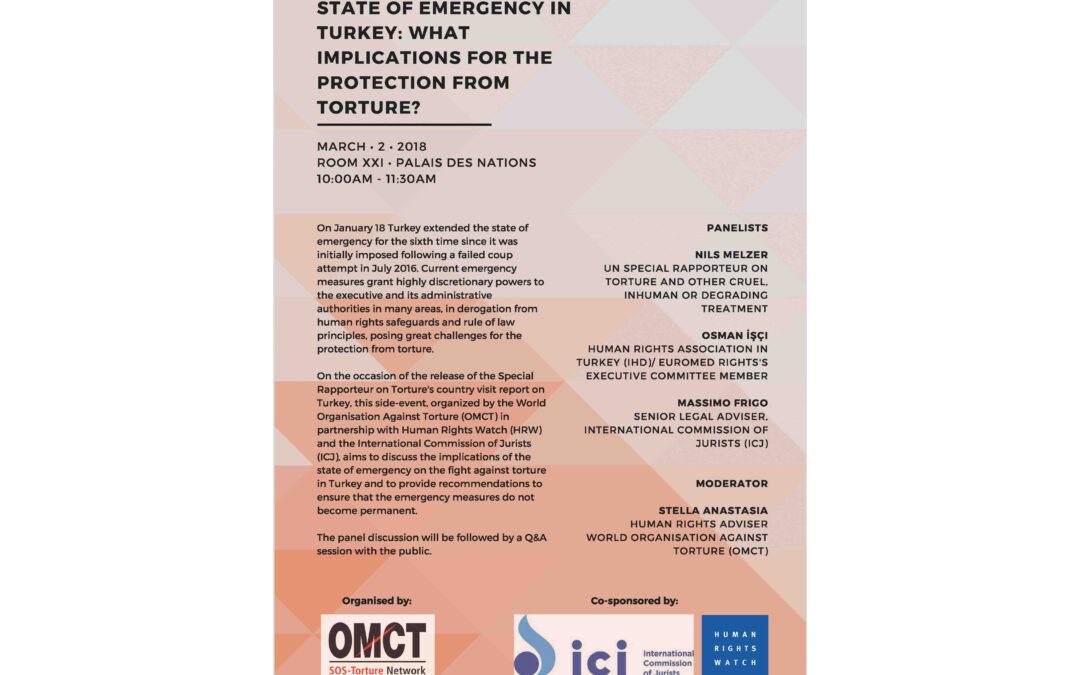
This side event at the Human Rights Council takes place on Friday, 2 March, 10:00-11:30, room XXI of the Palais des Nations. It is organized by the World Organization Against Torture (OMCT) and co-sponsored by the ICJ.
On January 18 Turkey extended the state of emergency for the sixth time since it was initially imposed following a failed coup attempt in July 2016.
Current emergency measures grant highly discretionary powers to the executive and its administrative authorities in many areas, in derogation from human rights safeguards and rule of law principles, posing great challenges for the protection from torture.
On the occasion of the release of the Special Rapporteur on Torture’s country visit report on Turkey, this side-event, organized by the World Organisation Against Torture (OMCT) in partnership with Human Rights Watch (HRW) and the International Commission of Jurists (ICJ), aims to discuss the implications of the state of emergency on the fight against torture in Turkey and to provide recommendations to ensure that the emergency measures do not become permanent.
The panel discussion will be followed by a Q&A session with the public.
Panelists:
UN Special Rapporteur on Torture and Other Cruel, Inhuman, or Degrading Treatment
Human Rights Association in Turkey (IHD)/Euromed Rights’s Executive Committee Member
Senior Legal Adviser, International Commission of Jurists (ICJ)
Moderator:
Stella Anastasia
Human Rights Adviser World Organization Against Torture (OMCT)
Turkey – Protection from Torture – News – Events – 2018 – ENG (flyer in PDF)
Feb 28, 2018 | Uncategorized
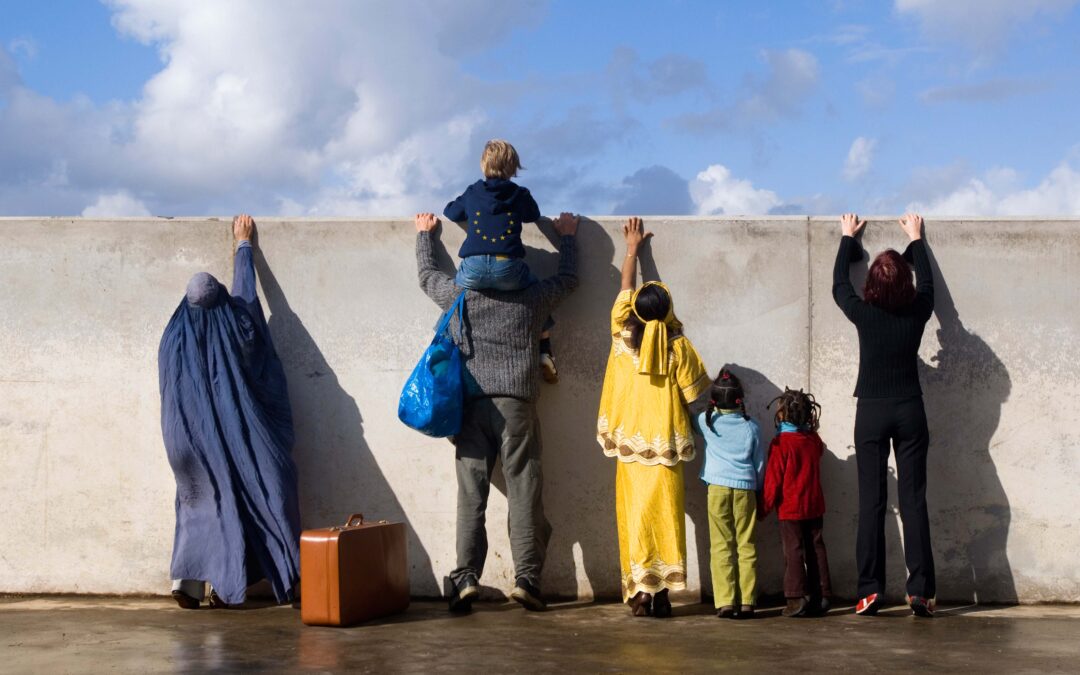
The ICJ together with 22 civil society organisations and UN agencies call on EU decision makers in a joint statement not to use coercion against children in order to obtain fingerprints and other biometric data.
The new EURODAC proposal currently being considered by the European Commission, Council and Parliament expands the purpose of the current database of asylum applicants to facilitate the identification of “irregularly staying third country nationals” through the use of biometric data and it lowers the age at which a child must be registered from 14 to six.
The European institutions are discussing allowing national authorities to use coercion to obtain fingerprints and facial images of children.
The identification and registration of children contributes to their protection within and across borders.
This must be done in a child-sensitive and child protective manner and the best interests of the child must be a primary consideration in such matters, in accordance with Article 3 of the Convention on the Rights of the Child.
Coercion of children in any manner or form in the context of migration related procedures, violates children’s rights, which EU Member States committed to respect and uphold.
All children, no matter their age, should be exempted from all forms of coercion in the EURODAC Regulation, in full compliance with the UN Convention on the Rights of the Child.
The UN Convention on the Rights of the Child (UN CRC) states that every person below the age of eighteen years is a child (art. 1).
States Parties should take all appropriate measures to protect children from all forms of physical or mental violence (art. 19.1) and no child shall be deprived of his or her liberty unlawfully or arbitrarily (art. 37).
The Committee on the Rights of the Child has affirmed that “No violence against children is justifiable; all violence against children is preventable”, where violence includes both physical and mental violence (General comment No. 13).
It has equally clarified: “that the detention of any child because of their or their parent’s migration status constitutes a child rights violation and contravenes the principle of the best interests of the child”.
Both the UN CRC and EU Charter of Fundamental Rights state that child’s best interests must be a primary consideration in all actions relating to children (art. 3 UN CRC, art. 24.2 EU Charter).
Feb 23, 2018 | News
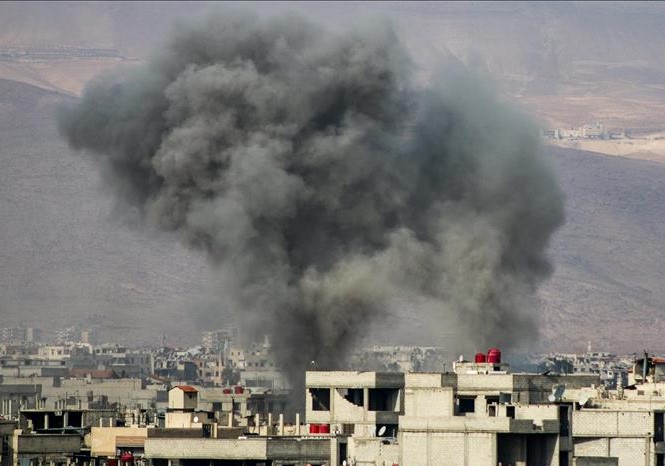
The ICJ today called on the governments of Syria and Russia to cease all attacks on the civilian population in Eastern Ghouta.
Intentionally directing attacks against the civilian population and civilian objects, including hospitals, constitutes a war crime.
All those responsible for such crimes must be held accountable.
“The UN Security Council is blatantly failing to discharge its primary responsibility for maintaining international peace and security. It’s so paralyzed by division that it cannot even enforce its own resolutions on protecting the civilian population in Syria and ensuring unimpeded humanitarian access,” said Said Benarbia, Director of the ICJ Middle East and North Africa Programme.
“After 7 years of shielding the Syrian regime from accountability for its egregious crimes, including the use of chemical weapons, Russia is joining forces with this regime’s cynical enterprise to murder and starve its own people,” he added.
The air and artillery bombing campaign conducted by the Syrian government, with the backing of Russia, have caused hundreds of victims since Sunday.
The destruction of hospitals and the lack of basic supplies and medicines are making the living conditions of the civilian population extremely dire.
Under international humanitarian law, the Syrian government and its ally Russia have obligations to protect the civilian population and to grant rapid and unimpeded passage to humanitarian relief for the residents of Eastern Ghouta.
The UN Security Council imposed a disarmament plan concerning the Syrian chemical arsenal, yet credible reports of government use of chemical weapons against civilians continued to emerge as late as January and February 2018, in particular in Eastern Ghouta and Saraqeb.
In its last report in October 2017, the OPCW-UN Joint Investigative Mechanism established the responsibility of the Syrian government for the use of chemical weapons.
In the same month, Russia vetoed a resolution to renew the Mechanism’s mandate.
“States must act individually and collectively to stop the escalation of horrors we are witnessing in Eastern Ghouta. They must also ensure, including through any means available in their national legal systems, as well as at the regional and international level, that all those responsible for the war crimes, crimes against humanity and other international crimes committed in Syria, irrespective of their nationality, rank or status, are brought to justice,” Benarbia added.
Contact
Said Benarbia, Director of the ICJ Middle East and North Africa Programme, tel: +41 798783546, e-mail: said.benarbia(a)icj.org
Syria – Ghouta Bombing – News – Webstory – 2018 – ARB (Arabic translation in PDF)
Feb 14, 2018 | News
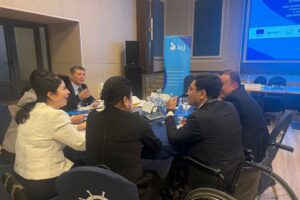
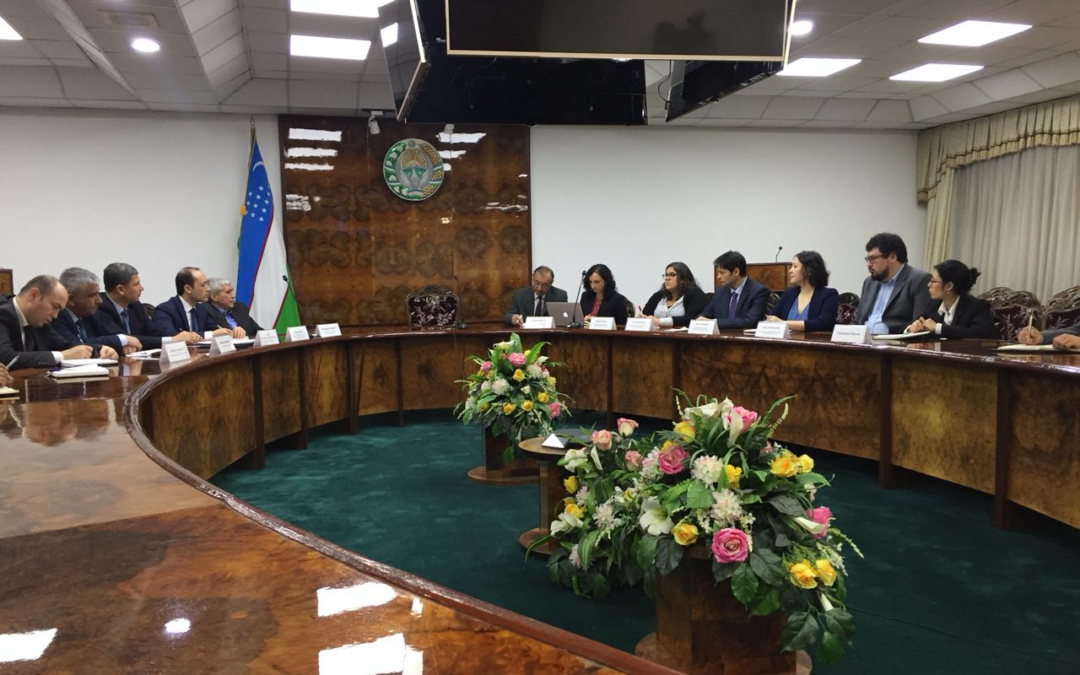
From 12 to 14 February, representatives the ICJ visited Uzbekistan as the first step in a new programme of work on access to justice in the area of economic, social and cultural rights.
During the visit, ICJ representatives met with a number of State institutions relevant to this topic, including the Supreme Court, the High Judicial Council, the Ministry of Justice, the Bar Association of Uzbekistan as well as the Commission of the European Union Technical Assistance Programme National Coordination Unit (NCU).
The ICJ also met with the Delegation of the European Union to Uzbekistan.
The visit allowed the ICJ to provide information and begin plans for its work to advance access to justice for the protection of economic, social and cultural rights in Uzbekistan in the framework of the ACCESS project (“Advancing Civil Society in promoting ESCR Standards”), supported by the Delegation of the European Union to Uzbekistan.
During this visit, the ICJ signed a Memorandum of Understanding with the Research Centre for the Study of Justice under the Supreme Judicial Council of the Republic of Uzbekistan, with which it held an international seminar on Comparative Approaches to Selection, Appointment and Evaluation of Judges in September 2017.
The memorandum will serve as a platform for furthering ICJ’s work with the judiciary in Uzbekistan within the ACCESS project and other initiatives.
The ICJ is grateful to all those who met with the ICJ representatives in Tashkent.