Sep 14, 2017 | Advocacy, Cases, Legal submissions, News
On 13 September, the European Committee of Social Rights decided on the admissibility of the collective complaint submitted by the ICJ and Forum for Human Rights, against the Czech Republic.
The Committee assessed the admissibility conditions set out in the Protocol and the Committee’s Rules and the Government’s objections on admissibility and declared the complaint admissible. The Czech Government has now two months to make written submissions on the merits of the complaint.
The complaint argues that the Czech Republic fails to ensure equal legal protection and participation of children below the age of criminal responsibility in the pre-trial stage of juvenile justice procedures.
The ICJ and FORUM submit that serious systemic flaws in the Czech juvenile justice system deprive a specific group of particularly vulnerable individuals – children below the age of criminal responsibility – of an adequate level of social protection and leave them at risk of inappropriate or unfair procedures leading to arbitrary punitive measures, in violation of Article 17 of the European Social Charter, both alone and read in conjunction with the principle of equality in the preamble to the Charter.
Europe-ECSR-ICJvCzechRepublic-ChildrenJustice-AdmissibilityDecision-2017 (download the Committee’s decision)
Sep 14, 2017 | Events
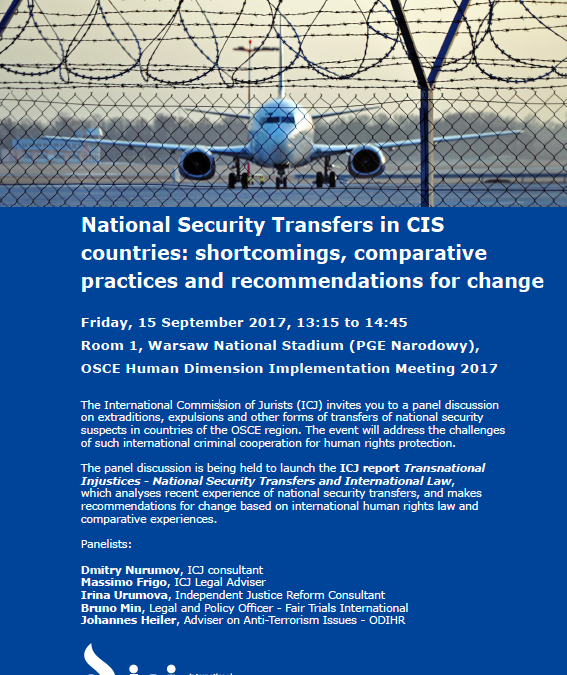
At a side event to the OSCE Human Dimension Implementation Meeting 2017, the ICJ will review the latest developments on extraditions, expulsions and other forms of transfers of national security suspects in countries of the OSCE region.
The event will address the challenges of such international criminal cooperation for human rights protection.
The panel discussion is being held to launch a new ICJ report which analyses recent experience of national security transfers, and makes recommendations for change based on international human rights law and comparative experiences.
The event will take place in Warsaw Friday 15 September at 13:15 – 14:45 at Room no. 1 at the OSCE HDIM 2017.
Panelists:
- Dmitry Nurumov, ICJ consultant
- Massimo Frigo, ICJ Legal Adviser
- Irina Urumova, Independent Justice Reform Consultant
- Bruno Min, Legal and Policy Officer – Fair Trials International
- Johannes Heiler, Adviser on Anti-Terrorism Issues – ODIHR
Working language: English and Russian (simultaneous translation provided)
A flyer for this event is available in PDF format by clicking here.
For more information, contact massimo.frigo(a)icj.org and/or dina.iskaliyeva(a)icj.org
Jul 28, 2017 | Multimedia items, News, Video clips
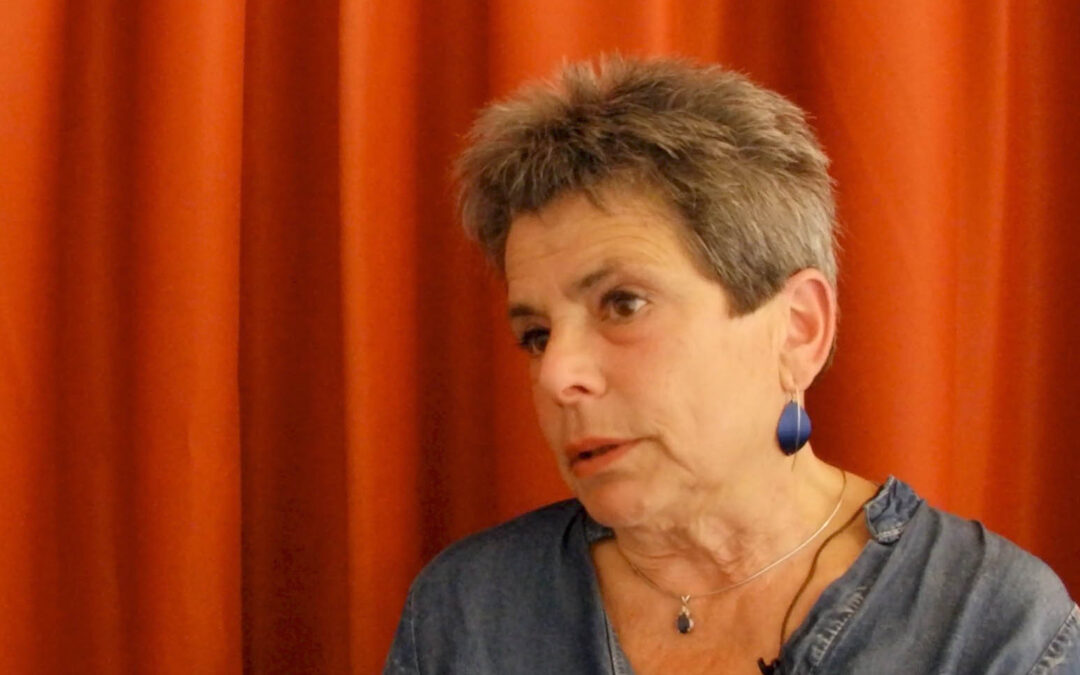
The ICJ continues its series of profiles of its women Commissioners with an interview with Prof. Jenny E. Goldschmidt, who is currently serving her third term as an ICJ Commissioner.
She was first elected to the Commission in 2003 and re-elected in 2008 and 2013.
She is a Member of the Advisory Board of Nederlands Juristen Comité voor de Mensenrechten (NJCM), and NJCM Public Interest Litigation Group. The NJCM is the ICJ’s National Section in the Netherlands.
In this wide-ranging interview, Jenny describes how she started out her career as a lawyer by studying Constitutional law; how her interests began to focus on the haves and the have nots and from there her interest in human rights developed.
She explains how she has always combined academic research and teaching with practical work, particularly during her years as the President of the Equal Treatment Commission in the Netherlands. She also stresses the importance of working in an inter-disciplinarian manner.
For example, she explained that after academics had developed concepts of direct discrimination, indirect discrimination, and systemic discrimination, these concepts were taken on board by lawyers and have been incorporated into case law.
She gave the example of how the European Court of Human Rights and the European Court of Justice are now incorporating this type of stereotyping into their equality concept.
She emphasized human rights law must protect women and that this protection must be embodied in law.
She considered that it is vital to take cases to the Treaty Bodies and courts everywhere to establish severe measures against discrimination and domestic violence.
But human rights lawyers also need sociologists to help find the arguments that convince people and how we can influence their behavior.
“Sometimes soft law and mediation can be effective and you need other disciplines to show in which cases which instruments are most effective,” she said.
She explained that because women are not a homogenous group and because of migration and all the divisions in society, inter-sectionality has become one of the crucial challenges for women’s rights.
She believes in combining a focus on the general problems which all women face as well as taking into account that some women are even less equal than others – that women who belong to minorities, that women who are disabled, that girls are more vulnerable than the majority of women.
“I think one of the things that the disability convention tries to do by giving a specific provision for women and girls rights is that it forces the authorities, the Treaty Bodies, the national and international institutions to be aware of the fact that we are talking about women and disabled people and that we have to take two perspectives at the same time into account,” she added.
When asked what advice she would give a woman who wants to pursue a career in human rights she said: “Don’t give up! And don’t think it will be easy. Human rights world still is a man’s world.”
Jenny Goldsmith is currently Emeritus Professor of Human Rights Law, and was from 2007-2014 Director of the Netherland Institute of Human Rights at the University of Utrecht.
From 1994-2003 she was President of the Equal Treatment Commission of the Netherlands.
She is on the board of Disability Studies in the Netherlands and involved in several NGOs of disability rights, democracy, and human rights.
Watch the interview:
The series of profiles introducing the work of ICJ Commissioners and Honorary Members on women’s rights was launched on 25 November 2016 to coincide with the International Day to Eliminate Violence against Women and the first day of the 16 Days of Activism Against Gender-Based Violence Campaign.
Jul 25, 2017 | News
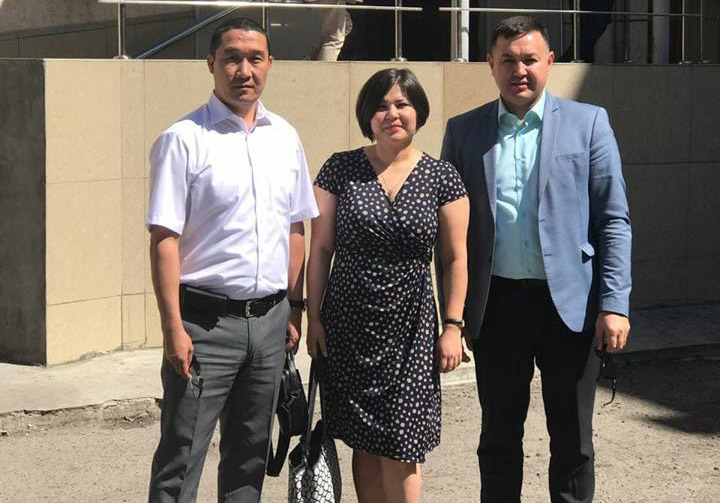
Today the ICJ expressed concern about the real threat of criminal prosecution against lawyers Yerlan Gazimzhanov, Amanzhol Mukhamedyarov and Assel Tokayeva (photo) in Kazakhstan.
The ICJ said the action against lawyers was aimed at their discharging of their professional functions on behalf of clients, and not for any genuine criminal misconduct.
The ICJ called on the responsible authorities of Kazakhstan to discontinue the proceedings against the lawyers, which are contrary to international law and standards on the role of lawyers and the rule of law in the administration of justice.
On 22 June, in a court hearing in the criminal case, judge Ubasheva issued interim rulings against the lawyers seeking their prosecution for a number of acts, which on their face do not consist of criminal misconduct. The conduct for which prosecution is sought includes lodging a complaint alleging unethical conduct by the judge with the Commission on Judicial Ethics and Judicial Jury of the Supreme Court of the Republic; filing a motion for recusal of the judge; stating that the crime for which their clients had been accused had in fact been committed by another defendant; and participating in an international conference, rather than attending a court hearing to defend clients.
The various legal procedures used by the lawyers, including their complaint against the judge and the request for the judge’s recusal, are not prohibited by law. On the contrary, acts such as filing motions for recusal, lodging ethics complaints through officially prescribed channels, and performing standard criminal defence functions they constitute regular procedures prescribed in legislation Kazakhstan. They are also fundamental pursuant to the proper administration of justice under the rule of law.
The interim rulings of the court did not provide an analysis of the legal provisions allegedly violated by the lawyers. Certain of the lawyers were said by the court to have “demonstrated superiority over other actors in criminal proceedings.” It was also alleged that the information posted on a Facebook page about the proceedings in which one of the lawyers took part was false. However, the ruling failed to cite any specific details or conduct of the lawyers which would support these conclusions.
Regarding the charge that two of the lawyers had chosen to participate in an international conference rather than appear at the court hearing, this at most would fall under disciplinary procedures governing the conduct of members of the bar, and not the criminal law. The ICJ notes these charges should normally be made to competent disciplinary body, the Collegium of Lawyers, and not the Ministry of Justice through the request of the judge.
In addition to the criminal prosecution, judge Ubasheva asked the Ministry of Justice to take measures against the lawyers for a breach of professional ethics, causing unjustified delays in criminal trial, and contempt of court, and asked the Ministry of Interior to undertake an inquiry to determine whether the conduct of the lawyers constituted an offence punishable under Article 407 of the Criminal Code of Kazakhstan (obstruction of justice).
On 20-21 July 2017, the Criminal Chamber of Appeals examined the lawyers’ appeals against the conviction and interim appeals against the interim rulings.
The appeal proceedings before the Astana City Court were attended by Gulnora Ishankhanova, ICJ Commissioner acting as an ICJ observer.
Kazhakstan-Trial observation 3 lawyers-News-web story-2017-RUS (story in Russian, PDF)

Jul 24, 2017 | Advocacy, Legal submissions
The AIRE Centre, ICJ, ILGA-EUROPE and ECRE have submitted a third party intervention in case O.S. v. Switzerland (no. 43987/16).
This intervention addresses the following points:
i) enforced concealment of one’s same-sex sexual orientation constitutes persecution under refugee law and is incompatible with the Convention, in particular, Article 3
ii) the criminalisation of consensual same-sex sexual conduct gives rise to a real risk of Article 3 prohibited treatment, thus triggering non-refoulement obligations under the Convention
iii) the risk of persecution based on sexual orientation in Gambia.
Universal-SexualOrientationRefugee-Advocacy-LegalSubmissions-2017-ENG (full legal submission)