Sep 13, 2017 | Advocacy, News
As proceedings resume in India v. Pakistan (Jadhav case) before the International Court of Justice (ICJ), the ICJ has published a briefing paper to clarify the key issues and relevant laws raised in the case in a Question and Answer format.
The case concerns Pakistan’s failure to allow for consular access to an Indian national detained on charges of serious crimes.
India has alleged “egregious violations of the Vienna Convention on Consular Relations (VCCR)” by Pakistan in connection with the detention, trial and conviction of Indian national Kulbhushan Sudhir Jadhav.
Pakistani authorities arrested Jadhav on 3 March 2016.
India was informed of the arrest on 25 March 2016. On 10 April 2017, Pakistan’s military announced Jadhav had been convicted and sentenced to death by a military court for “espionage and sabotage activities against Pakistan.”
India’s requests for consular access, made at least sixteen times starting from 25 March 2016, were either denied by Pakistan or made conditional upon India’s assistance in the investigation against Jadhav.
India alleges that denial of consular access breaches Pakistan’s obligations under Article 36(1) of the VCCR, to which both States are parties.
In May 2017, the ICJ accepted India’s request for provisional measures and directed Pakistan to “take all measures at its disposal” to ensure Jadhav is not executed pending the final decision of the Court.
India is due to file its written memorial with supporting documents today, 13 September.
Pakistan will have three months to file a counter-memorial.
The ICJ will then decide on dates for oral hearing of arguments.
Following the hearings, the Court will deliberate and issue a judgment.
While the case at issue is limited to denial of consular access under the VCCR, it engages other critical fair trial concerns that arise in military trials in Pakistan.
The International Commission of Jurists has documented how Pakistani military courts are not independent and the proceedings before them fall far short of national and international fair trial standards.
Judges of military courts are part of the executive branch of the State and continue to be subjected to military command; the right to appeal to civilian courts is not available; the right to a public hearing is not guaranteed; and a duly reasoned, written judgment, including the essential findings, evidence and legal reasoning, is denied.
The case also underscores one of inherent problems of the death penalty: that fair trial violations that lead to the execution of a person are inherently irreparable.
The International Commission of Jurists considers the death penalty a violation of the right to life and cruel, inhuman or degrading punishment and notes that a large majority of States, in repeated UN resolutions, have called on retentionist states to declare a moratorium on the practice with a view to abolition.
Contact:
Frederick Rawski (Bangkok), ICJ Asia Pacific Regional Director, e: frederick.rawski@icj.org
Reema Omer (London), ICJ International Legal Adviser, South Asia t: +447889565691; e: reema.omer(a)icj.org
Download the Q&A:
India-ICJ Q&A Jadhav case-Advocacy-2017-ENG (in PDF)

Aug 24, 2017 | News
Today, the Indian Supreme Court delivered a landmark judgment declaring the right to privacy an intrinsic part of the right to life and liberty under Article 21 of India’s Constitution.
The ICJ welcomed a momentous and courageous judgment, where the Supreme Court took an expansive view of the right to privacy, and held that, at its core, privacy includes “the preservation of personal intimacies, the sanctity of family life, marriage, procreation, the home and sexual orientation…”
As such, this judgment is an important step towards scrapping laws criminalizing same-sex activity in the country, the ICJ said.
“The judgment is a testament to the inspiring work of human rights activists and lawyers in India, who have shown the potential of the law to affirm human rights and equality,” said Frederick Rawski, ICJ’s Asia Director.
“The ruling could have far-reaching implications for a number of cases -including with respect to the criminalization of consensual same-sex relations – where laws, policy and practices have been challenged on the basis that they violate the right to privacy,” he added.
The judgment clarified that the right to privacy is not spatially bound and exists beyond four walls as it “attaches to the person” and is not “lost or surrendered merely because the individual is in a public place.”
Significantly, in explaining the ambit of the right to privacy, the Supreme Court held that sexual orientation is “an essential component of identity” and “equal protection demands protection of the identity of every individual without discrimination.”
The Court also highlighted that laws criminalizing same-sex activity have a “chilling effect on the exercise of the right”, posing “a grave danger to the unhindered fulfillment of one’s sexual orientation, as an element of privacy and dignity.”
Section 377 of the Indian Penal Code criminalizes voluntary “carnal intercourse against the order of nature with any man, woman or animal” and prescribes a range of penalties including life imprisonment.
In Naz Foundation v. Govt. of NCT of Delhi, the Delhi High Court in 2009 read down the application of section 377, holding, among other things, that insofar as it criminalizes consensual sexual acts, it violates Articles 21 (right to life and liberty), 14 (equal protection of the law) and 15 of the Constitution (freedom from discrimination) of the Indian Constitution.
However, in Suresh Kumar Koushal in December 2013, the Supreme Court reversed the 2009 Delhi High Court ruling, effectively recriminalizing homosexuality.
The petitioners challenged the ruling in Koushal, and in February 2016, the Indian Supreme Court referred a “curative petition” to a five-judge bench of the Supreme Court for consideration.
In today’s judgment, the Supreme Court questioned the rationale in Koushal, and expressed disagreement with the manner in which Koushal dealt with the “privacy–dignity based claims of LGBT persons.”
It also found the reasoning in Koushal flawed and unsustainable for being discriminatory towards LGBT persons by calling them “a miniscule fraction of the country’s population” and making that the basis for denying their right to privacy.
However, the Court held that since a challenge to section 377 is pending before a larger bench, its constitutional validity would be decided in the appropriate proceedings.
“The Supreme Court’s judgment is indeed historic, but the real test of its impact will be whether the right to privacy it affirms is given effect in its true spirit in individual cases, so as to ensure that laws, policies and practices meet India’s obligations under the Constitution as well as international standards,” added Rawski.
Contact:
Frederick Rawski (Bangkok), ICJ Asia Pacific Regional Director, e: frederick.rawski(a)icj.org
Ajita Banerjie, ICJ Consultant in Delhi, t: +918447784157; e: ajita.banerjie(a)icj.org
India-Privacy & section 377-News-web stories-2017-ENG (full story in PDF)
Jul 30, 2017 | News
Indian authorities must ensure full compliance with the Supreme Court’s historic judgment directing independent investigations into alleged extrajudicial killings by the police and security forces in Manipur from 1979 to 2012, the ICJ said today.
The ICJ is calling for independent, impartial and thorough investigations into all cases, in line with international standards.
It is further calling on Indian authorities to ensure all accused are brought to justice in fair trials in ordinary civilian courts, and that the families of victims are accorded access to an effective remedy and reparation for any human rights violations.
“Through this judgment, the Indian Supreme Court has given fresh hopes to the victims of human rights violations in India who seek justice,” said Frederick Rawski, ICJ’s Asia Pacific Programme Director.
“This bold and principled decision should finally end the cynical attempts by Indian security forces and law enforcement agencies to shield themselves from criminal accountability,” he added.
On 14 July 2017, the Supreme Court ordered the Director of the Central Bureau of Investigations (CBI) to constitute a Special Investigation Team (SIT) within two weeks to go through the records of at least 85 cases of alleged extrajudicial killings that took place in Manipur between 1979 and 2012, lodge First Information Reports (FIRs), and complete investigations where required.
The Court also directed that the investigations must be completed by 31 December 2017.
The Court noted that the Manipur Police had not registered any FIR at the instance of the family members of the deceased.
It also held that the Manipur Police could not be expected to carry out impartial investigations as some of its own personnel were said to be involved in the “fake encounters”.
India has a legal obligation under Articles 2(3) and 6 of the International Covenant on Civil and Political Rights (ICCPR), to which it is party, to investigate allegations of violations of the right to life promptly, thoroughly and effectively through independent and impartial bodies and to ensure that those responsible are brought to justice.
On 27 July 2017, the CBI constituted a five-member Special Investigating Team in accordance with the Supreme Court’s directions.
“The CBI’s compliance with the Supreme Court’s directions through the prompt constitution of an investigation team is a welcome step,” added Rawski. “It must now ensure that investigations are thorough, independent, impartial and in line with international standards, including the ICCPR.”
The ICJ urged the State of Manipur and the Union of India to extend full cooperation and assistance to the Special Investigating Team to complete the investigations without any hurdles or delays.
Other allegations of human rights violations in the petition must also be investigated in line with international standards, the ICJ said.
Contact
Frederick Rawski, ICJ’s Asia Pacific Regional Director (Bangkok), e: frederick.rawski(a)icj.org
Background
Extrajudicial Execution Victim Families Association, Manipur (EEVFAM) and Human Rights Alert filed a petition in the Supreme Court of India in 2012, alleging that from 1979 to 2012 over 1,528 cases of fake “encounter killings” had taken place in Manipur.
They further alleged that the State government had not conducted proper investigations into the allegations of excessive use of force by the security forces and the police and requested the Court to constitute a special investigation team, comprising police officers from outside the state of Manipur, to conduct a probe into the alleged unlawful killings.
In July 2016, the Supreme Court emphasized the need for accountability for human rights violations by security forces, including under the Armed Forces Special Powers Act (AFSPA), and directed the petitioners to present detailed documentation in support of their allegations.
In April 2017, the Supreme Court dismissed the Central Government’s curative petition requesting the Court to reconsider its July 2016 judgment on the ground that it hampered the security force’s ability to respond to insurgent and terrorist situations.
The killings mentioned in the petition all took place in areas considered “disturbed” under AFSPA. Once an area is declared “disturbed”, armed forces are given a range of “special powers”, which include the power to arrest without warrant, to enter and search any premises, and in certain circumstances, use lethal force.
AFSPA has facilitated gross human rights violations by the armed forces in the areas in which it is operational.
Human rights organizations, including the ICJ, and several UN human rights bodies have recommended that the AFSPA be repealed or significantly amended.
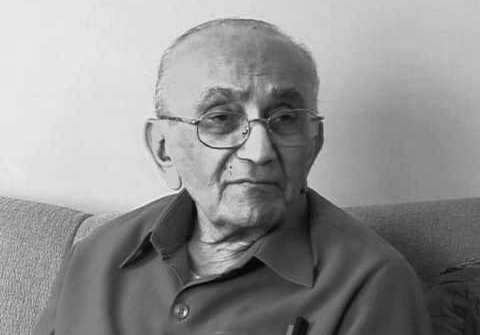
Jun 16, 2017 | News
Justice Prafullachandra Natwarlal Bhagwati, former ICJ Commissioner and Honorary Member and Chief Justice of the Supreme Court of India, passed away at the age of 95, on 15 June 2017, following a brief illness.
“The International Commission of Jurists benefited greatly from Justice Bhagwati’s engagement and leadership. He was a giant of the human rights movement, dedicated to enlarging and ensuring access to justice for everyone, including those who couldn’t seek and receive justice due to their economic or social status,” said Sam Zarifi, ICJ’s Secretary-General.
“His dedication and ground-breaking approach to human rights accountability inspired many within and outside of the ICJ, and the values he represented will continue to inspire and inform our work,” he added.
Justice Bhagwati had a long history of promoting and protecting human rights, both at home and on the international stage, particularly for the most marginalized and vulnerable individuals and groups.
Former Chief Justice of India, Justice P.N. Bhagwati held a long and illustrious career within the Indian judiciary.
He introduced many innovative reforms within the Indian judicial system that increased access to justice for the poorest and most disadvantaged, including as a pioneer of public interest litigation and absolute liability.
Outside of India, Justice P.N. Bhagwati played a prominent role in the international human rights movement, for example as a member of the Committee of Experts of the International Labour Organization and Chair of the United Nations Human Rights Committee.
He was also actively involved in a number of non-governmental organizations, including the ICJ, where he committed to a high number of missions, seminars, publications and other activities on behalf of the organization.
He also served as a long-standing Chair of the Advisory Board for the ICJ’s Centre for the Independence of Judges and Lawyers.
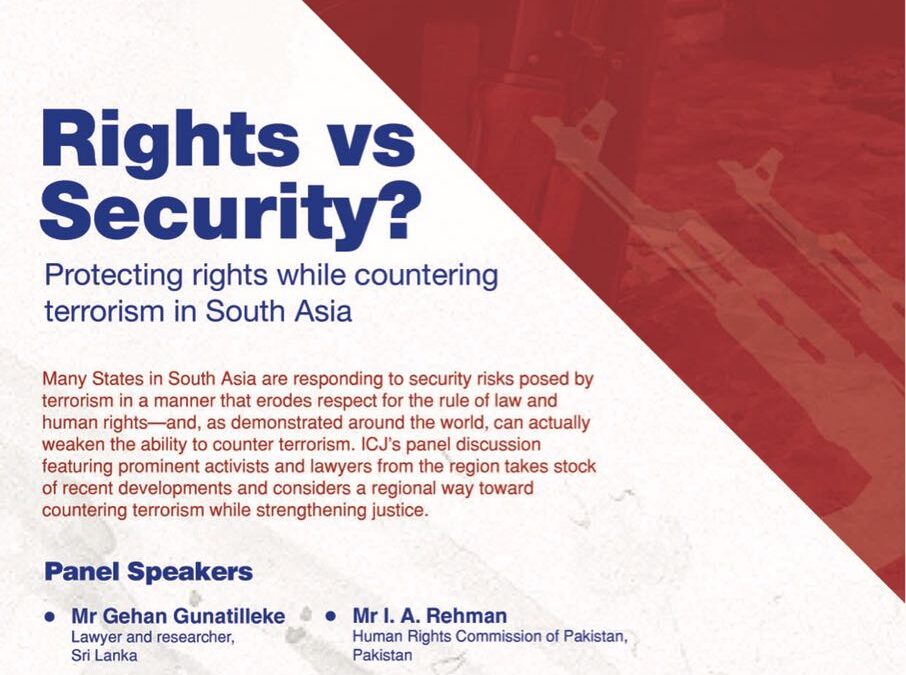
Mar 13, 2017 | Events, News
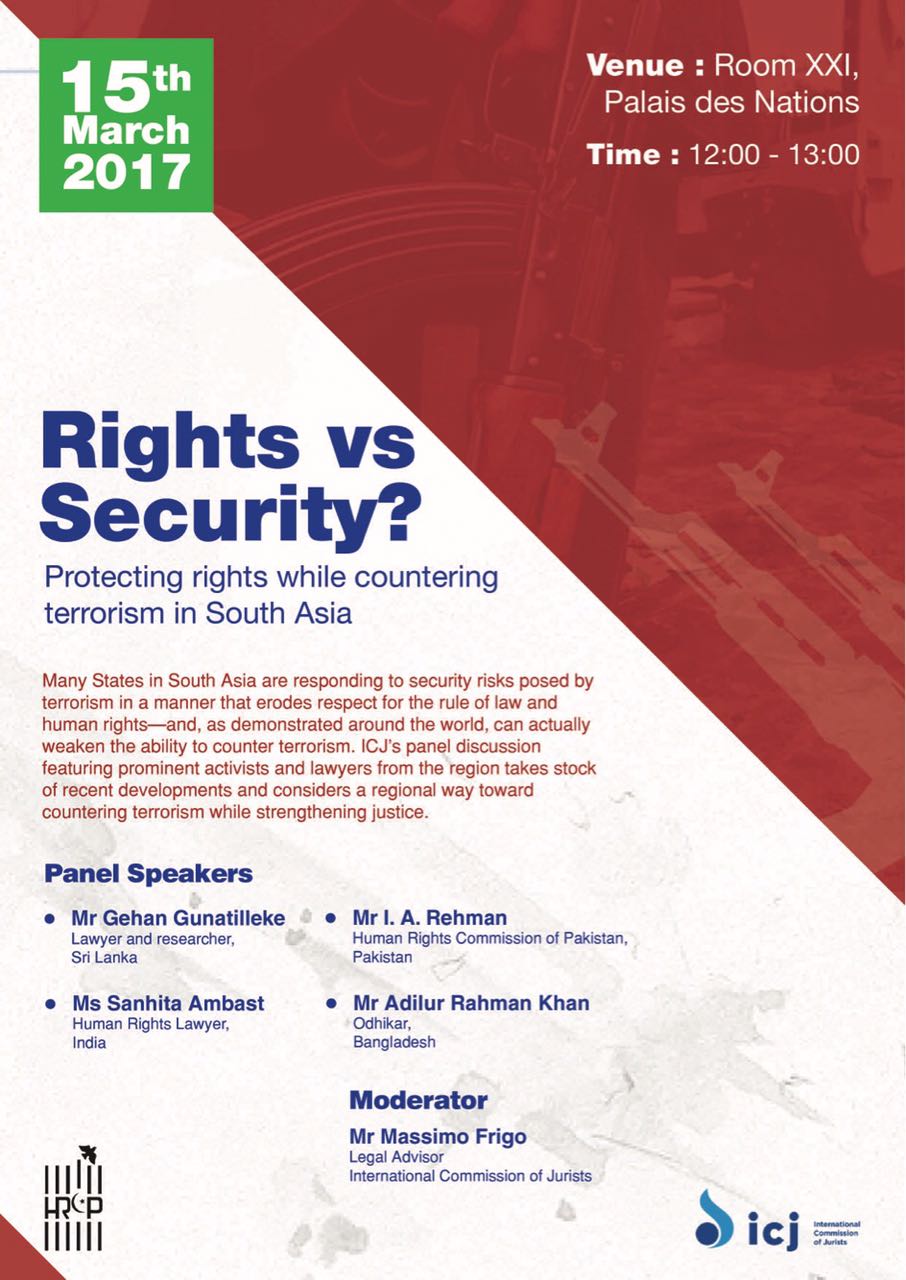
The ICJ and the Human Rights Commission of Pakistan are convening a side event at the UN Human Rights Council, entitled “Rights vs Security? Protecting human rights while countering terrorism in South Asia”.
The event takes place 15 March 2017, 12:00-13:00, Palais des Nations, Room XXI
Many States in South Asia are responding to security risks posed by terrorism in a manner that erodes respect for the rule of law and human rights—and, as demonstrated around the world, can actually weaken the ability to counter terrorism. ICJ’s panel discussion featuring prominent activists and lawyers from the region takes stock of recent developments and considers a regional way toward countering terrorism while strengthening justice.
Panelists:
Mr I. A. Rehman: Human Rights Commission of Pakistan (Pakistan)
Mr Adilur Rahman Khan: Odhikar (Bangladesh)
Mr Gehan Gunatilleke: Lawyer and researcher (Sri Lanka)
Ms Sanhita Ambast: Human rights lawyer (India)
Moderator:
Mr Massimo Frigo: International Commission of Jurists
A flyer may be downloaded here.