Feb 24, 2017 | News, Publications, Reports, Thematic reports
The Indian authorities must end discrimination against people based on sexual orientation and gender identity in the formal justice system, the ICJ said in a report released today.
The 60-paged report “Unnatural Offences”: Obstacles to Justice in India Based on Sexual Orientation and Gender Identity documents the challenges queer persons in India face while trying to access justice, starting from the impact of laws that criminalize people for their real or imputed sexual orientation and gender identity; to police harassment, violence and abuse; and to discrimination and other hurdles within the justice system.
Based on 150 interviews across nine cities in India, including with people who identified as lesbian, gay, bisexual, and transgender, the report uses the term “queer” to refer to any individual who identifies with a non-normative sexuality or gender identity.
It includes individuals who identify as lesbian, gay, bisexual, transgender, intersex and gender-queer, and also encompasses persons who may not fit into any of these identity categories.
“Criminalization, police violence, and the prejudiced attitudes of officials in the courts’ system have a profoundly detrimental impact on the ability and willingness of queer persons to resort to legal avenues to obtain justice,” said Sam Zarifi, ICJ’s Asia Director.
“The systemic discrimination and violence faced by queer persons in India, and the challenges they face accessing justice, are clearly contrary to India’s international human rights law obligations and the Indian Constitution,” he added.
The report also draws on responses from various government departments to ICJ’s requests under the Right to Information Act, both on the enforcement of the law against queer individuals and on gauging how legal entitlements have operated.
It describes how:
- Laws like Section 377 of the IPC and some other broad and vaguely formulated laws, such as those that criminalize sex work and begging, are used by the police to persecute people based on their real or imputed sexual orientation and gender identity, and inhibit queer persons from accessing justice.
- Even where the law purportedly provides legal entitlements and protections, queer persons continue to face a range of difficulties in accessing them.
- Police violence, abuse and harassment are one of the biggest barriers to queer persons’ access to the justice system in India.
- The challenges that lawyers who argue cases involving the human rights of queer persons combine with the biases of officials in the formal justice system compounding the difficulties queer persons face in obtaining justice.
“The inspiring work of activists and human rights lawyers in India has led to positive judicial decisions showing the potential of the law to affirm human rights and ensure justice for all persons, irrespective of their sexual orientation or gender identity,” Zarifi said.
“Indian authorities should build on this momentum and take immediate steps to end the discrimination and violence queer persons face,” he added.
The ICJ report makes a number of recommendations to Indian authorities, which include:
- Ensure that police officers promptly register and investigate any complaint regarding violence or any other criminal act filed by a queer person and/or on their behalf;
- Provide legal and sensitization training relating to sexual orientation and gender identity to lawyers and judges under the State and District Legal Services Authority along with outreach programmes to facilitate queer individuals’ access to the justice system;
- Repeal section 377 of the Indian Penal Code and vaguely worded criminal laws that invite discriminatory application, or substantially revise them to ensure there is no scope for abuse in their enforcement;
- Withdraw the Transgender Persons (Protection of Rights) Bill 2016 as currently drafted, engage in meaningful and substantial public consultation with members of the transgender community; and ensure that any process introduced for the legal recognition of gender identity is consistent with international human rights law and the NALSA.
Contact
Sam Zarifi (Bangkok), ICJ Asia Pacific Regional Director, t: +66 807819002; e: sam.zarifi(a)icj.org
Ajita Banerjie, ICJ Consultant in Delhi, t: +91 9920995526 ; e: ajita.banerjie@icj.org
Additional information
The Indian authorities have an obligation to respect, protect and fulfill the rights to equality before the law, equal protection of the law and freedom from discrimination; the rights to privacy, liberty and security of the person, including the right not to be subjected to arbitrary arrest and detention; the right to life, to freedom from torture and other ill-treatment; and the right to access justice and to an effective remedy, for all persons, including queer people, without discrimination as to their real or imputed sexual orientation and gender identity.
As the Supreme Court of India has reaffirmed, the Indian Constitution also guarantees several of these rights.
For example, in the seminal case of NALSA v UOI, the Court affirmed transgender persons’ right to their self-identified gender identity, based on the rights to equality, non-discrimination, freedom of expression and dignity.
India-SOGI report-Publications-Reports-Thematic report-2017-ENG (full report in PDF)
Oct 15, 2016 | News
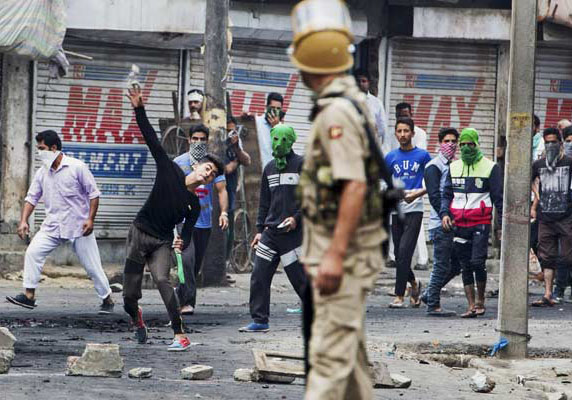
Authorities in Jammu and Kashmir should end the use of the Jammu and Kashmir Public Safety Act (PSA) to arbitrarily detain people, including children, the ICJ, Amnesty International India and Human Rights Watch said today.
The PSA violates international due process standards and should be repealed, the groups said.
“The use of the PSA to detain people, particularly children, violates a range of human rights, and its increasing use in recent weeks undermines the rule of law and further entrenches impunity in Kashmir,” said Sam Zarifi, ICJ Asia Director.
“Police should end the use of the PSA; if people are suspected of committing offences, they should be properly charged and given fair trials,” he added.
The PSA is an administrative detention law that allows detention without charge or trial for up to two years in some cases.
Following an amendment in 2012, the PSA expressly prohibits the detention of anyone under 18.
Between 9 July – when protests and violent clashes broke out in the state following the killing of a leader of the armed group Hizbul Mujahideen – and 6 October, authorities have detained over 400 people, including children, under the PSA, according to media reports.
“The government has a responsibility to address violence during protests, but indefinitely detaining people without charge only adds to the lawlessness,” said Meenakshi Ganguly, South Asia Director, Human Rights Watch. “Detaining children under the PSA is not only unlawful, but could have negative repercussions for years.”
On 16 September, Rayees Ahmad Mir, who is 16 years old according to his school records, was arrested in Baramulla district under ordinary criminal procedure for allegedly throwing stones at security forces.
Two days later, an executive official passed an order to detain him under the PSA, to preclude his release on bail.
The order incorrectly stated that he was 18 years old. Rayees Mir’s family challenged the order before the Jammu and Kashmir High Court, producing documents that proved he was only 16.
On 7 October, the court stated that Rayees Mir should be treated according to juvenile justice rules, as there was prima face evidence that he was a minor, and ordered his transfer to a juvenile home. The PSA detention order has not yet been quashed.
An official at the Kot Bhalwal jail said on 14 October that the prison authorities had not yet transferred Rayees Mir, as they had not received a copy of the court order.
Mir Shafqat Hussain, a lawyer representing many PSA detainees, said: “In a number of cases the families have not been informed about the grounds of detention. Arresting minors and booking them under PSA is definitely going to have an effect on their psyche. From schools and colleges, these boys end up in jails where they will be kept together with adults. It is definitely going to have an adverse effect on them.”
On 18 August, Waheed Ahmed Gojree, who is 16 according to his school records, was arrested in Kupwara district and detained at a police station.
According to his family, the police at first told them he would be released the next day, but then said that he had been detained under the PSA.
He was first taken to a jail in Baramulla, and then to the central jail in Jammu.
An official at the central jail confirmed that he had been detained under the PSA.
The family has not yet received a copy of the detention order, or been formally informed about the grounds of Waheed Gojree’s detention.
The authorities appear to have not taken his age into account before issuing his detention order.
“The central and state governments have spoken about following the principle of insaniyat, or humanity, in dealing with the crisis in Jammu and Kashmir,” said Aakar Patel, Executive Director at Amnesty International India. “But detaining children under the PSA is neither humane nor lawful.”
Amnesty International India, Human Rights Watch and the ICJ believe that anyone detained under the PSA must either be charged promptly with a recognizable criminal offence or prosecuted in a fair trial, or else be released.
Not prosecuting people suspected of committing offences can also violate the human rights of the victims of these offences.
Contact
Sam Zarifi, ICJ Asia & Pacific Regional Director (Bangkok), t: +66 807819002; email: sam.zarifi(a)icj.org
india-joint-statement-psa-news-press-release-2016-eng (full text of statement, in PDF)
Sep 16, 2016 | News
Indian authorities have detained a Kashmiri human rights activist after stopping him from traveling to the United Nations Human Rights Council in Geneva, Human Rights Watch and the ICJ said today.
Khurram Parvez was arrested in his home on 15 September 2016, a day after being prevented from leaving the country with a group of rights activists who were traveling to Geneva to raise concerns about the security force crackdown in Jammu and Kashmir.
Human Rights Watch and the ICJ call on authorities to immediately release Parvez and allow him to attend the Human Rights Council session.
“Indian authorities seem to have missed the irony of blocking a rights activist on his way to the UN Human Rights Council,” said Sam Zarifi, Asia Director at the International Commission of Jurists.
“Monitoring and engage
ment by civil society is necessary to prevent human rights violations and ensure accountability. The Government should immediately release Khurram Parvez and begin working with him and other activists to address the difficult issues facing Jammu and Kashmir,” he added.
Parvez, 39 years of age, is chair of the Asian Federation Against Involuntary Disappearances (AFAD) and program coordinator of the Jammu Kashmir Coalition of Civil Society (JKCCS).
He has documented cases of enforced disappearances and investigated unmarked graves in Kashmir.
According to his lawyer, Parvez has been detained by Kashmir police under “preventive detention” provisions of the Code of Criminal Procedure, including section 151 (arrest to prevent the commission of cognizable offense).
The Government’s actions against Parvez violate his right to freedom of movement.
Under international human rights law, any restrictions on freedom of movement for security reasons must have a clear legal basis, be limited to what is necessary and be proportionate to the threat.
This is further supported by article 5 of the UN Declaration on Human Rights Defenders, which states that “[f]or the purpose of promoting and protecting human rights and fundamental freedoms, everyone has the right, individually or in association with others, at the national and international levels… to communicate with nongovernmental or intergovernmental organizations.”
“Instead of trying to silence human rights activists, India should be addressing the serious human rights problems in Jammu and Kashmir and holding perpetrators of abuses to account,” said Meenakshi Ganguly, South Asia Director at Human Rights Watch.
“Preventing open discussion of these issues, whether in India or in Geneva, sends a message to Kashmiris that the government has no interest in addressing their concerns,” she added.
Background
Violent protests broke out in Jammu and Kashmir state after the killing of Hizb-ul-Mujahedin militant Burhan Wani in an armed encounter on 8 July.
Since then, the authorities have placed large parts of the state under curfew restrictions to try to stop protesters who hurl stones at security forces and attack police posts.
Security forces have used unnecessary lethal force to contain the violence, which has resulted in the death of 80 protesters and 2 police officers, and thousands injured.
Some protesters, including children, lost their vision from pellets fired from riot-control guns.
While police have a duty to protect lives and property, under the UN Basic Principles on the Use of Force and Firearms by Law Enforcement Officials, they should use non-violent means as far as possible, only use force when unavoidable and in a proportionate manner, and use lethal force only when absolutely necessary to save lives, Human Rights Watch and International Commission of Jurists said.
The authorities have also attempted to censor news and restrict access to information.
The Government shut down local newspapers for three days, blocked mobile internet services temporarily, and ordered local cable operators to block the transmission of five news channels on television.
India has failed to address longstanding grievances in Jammu and Kashmir.
Numerous expert committees in India have recommended steps to address past human rights violations, including a repeal of the draconian Armed Forces Special Powers Act, but the Indian Government has ignored these recommendations.
Contact:
Sam Zarifi, ICJ Asia-Pacific Regional Director, (Bangkok); t:+66(0) 807819002; e: sam.zarifi@icj.org
Sep 16, 2016 | Advocacy, Non-legal submissions
On 16 September 2016, the ICJ made a submission to the Universal Periodic Review of India.
The submission brings to the attention of the members of the Human Rights Council’s Working Group on the UPR issues concerning:
- discrimination and violence based on sexual orientation and gender identity;
- death penalty;
- impunity and accountability;
- freedom of speech, expression and association;
- ratification and implementation of international human rights instruments.
india-icj-upr-submission-advocay-non-legal-submission-2016-eng (full text in PDF)
Jul 18, 2016 | News
Indian authorities must immediately, independently and thoroughly investigate all incidents of excessive, particularly lethal, use of force in Kashmir over the past week, the ICJ said today.
Indian security forces have an obligation to comply with Government commitments to avoid using excessive force to quell protests, and must be held to account for any violations.
Violent clashes between protesters and security forces broke out in Kashmir after a popular Kashmiri militant leader, Burhan Wani, was killed, along with his two associates, by security forces on 8 July.
More than 35 people have been killed, including one security officer, and over 2000 injured. In some areas, protestors threw stones and attacked police stations. Security forces used tear gas, pellet guns and firearms.
“Security forces must respect the right to life at all times, and only use force when strictly necessary and in a manner proportionate to the legitimate performance of their duties,” said Sam Zarifi, ICJ Asia Director.
“The number of persons injured over the past week, as well as the nature of their injuries, indicates the urgent need for investigations. If security forces use any kind of weapon, they are governed by international standards that require force to be used as a last resort in self-defence or defence of others against an imminent threat of death or serious bodily injury, and in a manner to minimize injuries,” he added.
Indian security forces began using pellet guns routinely after 2010 following heavy criticism of their misuse of firearms against protesters.
But during the recent protests, the use of pellet guns, considered non-lethal weapons by security forces, has resulted in serious and potentially permanent health consequences for persons affected, including eye injuries and organ damage, which have required urgent treatment.
A recent report has suggested that at least a 100 people have sustained eye injuries. Pellet guns have also injured non-protestors, including children.
“Indian authorities should stop the use of pellet guns until they can assess whether these weapons can be used in a manner that is consistent with human rights standards on the use of force, including whether they are inherently inaccurate, indiscriminate and arbitrary; and ensure that the use of all non-lethal weapons is strictly regulated, because they have the capacity to cause serious and permanent injury,” Zarifi said.
Hospitals in Kashmir are struggling to cope with the high number of patients. There have also been reports that security forces have stopped ambulances carrying injured people, and disrupted the functioning of hospitals.
“All allegations of excessive use of force and other unlawful behaviour by the security forces must be investigated immediately. At the same time, protesters who resort to violence or injure other people must also be properly investigated and brought to justice by proper trials,” he added.
“Security forces absolutely must not interfere with access to health care. In addition to prompt, independent and effective investigations on this, the Government must proactively ensure that all injured persons are able to safely access necessary and quality health care,” he added.
Indian Prime Minister Narendra Modi has called on security forces in Kashmir to exercise “absolute restraint”.
The Chief Minister, Mehbooba Mufti, has committed to ensuring accountability in all cases where excessive force was used by security forces.
It is crucial that the Government follows through on this promise, and conducts thorough, independent and prompt investigations.
In the past, violations by security forces have largely enjoyed impunity in Kashmir for several reasons, including laws like the Armed Forces Special Powers Act that shield security forces from legal accountability for human rights violations.
For example, in 2010, clashes between protestors and security forces in Kashmir resulted in over 100 deaths. Very few, if any, of these have been credibly investigated to date.
Current events also cast doubt over whether the reforms introduced since have improved policing practices and made security forces more accountable.
The ICJ is therefore calling on Indian authorities to:
- Order that security forces desist from using excessive and unlawful force, comply with international human rights law, and only use force when strictly necessary and in a manner proportionate to the legitimate performance of their duty;
- Promptly, independently and effectively investigate all allegations of excessive and lethal uses of force by security forces, make the results of these investigations public, initiate prosecutions where appropriate, and ensure that all victims are provided with effective redress;
- Provide necessary and quality health care to injured persons, ensure they are able to access it, that hospitals are stocked and equipped to deal with the increased patient load, and that all allegations of security forces attacking ambulances and hospitals are immediately investigated.
Contact:
Sam Zarifi, ICJ Regional Director for Asia and the Pacific, t: +66807819002; e: sam.zarifi(a)icj.org
India-Kashmir statement-News-Press release-2016-ENG (full text in PDF)