May 30, 2017 | News, Op-eds
An opinion piece by Sean Bain, ICJ legal consultant in Myanmar, and Vicky Bowman, Director of the Myanmar Centre for Responsible Business.
A strategic environmental assessment is needed to enable sustainable development and the fulfilment of human rights for the people of Kyaukphyu, the site of a planned SEZ and deep-sea port.
In its interim report released in March, the Advisory Commission on Rakhine State chaired by former United Nations secretary-general Kofi Annan, called for a comprehensive assessment of the special economic zone in Kyaukphyu Township.
The aim would be to “explore how the SEZ may affect local communities and map how other economic sectors in the state may benefit (or possibly suffer) from the SEZ”.
The State Counsellor’s Office endorsed the commission’s interim recommendations, including for this assessment.
The call for a comprehensive assessment in Kyaukphyu echoes a proposal from our organisations, the Myanmar Centre for Responsible Business and the International Commission of Jurists, for the government to undertake a strategic environmental assessment.
Its purpose would be to address concerns about human rights and to consider the cumulative environmental and social impacts of planned developments. Oxfam has put forward a similar recommendation to the government.
Our recommendation comes as media reports this month suggest that the government is giving renewed attention to the future of the SEZ and related projects in Kyaukphyu.
The SEZ, which has been planned to include industrial parks along with deep-sea ports and transport links to China, would transform the demographic and economic character of Rakhine State’s central coast and hinterlands.
It would have significant impacts for local communities and the state economy, both during and beyond the envisaged 20-year construction period.
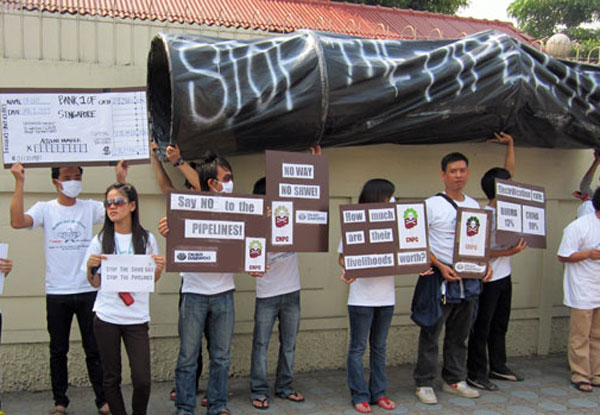
Kyaukphyu – already the starting point for oil and gas pipelines to China – would host the largest development project ever undertaken in Rakhine State.
Financed mostly by Chinese investors, with shipping facilities linking Myanmar to international routes through the Bay of Bengal, the project also has national and regional economic significance.
However, to date there has been insufficient consideration of the impacts, either positive or negative, on the livelihoods and human rights of residents and the economy of Rakhine State.
Plans for the SEZ are ambitious yet detailed information is scarce and so far there has been no genuine public participation in planning processes.
While contracts and payments regarding investments are decided in Myanmar’s economic and political capitals, it is at the local level that negative impacts can be felt the most.
It is also at the local level where economic benefits may be enhanced.
To address negative impacts and enable benefits, a joined-up approach that brings together national and local government and local and foreign companies with the people of the area is needed.
At present, a lack of coordination across ministries, and between national and regional governments is limiting the scope to harness opportunities and manage impacts of investments.
Despite their significance, neither the SEZ and deep-sea ports nor the offshore gas projects serviced from Kyaukphyu are included in Rakhine State’s socioeconomic development plan.
We believe a strategic environmental assessment is needed to enable sustainable development and the fulfilment of human rights in the Kyaukphyu area.
Strategic environmental assessments, which are part of Myanmar law, are defined in the 2015 Environmental Impact Procedure as “a range of analytical and participatory approaches that aim to integrate environment into policies, plans and programs and evaluate the inter-linkages with economic and social considerations.
The principle is to integrate environment, alongside economic and social concerns, into a holistic sustainability assessment.”
Unlike an environmental impact assessment, which is a permitting requirement for individual projects, a strategic environmental assessment takes a holistic approach by integrating environmental and social concerns and human rights protection, to produce a big picture view of the impacts of interrelated projects.
At Kyaukphyu, the national and state governments – drawing on financial and technical assistance from development and human rights partners – could commission expert independent consultants to undertake the necessary studies and analysis to produce such an assessment.
The assessment would consider the cumulative human rights and environmental impacts of the SEZ, seaports, pipelines, offshore gas developments and transport and energy infrastructure, including impacts on traditional fishing and farming livelihoods in Kyaukphyu.
It could address how best to avoid or minimise the physical and economic displacement of residents, and how to reduce the potential for local tensions and conflict associated with expected socioeconomic transformations.
A legal framework – based on international law and standards – for protecting human rights during economic displacement and resettlement needs to be put in place. That’s not just for the SEZs, but for all projects.
While insufficient to address the lack of legal accountability in the SEZ Law and the limited access to justice in Myanmar, a strategic environmental assessment could improve transparency and give voice to the views of local communities, businesses, civil society organisations and other stakeholders.
This would help fill major gaps in planning and decision-making processes thus far.
Consultation is critical to the value and legitimacy of any assessment but too often it is tokenistic or minimised to cut costs and time.
Development partners should ensure that they are funding genuine and extensive public participation.
A lesson from Myanmar’s only other assessment of this kind, currently underway with support from the International Finance Corporation focused on the hydropower sector, has been the need to communicate and engage constantly about the purpose and process of the assessment.
Many civil society groups chose not to participate in consultations for the IFC-backed assessment due to scepticism and lack of confidence in the process.
To learn from this experience, international and local NGOs in Kyaukphyu could share information and support communities to make informed decisions about their engagement with a strategic environmental assessment.
Until there is a concrete and transparent plan to manage impacts from development projects in Kyaukphyu, particularly those with negative impacts on human rights, current preparations for the SEZ should be put on hold.
This includes land acquisition that is underway and risks violating the rights of local residents.
The government should also delay entering into investment agreements with the winning consortium of developers, which is led by China’s CITIC Group, until there has been broader multi-stakeholder debate about the SEZ, and how it may develop and interact with other investments in the area.
A strategic environmental assessment in Kyaukphyu could contribute towards correcting a development process that has so far not contributed meaningfully to the realisation of human rights or addressed the economic needs of the population in Kyaukphyu or Rakhine State.
We hope that the Myanmar government at national and state level as well as development partners will take this forward, building on the advisory commission’s recommendation and its endorsement by the state counsellor.
May 25, 2017 | News, Op-eds
An opinion editorial by Daniel Aguirre, ICJ Legal Adviser in Myanmar.
Burma’s 2016 Investment Law and the implementing Investment Rules issued in April 2017 create space for the government and civil society to facilitate responsible investment and exclude investors that have track records of environmental destruction and human rights abuses.
This means that affected individuals and communities must now test Burma’s commitment to the rule of law.
There are new opportunities for civil society to use law to hold them accountable. In this regard, both international law and Burma’s constitution guarantee access to justice for rights abuses.
The Investment Rules instruct the Myanmar Investment Commission (MIC) to consider whether investors have demonstrated a commitment to responsible investment. In considering the good character and reputation of the investor, the MIC may study whether the investor or any associate with an interest in the investment broke the law in Burma or any other jurisdiction.
The rules explicitly mention environmental, labor, tax, anti-bribery and corruption or human rights law.
What this means is that if an investor is determined to have committed a crime, has violated environmental protection standards or was involved with human rights abuses, the MIC should not grant it a permit.
If such a company applies for an investment permit, civil society should bring its record to the attention of the MIC and advocate for the rejection of a permit.
Successive governments in Burma have focused on increased investment to develop the country and improve its people’s standard of living.
At the same time, human rights and environment proponents from civil society have opposed many investment projects, citing the impact on the environment and human rights of local communities.
They complain that land rights are not adequately protected, that environmental impact assessments are not implemented and that they lack access to justice for corporate human rights abuses.
There are challenges to using the law to protect human rights in Burma.
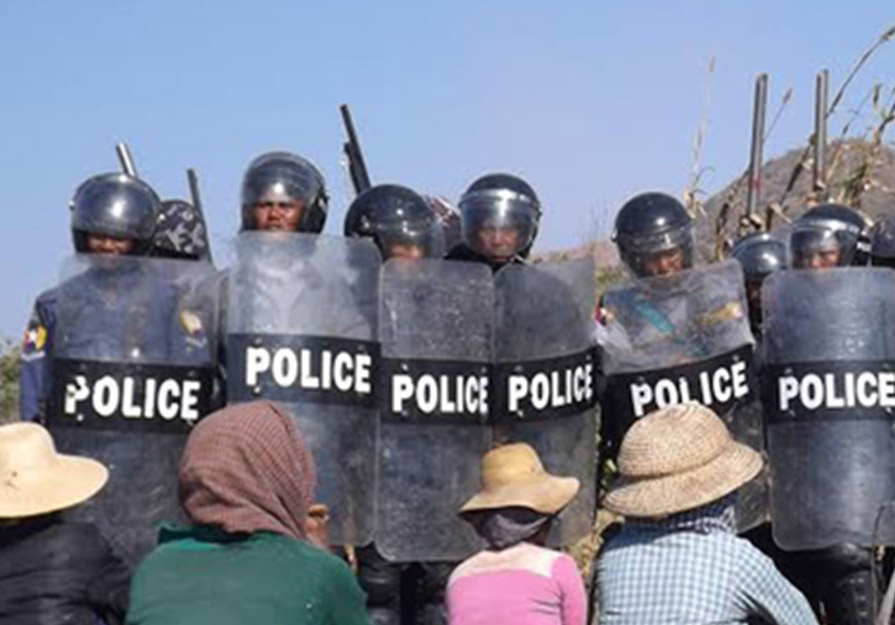
Disputes related to business activity are often considered sensitive political matters in which the courts are unable or unwilling to intervene.
They are reluctant to review crucial decisions of administrative bodies or to hold rights abusers accountable.
But community activists, human rights defenders and lawyers have increased opportunities to pressure the courts to apply the law and should do so.
Lawyers have an important role in protecting human rights by representing local communities.
Courts must become a venue to challenge administrative decisions that allow for irresponsible investment that does not comply with national law, and where appropriate, obtain remedies and reparations for victims of human rights violations.
The Investment Law and its rules, which govern both local and foreign investment except within special economic zones, provide legal guarantees for investors to access information and protections against expropriation including compensation and access to due process if changes in regulation affect their business.
Investors can also access long-term rights to use land.
Civil society should help to ensure that only responsible investors benefit from these protections.
According to the law, the MIC is the gatekeeper that issues permits and endorsements for many would-be national and international investments likely to cause a large impact on the environment and local community.
In order to ensure that the protective aspects of the law are effective, courts must have some power of review, at least to ensure that administrative bodies, such as the MIC, are acting reasonably and in accordance with the law, while respecting and protecting human rights.
If the MIC grants permits for companies that do not meet the requirements outlined in the Investment Rules, their decisions must be subject to review by the judiciary.
Burma’s courts have the authority to review administrative decisions, particularly through the application of constitutional writs.
Lawyers can use the writs of mandamus and certiorari to secure the performance of public duties and quash an illegal order already passed by public bodies such as the MIC.
This would help ensure the MIC uses its mandate to prevent irresponsible investment.
Likewise, investors that fail to respect human rights or unlawfully cause damage to the environment must be held accountable; but there are few options to do so in Burma.
Criminal prosecutions against companies, actions imposing administrative sanctions, and civil suits face a variety of procedural hurdles, particularly if involving joint ventures with state run enterprises.
For example, a negligence civil suit brought by villagers against the Heinda tin mine in Dawei District was unsuccessful because the 1909 Limitations Act demands complaints to be brought within one year of damage.
Section 80 of the Civil Procedure Code requires prior notice and the names of plaintiffs to be given to the government two months before filing a suit against the government and allows small procedural defects to preclude a claim.
Lawyers are sometimes unfamiliar with these procedures and communities are reluctant to put their names to such cases fearing reprisals.
Clearly there are significant challenges to ensuring that investment in Burma does not adversely affect human rights.
To overcome these, civil society and lawyers must engage the administration—the MIC—to ensure only responsible investments is permitted and start to use the judiciary to review its actions.
Likewise, cases must continue to be taken against investors that abuse human rights and harm the environment.
Powerful investors must be constrained by the confines of the law, including human rights law.
Unless civil society and lawyers can use the legal framework to address these concerns, Burma’s judicial system is unlikely to develop; lawyers will not gain valuable experience and the public will remain distrustful.
The process is long and arduous but necessary to protect human rights and the environment from irresponsible investment.
Mar 13, 2017 | Advocacy, Non-legal submissions
The ICJ today delivered a joint NGO oral statement to the UN Human Rights Council on the need in Myanmar for an international Commission of Inquiry and for an independent and self-governing legal profession.
In the statement, the International Commission of Jurists, joined by the International Bar Association’s Human Rights Institute and Lawyers’ Rights Watch Canada, welcomed the report of the Special Rapporteur on the situation for human rights in Myanmar, and her recommendation for a Commission of Inquiry to investigate persecution of Rohingya and other minorities in Rakhine State.
Since 9 October 2016, Myanmar’s security forces have reportedly targeted Rohingya during “clearance operations” which have no basis in law. Attacks against women, men, and children allegedly have involved extrajudicial killings; enforced disappearances; torture and other ill-treatment including rape and other sexual violence; hundreds of arbitrary arrests and detentions; forced displacement; and looting and destruction of homes, food and other property.
To date, authorities in Myanmar appear to have been unwilling or unable to investigate abuses or hold perpetrators accountable. Several national investigation commissions have lacked impartiality and independence. National judicial and law enforcement authorities lack capacity and independence to address this situation. Accordingly, we urge Council to adopt a resolution at this session establishing an international, independent Commission of Inquiry to assess facts, identify causes and perpetrators, and issue recommendations including remedies for victims.
The recent killing of lawyer U Ko Ni, who strongly advocated against religious discrimination and for inter-communal peace, must be subject to a prompt, impartial and effective investigation capable of identifying all those responsible and holding them accountable in a fair trial. It also underscores the urgent need for an independent and self-governing legal profession in Myanmar, enabled to uphold human rights and the rule of law without fear.
The statement may be downloaded in PDF format here: HRC34-OralStatement-Myanmar-2017

Feb 27, 2017 | News, Publications, Reports, Thematic reports
The Government of Myanmar should impose a moratorium on the development of Special Economic Zones (SEZs) until it can ensure SEZs can be developed inline with international human rights laws and standards, said the ICJ at a report launch held today in Yangon.
The 88-page report, entitled Special Economic Zones in Myanmar and the State Duty to Protect Human rights, assesses the laws governing Myanmar’s SEZs and finds that the legal framework is not consistent with the State’s duty to protect human rights.
For example, a case study examining the Kyauk Phyu SEZ in Rakhine State shows that the land acquisition process initiated in early 2016 lacks transparency, does not comply with national laws on land acquisition, and risks violating the rights of 20,000 residents facing displacement.
“The SEZ Law undermines the protection of human rights, and critical legal procedures are often poorly implemented, so the Kyauk Phyu project risks repeating the rights violations that have been associated with SEZs in the past,” said Sam Zarifi, the ICJ’s Asia Director.
“The NLD-led Government can make a break from the past by ensuring economic development projects benefit Myanmar’s people, rather than rushing to facilitate projects which result in human rights violations and ultimately undermine sustainable development,” he added.
Myanmar’s legal framework for SEZs is based on the 2014 SEZ Law and incorporating national laws governing land, labour and the environment.
The report shows that while national laws require Environmental Impact Assessments and the application of international standards on involuntary resettlement, the SEZ Law does not establish clear accountabilities for the implementation of these procedures.
This has contributed to human rights violations and abuses in each of Myanmar’s three SEZs, the report says.
“It has been encouraging that government officials have emphasized their commitment to protecting human rights in SEZs in line with the rule of law,” said Sean Bain, the ICJ’s Legal Consultant in Myanmar and lead author of the report.
“The legal reforms recommended in this report will be critical to meet these commitments while fulfilling the State’s duty to protect human rights in SEZs. We also suggest that investors take heightened due diligence measures to ensure they are not complicit in rights violations,” he added.
The report was based on extensive legal research as well as interviews with over 100 people, from affected communities to investors and government officials, during 2016.
Key recommendations to the Government of Myanmar
- Protect human rights in Myanmar’s SEZs by amending the SEZ Law, through meaningful public consultation in accordance with international standards.
- Order a moratorium on the development of SEZs, and on entering related investment agreements, until the SEZ Law has been amended to ensure conformity with international human rights law and standards.
- Commission a Strategic Environmental Assessment for the Kyauk Phyu SEZ, in line with Myanmar’s environmental conservation laws. This would involve consultation to inform decision-making on the Kyauk Phyu SEZ and related projects, by identifying cumulative environmental and social impacts of all the developments in Kyauk Phyu, while considering conflict dynamics and economic development in Rakhine State.
- Suspend land acquisition in Kyauk Phyu until after the completion of a resettlement plan that is in line with international standards, as required in the EIA Procedure.
Contact
Sean Bain, ICJ Legal Consultant in Myanmar, t: +95 9263533230 ; e: sean.bain(a)icj.org
Myanmar-SEZ assessment-Publications-Reports-Thematic reports-2017-ENG (full report, in PDF)
Myanmar-SEZ assessment SUMMARY-Publications-Reports-Thematic reports-2017-ENG (executive summary of the report, in PDF)
Myanmar-SEZ assessment full-Publications-Reports-Thematic reports-2017-BUR (Burmese version of full report, in PDF)
Myanmar-SEZ assessment-Publications-Reports-Thematic reports-2017-BUR (Burmese version of the executive summary, in PDF)
Feb 13, 2017 | News
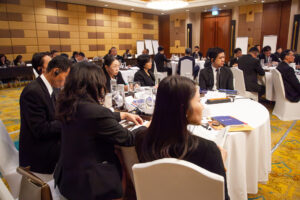
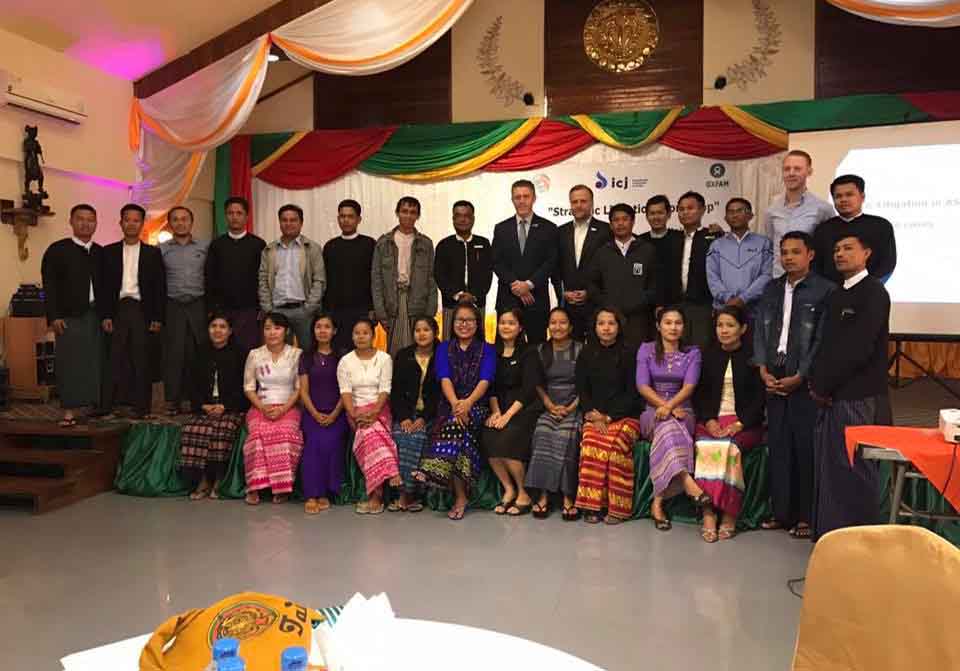
The workshop, held from 11-12 February in Sittwe, brought lawyers and civil society together to discuss of experiences of strategic litigation elsewhere in Myanmar and the region, and consider potential public purpose litigation cases in Rakhine State.
Dr Daniel Aguirre, the ICJ’s International Legal Adviser in Myanmar, provided an introduction to strategic litigation as a method for promoting accountability in a time of transition in governance.
He noted the critical role of independent lawyers in protecting human rights, by representing clients from all communities in Rakhine State.
And he emphasized the importance of strategic litigation as a means to prevent violations and abuses of human rights, or to seek reparations where violations and abuses have occurred.
Kingsley Abbot and Jintana Sakulborirak, from the ICJ’s Asia Regional Office in Thailand, discussed strategic litigation cases from the region, including in northern Thailand where community members have launched an action to appeal the legality of land acquisition for a planned SEZ in Tak Province.
The cases highlighted how media engagement is a critical part of strategic litigation, to raise public attention on human rights issues and demands for accountability in the implementation of investment projects.
Daw Aye Mon Thu, advocate from Dawei Pro Bono Lawyers Network presented the experiences of Heinda Mine cases from Dawei Region, Southern Myanmar, emphasizing the importance of trust-building and cooperation with local community as stake-holder. Such a strategic litigation cases are extremely rare in Myanmar.
Discussions followed about potential cases for strategic litigation from Kyauk Phyu and Sittwe, including issues related to land acquisition for railways construction and an SEZ appear to have been carried out unlawfully in violation of human rights.
Participants discussed the principle of undertaking litigation for broader advocacy objectives rather than solely focusing on actually winning the case in the court.
They also reflected on the challenges and limitations for Myanmar lawyers to undertake strategic litigation.
Highlighting the vital role of lawyers, speakers encouraged participants to consider strategic litigation as a means to challenge unlawful acts that violate or abuse human rights, particularly accompanying business enterprises.
Rakhine State is among Myanmar’s poorest and most isolated provinces, where lawyers and CSOs have had limited exposure to concepts of human rights and international laws.
This workshop, the first of its kind to be held in Rakhine State, is part of efforts to address this gap by building legal literacy on international human rights law and lawyers to consider litigation as a strategy to protect human rights.