Arthur Chaskalson mourned
 It was with great sadness that the ICJ learned of the death of its former President Arthur Chaskalson at the age of 81 this weekend.
A renowned human rights lawyer and a tenacious opponent of the apartheid government, Arthur Chaskalson was part of Nelson Mandela’s defence team in the 1963 Rivonia Trial, which saw Mandela and other ANC leaders sentenced to life.
He then helped establish the Legal Resources Centre, a non-profit organization seeking to use the law to pursue justice and human rights around South Africa. He ran the Centre from 1978 until 1993.
President of South Africa’s Constitutional Court (1994-2001), Chaskalson became Chief Justice of the same court from 2001 to 2005, after which he retired.
He was elected as an ICJ Comissioner in 1995 and served as President of the organization from 2002 to 2008.
In 2005, the ICJ convened the Eminent Jurists Panel, comprising eight leading international experts who spent three years conducting a worldwide investigation into the impact of counter-terrorism laws and practice on human rights globally.
Arthur Chaskalson chaired the panel, which held 16 hearings covering forty countries in all regions of the world.
Chaskalson also played a major role in the panel’s report, which concluded that many States had confronted the threat of terrorism with ill-conceived measures undermining the Rule of Law and human rights, which has proved to be an important reference for the post 9/11 era.
South Africa-Judicial Matters Amendment Act (2012)
South Africa-Judicial Matters Amendment Act-2012-eng
South Africa: ICJ concerned by the tragic events at the Lonmin mines
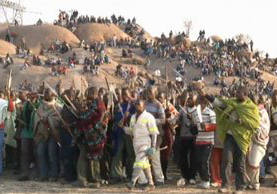 The ICJ has observed with deep concern the tragic and violent events that took place at the Lonmin mines since 10 august 2012, when miners embarked on a collective action for an increase in wages.The lives that have been lost during this short period bring to the fore various issues concerning the realization of economic and social rights, including the sensitive issue of business and human rights. Poverty, lack of employment and many other socio-economic issues sometimes lead to frustrations, which in turn manifest themselves in violence.

Sexual orientation and gender identity: joint oral statement by the ICJ, Human Rights Watch and Amnesty International
 During the 19th session of the Human Rights Council, a plenary Panel discussion was convened on discrimination and violence based on sexual orientation and gender identity – the first of its kind.
In a joint oral statement with Human Rights Watch and Amnesty International, the ICJ welcomed the study by the Office of the High Commissioner for Human Rights and addressed concerns about the serious mischaracterization of international human rights law by some delegations at the Human Rights Council.
oral statement-analysis brief-2012 (full text in English, PDF)
Recent News
 Thailand: Three draft anti-SLAPP laws must deliver comprehensive protection23 Oct 2026
 Egypt’s Matsda2sh case: end the crackdown on media workers with fake “terrorism” charges19 Oct 2026
 Joint Letter: Addressing Human Rights Abuses During Vietnam’s To Lam’s Visit16 Oct 2026
 Joint Letter: Urgent diplomatic action to halt further executions in eastern Libya13 Oct 2026