Sep 3, 2018 | News
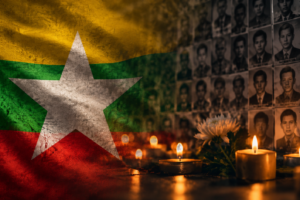
The ICJ held a workshop on reforming Myanmar’s 1982 citizenship law in Yangon from 1 to 2 September 2018.
The workshop convened a group of international and national legal experts, human rights defenders, political scientist, academics and researchers to jointly consider the way forward to identify creative legal and non-legal advocacy approaches for reforming Myanmar’s 1982 Citizenship Law.
The ICJ, UN organs and civil society organizations, through research and legal analysis, have consistently found this law to be discriminatory both in its content and application.
Unlike many other laws promulgated during the military junta era of General Ne Win, this law remains in force. Its tiered hierarchy of citizenship has effectively rendered many individuals as second- or third-class citizens, or in some instances stateless.
In August 2017, the government’s own Advisory Commission on Rakhine State, chaired by the late Kofi Annan, recommended a review of the Citizenship Law. The recommendation was accepted by the Government of Myanmar in principle, but in practice this commitment has not been followed up by any implementing measures.
The workshop’s participants included academics, researchers, human rights defenders, political scientist, legal and non-legal experts of different ethnic and religious backgrounds from a range of organizations from the U.K, Spain, Australia, Kachin, Chin, Mandalay, Rakhine, and Yangon.
The ICJ’s legal adviser, Sean Bain, introduced the workshop by noting that legal recognition of nationality is central to the enjoyment of many human rights.
Noting that protecting the right to nationality is an essential part of the rule of law in any democratic society, he highlighted that too often it is members of minority groups who experience a violation of their human rights due to discriminatory laws and their application with regards to citizenship.
The ICJ’s legal researcher Dr. Ja Seng Ing presented the overview and assessment of the Citizenship Law, including problematic provisions and key institutional actors with authority in Myanmar.
Amal de Chickera, a Sri Lankan Human Rights lawyer and Co-Director of Institute on Statelessness and Inclusion, delivered an introduction on the International law and comparative studies and the approaches and strategies for law reform from international perspectives.
José María Arraiza, Information, Counselling and Legal Assistance Specialist, Norwegian Refugee Council, spoke about a number of approaches and strategies for legal reform, including imperative role of collective identities, inclusive dialogue and evidence based advocacy strategies with comparative international experiences.
Michelle Yesudas, a Malaysian Human Rights lawyer, shared good practices and lesson learned from application of strategic litigation in citizenship related cases in Malaysian context to raise the awareness of the public and also discussed potential strategies for pushing the legislative reform and enforcement of the law in Myanmar.
The ICJ’s legal adviser Daw Hnin Win Aung, facilitated a panel discussion where the Senior legal scholars and researchers from Myanmar also provided their perspectives, based on their own independent research and writing on the legal and non-legal opportunities and challenges for law reform in Myanmar.
Advocate lawyer, Daw Zar Li Aye highlighted the legal consequences of mixed-nationality marriage in Myanmar, for instance, the authorities used physical appearance of the children as a determining factor when considering provision of citizenship / documentation in practice.
The participants considered a wide range of issues relating to statelessness and citizenship in Myanmar with comparative case studies, including the varying approaches for law reform across the region to improve understanding of the advocacy target groups on the issue and potentially inform public policy.
The participants also recognized the importance of multidisciplinary approaches, including strategic litigation in citizenship related cases, for developing advocacy strategies for law reform and to increase knowledge and understanding of the general public on the issue.
This event is part of the ICJ’s ongoing efforts to convene civil society actors including lawyers to discuss critical human rights issues in Myanmar with a view to advancing the protection of human rights in the country.
Aug 30, 2018 | News
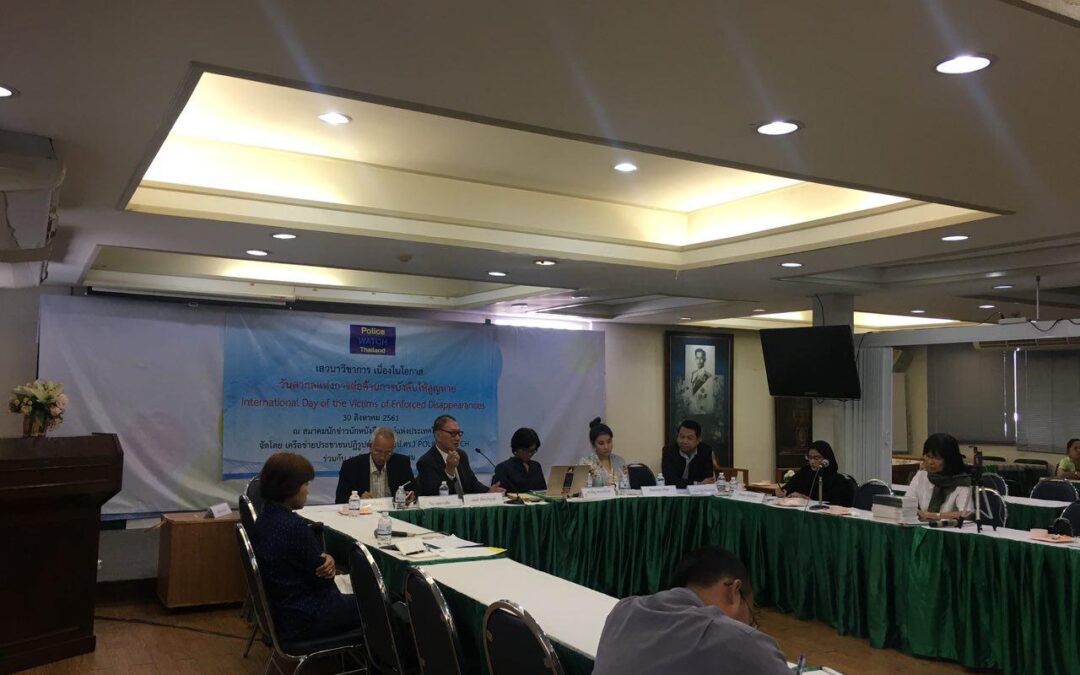
The ICJ participated in a panel discussion to commemorate International Day of the Victims of Enforced Disappearances, organized by Police Watch Thailand and Cross Cultural Foundation.
The discussion was held at the premises of the Thai Journalists’ Association.
The event began with opening remarks by Surapong Kongchantuk, Chairperson of the Cross Cultural Foundation, who called on the Thai Government to ratify the International Convention for the Protection of All Persons from Enforced Disappearance (ICPPED) and for the existing Draft Prevention and Suppression of Torture and Enforced Disappearance Act (‘Draft Act’) to come into force without undue delay.
He also emphasized that perpetrators of the crime of enforced disappearance needed to be brought to justice, and victims and relatives of victims of enforced disappearance must be provided with effective remedies and reparation.
A panel discussion followed the opening remarks, moderated by Pornpen Khongkachonkiet, Director of Cross Cultural Foundation. Panelists included Sanhawan Srisod, ICJ’s National Legal Adviser, Veera Somkomkid, from People Anti-Corruption Network, Pol.Col. Wirut Sirisawadibuth, Columnist and police reform activist, and Adul Kiewboribon, Chair of a committee of persons whose relatives disappeared during May 1992 protests against the government of General Suchinda Kraprayoon.
In her remarks, Sanhawan Srisod expressed concern at the absence of domestic legislation making torture and enforced disappearance specific crimes in Thai law and gaps in the existing Draft Act.
She also called for prompt, independent, impartial and effective investigations into the fate and whereabouts of disappeared persons consistent with international law and standards.
Human Rights Commissioner, and wife of disappeared lawyer and human rights defender Somchai Neelapaijit, Angkhana Neelapaijit, made closing remarks for the event.
The panel discussion followed a forum the ICJ co-hosted in March this year, commemorating the 14th year anniversary of the enforced disappearance of Somchai Neelapaijit, which also raised awareness about amendments to the Draft Act.
During the forum, the ICJ raised concerns about the independence of the ‘Committee managing complaints of torture and enforced disappearance cases’, which was established in May 2017, and expressed the need for further clarification on the legal framework – domestic and/or international – that will ground the Committee’s operation.
Background
The International Day of the Victims of Enforced Disappearances falls on 30 August every year.
Thailand is bound by international legal obligations under the International Covenant on Civil and Political Rights (ICCPR) and Convention against Torture and Other Cruel, Inhuman or Degrading Treatment or Punishment (CAT) – both of which it has acceded to – to investigate, prosecute, punish and provide remedies and reparation for the crimes of torture, other acts of ill-treatment, and enforced disappearance.
However, Thailand has not enacted domestic legislation recognizing enforced disappearance as a criminal offence. Thailand is also yet to ratify the ICPPED, despite signing the Convention in January 2012.
Thailand’s Ministry of Justice concluded a second round of public consultation on the Draft Act and is now reportedly in the process of evaluating the results of the consultation.
On 30 August 2017, 23 November 2017 and 12 March 2018, civil society organizations, including the ICJ, Amnesty International and Human Rights Watch, sent open letters to the Government, including to Thailand’s Minister of Justice, outlining amendments that would be necessary to bring the Draft Act in line with Thailand’s international human rights obligations.
In the absence of domestic legislation criminalizing torture and enforced disappearance, on 23 May 2017, a ‘Committee managing complaints for torture and enforced disappearance cases’ was established by the Prime Minister, pursuant to Prime Minister’s Office Order No. 131/2560 (2017).
The Committee, chaired by the Minister of Justice, consists of 15 officials drawn from different ministries,including the Ministry of Defence, the Royal Thai Police and the Internal Security Operations Command (ISOC).
Jul 24, 2018 | Events, News
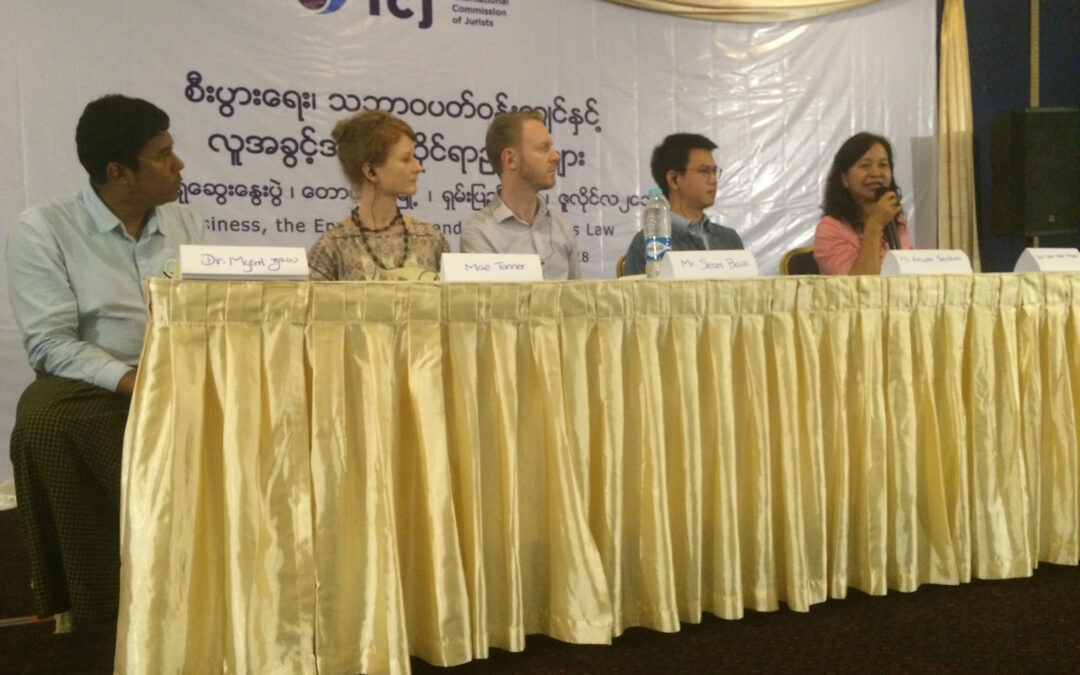
On 22 and 23 July the ICJ convened a workshop on Business, the Environment and Human Rights Law in Taunggyi, the capital of Myanmar’s Shan State.
This followed meetings between the ICJ’s legal advisers and the Shan State High Court and also with the State Advocate General on 13 July, to discuss rule of law developments.
The workshop aimed to identify ways to address the impacts of business activities on human rights and the environment, through legal advocacy including strategic litigation, and to provide a forum for cooperation and experience sharing among participants.
More than 50 lawyers, parliamentarians, human rights defenders and civil society representatives attended from Shan, Kayah and Mon states – provinces that together border Thailand, Laos and China.
An overview of the investment context was provided by Dr Myint Zaw of Paung Ku Myanmar, who also shared lessons from environmental activism in Myanmar.
As well as highlighting weaknesses in domestic law and policy, he presented concerns around lack of transparency and information sharing between the legislature and executive branches of government.
Australian lawyer and ICJ consultant Mae Tanner gave an overview of international human rights law and standards relevant to business activities and environmental protection, particularly emphasizing the obligations assumed by Myanmar in ratifying the International Covenant on Economic, Social and Cultural Rights.
She offered insights as to how UN mechanisms can be used by civil society to advance their advocacy on business and human rights in Myanmar.
Senior Advocate U Myint Thwin drew on his extensive litigation experience to share perspectives on the complex and confusing array of land laws in Myanmar and emphasized the importance of legal knowledge and training to combat corruption and achieve accountability.
The ICJ’s legal adviser Mr Sean Bain outlined the domestic laws relevant to investment and environmental protection in Myanmar and highlighted some key provisions that offer protection against human rights violations and abuses.
He noted the government’s stated aim of promoting the rule of law in Myanmar and emphasized the importance of demanding accountability, transparency and justice in this context.
Amarin Saichan, lawyer with Thai NGO EnLAW, shared experiences of pursuing strategic litigation to address unlawful and harmful business activities in Thailand, stressing the need for creativity in using the law to seek justice and accountability.
He also raised concerns around the use by government of strategic litigation against public participation in Thailand and explained how Thai lawyers are using the courts to guarantee the right protest against harmful development projects.
Participants had the opportunity to discuss how the strategies they shared could be used in the context of issues faced by their communities.
These included human rights and environmental concerns raised by energy and extractive projects, restrictions on shifting agriculture, and violations of the right to freedom of expression and assembly faced by communities who oppose state-backed developments.
They considered advocacy strategies for four case studies selected by participants from across Shan, Kayah and Mon states.
Throughout the workshop speakers and participants highlighted the importance of cooperation between civil society and lawyers, and the need to use Myanmar’s legal system more proactively as part of their broader advocacy strategies.
This workshop is part of the ICJ’s ongoing support to lawyers and civil society in Myanmar.

Jul 13, 2018 | News
The Sri Lankan Government should reconsider and reverse its decision to bring back the death penalty for drug related offences, the ICJ said today.
On 10 July, the Sri Lankan Cabinet unanimously approved an action plan to implement the death penalty for “drug smugglers”.
According to the spokesperson of the Cabinet, 19 people convicted for “large scale drug offences” who “are still involved in drug trafficking…from within prisons” would initially be those initially designated for execution.
Sri Lanka has had a moratorium on the death penalty for over four decades.
The last execution carried out in the country was in 1976.
“The resumption of executions of convicted drug offenders would constitute a violation of the right to life under international law,” said Ian Seiderman, ICJ’s Legal and Policy Director.
”And, based on experience around the globe, it will not in any way serve the purported objective of tackling the problems of drug-related crime in Sri Lanka,” he added.
Article 6 of the International Covenant on Civil and Political Rights (ICCPR), which Sri Lanka acceded to in 1980, guarantees the right to life and requires that states that have not yet abolished the death penalty must restrict capital punishment to only the “most serious crimes”.
The UN Human Rights Committee, the supervisory body for the ICCPR, considers that the death penalty may never be used for drug offences.
The extraordinarily retrograde measure of resuming executions following a 42-year moratorium would also constitute a violation of article 6, which contemplates at least progressive movement towards abolition.
The UN General Assembly has repeatedly adopted resolutions emphasizing that that the use of the death penalty undermines human dignity and calling on those countries that maintain the death penalty to establish a moratorium on its use with a view to its abolition.
In 2016, an overwhelming majority of 117 UN Member States – including Sri Lanka – voted in favor of a worldwide moratorium on executions as a step towards abolition of the death penalty.
“At least 150 countries have now either abolished the death penalty in law or practice,” added Seiderman.
The ICJ considers the death penalty to be a violation to the right to life and the right not to be subjected to cruel, inhuman or degrading punishment.
The ICJ urges Sri Lanka to reinstate its moratorium on executions and take steps towards taking all necessary measures to abolish the death penalty.
Contact:
Ian Seiderman, ICJ’s Legal and Policy Director, email: ian.seiderman(a)icj.org
Reema Omer, ICJ’s International Legal Advisor, South Asia, email: reema.omer(a)icj.org
Jul 10, 2018 | News
The SC is set to reconsider the criminalization of consensual same-sex relationships between adults, in response to a writ petition with significant ramifications for addressing the full range of human rights violations based on sexual orientation or gender identity in India said the ICJ.
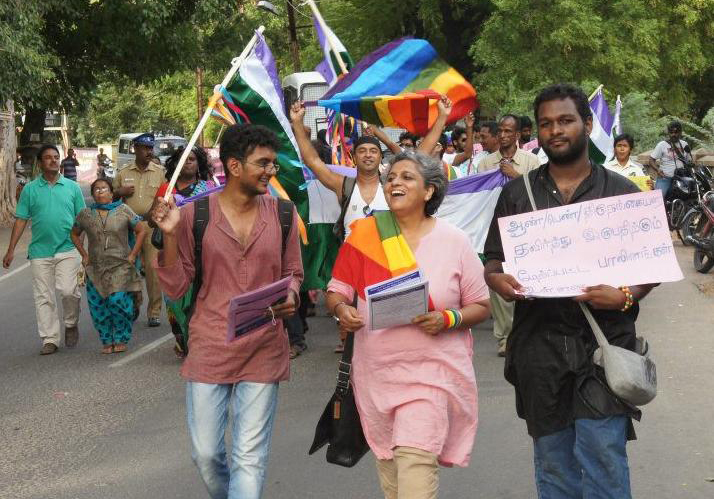
The Indian Supreme Court commenced hearing the case, Navtej Singh Johar v. Union of India, which is joined with five connected cases, today, concerning the constitutional validity of the criminalization of consensual same-sex relations between adults under Section 377 of the Indian Penal Code in response to writ petitions filed by several LGBTI individuals.
Section 377 criminalizes “carnal intercourse against the order of nature”. Section 377 is a relic of the British colonial penal code and is replicated in several former British colonies even though it was it was finally repealed in Northern Ireland in 1982, following repeals in Scotland in 1980 and England and Wales in 1967.
“Hopefully, the Indian Supreme Court will follow and build upon the strong precedent set by the Delhi High Court in the Naz Foundation v. Govt. of NCT of Delhi that declared Section 377 and the criminalization of consensual same-sex relationships to be in violation of the Indian Constitution as well as international law in 2009,” said Sam Zarifi, ICJ’s Secretary General.
“There are real grounds for optimism as the Indian Supreme court as recently as August 2017 handed a landmark judgment in Justice K.S. Puttaswamy and Another v. Union of India and Others that declared the right to determine one’s sexual orientation and gender identity as core to the right of privacy,” he added
The ICJ has documented how section 377 has created a climate in which arbitrary arrest, extortion, harassment and blackmail of LGBTI persons in India thrives.
“The Indian judiciary’s decision to read down section 377 in Naz Foundation v. Govt. of NCT of Delhi, which was then overruled by the Supreme Court, has been used by several other jurisdictions, such as Trinidad and Tobago as support for putting an end to criminalization of same-sex relationships. So the outcome of this petition before the Indian Supreme Court is of significance not just to people in India, but to the fight against discrimination around the world,” Zarifi said.
“But even a good decision by the Indian Supreme Court will not end the discrimination against people on the basis of their sexual orientation or gender identity in India. It’s time for the Indian Parliament to repeal section 377 in its entirety and engage in a wide-ranging review to consider which gaps, if any, need to be filled, for example with respect to acts constituting rape or other sexual offences,” he added.
Contact:
Maitreyi Gupta (Delhi), International Legal Adviser for India, t: +91 7756028369 ; e: maitreyi.gupta(a)icj.org
India-Supreme Court and Section377-News-press release-2018-ENG (full story with additional information, in PDF)