Mar 29, 2021 | Advocacy, News
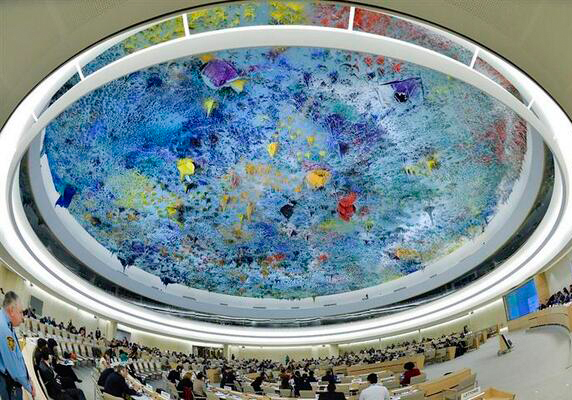
On 25 March 2021, the ICJ filed two submissions to the UN Human Rights Council Working Group on the Universal Periodic Review (UPR) ahead of the review of Thailand’s human rights record in November 2021.
For this particular review cycle, the ICJ made two joint UPR submissions to the Human Rights Council.
In the joint submission by ICJ and Thai Lawyers for Human Rights (TLHR), the organizations provided information and analysis to assist the Working Group on the UPR to make recommendations addressing various human rights concerns that arise as a result of Thailand’s failure to guarantee, properly or at all, a number of civil and political rights, including with respect to:
- Constitution and Legal Framework: concerning the 2017 Constitution that continues to give effect to some repressive orders issued by the military junta after the 2014 coup d’état, the Emergency Decree, the Martial Law, and the Internal Security Act;
- Freedom of Expression and Assembly: concerning the use of laws that are not human rights compliant and, as such, arbitrarily restrict the rights to freedom of expression, association and peaceful assembly, in the context of the Thai government’s response to the pro-democracy protests and, purportedly, to COVID-19; and
- Right to Life, Freedom from Torture and Enforced Disappearance: concerning the resumption of death penalty, the failure to undertake prompt, thorough and impartial investigations, and to ensure accountability of those responsible for the commission of torture, other ill-treatment and enforced disappearance, and the failure, to date, to enact domestic legislation criminalizing torture, other ill-treatment and enforced disappearance.
In the second, joint submission by ICJ, ENLAWTHAI Foundation and Land Watch Thai, the organizations provided information and analysis to assist the Working Group to make recommendations addressing various human rights concerns that arise as a result of Thailand’s failure to guarantee, properly or at all, a number of economic, social and cultural rights, including with respect to:
- Human Rights Defenders: concerning threats and other human rights violations against human rights defenders, and the restrictions on civil society space and on the ability to raise issues that the government deems as criticism of its conduct or that it otherwise disfavours;
- Constitution and Legal Framework: concerning the continuing detrimental impact of the legal framework imposed since the 2014 coup d’état on economic, social and cultural rights;
- Community Consultation: concerning the lack of participatory mechanisms and consultations, as well as limited access to information, for affected individuals and communities in the execution of economic activities that adversely impact local communities’ economic, social and cultural rights;
- Land and Housing: concerning issues relating to access to land and adequate housing, reports of large-scale evictions without appropriate procedural protections as required by international law, and the denial of the traditional rights of indigenous peoples to their ancestral lands and natural resources; and
- Environment: concerning the widespread and well-documented detrimental impacts of hazardous and industrial wastes on the environment, the lack of adequate legal protections for the right to health and the environment, and the effectiveness of the environmental impact assessment process set out under Thai laws.
The ICJ further called upon the Human Rights Council and the Working Group on the Universal Periodic Review to recommend that Thailand should take various measures to immediately cease all aforementioned human rights violations; ensure adequate legal protection against such violations; ensure the rights to access to justice and effective remedies for victims of such violations; and ensure that steps be taken to prevent any future violations.
Download
UPR Submission 1 (PDF)
UPR Submission 2 (PDF)
Mar 24, 2021 | News
The High Court of Singapore decision ordering a blogger to pay the Prime Minister thousands of dollars in a defamation suit continues the country’s troubling trend of restricting online freedom of expression, the ICJ said today.
Mar 22, 2021 | Advocacy, Non-legal submissions
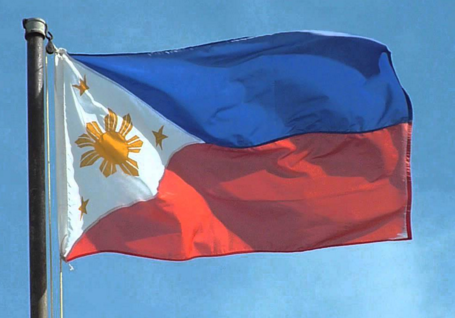
The ICJ joined today seven other organisation in a statement before the UN Human Rights Council expressing concern at the systematic human rights violation and the persistent impunity in the Philippines and calling for more accountability.
The joint statement delivered by FORUM ASIA reads as follows:
“Madam President,
Nearly six months since its adoption, Human Rights Council resolution 45/33 offering technical assistance to the Philippines has proven to be utterly insufficient to address the systematic human rights violations and persistent impunity documented in the High Commissioner’s report. The Philippine Government’s policies and actions since the Resolution’s adoption have been completely at odds with the commitments outlined in it.
Extrajudicial killings in the so-called ‘war on drugs’ have continued. To date, the Government has made no tangible progress towards accountability against those most responsible for such killings. In December 2020, the Office of the Prosecutor of the ICC found that there is “reasonable basis to believe that the crimes against humanity” of murder, torture, the infliction of serious physical injury and mental harm, and other inhumane acts were committed between at least 1 July 2016 and 16 March 2019.
Human rights defenders pursuing legitimate work, especially those who advocate for international accountability, including lawyers, continue to be attacked and accused of belonging to terrorist groups. Rights defenders continue to be arrested and jailed. The draconian Anti-terrorism Act, passed last year, exacerbates risks to defenders. The killing of nine human rights defenders and activists on 7 March, two days after President Duterte ordered the police and military to “finish off” and “kill” those purported to be “communist rebels”, illustrates clearly the persistent killings and attacks faced by activists and defenders. It is very clear that no amount of technical assistance or capacity building will end the killings as the President and top government officials continue to incite murder and violence as official policy.
In this context, it is imperative that the Council set up an international accountability mechanism to end the cycle of violence and impunity in the Philippines.
Thank you.”
The statement was endorsed by:
- Amnesty International
- Asian Forum for Human Rights and Development (FORUM-ASIA)
- CIVICUS: World Alliance for Citizen Participation
- Human Rigths Watch
- International Commission of Jurists (ICJ)
- International Federation for Human Rights (FIDH)
- Philippines Alliance of Human Rights Advocates (PAHRA)
- World Organisation Against Torture (OMCT)
Contact:
Massimo Frigo, ICJ UN Representative, e: massimo.frigo(a)icj.org, t: +41797499949
Mar 17, 2021 | News
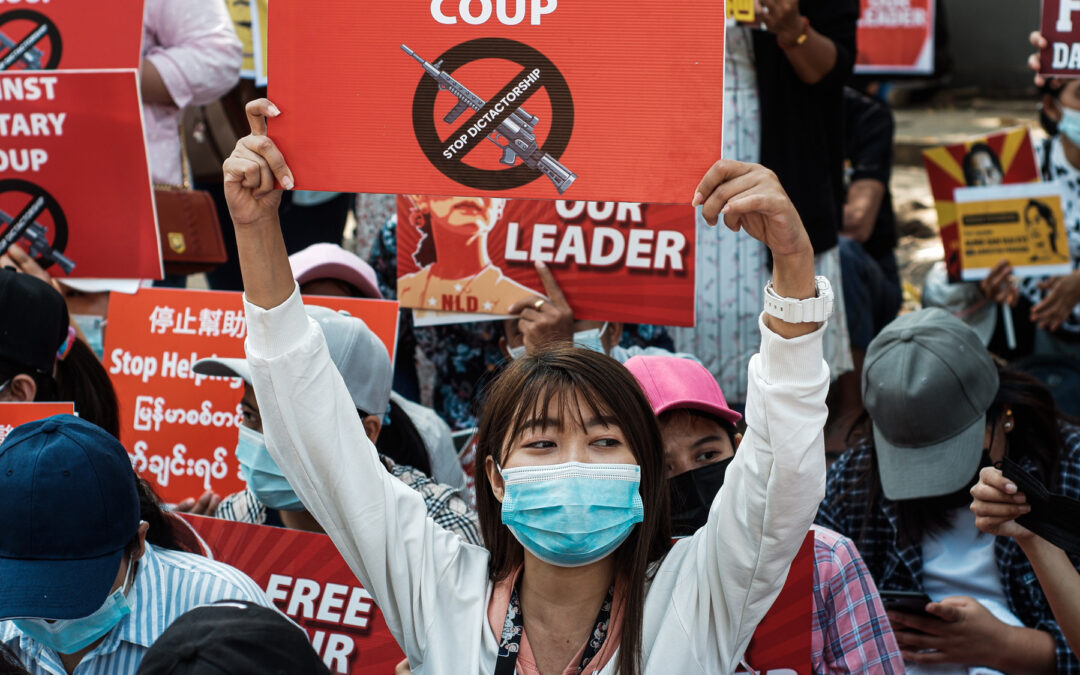
Imposition of Martial Law in several areas of Myanmar subjects civilians to trial by military tribunals, a dangerous escalation of the military’s repression of peaceful protests, said the ICJ today.
“Use of martial law marks the return to the dark days of completely arbitrary military rule in Myanmar. It effectively removes all protections for protestors, leaving them at the mercy of unfair military tribunals.”
– Ian Seiderman, ICJ’s director of law and policy
On 14 March, the Myanmar military issued Martial Law Order 3/2021, covering a number of townships of different provinces in Myanmar. According to this order, military officials assume full authority from civilian officials, and civilians may be subjected to military tribunals for charges of 23 violations of the criminal code and other laws. The 23 crimes include many of the charges used most against peaceful protesters in the past month, including charges of ‘disrupting or hindering government employees and services’ and ‘spreading false news’ about the government, and ‘exciting disaffection towards the government.’
The Martial Law Order also assigns disproportionately severe sentences, including the death penalty and prison sentences with hard labor. Judgments of military tribunals are not subject to appeal, even if the death penalty is imposed.
“Martial law has been imposed in precisely the areas where the military have used unlawful and lethal force against peaceful protesters, and removes even the pretense of access to courts for the people whose rights have been violated systematically by the military, ” said Seiderman.
The ICJ’s detailed review of military courts has documented that they lack competence, independence and impartiality to prosecute civilians. International law provides that the jurisdiction of military tribunals must generally be restricted solely to specifically military offenses committed by military personnel.
“The military courts lack transparency, due process and judicial oversights. It leaves no possibility to appeal the sentences, including the death sentences that have been handed down by military generals, ” said Seiderman.
Since the military coup d’etat of February 1 and the declaration of a state of emergency, the military has enacted and amended legislation enabling ongoing gross human rights violations, including possible crimes against humanity. More than 200 people have been unlawfully killed, with 2,000 more injured as security forces have used excessive force to suppress peaceful protests.
Background
On 14 March, the military-appointed State Administration Council, in accordance with Article 419 of the Constitution, enacted Martial Law Order 1/2021, imposing martial law in a number of areas in Yangon. The affected areas were further expanded through two other orders issued on 15 March, Martial Law Order 2/2021 and 3/2021. These orders transfer all power to the Military Commander in those areas. All local administration bodies have been placed under martial law, effectively giving military full control of all judicial and administrative processes.
The Order 3/2021 in particular is divided into six main sections with the most concerning provisions in relation to the list of crimes to be heard by military tribunals, and the proscribed punishments.
Contact
Osama Motiwala, ICJ Asia-Pacific Communications Officer, e: osama.motiwala(a)icj.org
Mandira Sharma: ICJ Senior Legal Adviser, e: mandira.sharma(a)icj.org
Mar 15, 2021 | Advocacy, Non-legal submissions
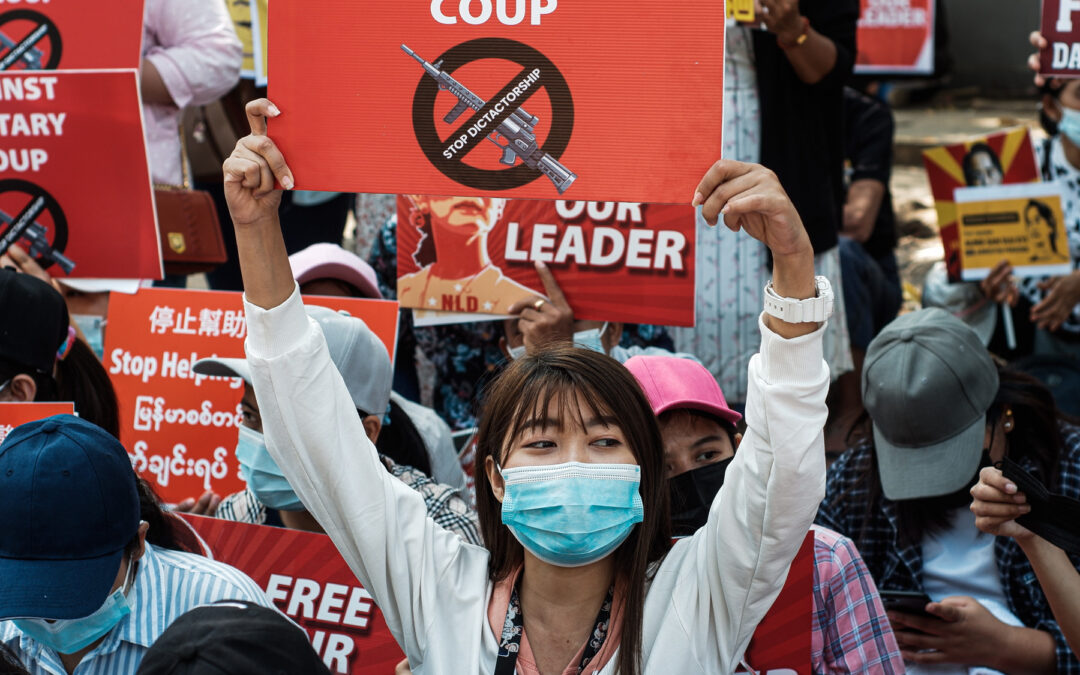
Today, during a General Debate, the ICJ called on the UN Human Rights Council to condemns a set of laws amendend by the military governmentn in Myanmar and restricting human rights, and to demand the return to of Myanmar civilian rule respecting the rule of law.
The statement reads as follows:
“Madame President,
The International Commission of Jurists (ICJ) condemns the illegitimate attempts to “amend” several laws by the Military appointed Myanmar’s State Administration Council (SAC) following its unlawful seizure of power on 1 February 2021.
The implementation of the Amended Law Protecting the Privacy and Security of Citizens (2017) would undermine the democratic process, criminalize peaceful protests and remove various human rights protections. It would provide for broad and unchecked power to the military to arrest anyone without a warrant and aim to remove basic protections, including the rights to be free from arbitrary detention and from warrantless surveillance and search and seizure.
The amendments to the Penal Code and the Criminal Procedural Code have made non-bailable certain offenses, specifically targeting persons criticizing the coup or the military junta, as well as those encouraging others to support the “Civil Disobedience Movement.”
In addition, Amendments made to other existing laws, such as the Ward and Tract Administration Law and Electronic Transactions Law, allow for search and seizure at night without arrest warrant and allow for the silencing of critical voices against the coup and human rights violations of the military, in violation of international standards.
The ICJ calls on the Council to adopt a resolution, which, among other things, univocally condemns and demands the repeal of these laws and the return to of Myanmar civilian rule respecting the rule of law.
Thank you.”