Apr 16, 2018 | News
On the fourth anniversary of the apparent enforced disappearance of Karen activist, “Billy,” the ICJ repeats its calls for the Department of Special Investigations (DSI) to assume responsibility for effectively investigating the case.
To date no progress has been made to establish the fate of Billy and the DSI has declined to take up the matter.
Pholachi “Billy” Rakchongcharoen was last seen on 17 April 2014 in the custody of Kaeng Krachan National Park officials.
At the time of his apparent enforced disappearance, Billy had been working with ethnic Karen villagers and activists on legal proceedings the villagers had filed against the National Park, the Wildlife and Plant Conservation Department, the Ministry of Natural Resources and Environment, and the former Chief of Kaeng Krachan National Park concerning the alleged burning of villagers’ homes and property in the National Park in 2010 and 2011.
“The very reason the DSI was created was to investigate complex cases of this kind, including where Government officials may be implicated in gross human rights violations that amount to crimes under international law,” said Kingsley Abbott, Senior International Legal Adviser with the ICJ.
“If the DSI continues to refuse to open a special investigation after four years of little apparent progress by the police, the DSI will risk being perceived as contributing to the pervasive culture of impunity that exists within Thailand,” he added.
This week, Billy’s wife, Phinnapha Phrueksaphan, advised the ICJ that the last time the DSI had discussed Billy’s investigation with her and her family was over a year ago.
The ICJ was further informed that on 9 April 2018, Phinnapha submitted a letter to the Director-General of the DSI seeking updates on the progress of Billy’s case and clarification as to why the DSI had not accepted Billy’s case for a special investigation.
“Thailand has a clear legal duty to continue to investigate the case until Billy’s fate or whereabouts are established and to ensure that the investigative process and any outcomes are transparent – which is especially important to victims’ families who play a crucial role in investigations,” added Abbott.
On 23 May 2017, Thailand established a Committee consisting of 18 officials, including from the DSI, to formulate policies for the prevention of acts of torture and enforced disappearance, and to investigate and provide remedies in accordance with the Convention against Torture and Other Cruel, Inhuman or Degrading Treatment or Punishment (CAT), to which Thailand is a party, and the International Convention for the Protection of All Persons from Enforced Disappearance (ICPPED), which Thailand has signed but not yet ratified.
On 26 June 2017, the Committee reportedly stated that it would consider past, pending and new cases of enforced disappearance, including the case of Billy.
However, the Committee has yet to demonstrate effectiveness in efforts to implement Thailand’s international human rights obligations.
“While any steps Thailand takes towards accountability for allegations of torture, ill-treatment and enforced disappearance is welcome, the Committee should not be seen as a meaningful substitute for establishing these as crimes under domestic law,” Abbott said.
Thailand-Billy disappearance 4th year-News-web story-2018-ENG (Full story in PDF)
Thailand-Billy fourth-News-webstory-2018-THA (Thai version, in PDF)
Further Reading
Billy’s case
ICJ, ‘Launch special investigation into enforced disappearance of “Billy”’, 6 August 2015
ICJ, ‘Strengthen efforts to solve the apparent enforced disappearance of “Billy”, 16 April 2015
ICJ, ‘“Disappearance” of Billy demands special investigation’, 17 July 2014
ICJ, ‘Thai authorities must urgently investigate Billy’s ‘disappearance’’, 28 April 2014
Draft Act criminalizing torture and enforced disappearance
ICJ and Amnesty International, Open letter to Thailand’s Minister of Justice on the amendments to the Draft Prevention and Suppression of Torture and Enforced Disappearances Act, 12 March 2018
English
Thai
ICJ and Amnesty International, Recommendations to Thailand’s Ministry of Justice on the Draft Prevention and Suppression of Torture and Enforced Disappearances Act, 23 November 2017
Human Rights Committee review of Thailand
ICJ and Thai Lawyers for Human Rights and Cross-Cultural Foundation, Joint follow-up submission to the UN Human Rights Committee, 27 March 2018
UN Committee against Torture review of Thailand
ICJ and Thai Lawyers for Human Rights, Joint submission to the UN Committee against Torture, 29 January 2018
Contact
Kingsley Abbott, ICJ Senior International Legal Adviser, email: kingsley.abbott(a)icj.org
Apr 10, 2018 | News
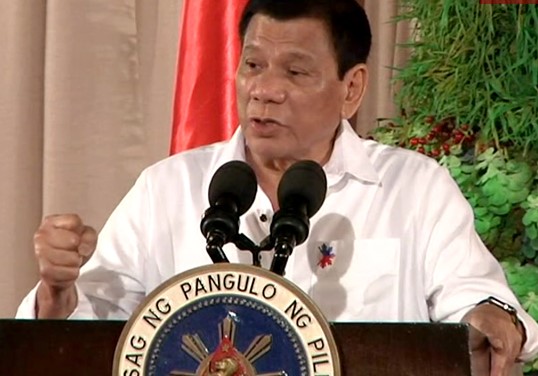
The ICJ today condemned a threatening statement made by Philippine President Rodrigo Duterte attacking Chief Justice Maria Lourdes Sereno of the Philippines Supreme Court.
The ICJ said that the President’s remarks constituted an assault not just on the Chief Justice, but on the independence of the judiciary in the country.
The ICJ urged President Duterte to respect judicial independence and not to exert political pressure on any government official or agency to undermine the independence of the judiciary.
In a press conference on 9 April 2018, President Duterte told reporters: “I’m putting you on notice that I’m your enemy and you have to be out of the Supreme Court.”
He also called on the House of Representatives to expedite impeachment proceedings presently underway against Chief Justice Sereno.
“It is absolutely unacceptable for President Duterte to make such a statement not only because it constitutes direct intimidation of the Chief Justice, but the chilling effect it may have on other independent judges who carry out their professional duties,” said Emerlynne Gil, Senior International Legal Adviser of ICJ.
“By expressing his personal feelings against the Chief Justice and by directing the House of Representatives to accelerate the impeachment proceedings, the President is actively influencing and interfering with the functions of other co-equal branches of government,” Gil added.
The ICJ reminds President Duterte that as enunciated in the UN Basic Principles on the Independence of the Judiciary, “[i]t is the duty of all governmental and other institutions to respect and observe the independence of the judiciary.”
The Principles affirm that the judiciary must be able to carry out its work “without any restrictions, improper influences, inducements, pressures, threats or interferences, direct or indirect, from any quarter or for any reason.”
The ICJ strongly urges President Duterte to retract his comments and to refrain in the future from making any statements attacking individual judges or in any way interfering with the independence of the judiciary.
Contact
Emerlynne Gil, Senior International Legal Adviser, t: +662 619 8477 (ext. 206) ; e: emerlynne.gil@icj.org.
Background
In September 2017, two impeachment complaints against the Chief Justice were filed before the Committee of Justice of the House of Representatives, the Lower House of Congress.
The Committee of Justice approved only one of the complaints, which is scheduled to be put before the plenary of the House of Representatives in May 2018 when Congress resumes its session.
If it obtains one-third vote of all members in the House of Representatives, the articles of impeachment will be transmitted to the Senate, which is the Upper House of Congress.
Any impeachable officer may be removed from office by a vote of two-thirds of all the members of the Senate sitting as the impeachment court.
Some of the points raised in the approved impeachment complaint are the Chief Justice’s failure to report certain income in her statements of assets, liabilities and net worth (SALN), allegations of use of public funds to finance her extravagant and lavish lifestyle, and manipulation of judicial appointments for personal and political reasons, among others.
The Chief Justice maintains she correctly filed her SALNs. She also further claims that the other allegations in the impeachment complaint are baseless or mere fabrications.
In March 2018, the Philippines’ Solicitor General Jose Calida filed a petition before the Supreme Court questioning the Chief Justice’s appointment due to her alleged failure to fully disclose her wealth. Oral arguments on this petition were made on 10 April 2018.
Apr 9, 2018 | News
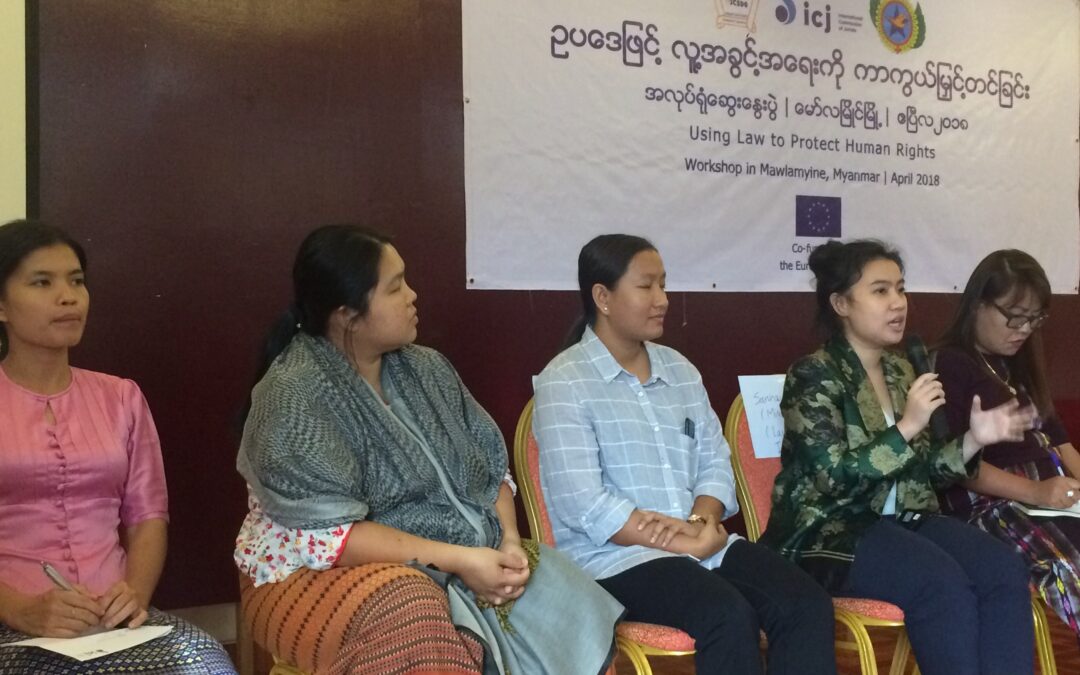
Prior to this workshop, on 6 April the ICJ met with the Mon State High Court, including its Chief Justice.
Legal advisers from the ICJ had a constructive discussion with the justices about judicial reform in Myanmar, including the role of lawyers and civil society, as well as jurists, in advancing accountability and access to justice.
The two-day workshop aimed to identify challenges and opportunities for human rights advocacy using law, and to encourage the building of relationships and networks between lawyers and civil society.
The workshop considered strategic litigation concepts and case studies in the region. It also discussed the landscape of rule of law and justice in Myanmar, particularly the experiences regarding access to justice of some sixty participants from Mon State.
Mar 27, 2018 | Advocacy, Non-legal submissions
On 27 March 2018, the ICJ, Thai Lawyers for Human Rights (TLHR) and Cross Cultural Foundation (CrCF) made a joint follow-up submission to the UN Human Rights Committee on Thailand’s implementation of the Committee’s prioritized recommendations.
On 23 March 2017, during its 119th Session, the Human Rights Committee adopted its concluding observations on the second periodic report of Thailand under article 40 of the International Covenant of Civil and Political Rights (ICCPR).
Pursuant to its rules of procedure, the Committee requested Thailand to provide a follow up report on its implementation of the Committee’s recommendations made in paragraphs 8 (constitution and legal framework) 22 (extrajudicial killings, enforced disappearances and torture) and 34 (conditions of detention) of its concluding observations by 23 March 2018. To date, the Thai authorities are yet to file their follow-up report with the Committee.
In their joint submission to the Human Rights Committee, the ICJ, TLHR and CrCF detailed their concerns in relation to Thailand’s failure to implement the Committee’s recommendations in paragraphs 8 and 22 of its concluding observations. The three organizations’ submission focuses on their concerns arising from the following:
Constitution and legal framework
- Orders by the Head of the National Council for Peace and Order (‘HNCPO’); and
- Escalation in use of HNCPO Order No. 3/2558 to restrict fundamental freedoms.
Extrajudicial killings, enforced disappearances and torture
- Allegations of widespread use of torture and other ill-treatment;
- Incommunicado detention;
- Southern Border Provinces; and
- Threats and reprisals against persons working to bring to light cases of alleged torture, ill–treatment and enforced disappearance.
Read also
ICJ and Thai Lawyers for Human Rights, Joint submission to the UN Human Rights Committee, 13 February 2017
Contact
Kingsley Abbott, ICJ Senior International Legal Adviser for Southeast Asia, e: kingsley.abbott(a)icj.org
Thailand_Joint-Follow-up-Human-Rights-Committee-Submission-march-2018 (Full submission in ENG, PDF)
Thailand-Follow up HRC-Advocacy-Non legal submission-2018-THA (Thai version, in PDF)

Mar 27, 2018 | News
The ICJ and Suara Rakyat Malaysia (SUARAM) today urged Malaysia’s Parliament not to pass the Anti-Fake News Bill 2018.
The two organizations are concerned that the bill will unduly limit freedom of opinion or expression in Malaysia, and could be used to suppress legitimate criticism of the government.
“The bill is flawed in its design and will be open to abuse by the Malaysian government which maintains a poor track record in upholding freedom of expression,” said Sevan Doraisamy, SUARAM’s Executive Director.
“The term ‘fake news’ is in itself problematic. It is defined in an overbroad manner in the draft law, and therefore vulnerable to arbitrary interpretation and enforcement,” said Emerlynne Gil, ICJ’s Senior International Legal Adviser.
“Given past experience in Malaysia, it is highly likely to be used to suppress legitimate criticism of the government on matters of opinion or where the facts are contested,” she added.
The right to freedom of opinion and expression is guaranteed by the Federal Constitution of Malaysia, as well as the Universal Declaration of Human Rights.
The bill makes no provision for exceptions or defences such as honest mistake, parody, artistic merit, or public interest. The bill would allow up to ten years imprisonment.
“The penalties are wildly disproportionate,” said Gil. “Indeed, under international standards, imprisonment is never an appropriate penalty for such offences.”
On 3 March 2017, the UN Special Rapporteur on Freedom of Opinion and Expression, together with his counterparts from the Organization for Security and Cooperation in Europe (OSCE), the Organization of American States (OAS), and the African Commission on Human and People’s Rights (ACHPR), issued a joint declaration on ‘fake news’, disinformation, and propaganda.
The joint declaration emphasized that “the human right to impart information and ideas is not limited to ‘correct’ statements, that the right to also protects information and ideas that may shock, offend and disturb.”
It also said that “general prohibitions on the dissemination of information based on vague and ambiguous ideas, including ‘false news’ or ‘non-objective information’ are incompatible with international standards for restrictions on freedom of expression.”
The ICJ and SUARAM also note that the timing and the lack of transparent consultation on how it was developed raise concerns about the government’s motivation behind the introduction of this bill.
The bill has been introduced during the final days of Parliament sitting and is expected to be voted on within this week, leaving little time for deliberation or consultation.
“Allowing this bill to be passed would only serve as an affront to democratic values. It will be another strike on Malaysia’s already shoddy human rights record,” Doraisamy said.
“Adopting a law that would unduly limit the right to freedom of opinion and expression is not the optimal way to counter disinformation and propaganda,” said Gil.
“The best way is to disseminate accurate information and to make such information accessible to everyone,” she added.
The ICJ and SUARAM strongly urge the Malaysian parliament not to pass the Anti-Fake News Bill 2018 and uphold the right to freedom of opinion and expression in the country.
Contact
Emerlynne Gil, Senior International Legal Adviser for Southeast Asia of ICJ, t: + 662 619 8477 (ext. 206) ; e: emerlynne.gil@icj.org
Background
The Anti-Fake News Bill 2018 has been tabled for first reading at the Malaysian Parliament on 26 March 2018 and may be voted on this week or early next week.
The bill defines ‘fake news’, without any defences or exceptions, as including “any news, information, data and reports” which are “wholly or partly false”.
Furthermore, the bill states that ‘fake news’ may be “in the form of features, visuals or audio recordings or in any other form capable of suggesting words or ideas.”
If passed, any person may be subject to a penalty of up to ten (10) years imprisonment and/or a fine amounting to MYR 500,000 (approximately USD 127,681) if convicted of knowingly creating, offering, publishing, printing, distributing, circulating, or disseminating any ‘fake news’ or publication of ‘fake news’.
The bill also seeks to penalize both Malaysians and foreigners alike, even if they are outside of Malaysia, as long as the fake news concerns Malaysia or a Malaysian citizen.