Mar 14, 2018 | News
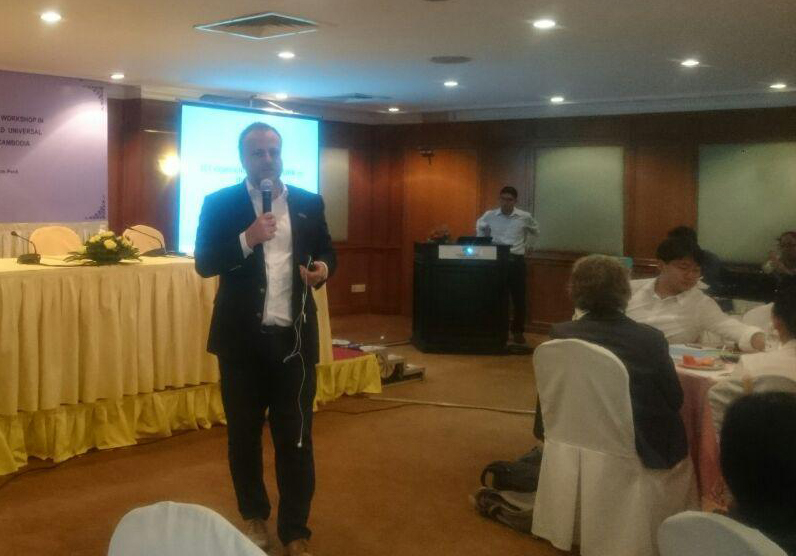
On 12 and 13 March 2018, the ICJ participated in and presented at a workshop for Cambodian civil society on the Universal Periodic Review (UPR).
The workshop was organized by the Cambodian Center for Human Rights (CCHR), UPR Info and the Cambodia Country Office of the United Nations Office of the High Commissioner for Human Rights (OHCHR).
This workshop aimed to prepare participants ahead of the deadline for civil society submissions to the UPR in July 2018.
The Royal Government of Cambodia (RGC) will undergo the third cycle of its UPR in January 2019.
The objectives of the workshop were to:
- 1. Introduce the UPR to newcomers, identifying where the UPR fits within the UN’s human rights framework and demonstrating how civil society organizations (CSOs) can utilize the UPR to further their human rights objectives;
- 2. Share experiences of national stakeholders in the UPR process and discuss developments since the second cycle and priorities for the third cycle;
- 3. Learn from the experiences of CSOs in the region on developing UPR CSO submissions;
- 4. Provide technical training regarding the drafting of UPR CSO submissions;
- 5. Establish thematic groups to begin developing joint submissions and establish a timeline for the drafting process.
On 12 March 2018, Kingsley Abbott, Senior International Legal Adviser for Southeast Asia for the ICJ, delivered a presentation on submissions drafting and advocacy techniques for the UPR and also spoke about the experiences of CSOs in Thailand in developing UPR CSO submissions.
Contact
Kingsley Abbott, ICJ Senior International Legal Adviser for Southeast Asia, e: kingsley.abbott(a)icj.org
Mar 13, 2018 | News
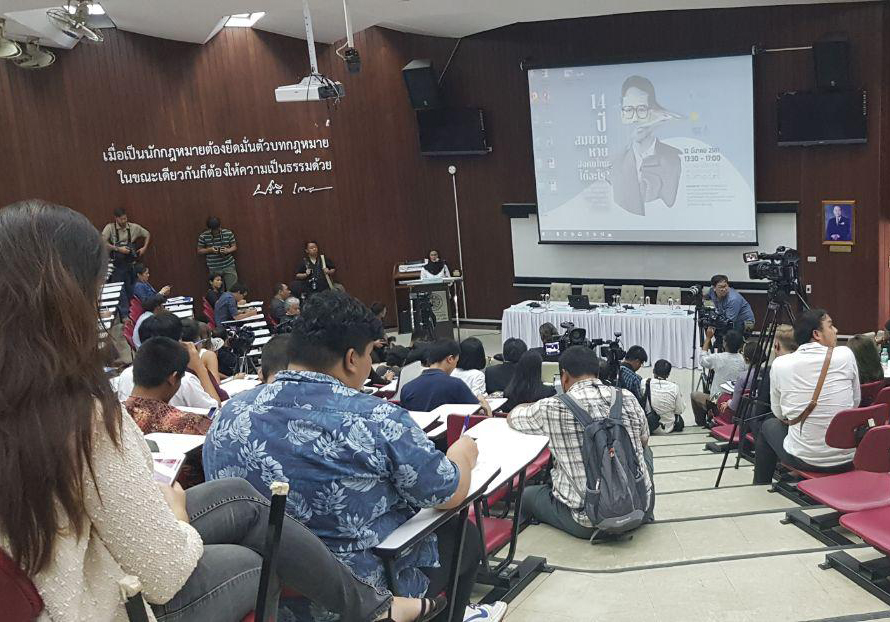
On 12 March 2018, the ICJ co-hosted the forum “14 Years after Somchai’s Disappearance, What Have We Learned?” to commemorate the 14th anniversary of the enforced disappearance of prominent lawyer and human rights defender Somchai Neelapaijit.
The forum was held at the Faculty of Law in Thammasat University’s Tha Pra Chan campus.
More than 80 participants attended the event, including alleged torture victims, family victims of torture and enforced disappearance, students, lecturers, lawyers, civil society organizations, diplomats, members of the Thai authorities and media.
The objectives of the forum were to (i) mark the 14th anniversary of the enforced disappearance of Somchai Neelapaijit and the lack of progress in the investigation (ii) raise awareness and discuss the latest amendments to the Draft Prevention and Suppression of Torture and Enforced Disappearances Act (‘Draft Act’) and its deficiencies; and (iii) discuss the newly constituted Committee managing complaints of torture and enforced disappearance, which was established by the Prime Minister on 23 May 2017.
Opening remarks were delivered by Angkhana Neelapaijit, wife of Somchai Neelapaijit, and Laurent Meillan, OHCHR’s Deputy Regional Representative.
Sanhawan Srisod, the ICJ’s National Legal Advisor, spoke during the first panel discussion on recent amendments to the Draft Act, which was moderated by Poonsuk Poonsukcharoen from Thai Lawyers for Human Rights (TLHR) and also included the following panelists:
- Nongporn Rungpetchwong, Human Rights Expert, Rights and Liberties Protection Department, Ministry of Justice
- Assistant Professor Dr. Ronnakorn Bunmee, Faculty of Law, Thammasat University
- Somchai Homlaor, Lawyer and Senior Advisor to Cross Cultural Foundation (CrCF)
The second panel discussion on the roles and duties of the Committee Managing Complaints for Torture and Enforced Disappearance Cases was moderated by. Yingcheep Atchanont from Internet Law Reform Dialogue (iLaw) and included the following speakers:
- Manunpan Rattanacharoen, Office of Foreign Affairs and International Crimes, Department of Special Investigation (DSI), Ministry of Justice
- Professor Narong Jaihan, Chair, Sub-committee on Prevention of Torture and Enforced Disappearance Cases
- Angkhana Neelapaijit, Family of “disappeared” person
- Isma-ae Tae, Alleged victim of torture and ill-treatment
During the event, the ICJ also highlighted its open letter to Thailand’s Minister of Justice, dated 12 March 2018, on the recent amendments to the Draft Act, which sets out concerns that the recent amendments would, if adopted, fail to bring the law into compliance with Thailand’s international human rights obligations.
The forum was co-organized with the Neelapaijit family, Thammasart University’s Faculty of Law, Amnesty International Thailand, Cross Cultural Foundation (CrCF), together with the United Nations’ Office of the High Commissioner for Human Rights (OHCHR) Regional Office for South East Asia.
Read also
ICJ and Amnesty International, Open letter to Thailand’s Minister of Justice on the amendments to the Draft Prevention and Suppression of Torture and Enforced Disappearances Act, 12 March 2018
English
Thai
ICJ and Thai Lawyers for Human Rights, Joint submission to the UN Committee against Torture, 29 January 2018
ICJ and Amnesty International, Recommendations to Thailand’s Ministry of Justice on the Draft Prevention and Suppression of Torture and Enforced Disappearances Act, 23 November 2017
To mark the 10-year anniversary of Somchai Neelapaijit’s ‘disappearance’, the ICJ released a report documenting the tortuous legal history of the case, Ten Years Without Truth: Somchai Neelapaijit and Enforced Disappearances in Thailand, 7 March 2014
Contact
Kingsley Abbott, ICJ Senior International Legal Adviser for Southeast Asia, e: kingsley.abbott(a)icj.org
Thailand-Amendments-to-Prevention-and-Suppression-of-Torture-2018-ENG (Full text in ENG, PDF)
Thailand-Amendments-to-Prevention-Suppression-of-Torture-2018-THA (Full text in THA, PDF)
Mar 12, 2018 | Advocacy, Non-legal submissions
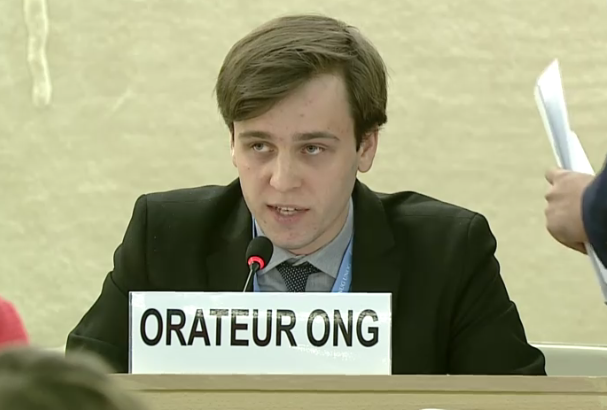
The ICJ today delivered a statement at the UN Human Rights Council calling on Myanmar to cooperate with UN mechanisms and for all UN agencies in the country to make human rights central to their approach.
The statement, made in the interactive dialogue with the international Fact Finding Mission on Myanmar, and the Special Rapporteur, read as follows:
“The International Commission of Jurists (ICJ) welcomes the update of the Independent International Fact Finding Mission. In relation to crimes under international law, the ICJ encourages the experts to continue to develop further specific recommendations for securing criminal accountability and providing redress.
The ICJ also welcomes the report of the Special Rapporteur, and strongly supports the renewal of her mandate and tenure.
As a UN Member State, the Government of Myanmar should fully cooperate with all the organs and mechanisms of the UN, in accordance with its obligations under the UN Charter.
At this session, the government asked for ‘concrete evidence’ of alleged human rights violations, and committed to taking action against perpetrators, but permission to enter the country is still refused to the Fact Finding Mission, to the Special Rapporteur and to the Office of the High Commissioner for Human Rights.
To demonstrate a genuine commitment to truth and accountability, the Government must allow them full access to areas of concern, particularly to Rakhine State and to conflict areas in Kachin State and Shan State.
Humanitarian actors and independent media must also be immediately allowed full and unimpeded access, particularly to Rakhine State, as recommended by the government’s own Advisory Commission.
The current situation in Rakhine State is incongruous to voluntary returns of Rohingya refugees. At the same time, the UN High Commissioner for Human Rights must be included in repatriation planning with a full mandate to protect refugees. This is contemplated in current repatriation arrangements with the Government of Bangladesh, and the Government of Myanmar must now formalize this relationship with UNHCR.
Experts, what can be done to ensure all UN agencies present in Myanmar actually put ‘human rights up front’ in the line with the mandate of every UN organ under the UN Charter?”
Mar 9, 2018 | Events, News
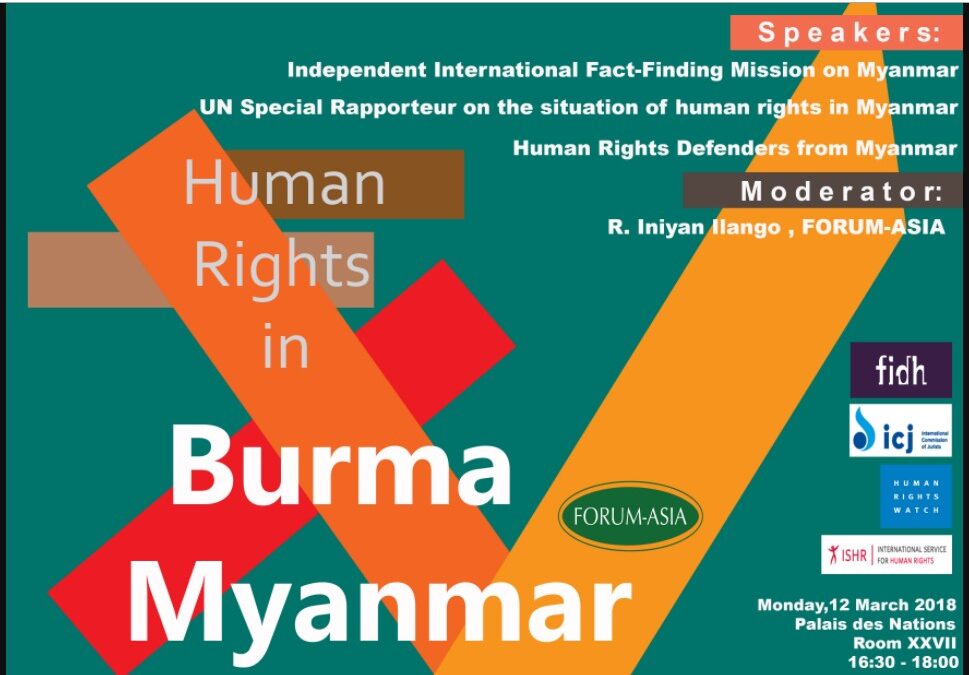
This side event at the Human Rights Council takes place on Monday, 12 March, 16:30-18:00, room XXVII of the Palais des Nations. It is organized by Forum-Asia, and co-sponsored by the ICJ.
Speakers:
Independent International Fact-Finding Mission on Myanmar
UN Special Rapporteur on the situation of human rights in Myanmar
Human Rights Defenders from Myanmar
Moderator:
R. Iniyan Ilango, Forum – Asia
Feb 27, 2018 | Events, News
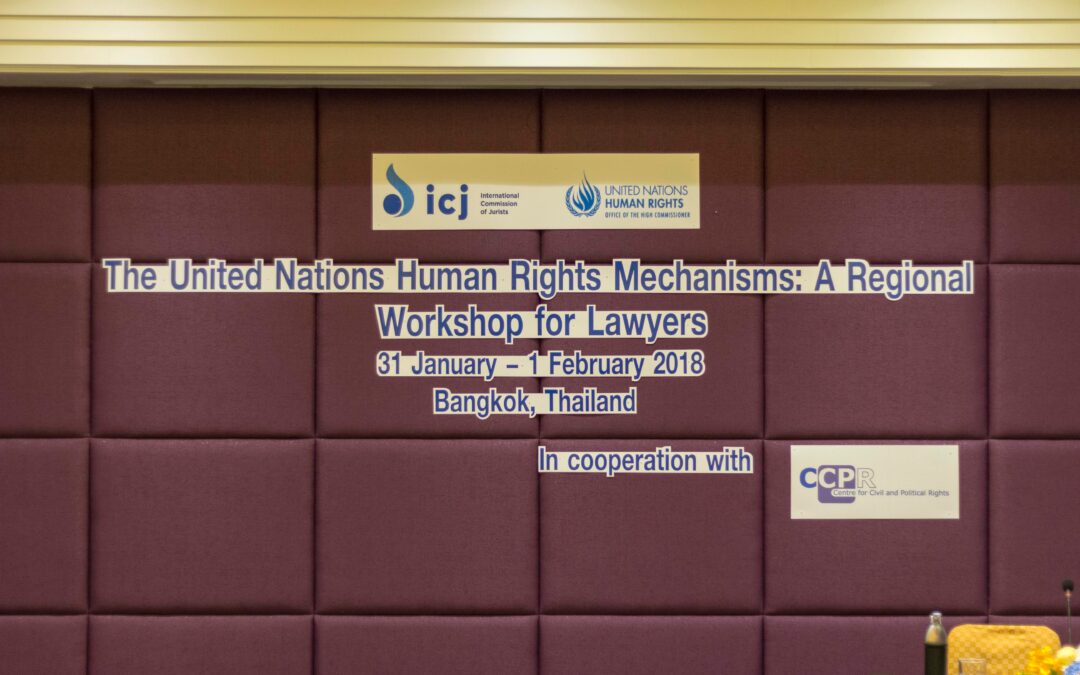
The ICJ, in collaboration with the UN High Commissioner for Human Rights Regional Office for South-East Asia (OHCHR), and the Centre for Civil and Political Rights, organised a workshop for lawyers from southeast Asia, on engaging with UN human rights mechanisms.
The two-day workshop provided some thirty lawyers from Thailand, Cambodia, Vietnam, and Lao PDR with knowledge, practical skills and expert advice about UN human rights mechanisms, with the participants themselves sharing their own experiences and expertise.
In addition to explaining what the UN mechanisms are and how they work, the workshop discussed how lawyers can use the outputs of UN human rights mechanisms in their professional activities, as well as how to communicate with and participate in UN human rights mechanisms in order to ensure good cooperation and to best serve the interests of their clients.
Sessions were introduced by presentations by the ICJ’s Main Representative to the United Nations in Geneva and OHCHR officials, followed by discussions and practical exercises in which all participants were encouraged to contribute questions and their own observations.
A special discussion of effective engagement of lawyers with Treaty Bodies was led by Professor Yuval Shany, a member of the Human Rights Committee established to interpret and apply the International Covenant on Civil and Political Rights (ICCPR).
The workshop also aimed to encourage the building of relationships and networks between the lawyers from across the region.
The workshop forms part of a broader project of awareness-raising and capacity-building for lawyers from the region, about UN mechanisms.
A similar workshop was held in January 2017 for lawyers from Myanmar.
The project has also published (unofficial) translations of key UN publications into relevant languages, and is hosting lawyers in a mentorship programme in Geneva.
More details are available by contacting UN Representative Matt Pollard (matt.pollard(a)icj.org) or by clicking here: https://www.icj.org/accesstojusticeunmechanisms/