Jun 26, 2017 | Advocacy
Amnesty International (AI) and the ICJ welcome the commitments made by the Royal Thai Government to prevent torture and other ill-treatment and urge authorities to ensure no further delay in implementing these undertakings.
The statement came on on the 30th anniversary of the United Nations Convention against Torture and Other Cruel, Inhuman or Degrading Treatment or Punishment (UNCAT) – marked on June 26 as the International Day in Support of Victims of Torture.
October 2017 will mark ten years since Thailand pledged to respect and protect the right of all persons to be free from torture and other ill-treatment by ratifying the Convention against Torture. AI and the ICJ however remain concerned that torture is still prevalent throughout the country.
Thailand has made significant and welcome commitments at the United Nations Committee against Torture, Universal Periodic Review of the Human Rights Council and UN Human Rights Committee to uphold its obligations under the Convention against Torture.
These include commitments to penalize torture, as defined in the Convention, under its criminal law and to create an independent body to visit all places of detention under the purview of the Ministry of Justice.
However, to date, these remain paper promises, which have not yet translated into action.
AI and the ICJ call on Thailand to move forward with these commitments, including by criminalizing torture and other acts of ill-treatment, establishing practical, legal and procedural safeguards against such practices, and ensuring that victims and others can report torture and other ill-treatment without fear.
The prohibition of torture and other ill-treatment in international law is absolute. Torture is impermissible in all circumstances, including during public emergencies or in the context of threats to public security.
AI and the ICJ regret repeated delays to the finalisation and passage of Thailand’s Draft Prevention and Suppression of Torture and Enforced Disappearance Act.
If the remaining discrepancies with the Convention against Torture are addressed, the passage of this Act would criminalise torture and enforced disappearances and establish other safeguards against these acts.
Both organizations urge the Royal Thai Government to actualise its commitment to eradicating torture by addressing remaining shortcomings in the Act and prioritising its passage into law in a form that fully complies with Thailand’s obligations under the Convention against Torture and the Convention for the Protection of All Persons from Enforced Disappearance.
Additional consultations with the public and other parties should be carried out in a transparent and inclusive manner and without delay.
Similarly, AI and the ICJ urge Thailand to move ahead with its commitment to ratify the Optional Protocol to the Convention against Torture, which obligates authorities to establish a National Preventive Mechanism – an independent expert body authorised to visit places of detention, including by carrying out unannounced visits – as well as to allow such visits by an international expert body.
Such independent scrutiny is critical to prevent torture and other ill-treatment, including through implementing their detailed recommendations based on visits.
Authorities should also act immediately on the commitment made at Thailand’s Universal Periodic Review before the United Nations Human Rights Council in 2016 to inspect places of detention in line with the revised UN Standard Minimum Rules for the Treatment of Prisoners, also known as the Nelson Mandela Rules.
Thailand-Torture satement AI-ICJ-Advocacy-ENG-2017 (full statement in English, PDF)
Thailand-Torture satement AI-ICJ-Advocacy-THA-2017 (full statement in Thai, PDF)

Jun 23, 2017 | News
Today, the ICJ co-hosted an event in Bangkok, Thailand, named “Torture Bill, Still No Justice” to commemorate International Day in Support of Victims of Torture.
The event began with a keynote address by Professor Vitit Muntarbhorn, Special Rapporteur on violence and discrimination based on sexual orientation and gender identity and former ICJ Commissioner.
Following a screening of the film “The Railway Man”, the ICJ moderated a panel discussion which included victims of torture.
The event focused on the decision in February this year of Thailand’s National Legislative Assembly (NLA) to further delay the passage of essential legislation criminalizing torture and enforced disappearance.
Thailand is a State party to the International Covenant on Civil and Political Rights (ICCPR), the Convention against Torture and other Cruel, Inhuman or Degrading Treatment or Punishment (CAT), and has signed, but not yet ratified, the International Convention for the Protection of All Persons from Enforced Disappearance (ICPPED).
The other organizers of the event were the Southeast Asia Regional Office of the Office of the High Commissioner for Human Rights, Amnesty International Thailand, the Cross-Cultural Foundation (CrCF), the Association for the Prevention of Torture (APT) and the Canadian Embassy in Bangkok.
A comic in English and Thai named “Torture is a Crime” was produced especially for the event by Shazeera Zawawi of APT.
Contact
Kingsley Abbott, ICJ Senior International Legal Adviser for Southeast Asia, t: +66 94 470 1345 ; e: kingsley.abbott(a)icj.org
Thailand-Comic-Torture is A Crime-Advocacy-2017-ENG (English version of the comic, PDF)
Thai version here
May 26, 2017 | News
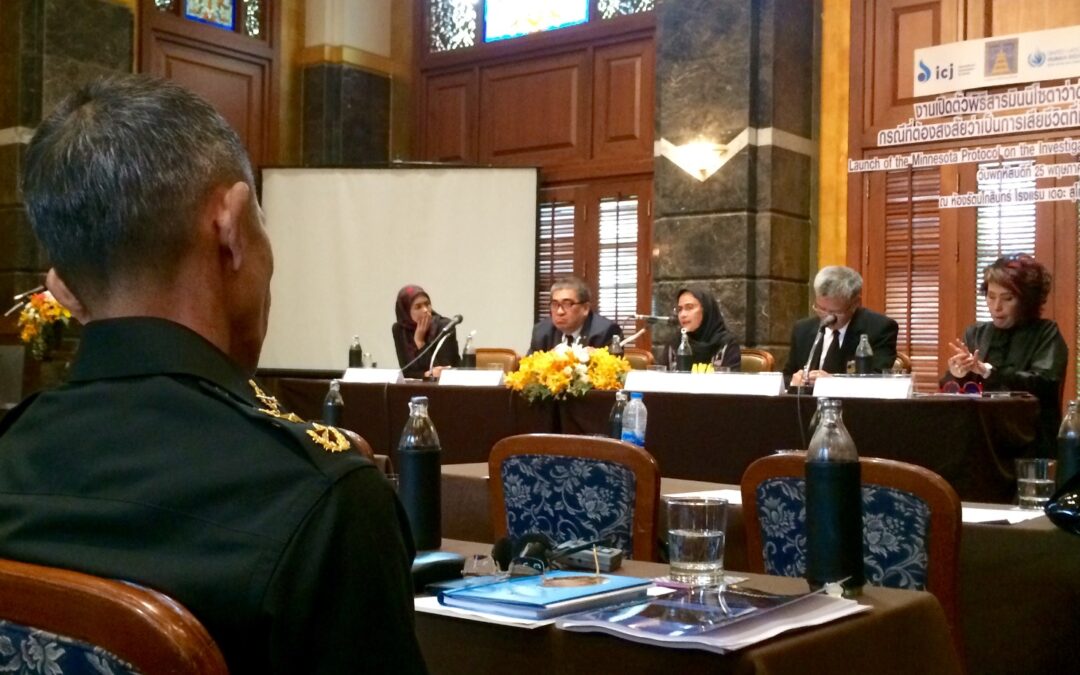
The ICJ has launched the revised Minnesota Protocol on the Investigation of Potentially Unlawful Death (2016) in Thailand, together with the Thai Ministry of Justice, the Office of the High Commissioner for Human Rights and the German Embassy in Bangkok.
The launch on Thursday coincided with a parallel launch of the revised Minnesota Protocol by the Office of the High Commissioner for Human Rights in Geneva.
The Minnesota Protocol is a companion document to the UN Principles on the Effective Prevention and Investigation of Extra-legal, Arbitrary and Summary Executions (1989), and sets a common standard of performance in investigating potentially unlawful death and a shared set of principles and guidelines for States, as well as for institutions and individuals who play a role in death investigations.
The launch was attended by representatives of the Ministry of Justice, Ministry of Foreign Affairs, the Royal Thai Police, the Office of the Attorney General, the Ministry of Defence, and the National Human Rights Commission of Thailand.
Kingsley Abbott, ICJ Senior International Legal Adviser for Southeast Asia and member of the Forensics and Legal Working Groups which assisted with the revision the Minnesota Protocol, opened the event for the ICJ by commending Thailand for hosting the first national launch of the revised Minnesota Protocol.
“Investigations play a key role in accountability by upholding the right to life which is guaranteed by Article 6 of the International Covenant on Civil and Political Rights, to which Thailand is a State Party,” said Abbott. “All over the world we witness impunity in cases of unlawful death because either investigations do not take place or are inadequate and non-compliant with international law and standards.”
“The Minnesota Protocol makes it clear that investigations must be prompt, effective and thorough, as well as independent, impartial and transparent, and we expect that the revised Minnesota Protocol will help Thailand and other States to meet that obligation,” added Abbott. “The ICJ wishes to take this opportunity to reaffirm our long-standing commitment to the Thai authorities to assist them in efforts to implement Thailand’s international human rights obligations.”
The other speakers at the launch were:
- Ms Pitikarn Sitthidech, Director General, Rights and Liberties Protection Department, Ministry of Justice
- Ms Katia Chirizzi, Deputy Head, Office of the High Commissioner for Human Rights (OHCHR), Regional Office for Southeast Asia
- Prof. Stuart Casey-Maslen, Project Manager of the revision of the Minnesota Protocol, University of Pretoria
- Dr Pornthip Rojanasunan, Adviser, Central Institute for Forensic Science (CIFC) and member of the Expert Advisory Panel of the revision of the Minnesota Protocol
- Ms Angkhana Neelapaijit, Commissioner, National Human Rights Commission of Thailand and Victim Representative
- Mr Kittinan Thatpramuk, Deputy Director General, Department of Investigation, Office of the Attorney General
- Pol.Lt.Col. Payao Thongsen, Commander, the Special Criminal Cases Office 1, Department of Special Investigation (DSI)
Contact
Kingsley Abbott, ICJ Senior International Legal Adviser for Southeast Asia, t: +66 94 470 1345; e: kingsley.abbott(a)icj.org
Universal-Minnesota Protocol-Advocacy-2017-ENG (PDF, English)
Universal-Minnesota-Protocol-Advocacy-2017-THA (PDF, Thai)
Universal-Minnesota Protocol-Advocacy-2017-BUR (PDF, Burmese)
May 4, 2017 | News
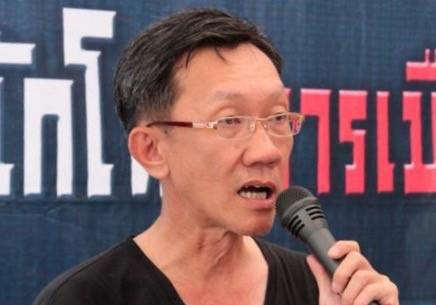
Thailand should immediately end the practice of arbitrarily detaining persons in unofficial places of detention said the ICJ today.
The statement came after it was revealed that human rights lawyer, Prawet Prapanukul, who had been arbitrarily detained for five days at a detention facility inside a military base in Bangkok, finally appeared and was charged at the Bangkok Criminal Court on 3 May 2017.
During the morning of 29 April 2017, military officers invoked Head of National Council for Peace and Order (NCPO) Order 3/2015 to arrest Prawet Prapanukul and search his residence in Bangkok, seizing a number of items located at the property including computers, phones and hard-drives.
The whereabouts of Prawet Prapanukul were unknown until the afternoon of 3 May 2017, when Prawet Prapanukul contacted several lawyers including Thai Lawyers for Human Rights (TLHR) and said he had been held at the Nakhon Chaisri temporary remand facility inside the 11th Army Circle military base in Bangkok.
“Prawet Prapanukul’s five-day incommunicado detention without being brought before the courts or access to legal counsel amounts to an arbitrary detention in violation of his rights under international law and consequently he should be provided with appropriate reparation,” said Kingsley Abbott, the ICJ’s Senior International Legal Adviser for Southeast Asia.
“To ensure the protection of all persons while in detention, Thailand has a duty to detain people in officially recognized places of detention, to have their names and places of detention made available to interested persons and to bring them before a court without delay within 48-hours,” he added.
According to TLHR, on 3 May 2017, Prawet Prapanukul was charged with ten counts of the highly restrictive crime of lese majeste (article 112 of the Criminal Code), three counts of a sedition-like offence (article 116 of the Criminal Code), and violation of article 14(3) of the Computer Crime Act.
The ICJ has previously raised concerns about abusive recourse to these laws.
Pursuant to article 91(3) of the Thai Criminal Code, it is possible that, if convicted of these charges, Prawet Prapanukul could receive a maximum sentence of 50-years imprisonment.
“Freedom of expression, as protected under international law, must never be criminalized. In any event, imprisonment is never a proportionate penalty for the exercise of free expression, let alone the unthinkable possibility of 50-years, which would set a new recorded record for a sentence for lese majeste,” Abbott said.
On 25 April 2017, after reviewing Thailand’s compliance with its obligations under the International Covenant on Civil and Political Rights (ICCPR), to which Thailand is a State Party, the Human Rights Committee, the international expert body charged with supervising the implementation of the ICCPR, issued its Concluding Observations in which it noted that in Thailand “individuals were reportedly often detained without charge and held incommunicado at undisclosed places of detention for periods of up to seven days, with no judicial oversight or safeguards against ill-treatment and without access to a lawyer.” The Human Rights Committee observed that Thailand should immediately release all victims of arbitrary detention and provide them with full reparation.
“The fact that Thailand arbitrarily detained Prawet Prapanukul at a military facility just five days after the Human Rights Committee issued its Concluding Observations criticizing Thailand’s practice of detaining people incommunicado in undisclosed placed of detention demonstrates a worrying contempt for its international human rights obligations as pointed out by the Committee,” Abbott added.
Contact
Kingsley Abbott, ICJ Senior International Legal Adviser for Southeast Asia, t: +66 94 470 1345 ; e: kingsley.abbott(a)icj.org
Thailand-Prapanukul-detention-News-2017-ENG (full text with background, in PDF)
Thailand-Prapanukul-detention-News-2017-THA (Thai version, in PDF)
Mar 12, 2017 | Events, News
A side event to the UN Human Rights Council, Tuesday 14 March, 16.00 – 17.00, Palais des Nations room XXI.
TORTURE AND ENFORCED DISAPPEARANCE IN THAILAND
THE STATE RESPONSE
Tuesday 14 March/16.00-17.00
room XXI
Panelists:
Angkhana Neelapaijit, National Human Rights Commissioner and family victim of enforced disappearance
Yuval Ginbar, Amnesty International legal advisor
Moderated by Matt Pollard, ICJ Senior Legal advisor
The event follows the Human Rights Committee’s examination of Thailand’s second periodic report on its implementation of the International Covenant on Civil and Political Rights on 13 and 14 March 2017.
The event will focus on the measures Thailand has taken to implement its international human rights obligations with respect to the prohibition of enforced disappearance, torture and ill-treatment – with a particular focus on the draft Prevention and Suppression of Torture and Enforced Disappearance Act (Draft Law).
Background
Eighty-two cases of enforced or involuntary disappearance in Thailand were reported to the Working Group on Enforced or Involuntary Disappearances between 1980 and 2016. Civil society has also issued several reports containing allegations of torture by security forces, particularly in the restive deep South. These allegations were made against a culture of impunity which pervades Thailand.
In October 2016, after 11 years and three months of investigation, the Department of Special Investigation (‘DSI’) declared the emblematic enforced disappearance case of Somchai Neelapaijit closed, saying no culprits had been found. In January 2017, the DSI further announced it would not investigate the apparent enforced disappearance of Pholachi “Billy” Rakchongcharoen, a Karen minority human rights defender. These cases underscore the difficulties victims face in obtaining justice under the current legal framework in Thailand.
For several years, Thailand has pledged its commitment to ratifying the International Convention on Enforced Disappearance (ICCPED) and passing domestic legislation criminalizing torture and enforced disappearance. In May 2016, the Cabinet approved a Draft Law, which was subsequently transmitted to Thailand’s legislature, the National Legislative Assembly (NLA). However, last month, the NLA announced it would send the Draft Law back to the Cabinet for further consultation, effectively ending the possibility of it being enacted in the foreseeable future.
For further information on recent developments concerning this piece of legislation, please see: https://www.icj.org/thailand-prioritize-the-amendment-and-passage-of-legislation-on-torture-and-enforced-disappearances/.
A flyer for the event may be downloaded here.