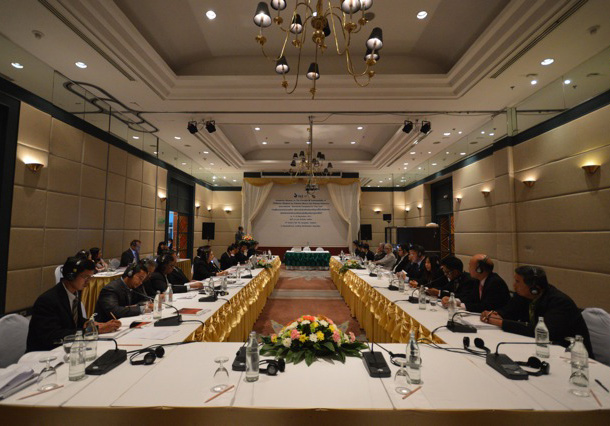
ASEAN lawyers to work towards stronger human rights safeguards
More than 40 delegates from nine countries attended a regional workshop for ASEAN lawyers in Bangkok April 28-30 on the promotion and protection of the rights of human rights defenders.
The ICJ and other rights groups today demanded the Royal Thai Government carry out a thorough and impartial investigation into the “disappearance” of Pholachi “Billy” Rakchongcharoen.
The ICJ recently organized a Legal Seminar for Thai Lawyers and Women Human Rights Defenders on the Optional Protocol to the Convention on the Elimination of all forms of Discrimination Against Women.
On 25 April 2014 Thai lawyers and human rights defenders participated in a legal seminar on using international complaints mechanisms to advance women’s access to justice and human rights protection.
The ICJ seminar enabled global experts to provide local actors with practical guidance and strategic advice on using the Optional Protocol to the Convention on the Elimination of All Forms of Discrimination against Women (CEDAW).
The Protocol, which was ratified by Thailand in 2004, allows women who believe their rights under CEDAW have been violated, to submit a complaint to the UN Committee on the Elimination of Discrimination against Women and seek the Committee’s deliberation and views on the matter.
The legal seminar was part of ongoing ICJ work to empower women lawyers and human rights defenders and advance women’s access to justice in Thailand.
Thailand’s caretaker government must remove emergency measures throughout the country following the lifting of the Emergency Decree in the capital Bangkok and its surrounding provinces this week, the ICJ said today.
On 18 March, the caretaker government voted to lift the Emergency Decree (effective 19 March) that had been in place in Bangkok and surrounding provinces since 21 January 2014 in response to protests led by the People’s Democratic Reform Committee (PDRC).
At least 20 people have died in protest-related violence and hundreds have been injured.
The Emergency Decree was replaced by the Internal Security Act (ISA), which also does not fully comply with international standards, but provides better remedies for victims of human rights violations than the Decree.
“The imposition of the Emergency Decree creates an environment conducive to abuse of power and human rights violations such as arbitrary arrest and detention, torture and enforced disappearance,” said Sam Zarifi, ICJ’s Regional Director for Asia and the Pacific. “Lifting the Emergency Decree in Bangkok is a positive step, but it is crucial that the authorities remove the Emergency Decree and other measures of emergency rule, including martial law, that are in force in all or parts of at least 30 of Thailand’s 77 provinces.”
These measures should be replaced by law and action that are consistent with international human rights standards, Zarifi said, adding that martial law should not be used as a political tool.
The caretaker government must respond to demonstrations, unrest and emergencies in a manner which complies with its obligations under the International Covenant on Civil and Political Rights (ICCPR), and other international standards, including the Code of Conduct for Law Enforcement Officials, adopted by the UN General Assembly in 1979, and the Basic Principles on the Use of Force and Firearms by Law Enforcement Officials, adopted by the UN Congress on the Prevention of Crime and Treatment of Offenders in 1990.
These standards set out the circumstances in which resort to necessary and proportional force may be lawfully exercised. Article 8 of the Basic Principles on the Use of Force and Firearms states that “exceptional circumstances such as internal political instability or any other public emergency may not be invoked to justify any departure from these basic principles.”
In order to safeguard the rule of law and enhance the protection of human rights in Thailand, the ICJ calls on the caretaker government to repeal the Emergency Decree and other emergency measures including martial law, and to ensure accountability for violent acts through the thorough and effective investigation of criminal acts and prosecution of those reasonably suspected of committing them, in the course of fair, human rights-compliant criminal proceedings.
CONTACT: Sam Zarifi, ICJ Asia-Pacific Regional Director, (Bangkok), t:+66 807819002, e-mail: sam.zarifi(a)icj.org
Craig Knowles, ICJ Media & Communications, (Bangkok), t:+66 819077653, e-mail: craig.knowles(a)icj.org
For further reading on ICJ’s work on emergency laws in Thailand see: Thailand’s Internal Security Act, Risking the Rule of Law? (2010) https://www.icj.org/thailands-internal-security-act-risking-the-rule-of-law/ Implementation of Thailand’s Emergency Decree (2007) https://www.icj.org/thailand-implementation-of-thailand%C2%B4s-emergency-decree/ More Power, Less Accountability: Thailand’s New Emergency Decree (2005) https://www.icj.org/more-power-less-accountability/
A new ICJ report criticizes the Thai Government’s failure to take the steps necessary to establish the fate and whereabouts of missing lawyer Somchai Neelapaijit, saying it illustrates the challenges of achieving justice in cases of serious human violations in Thailand.
In the report, Ten Years Without Truth: Somchai Neelapaijit and Enforced Disappearances in Thailand, the ICJ documents the tortuous legal history of the case.
It highlights several key problems, such as poor use of forensic evidence, failure to follow and develop leads, unduly restrictive interpretation of national and international law, and above all, a lack of political will to resolve a case that remains emblematic of the culture of impunity in Thailand.
“Over the past 10 years, this case has taken many unexpected turns, including the disappearance of a prime suspect, admissions of Somchai’s death from officials while the courts have rejected such a finding, and most recently, a statement from the Department of Special Investigations that it had lost, and then found, the case files,” said Sam Zarifi, ICJ’s Regional Director for Asia and the Pacific.
“The Royal Thai Government has not exhausted all potential areas of inquiry and it must continue this investigation. There is no statute of limitations on an enforced disappearance and Somchai’s case is not forgotten in Thailand or around the world.”
Somchai, a lawyer and human rights defender, was stopped at a Bangkok roadside on March 12, 2004 and pulled from his car by a group of men. He has not been seen since.
At the time, Somchai was defending clients from Thailand’s restive southern provinces who were accused of attacking a military base as part of the ongoing insurgency in the region. Somchai had alleged police tortured the Muslim suspects.
Ten years later, Somchai’s wife, Angkhana Neelapaijit, and her family are no closer to knowing the truth about what happened to him.
“Somchai’s enforced disappearance, and the failure of the Royal Thai government to provide accountability or even basic information about his fate are emblematic of the challenges of achieving justice in cases of serious human rights violations in Thailand,” said Zarifi. “Enforced disappearance is not only a serious human rights violation but also a crime under international law.”
Thailand signed, but has not yet ratified, the Convention Against Enforced Disappearance in January 2012. Pending the ratification, Thailand must desist from any acts that would defeat the objective and purpose of the convention, which places an obligation on State Parties to make enforced disappearance a criminal offence and treat family members of a ‘disappeared’ person as victims in their own right.
The ICJ has followed Somchai’s case closely and worked with Angkhana Neelapaijit since 2004.
“The Royal Thai government’s failure to shed any more light on the enforced disappearance of Somchai Neelapaijit, despite providing compensation for his family and finding him to be ‘disappeared’, contradicts multiple past declarations of its commitment to seeking justice, or at least truth, including by several former Prime Ministers, Attorneys General, and officials,” the report says.
“It also contradicts official commitments before the United Nations Human Rights Council in March 2008.”
The ICJ’s report calls on the Royal Thai government to prioritize and advance the investigation into Somchai’s disappearance in a manner that conforms to its international obligations. It also recommends that Thailand:
–Ratify the Convention Against Enforced Disappearance;
–Enact legislation that makes enforced disappearance a specific crime in Thai domestic law, together with penalties that recognize its extreme seriousness;
–Amend existing Thai law to conform to the Convention Against Enforced Disappearance, as well as the State’s obligations, including with respect to effective remedy and reparation, under the ICCPR and CAT;
–Provide Angkhana Neelapaijit and her family with effective remedy and full reparation, in particular knowledge and clarification of the facts leading to the enforced disappearance and the progress and results of the Department of Special Investigations, and;
–Address the recommendations the ICJ made to the DSI in its letter of February 4, 2014 with respect to its investigation.
CONTACT
Sam Zarifi, ICJ Asia-Pacific Regional Director, (Bangkok), t:+66 807819002, e-mail: sam.zarifi(a)icj.org
Craig Knowles, ICJ Media & Communications, (Bangkok), t:+66 819077653, e-mail: craig.knowles(a)icj.org
Download the full report in PDF:
Ten Years Without Truth- Somchai Neelapaijit and Enforced Disappearances in Thailand – report – 2014
Thailand-Ten Years Without Truth-Publications-Reports-2014-THAI