Jun 24, 2019 | News
The ICJ and the International Bar Association’s Human Rights Institute (IBAHRI) have jointly sent international observers to attend the first hearing of the criminal trial on the “Gezi Park” protest at the Silivri Prison Courthouse in Istanbul, scheduled to take place on 24 and 25 June 2019.
The International Observers who will be attending are Justice Ketil Lund, former judge of the Supreme Court of Norway and ICJ Commissioner, and Dr Mark Ellis, Executive Director of the International Bar Association.
Justice Lund and Dr Ellis will be observing a trial hearing before İstanbul 30th Assize Court with principal defendant Osman Kavala and 15 others: Ali Hakan Altınay, Ayşe Mücella Yapıcı, Ayşe Pınar Alabora, Can Dündar, Çiğdem Mater Utku, Gökçe Yılmaz, Handan Meltem Arıkan, Hanzade Hikmet Germiyanoğlu, İnanç Ekmekci, Memet Ali Alabora, Mine Özerden, Şerafettin Can Atalay, Tayfun Kahraman, Yiğit Aksakoğlu and Yiğit Ali Ekmekçi.
The observers will report directly to the IBAHRI and ICJ Secretariats on the proceedings following the mission.
The Gezi Park protests began in May 2013 as an effort by a group of environmentalists to save a park in central Istanbul from being rezoned, but soon turned into nationwide demonstrations. The protest was quelled by police with the use of tear gas and water cannons against the protesters in Taksim Square.
Following a six-year investigation into the events, the 657-page indictment issued by the Istanbul Chief Public Prosecutor’s Office was accepted by the 30th A Court in Istanbul on 4 March 2019.
The defendants are to be charged under Turkish Criminal Code Article 312 (attempt to overthrow the Turkish Government or attempt to prevent it from fulfilling its duties), Article 151 (damage to property), Article 152 (qualified damage to property), Article 174 (possession or exchange of hazardous substances without permission), Article 153 (damaging places of worship and cemeteries), Article 149 (qualified robbery), Article 86 (intentional injury); crimes under the Law on Firearms, Knives and Other Tools no. 6136, and crimes under the Law on Protection of Cultural and Natural Assets no. 2863. The total sentence asked for by the prosecution for these offences amounts to approximately 47,520 years imprisonment.
Contact:
Massimo Frigo, Senior Legal Adviser, t: +41 22 979 38 05 – e: massimo.frigo(a)icj.org
Jun 23, 2019 | Events, News
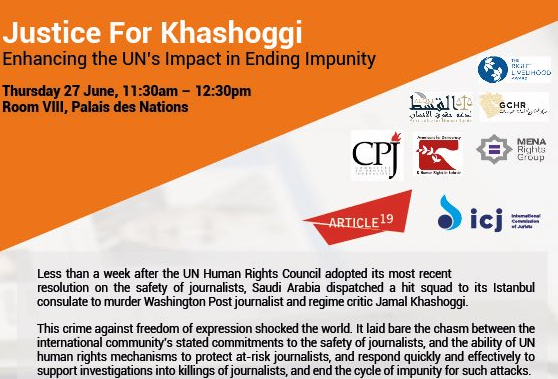
The ICJ joins other NGOs and UN experts in presenting a side event to the UN Human Rights Council, Thursday 27 June, 11:30am – 12:30pm, in Room VIII, Palais des Nations
Less than a week after the UN Human Rights Council adopted its most recent resolution on the safety of journalists, Saudi Arabia dispatched a hit squad to its Istanbul consulate to murder Washington Post journalist and regime critic Jamal Khashoggi.
This crime against freedom of expression shocked the world. It laid bare the chasm between the international community’s stated commitments to the safety of journalists, and the ability of UN human rights mechanisms to protect at-risk journalists, and respond quickly and effectively to support investigations into killings of journalists, and end the cycle of impunity for such attacks.
This human rights crisis is not limited to autocratic countries or nascent democracies – after several years in decline, the number of killings of journalists worldwide spiked in 2018, whilst impunity for historic cases remains troublingly high, fueling further violence. In Malta, a report by PACE Special Rapporteur Pieter Omtzigt into the killing of Daphne Caruana Galizia more than 18 months ago, highlighted serious concerns over national investigations, pointing to systemic rule of law failings in the country.
As the UN Special Rapporteur on extrajudicial, arbitrary or summary executions, Dr. Agnès Callamard, presents the findings of her independent investigation into the killing of Jamal Khashoggi to the 41st Session of the UN Human Rights Council, join us to discuss what recent attacks on journalists have taught us about gaps in prevention, protection and prosecution, and how to enhance the UN’s response to impunity.
| Panelists |
Dr. Agnès Callamard |
UN Special Rapporteur on extrajudicial, summary or arbitrary executions |
|
David Kaye |
UN Special Rapporteur on freedom of opinion and expression |
|
Hatice Cengiz |
Fiancée of Jamal Khashoggi |
|
Pieter Omtzigt |
Special Rapporteur, Council of Europe |
|
Rob Mahoney |
Deputy Executive Director, Committee to Protect Journalists |
|
Yahya Assiri |
Founder and Director, ALQST |
| Moderator |
Thomas Hughes |
Executive Director, ARTICLE 19 |
Jun 20, 2019 | Advocacy, Cases, Legal submissions, News
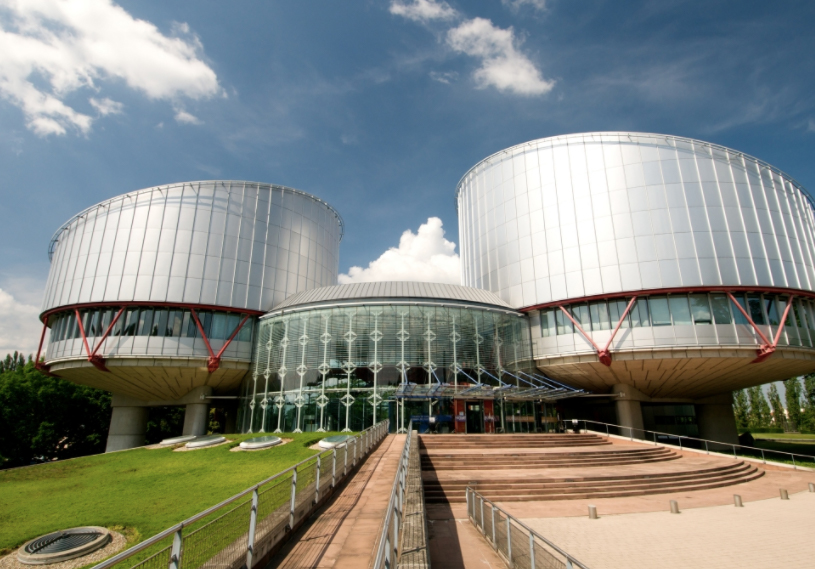
The International Commission of Jurists, jointly with Amnesty International and the Turkey Litigation Support Project intervened today before the European Court of Human Rights in the case of a Turkish public servant, Hamit Pişkin, who was dismissed by executive decrees during the State of Emergency.
The case is key with regard to the situation in Turkey now and under the State of Emergency, because it raises significant questions regarding procedural rights in employment proceedings leading to the dismissal of an employee working with or for a State agency on grounds related to national security, including under a State of Emergency, as well as the application of the principles of legality and legal certainty and non-retroactivity as applied to national security, including in counter-terrorism.
During the State of Emergency in Turkey, that lasted two years from 2016 to 2018, almost 130,000 employees in the public sector were dismissed under emergency legislation. Their dismissal however remained in force also after the end of the State of Emergency.
In the submission, the interveners provide the European Court of Human Rights with observations concerning:
- the applicability of the criminal limb of Article 6 of the European Convention on Human Rights (ECHR) to judicial proceedings leading to dismissal of an employee of a public institution;
- the lack of procedural guarantees in the dismissal process necessary to comply with Article 6 of the ECHR, in particular with the presumption of innocence Article 6(2), in such proceedings;
- the application of the principles of legal certainty and non- retroactivity to such decisions (by addressing the problems arising from the application of State of Emergency decrees to events that occurred before the declaration of the State of Emergency).
The full intervention can be downloaded here: Piskin_v_Turkey-ECtHR-TPI-ICJAITLSP-2019-eng
Apr 12, 2019 | News
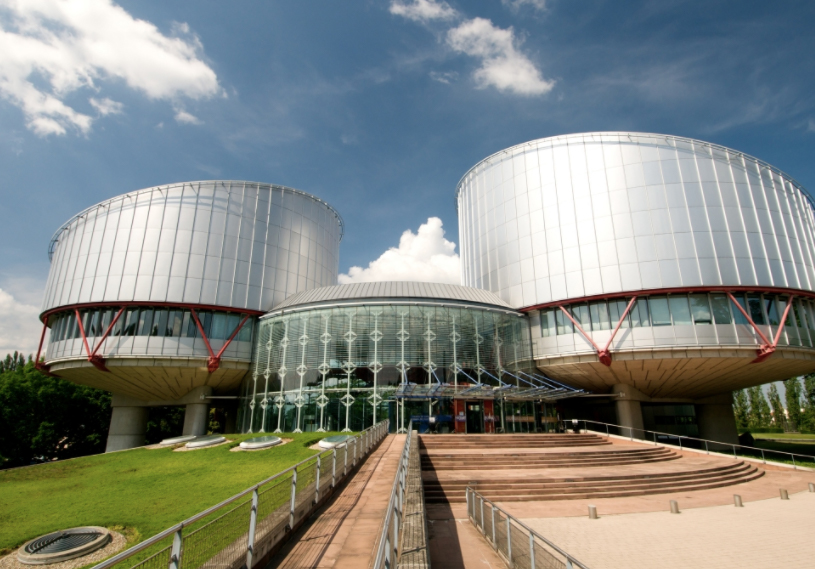
Today in Ankara the ICJ convened a workshop for lawyers and civil society practitioners on the implementation of judgments of the European Court of Human rights.
The 29 participants in the workshop will examine methods and tools available to guarantee the effective execution of the European Court of Human Rights judgments in Turkey.
The participants in the workshop will discuss the use of the Committee of Ministers’ judgment execution process and the potential of “rule 9“submissions, as well as ways to advance the implementation of the judgments oft he European Court of Human Rights in Turkey.
The workshop will share good practices with a view to promoting solutions and opportunities for cooperation in the matter.
This one-day event is organized by ICJ, in cooperation with its partners Kapasite Geliştirme Derneği, Human Rights Joint Platform and European Implementation Network, as part of the EU co-financed project Rebuilding and Ensuring Access to justice with civil society in Turkey.
The project is funded by the European Instrument for Democracy and Human Rights (EIDHR) of the European Union.
Mar 12, 2019 | Advocacy, Non-legal submissions
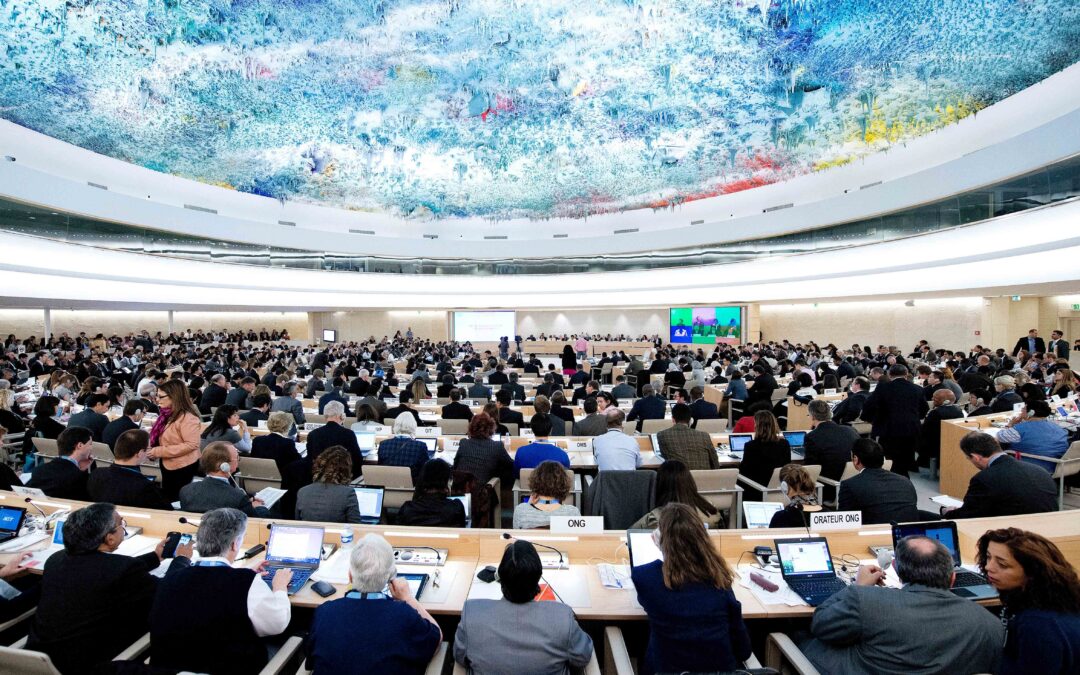
The ICJ today highlighted threats to the rule of law in Turkey, Poland, Hungary and Azerbaijan, and the need to address corporate complicity in South Sudan, at the UN Human Rights Council in Geneva.The statement, delivered during general debate, read as follows:
“The situation remains grave for the rule of law and legal protection of human rights in Turkey and Poland.
In Turkey, constitutional reforms in 2017 that undermined the independence of the judiciary should be abolished. Civil society members are prosecuted under overbroad and vague terrorism offences.
In Poland, the Legislature is trying arbitrarily to remove one third of the Supreme Court, a measure that is on hold only temporarily. Unjustified disciplinary proceedings are also being pursued against Polish judges for having sought a ruling of the Court of Justice of the EU.
Elsewhere, in Hungary civil society is ostracized and subject to legislation that risks criminalizing their legitimate activities. In Azerbaijan, as one example of a broader pattern of interference with lawyers and other human rights defenders, lawyer Elchin Sadigov was reprimanded for advising in a confidential manner to his client in detention to complain about torture to which he allegedly had been subjected.
The ICJ is also concerned at the findings by the Commission on Human Rights in South Sudan (A/HRC/40/69, A/HRC/40/CRP.1) that point to the oil industry as a “major driver” in the continuation of the armed conflict and resulting human rights violations. Potential corporate complicity with crimes under international law demand investigation and a strong monitoring mechanism for the use of oil revenues should be established.”