Jun 12, 2017 | Advocacy, Non-legal submissions
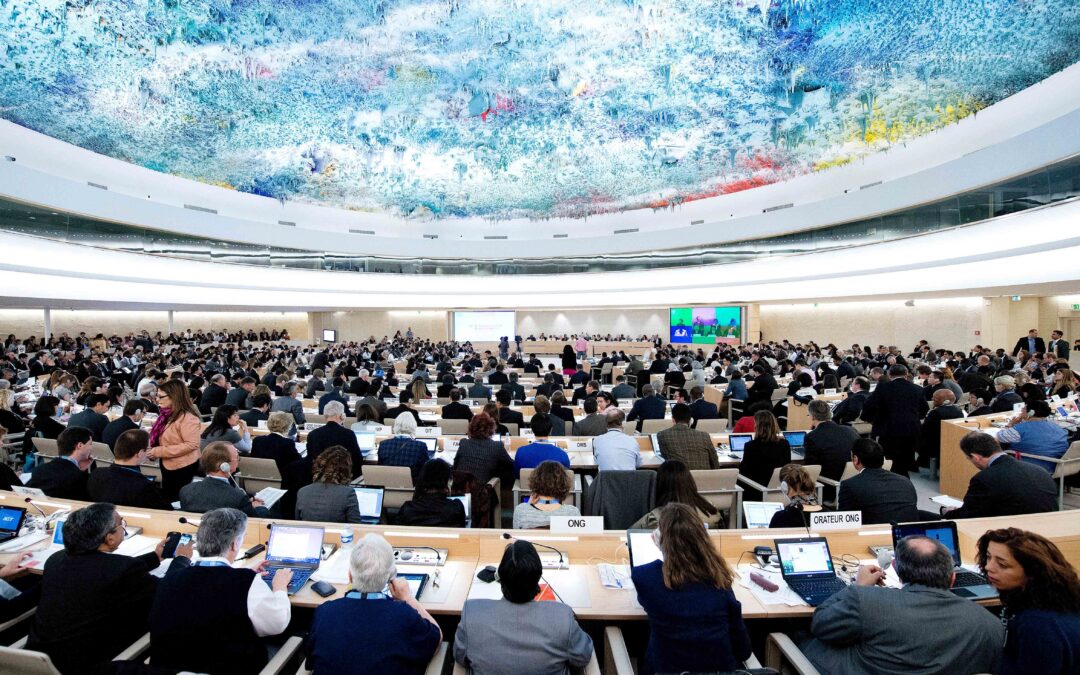
Speaking at the UN Human Rights Council, the ICJ today highlighted judicial corruption and threats to judges and lawyers in Turkey and Azerbaijan, as well as regressive steps on violence against women in the United States of America and Russian Federation.
The statement, delivered during the interactive dialogue with the UN Special Rapporteur on Independence of Judges and Lawyers and the UN Special Rapporteur on Violence against Women, was as follows:
“The ICJ warmly welcomes the new Special Rapporteur on Independence of Judges and Lawyers. As he has highlighted, ensuring judges are accountable for corruption and human rights violations, while respecting judicial independence, should be a global priority. Our Practitioners’ Guide on Judicial Accountability, published last year, should be of particular use to the Rapporteur and other actors in this regard.
Several situations serve as stark examples of other issues raised in his report. In Turkey, recent constitutional amendments give the President and Parliament control over the judiciary’s governing body. This has undermined the judiciary’s independence, already threatened by the mass dismissal of judges and the state of emergency. Lawyers and legal scholars, among others, are routinely dismissed or threatened by the authorities.
In Azerbaijan, the Bar Association is not independent and does not protect its members against undue interference with the exercise of their professional duties. Rather, it often serves as a tool of retaliation against independent human rights lawyers, including through disbarment proceedings that contravene international standards.
We would ask the Special Rapporteur for his views on the role his mandate can play in these and similar situations.
The ICJ also welcomes the report of the Special Rapporteur on violence against women.
Despite increasing global acknowledgement of the grave and systemic nature of violence against women, some States continue to introduce regressive legislation undermining protections for women. For example, the Russian Federation’s decriminalization of certain forms of domestic violence, and attempts in some parts of the United States of America to restrict availability of sexual and reproductive healthcare, particularly impact on victims of sexual violence. The Philippines’ President’s public statements disregarding the gravity of sexual violence are another example. The ICJ would ask the Special Rapporteur what can be done to prevent such backsliding?”
Jun 8, 2017 | Events, News
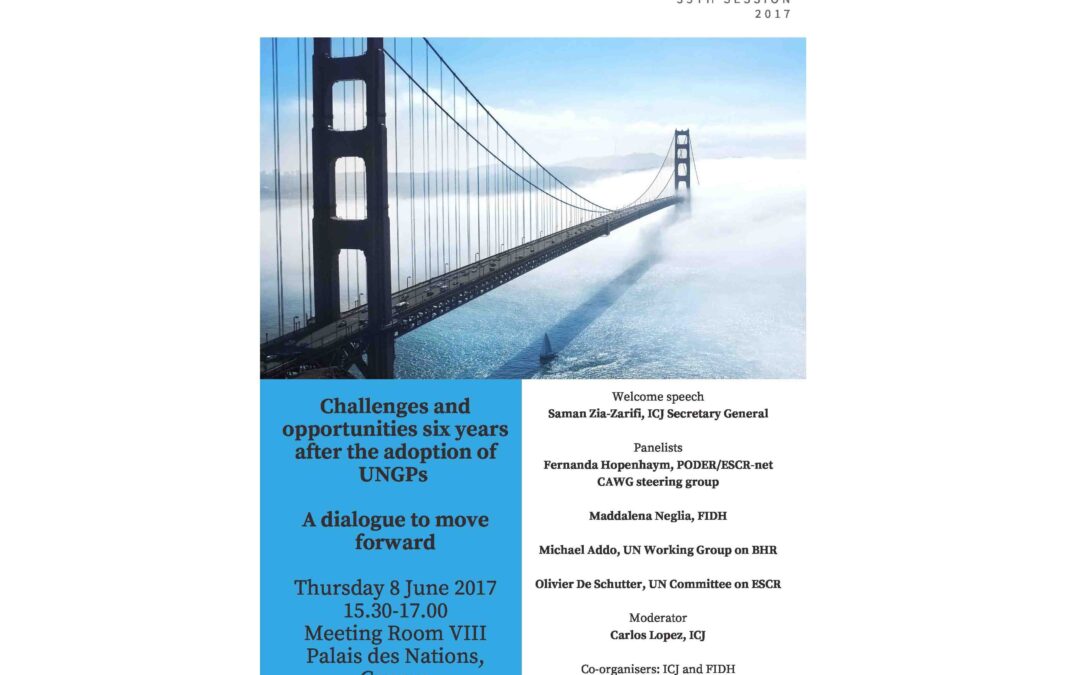
Today, the ICJ and FIDH are organizing a side event to to the 35th Regular session of the Human Rights Council on business and human rights.
Business responsibility to respect human rights
Challenges and opportunities six years after the adoption of UNGPs
A dialogue to move forward
Thursday 8 June 2017, 15.30-17.00
Meeting Room VIII
Palais des Nations, Geneva
After the adoption of the UNGP in 2011, standards on business responsibility to respect human rights and business human rights due diligence have gained prominence in the global debate on business accountability.
Many companies claim to comply with the UNGP by performing a human rights due diligence including across their global supply chain.
Several initiatives have emerged at regional and national level to promote companies’ due diligence processes, including the EU Directive on non-financial reporting, the UK Modern Slavery Act, the French law on company devoir de vigilance.
Despite the progress, serious human rights abuses still occur in both developing and developed countries.
The ability of companies to identify, monitor and prevent negative human rights impacts in their operations and relationships is still weak and the access to effective remedy remains difficult if not impossible.
This is an opportune moment to take stock of the progresses made to date and the challenges ahead in order to create a level playing field that will effectively promote the respect of human rights in business global operations.
Welcome speech
Saman Zia-Zarifi, ICJ Secretary General
Moderator
Carlos Lopez, ICJ
Panelists
Fernanda Hopenhaym, PODER/ESCR-net CAWG steering group
Maddalena Neglia, FIDH
Michael Addo, UN Working Group on BHR
Olivier De Schutter, UN Committee on ESCR/University of Louvain

May 30, 2017 | News
Representatives of large European business enterprises met today with State delegates and representatives of FIDH and the ICJ in Geneva to discuss their views on a prospective international treaty on business and human rights.
The meeting was organized by the FIDH and ICJ and took place under Chatham House rules.
The United Nations Human Rights Council started in 2014 an intergovernmental process towards an international treaty concerning business and the protection human rights.
The first draft elements of that treaty should be discussed in October 2017, after two years of preparatory consultations among the concerned stakeholders.
The meeting in Geneva took place in the context of growing involvement by key business leaders in international discussions, in dialogue with civil society and governments, around global human rights standards.
Business representatives present in the meeting expressed their views regarding the content of a future international treaty founded on their need to have level playing field regarding human rights responsibilities to operate in global markets.
They pointed out that the new treaty should apply to all businesses, go beyond the existing frameworks and create a framework for a fair human rights based competition among businesses towards higher standards.
State delegates and NGOs representatives also shared their perspectives noting that the current circumstances call for bolder collective action as a matter of urgency.
Most participants underlined the key role that State agencies should play in enforcing the rules at the local level and in protecting their people.
Finally, a call was made for businesses, civil society and governments to take their responsibility to promote global human rights binding rules for business operations, including in the global marketplace.
May 27, 2017 | News
On 24 May 2017, States at the UN reached an agreement to prepare an “international regulatory framework” to protect human rights and ensure accountability for violations and abuses relating to the activities of private military and private security companies (PMSCs).
The agreement, reached at Working Group level, has still to be ratified by the full UN Human Rights Council.
It would be the first universal international instrument on human rights and private security companies negotiated and adopted at the UN.
This could pave the way to further developments towards increased monitoring and accountability of the private security industry.
The agreement constitutes a landmark achievement. The intergovernmental Working Group over the past six years have been mired in circular debates as to whether or not it is desirable to develop a legally binding instrument on PMSCs.
Last’s week agreement leaves aside for the moment the decision about the nature of the instrument and will instead allow for a constructive focus on the contents of the future instrument.
Activities of private and military security companies became the object of heightened international scrutiny particularly after events in the context of the armed conflict in Iraq over the past decade.
These include unlawful killings at Nisoor Square and torture and ill-treatment at Abu Graib prison.
A Working Group of experts on mercenary activity appointed by the UN Human Rights Council started to look at the issues in 2007, generating proposals for international instruments to fill perceived regulatory gaps.
Many States have now accepted that the absence of an international regulatory framework combined with limited or non-existent regulation at national level offers a “breeding ground” for human rights abuses committed by PMSCs.
The main clients of these companies are governments that contract them to carry out specific functions, including some that many believe should remain firmly in the hands of public officials.
One key issue that the future instrument should address is the circumstances under which PMSCs can be considered to act on behalf of the State when they are contracted to perform functions that are typically State functions.
International law already governs some aspects of PMSC activity. International human rights law provides for a general obligation of States to protect against the adverse consequences of PMSC activity.
There has also been other international regulatory activity outside of UN auspices in this area.
In 2008 a select group of mostly Western States led by the Government of Switzerland and the International Committee of the Red Cross (ICRC) elaborated the Montreux Document on pertinent obligations for States regarding PMSCs.
Other initiatives such as a Code of Conduct for the PMSCs themselves followed suit. But many States and civil society organizations regard these initiatives as insufficient and lacking the universality afforded by UN processes.
One notable weakness in current approaches is the dearth of standards and mechanisms squarely addressing accountability of private security industry and to ensure access to remedy for those victims of abuse.
Experience shows that States legal frameworks have limited effectiveness when abuses occur at the cross-border level, involving more than one company in more than one jurisdiction, especially in conflict or post-conflict environments.
The prospective international regulatory framework should surely build on existing initiatives, research and findings.
To that end, broad participation by all stakeholders should be ensured.
In this regard, participation of civil society and NGOs specialized in human rights has not been optimal so far.
States leading this new process should make all and every effort to fill that gap, ensuring that international and national civil society receive timely information and facilities for meaningful participation.
May 5, 2017 | Advocacy, News, Publications
The ICJ has published a set of Principles on the Role of Judges and Lawyers in relation to Refugees and Migrants.
The Principles were developed by the ICJ on the basis of consultations with senior judges, lawyers, and legal scholars working in the field of international refugee and migration law (including at the 2016 Geneva Forum of Judges & Lawyers), as well consultations with States and other stakeholders on a draft version during the March 2017 Human Rights Council session, and other feedback.
The Principles seek to help judges and lawyers, as well as legislators and other government officials, better secure human rights and the rule of law in the context of large movements of refugees and migrants. They are intended to complement existing relevant legal and other international instruments, including the New York Declaration, as well as the Principles and practical guidance on the protection of the human rights of migrants in vulnerable situations within large and/or mixed movements being developed by the OHCHR.
The Principles address the role of judges and lawyers in relation to, among other aspects:
- determinations of entitlement to international protection;
- deprivation of liberty;
- removals;
- effective remedy and access to justice;
- independence, impartiality, and equality before the law;
- conflicts between national and international law.
The Principles, together with commentary, can be downloaded in PDF format by clicking here: ICJ Refugee Migrant Principles 2017.
They are also available in Spanish, French and Arabic.
The ICJ formally launched the published version of the Principles at a side event to the June 2017 session of the Human Rights Council (click here for details), where their importance and utility were recognised by the UN Special Rapporteur on the human rights of migrants, as well as representatives of UNHCR and the OHCHR.
The ICJ had earlier released the final text in connection with the Thematic Session on “Human rights of all migrants” for the UN General Assembly Preparatory Process for the Global Compact for Safe, Orderly and Regular Migration to be held in Geneva 8-9 May 2017, where in an oral statement the ICJ was able to highlight the potential utility of the Principles in the development of the Compact.
The ICJ further promoted consideration of the Principle, in an oral statement to the Human Rights Council.
More information about the process of development of the Principles, including the list of participants to the 2016 Geneva Forum, is available here.
The consultations, preparation and publication of the Principles was made possible with the financial support of the Genève Internationale office of the Republic and Canton of Geneva, for which the ICJ is grateful.
For further information, please contact ICJ Senior Legal Adviser Matt Pollard, matt.pollard(a)icj.org