Oct 2, 2013 | Events
The ICJ today welcomed the launch of the OSCE/FBA Handbook for Monitoring Administrative Justice as a tool able to contribute to the open administration of justice.
Noting that trends throughout the world see administrative cases dealt with in a manner that lacks transparency and fails to comport with the open administration of justice, the ICJ expressed the hope that the tool will be used by practitioners and officials to make an impact on the ground. The ICJ pointed to several reasons why the open administration of justice, in all forms of proceedings, is important to human rights and the rule of law:
- As a starting point, it is widely recognised, including by the UN Human Rights Committee in its General Comment on the right to a fair trial, that the open and transparent administration of justice is an important safeguard for the interests of both the individual and society at large.
- The conduct of administrative and other proceeds in an open and transparent manner helps to ensure the integrity of such proceedings and protect against potential abuse.
- Publicly accessible documentation, including timely and reasoned decisions, protects individuals from being subject to arbitrary decisions.
- Transparency and openness contributes to accountability by enabling parties to determine the viability of any appeal or review, including the possibility of taking a case to regional or international mechanisms.
- In all these ways, the open administration of justice also helps guarantee the right of individuals and society to access justice, including remedies and reparation.
The Handbook is a publication arising from a joint initiative of the Folke Bernadotte Academy (FBA) Rule of Law Unit and the OSCE Office for Democratic Institutions and Human Rights. Work began on the Handbook in May 2011. The ICJ participated in expert meetings on the development of the Handbook in 2011 and 2012.
OSCE/FBA Handbook for Monitoring Administrative Justice

Oct 2, 2013 | News
The ICJ welcomes the endorsement today by the Parliamentary Assembly of the Council of Europe of the Tshwane Principles on National Security and the Right to Information.
The ICJ was one of a number of civil society groups and government representatives who contributed to the development of the Principles.
Headline stories such as the Bradley Manning, Edward Snowden, and David Miranda cases, and the large number of other similar cases and situations around the world that do not necessarily receive the same media attention, demonstrate the timeliness and relevance of the Principles.
The ICJ hopes that the precedent set by the PACE will now be followed by other inter-governmental organisations at the global and regional levels, recognizing and endorsing the Principles.
Links to the resolution and recommendation by the PACE:
http://assembly.coe.int/nw/xml/XRef/Xref-DocDetails-EN.asp?fileid=20190&lang=EN
http://assembly.coe.int/nw/xml/XRef/Xref-DocDetails-EN.asp?fileid=20194&lang=EN
Global-Tshwane Principles on right to information-position paper-2013 (full text in pdf)
Sep 12, 2013 | News
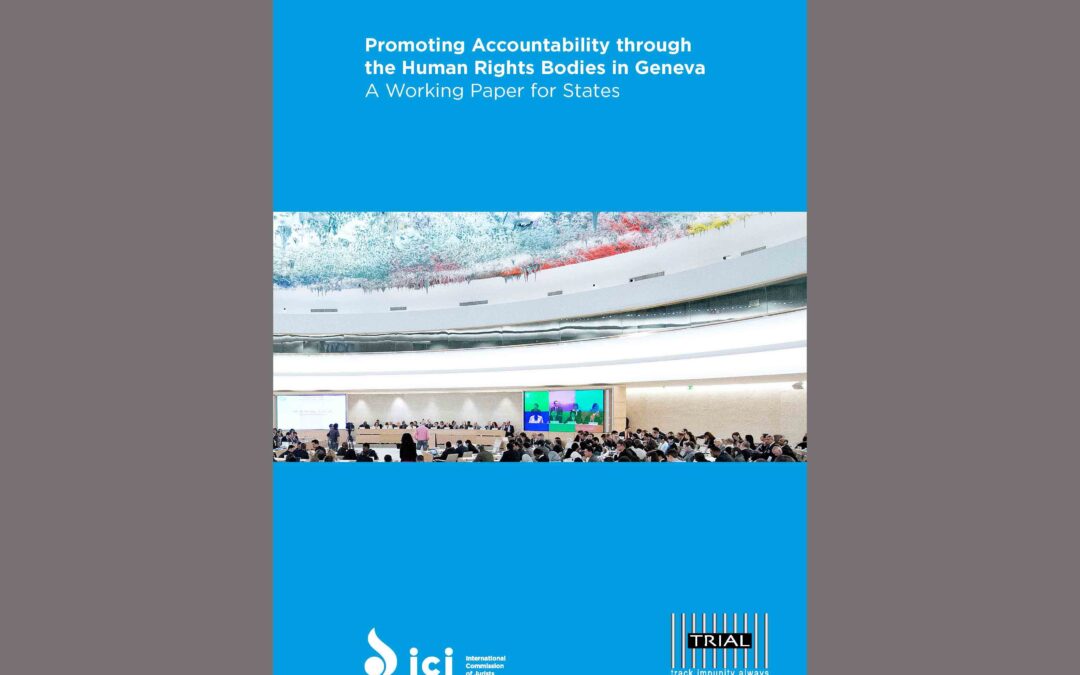
Yesterday, during the 24th session of the UN Human Rights Council, the ICJ and TRIAL (Swiss Association against Impunity) jointly held a parallel event on promoting accountability through human rights mechanisms in Geneva.
The event was co-sponsored by the Permanent Missions of Switzerland, Estonia and Costa Rica to the United Nations Office at Geneva.
A corresponding report produced by ICJ and TRIAL was also launched at this event in two versions, one aimed at civil society and another aimed at States.
Panellists at this event included Ian Seiderman of the ICJ, Gabriella Citroni of TRIAL and Theo van Boven, former Special Rapporteur on torture and other cruel, inhuman or degrading treatment or punishment and ICJ Honorary Commissioner.
Mona Rishmawi of the Office of the High Commissioner for Human Rights (OHCHR) chaired the event.
The main topic of this event was the ICJ-TRIAL report, which reviews the legal framework for promoting accountability and suggests possible action by civil society and States to engage with the human rights mechanisms in Geneva to better promote and achieve accountability for human rights violations.
The role of national mechanisms, such as national human rights institutions, working in cooperation with the UN mechanisms was also highlighted.
The report focuses specifically on the Human Rights Council and its subsidiary bodies, such as the Universal Periodic Review and the special procedures mechanisms.
OHCHR’s role was further emphasised in regards to sharing best practices as well as ensuring follow-up to issues of accountability as they come to the attention to the UN.

Aug 22, 2013 | Advocacy, Non-legal submissions
With other nongovernmental organizations, the ICJ calls on the Human Rights Council to select candidates for Special Procedure mandates on the basis of technical, professional and other objective requirements.
Ahead of the 24th session of the Human Rights Council (9 to 27 September 2013), several NGOs, including the ICJ, today joined in submitting written statements to the UN concerning the selection of candidates for membership in the Working Group on Arbitrary Detention and the Working Group on Enforced and Involuntary Disappearances and for the mandate-holder of the Special Rapporteur on the situation of human rights defenders. The statements identify a checklist intended as an interpretive aid for the selection of candidates based on qualifications and skills; relevant expertise; established competence; and flexibility and availability of time.
HRC24-JointWrittenStatement-SelectionCriteriaWGAD-NonLegalSubmission-2013 (download full statement concerning selection criteria for the Working Group on Arbitrary Detention)
HRC24-JointWrittenStatement-SelectionCriteriaWGEID-NonLegalSubmission-2013 (download full statement concerning selection criteria for the Working Group on Enforced and Involuntary Disappearances)
HRC24-JointWrittenStatement-SelectionCriteriaSRHRDs-NonLegalSubmission-2013 (download full statement concerning selection criteria for the Special Rapporteur on the situation of human rights defenders)