Oct 5, 2018 | News
2018 marks the 60th anniversary of the ICJ’s move to Geneva thanks to the great Swiss jurist Jean-Flavien Lalive, who was ICJ’s Secretary General in 1958.
This makes the ICJ one of the earliest international organizations to establish its headquarters in Geneva.
At the 1959 ICJ Congress in New Delhi, Dr. Lalive helped breathe new life into the rule of law and human rights.
The Delhi Declaration is, to date, a fundamental instrument interpreting the rule of law as a living concept, and underscoring the primary role of lawyers in its safeguard and in the advancement of human rights.
The ICJ plays a unique and preeminent role as a non-governmental organization seeking to defend human rights and the rule of law worldwide.
The ICJ will mark this event with two major initiatives:
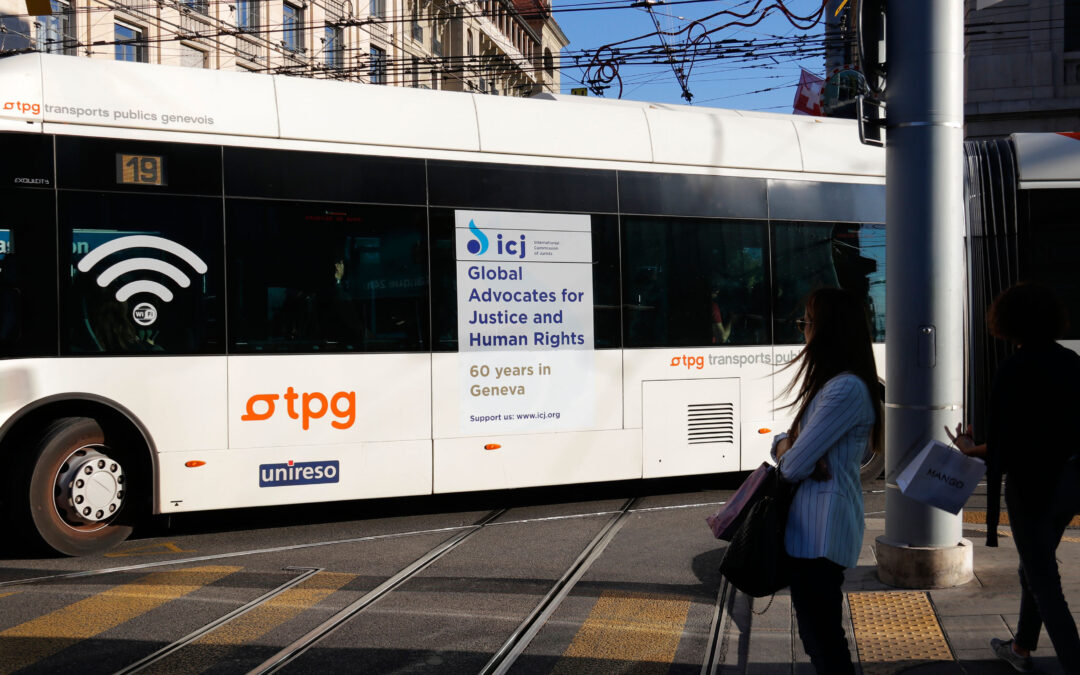
- A visibility campaign from 26th September to 9th October: the TV screens on the Geneva public transport network and five vehicles will carry the slogan “Global Advocates for Justice and Human Rights – 60 years in Geneva”
- The launch of the “60th Anniversary Appeal” to all lawyers in the Republic and canton of Geneva to support the ICJ and, in turn, their less privileged colleagues, victims of persecution on five continents.
“Geneva can be proud of its image as the world human rights capital. It is a beacon for justice advocates around the world. We must continue to make it shine,” said Sam Zarifi, Secretary General of the ICJ.
“Through its 60-year history, the ICJ has contributed significantly to Geneva’s human rights record: the campaigns that led to the creation of the post of UN High Commissioner for Human Rights in 1993 and the UN Human Rights Council in 2006, as well as the adoption of the United Nations Convention against Torture in 1984 are some emblematic examples,” said Olivier Coutau, Head of La Genève Internationale.
“In the face of repeated attacks on human rights, the world needs, more than ever the ICJ’s competent, rigorous and effective defense of the rule of law,” Sam Zarifi added.
The Republic and canton of Geneva support the ICJ 60th Anniversary Appeal.
Additional information
The international reputation of the ICJ rests on these pillars:
- 60 Commissioners – eminent judges and lawyers – from all regions of the world and all legal systems – with unparalleled knowledge of the law and human rights;
- Cooperating with governments committed to improving their human rights performance;
- Effective balance of diplomacy, constructive criticism, capacity building, and if necessary, ‘naming and shaming’;
- Unmatched direct access to national judiciaries, implementing international standards and improved legislation impacting millions;
- Guiding, training and protecting judges and lawyers worldwide to uphold and implement international standards;
- Working for access to justice for victims, survivors and human rights defenders, in particular from marginalized communities;
- Following a strict result based management in project delivery.
In recognition of this effective approach, the ICJ has been awarded, during its long history, some of the most prestigious international awards: the Council of Europe Human Rights Prize, the United Nations Award for Human Rights, Erasmus Prize, Carnegie Foundation Wateler Peace Prize.
In 2018, the ICJ provided local trainings on five continents to assist 4,300 judges, lawyers and prosecutors strengthen their ability to protect and promote fundamental rights.
The ICJ has consultative status with the United Nations Economic and Social Council, UNESCO, the Council of Europe and the African Union.
Contact :
Michaël W. Sombart, Director Philanthropy & Strategic Partnerships, t: +41 22 979 38 31 ; m: +41 77 965 98 45 ; e: michael.sombart(a)icj.org
Oct 1, 2018 | Advocacy, Cases, Legal submissions
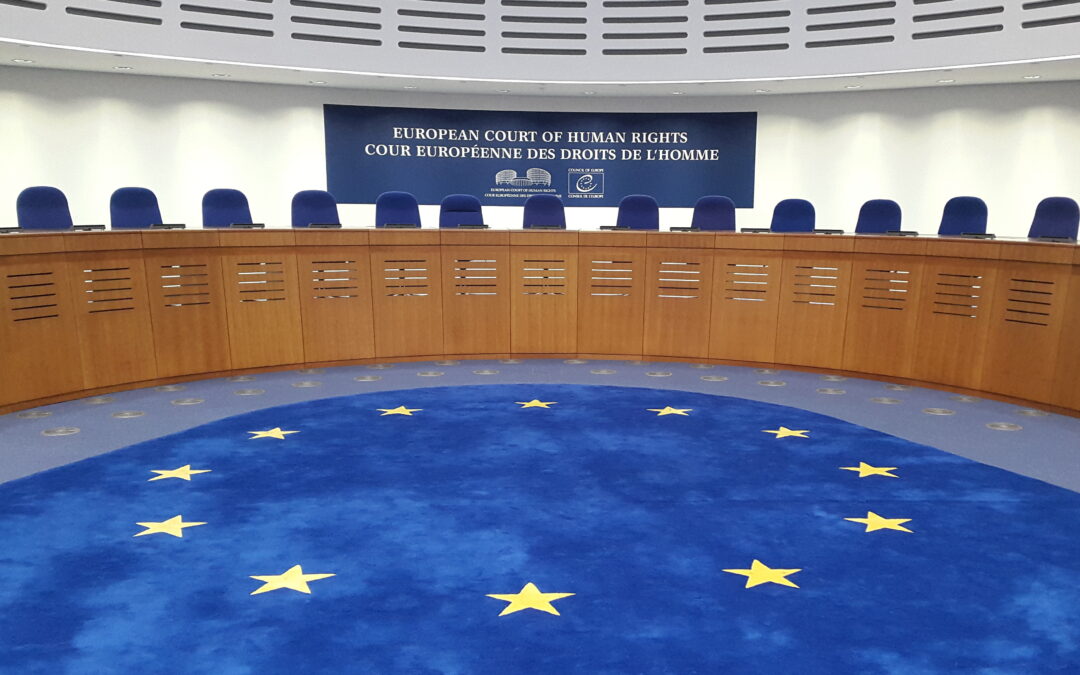
The ICJ made submissions today to the European Court of Human Rights in support of the right of association of Azerbaijan’s lawyers representing applicants before the Court and highlighting the situation of harassment of the legal profession in the country.
The ICJ intervened today in the cases of Democracy and Human Rights Resource Centre v. Azerbaijan and Mustafayev and Democracy and Human Rights Resource Centre v. Azerbaijan.
In these cases, lawyer Asabali Mustafayev and its NGO challenged the compliance of the freezing of their assets and criminal proceedings for financial offences as arbitrary interferences with their work as human rights defenders and in representation of clients before the European Court of Human Rights itself.
The ICJ has intervened to highlight the case-law regarding the right to individual application before the Court under article 34 ECHR and its application to the work of lawyers and legal NGOs.
It further examined the systemic practice in Azerbaijan of harassment of lawyers and of NGOs established by lawyers for the purpose of providing legal advice or representation, including representation of applicants before the European Court of Human Rights.
Finally, the ICJ analyzed the implications of such practices with regard to the State’s obligations under article 18 ECHR read together with article 11 ECHR.
Azerbaijan-icj-DHRRC&other-Advocacy-legal submission-2018-ENG (download the submission)
“Defenseless Defenders: Systemic Problems in the Legal Profession of Azerbaijan” – ICJ report in Azeri, Russian and English.
Question to the parties: http://hudoc.echr.coe.int/eng?i=001-184179
Oct 1, 2018 | News
The ICJ expressed disappointment regarding Friday’s ruling by Thailand’s Administrative Court dismissing a case filed against the Royal Thai Police (RTP) for unjustified restriction of the freedom of peaceful assembly and freedom of expression, and again called on Thailand to lift its ban on political gatherings and fully reinstate fundamental freedoms in Thailand.
On 28 September 2018, the Administrative Court dismissed a case filed by the organizers of a “We Walk Friendship March” (‘We Walk march’) against the RTP and six policemen for restricting the march on the basis that it was in violation of Head of NCPO Order No. 3/2558 (2015) (‘HNCPO Order 3’).
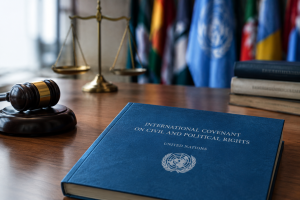
The Administrative Court referred to the Thai Constitution, the Public Assembly Act B.E. 2558 (2015), the International Covenant on Civil and Political Rights (ICCPR) to which Thailand is a State party, and HNCPO Order 3, in deciding that the march was a public assembly. Its decision clarified that the case had to be dismissed as the RTP’s actions had complied with the Public Assembly Act.
“It is astonishing that more than four years after the coup, HNCPO Order 3 and other repressive laws, orders and announcements which restrict fundamental freedoms remain in place,” said Kingsley Abbott, Senior Legal Adviser at the ICJ.
“The Administrative Court missed a critical opportunity to deliver an opinion that the ban on political gatherings should be lifted and that all laws, orders and announcements that are inconsistent with Thailand’s international human rights obligations should be amended or revoked immediately to reinstate all fundamental freedoms in Thailand,” added Abbott.
The march, which went ahead peacefully, aimed to bring attention to the need in Thailand for universal healthcare services, policies guaranteeing food security, laws that would not violate human rights, and public participation in the development of the Constitution.
Contact
Kingsley Abbott, ICJ Senior Legal Adviser, email: kingsley.abbott(a)icj.org
The ICJ’s full statement in English is available here: Thailand-Ban on Political Gatherings-News-Web Story-2018-ENG
The ICJ’s full statement in Thai is available here: Thailand-Ban on Political Gatherings-News-Web- Story-2018-THA
Sep 24, 2018 | Feature articles, News
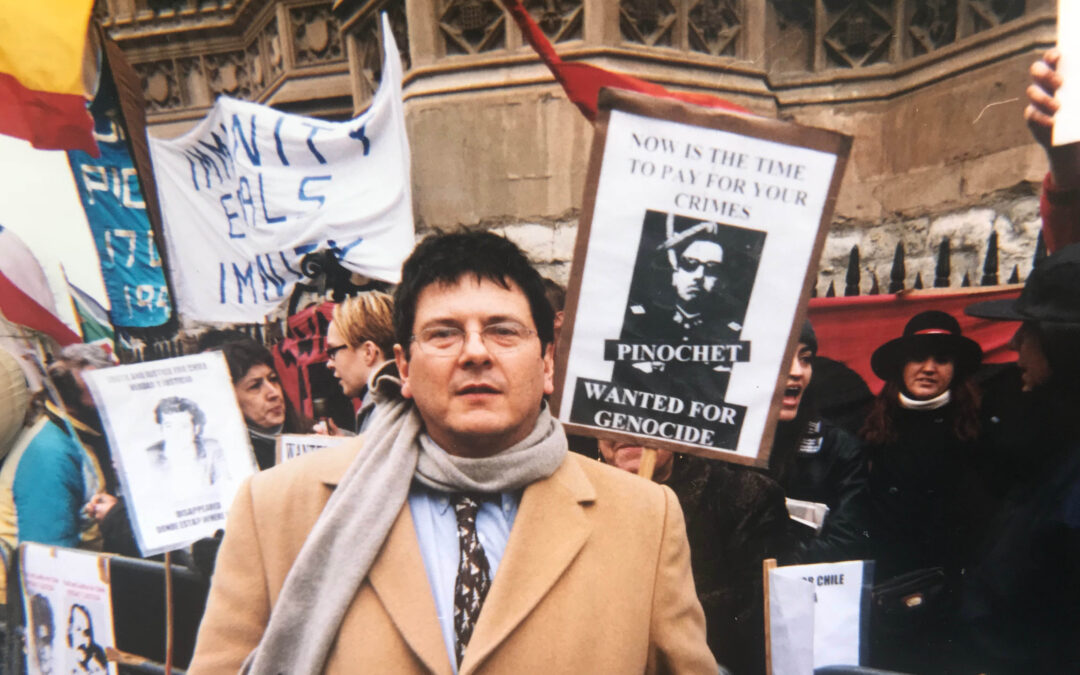
On October 16, 1998, the former dictator of Chile Augusto Pinochet was arrested in London on a warrant from a Spanish judge. Reed Brody participated in the subsequent legal case.
Reed Brody went on to apply the “Pinochet precedent” in the landmark prosecution of the former dictator of Chad, Hissène Habré, who was convicted of crimes against humanity in Senegal in 2016.
He now works with victims of the former dictator of Gambia, Yahya Jammeh. The ICJ interviewed Brody about the Pinochet case and its legacy.
What was your role in the Pinochet case?
My role started when Pinochet was arrested in London. The case began long before that, of course, in the early years of Pinochet’s dictatorship when brave human rights activists documented each case of murder, and “disappearance.”
The ICJ worked with those advocates to produce a seminal 1974 report on those crimes, just six months after Pinochet’s coup. Shut out of Chile’s courts, even after the democratic transition of 1990, victims and their lawyers pursued a case against Pinochet in Spain under its “universal jurisdiction” law and when Pinochet traveled to London, Spanish Judge Baltasar Garzón requested and obtained his detention.
When Pinochet challenged his arrest in court claiming immunity as a former head of state, I went to London for Human Rights Watch, and we and Amnesty International were granted the right to intervene with teams of lawyers in the proceedings at the judicial committee of the House of Lords, then Britain’s highest court.
The Lords cited our research in rejecting Pinochet’s immunity.
You famously described the Lords’ Pinochet decision as a “wake-up call” to tyrants everywhere. Looking back, do you think it was?
Actually no, I think one would be hard pressed to discern a change in the behavior of dictators. Mugabe didn’t quake in his boots, Saddam didn’t clean up his act.
The more important and more lasting effect of the case was to give hope to other victims and activists. When the Lords ruled that Pinochet could be arrested anywhere in the world despite his status as a former head of state, the movement was in effervescence.
As a human rights lawyer, I was used to being legally and morally right, but still losing. In the Pinochet case, not only did we win, but we upheld the detention of one of the world’s most iconic dictators.
The Pinochet case inspired victims of abuse in country after country, particularly in Latin America, to challenge the transitional arrangements of the 1980s and 1990s, which allowed the perpetrators of atrocities to go unpunished and, often, to remain in power.
These temporary accommodations with the ancien régime didn’t extinguish the victims’ thirst to bring their former tormentors to justice.
How did you go from Pinochet to Habré?
With Pinochet, we saw that universal jurisdiction could be used as an instrument to bring to book people who seemed out of the reach of justice.
Together with groups like Amnesty, the FIDH, and the ICJ (which wrote an important report on the Pinochet case and its lessons), we had meetings on who could be the “next Pinochet.”
That’s when Delphine Djiraibe of the Chadian Association for Human Rights asked us to help Habre’s victims bring him to justice in his Senegalese exile.
I was excited at the prospect of persuading a country in the Global South, Senegal, to exercise universal jurisdiction, because there was a developing paradigm of European courts prosecuting defendants from formerly colonized countries.
It took us 17 years, but Habré became the first prosecution ever of a former head of state using universal jurisdiction, and indeed the first universal jurisdiction trial in Africa.
1998 was a high water mark for international justice with the adoption of the ICC Rome Statute and Pinochet’s arrest. Neither the ICC nor universal jurisdiction have quite lived up to their expectations. Why?
International justice doesn’t operate in a vacuum, it’s conditioned by the global power structure. Each case, whether at the ICC level or the transnational level, is a product of the political forces which must be mobilized, or fended off, to allow a prosecution to proceed.
Those forces, particularly since September 11, 2001, have been hostile to human rights enforcement in general and to justice in particular. Universal jurisdiction has been subject to the same double standards as the ICC.
The Belgian and Spanish universal jurisdiction laws, which were the broadest in the world, were both repealed when they were used to investigate superpower actions.
But many of the most successful cases have been those in which the victims and their activist supporters have been the driving forces, have compiled the evidence themselves, built an advocacy coalition which placed the victims and their stories at the center of the justice struggle and helped create the political will in the forum state.
I’m thinking not just of Habré, but the genocide prosecution in Guatemala of the former dictator Efraín Ríos Montt, the case in Haiti of “President for Life,” Jean-Claude “Baby Doc” Duvalier, the Liberian cases brought around the world by Civitas Maxima and its partners, the Swiss cases initiated by TRIAL International, and the Syria litigation by ECCHR and others.
These cases were brought before domestic courts either of the country in which the atrocities took place (Guatemala, Haiti) or of foreign countries based on universal jurisdiction, rather than before international courts.
Most of these cases took advantage of legal regimes which allowed victims directly to participate in the prosecutions as “parties civiles,” or “acusación particular” rather than play passive or secondary roles in cases prosecuted solely by state or international officials.
How do victim-driven prosecutions look different than institutional cases?
When it’s the victims and their allies who get the cases before a court, who gather the evidence, and who have formal standing as parties, the trials are more likely to live up to their expectations.
In the Rios Montt case, for instance, the Asociación Para la Justicia y Reconciliacion (AJR) and the Centro Para la Acción Legal en Derechos Humanos (CALDH) mobilized the victims, developed the evidence, defined the narrative and, essentially, determined the outlines of the case and chose the witnesses who would testify for the prosecution.
In the Habré case, we spent 13 years building the dossier, interviewing hundreds of victims and former officials and uncovering regime police files. The victims’ coalition always insisted that any trial include crimes committed against each of Chad’s victimized ethnic groups, and that is exactly was happened.
In contrast, a distant prosecutor, disconnected from national narratives and inherently not accountable to the victims or civil society, can be tempted to narrowly tailor prosecutions in the hopes of securing a conviction or avoiding political resistance.
This was the case with the ICC in the Democratic Republic of the Congo, for instance, where, as Pascal Kambale has persuasively argued, it betrayed the victims’ hopes.
Millions of civilians died in the DRC and Luis Moreno Ocampo only went after two local warlords. I think the current prosecutor is paying more attention to local realities.
The inspiration from victim-driven cases is also greater, and they are to some degree replicable. As Naomi Roht-Arriaza has written, these cases “stirred imaginations and opened possibilities precisely because they seemed decentralized, less controllable by state interests, more, if you will, acts of imagination.”
When I showed Chadian victims video clips of the Ríos Montt trial, they saw in those images exactly what they were trying to do.
Just as the Chadians came to us in the Habré case seeking to do what Pinochet’s victims had done, our hope in getting the Habré case to trial was that other survivors would be inspired by what Habre’s victims had done and say, “you see these people, they fought for justice and never gave up. We can do that too.”
And indeed, Liberian victims and Gambian victims have patterned their campaigns for justice on what Habre’s victims did. So, the Pinochet case continues to be an inspiration.
Sep 21, 2018 | Advocacy, News, Non-legal submissions
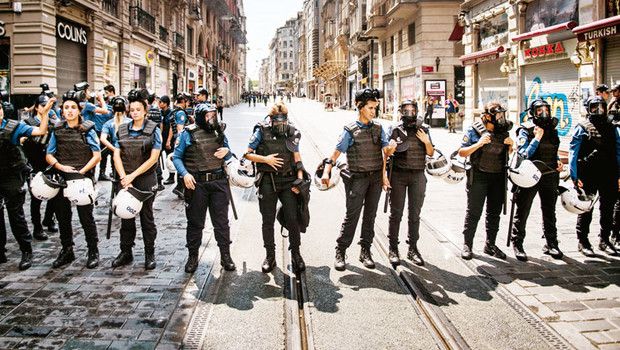
The ICJ wrote today to the Council of Europe’s Commissioner for Human Rights, Dunja Mijatović, to request action against the decision by Turkish authorities to ban entrance to Galatasaray square in Istanbul (Turkey) to a collective of mothers of disappeared persons called “Saturday Mothers”.
On 25 August 2018 , the Sub-Governorship of Beyoğlu District of İstanbul announced the prohibition of gatherings for assembly of any type of demonstrations in Galatasaray Square in Istanbul, the square where the Saturday Mothers have gathered every Saturday since 1995 to 1998 and since 2009 until 2018.
On the 700th week of their peaceful protests, the Saturday Mothers and their supporters congregated in Galatasaray Square at midday to once again raise awareness of the need for those responsible to be held accountable for the extrajudicial killings and enforced disappearances following their time in State custody in the 1990s. The police used tear gas to stop the protest and arrested 47 people. All were released by Saturday evening.
Senior officers of the Turkish authorities have even issued statements accusing the Saturday Mothers of being abused by or in collusion with terrorist organisations.
The ICJ wrote to the European Commissioner for Human Rights, that it “considers this situation to be at odds with Turkey’s obligations under international human rights law, in particular of the right to peaceful assembly under article 11 of the European Convention on Human Rights and article 21 of the International Covenant on Civil and Political Rights.”
The ICJ further added that “given the consistent record and presence of the Saturday Mothers in Galatasaray Square throughout the years, it is hard to see how the restriction on their right to peaceful assembly could in any way be necessary and proportionate to a legitimate purpose. It is clear that no prior warning for the gathering was needed for security reasons in light of its regular occurrence at least since its resumption in 2009, i.e. nine years ago. Furthermore, the demonstration took place on a pedestrian area where cars are not allowed.”
ICJ-Letter-SaturdayMothers-CoEComm-Turkey-2018-ENG (download the letter)