Jun 4, 2021 | News
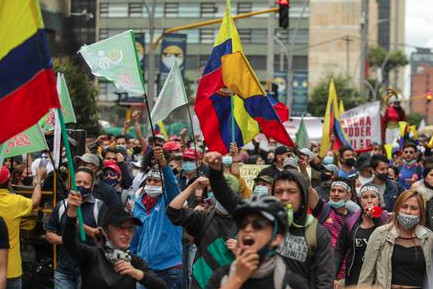
Colombian authorities should immediately stop law enforcement officials from using excessive force to respond to protests and withdraw the military from law enforcement functions, said the ICJ today.
Over the course of ongoing protests, largely against economic and social conditions, multiple human rights and other civil society organizations have documented widespread human rights violations, including instances of torture and ill-treatment, sexual violence, extrajudicial killings, and enforced disappearances.
“The reports of violence and excessive and often unnecessary use of force by law enforcement officials are part of a wider failure of the authorities to adopt effective measures to protect and guarantee the right to life and the right to peaceful protest” said Carolina Villadiego, ICJ legal adviser for Latin America.
According to Indepaz, a local Non-Governmental Organization, as of 30 May 2021, at least 71 people had been killed, likely unlawfully, in the context of the protests. The situation is particularly dire in Cali where in just one day, 28 May 2021, 13 people were reportedly killed. In addition, it has been documented that firearms and lethal force have been deployed against protestors, including indigenous persons, by armed individuals in Cali. In at least one incident, multiple video recordings show police officials were present during the shootings and took no action to stop the shootings or apprehend the armed individuals.
Police and other law enforcement officials have the obligation to defend the rights of people, including their right to protest, and to protect them from violence by others. Colombian law enforcement officials have not only violated their obligation to avoid use of unnecessary or excessive use of force against people, but in Cali, they seem to have failed to prevent criminal violence by armed individuals as well.
“There must be a prompt, thorough and impartial investigation into these violations with a view to holding accountable those responsible”, said Carolina Villadiego.
The ICJ is also deeply concerned with militarization of the response to the protests. On 28 May 2021, President Duque issued Decree 575 of 2021 that authorizes the intervention of military forces in at least eight departments out of thirty two in the country, to assist in the lifting of any kind of roadblocks and to prevent the installation of new blockades by protesters. The Decree fails to consider any limitation of the use of force by military forces in line with international law standards such as the UN Basic Principles on the Use of Force by Law Enforcement.
Additionally, the sweeping and overbroad scope of the Decree to involve the military forces in what are inherently law enforcement functions does not consider that they are not trained or designed to protect civilians during protests or scenarios of public order disruption.
The ICJ urges the Colombian Government to fully respect the UN Basic Principles and other international standards on the use of force and the intervention of military forces to control protests and demonstrations. In this regard, the Government must fully comply with the September 2020 ruling on measures to guarantee peaceful protests issued by the Colombian Supreme Court.
In the ruling, the Supreme Court identified serious violations regarding the intervention of law enforcement officials, especially police officials, in protests and demonstrations. The Court identified systematic violence against demonstrators, the existence of stereotypes and prejudice against those who criticize the government’s policies, and a lack of mechanisms to hold the officials accountable.
Consequently, the Court ordered several measures to address this situation and guarantee the right to peaceful protest, including adopting and implementing a protocol to regulate the use of force during protests and manifestations, in accordance with international human rights standards.
The ICJ also calls on the Colombian Government to guarantee the right to peaceful protest. As the UN Human Right Committee has clearly affirmed, the right to peaceful protest may entail the disruption of vehicular or pedestrian movement, which “may be dispersed, as a rule, only if the disruption is “serious and sustained””.
While the vast majority of protestors have acted peacefully, there have been some instances where they have not. The ICJ calls on all persons to avoid violence during the protests and condemns the crimes committed against police officials, including the killing of at least two police officers, the serious injuries suffered by one police officer after being hit by a Molotov cocktail, and the sexual violence suffered by a police woman.
The ICJ deplores the particular use of some roadblocks that have affected the delivery of essential medical services, as well as the fires at the courthouse in Tuluá and other public buildings. Any individual engaging in criminal behaviour must be impartially investigated and, if found guilty in a fair trial, brought to account.
Finally, the ICJ also urges the National Government to fully cooperate with the mission of the Inter-American Commission on Human Rights (IACHR) to Colombia that will take place from 8 June to 10 June 2021. The Government should respect and ensure the IACHR’s independence and autonomy during the visit.
Contacts:
Carolina Villadiego Burbano, Latin American Legal and Policy Adviser, email: carolina.villadiego(a)icj.org
Rocío Quintero M, Latin American Legal Adviser, email: rocio.quintero(a)icj.org
Jun 4, 2021 | News
(Istanbul, June 4, 2021) – The Council of Europe should insist that Turkey comply immediately with judgments from the European Court of Human Rights (ECtHR), or face infringement proceedings, a group of leading nongovernmental organizations working on human rights in Turkey said today.
An upcoming Council of Europe Committee of Ministers meeting on June 7-9, 2021, will review the Turkish government’s failure to implement two leading ECtHR judgments that ordered the immediate release of the human rights defender Osman Kavala and the Kurdish politician Selahattin Demirtaş. Human Rights Watch, the International Commission of Jurists, and the Turkey Human Rights Litigation Support Project urged the committee to use all available measures to require Turkey to rectify its flagrant non-compliance with its obligations, the court judgments, and the committee’s decisions on this matter.
“The Committee of Ministers should be using every means it has to push Turkey to implement the Kavala and Demirtaş judgments,” said Aisling Reidy, senior legal adviser at Human Rights Watch. “That means that the committee should be prepared to trigger infringement proceedings against Turkey if it persists with its defiance of the European Court’s binding judgment in favor of Kavala, and to call for the immediate release of Demirtaş with a commitment to escalate measures if it does not happen.”
The three groups repeated their March 2021 call for the committee to commence infringement proceedings against Turkey for flouting its decisions requesting Kavala’s release and urged the committee to issue a second decision for Demirtaş’s immediate release. The committee should also make clear that if Demirtaş is not released, it will take further action at its September session.
The ECtHR ruled on December 10, 2019, that by holding Kavala in pretrial detention since November 2017 and prosecuting him on the basis of his human rights activities, the Turkish authorities had “pursued an ulterior purpose, namely to silence him as a human rights defender.”
Similarly, the ECtHR ruled on December 22, 2020, that by holding Demirtaş in pretrial detention since November 2016 and prosecuting him for his activities and speeches protected under the European Convention on Human Rights (ECHR), the Turkish authorities had pursued an ulterior purpose of preventing him from carrying out his political activities, depriving voters of their elected representative, and “stifling pluralism and limiting freedom of political debate: the very core of the concept of a democratic society.”
In both cases, the Court found that by using detention for political ends, Turkey had violated the right to liberty and other rights, and had misused the discretion given to governments to impose limitations on rights for illegitimate purposes (articles 5 and 18 of the ECHR respectively). The Court took the rare step of ordering their immediate release.
Despite the fact that the landmark judgments are legally binding, the Turkish authorities have snubbed the Strasbourg court and ignored the Committee of Ministers’ decisions calling for the men’s release.
“Turkish prosecutors and judges have sought to circumvent the authority of the European Court by adopting the tactic of opening new criminal proceedings against Kavala and Demirtaş based on the reclassification of the same facts,” said Helen Duffy of the Turkey Human Rights Litigation Support Project “This cynical non-compliance with the court’s judgments requires a robust response from the Committee of Ministers.”
On May 21 when the retrial of Kavala for his alleged role in the 2013 Gezi Park protests opened, Turkish authorities merged that case with another concerning his alleged involvement in the 2016 coup attempt and espionage. The Istanbul 30th Assize Court hearing the case extended his detention. The next hearing against Kavala is scheduled for August 6.
In Demirtaş’s case, Ankara 22nd Assize Court on April 19 merged an existing case against him with a new case before it despite the fact that it involved the same or similar facts, which the European Court had held consisted of peaceful political speeches and activities protected under the ECHR. In the new case, the facts used as the evidence have been reclassified under different charges.
The indictment now charges Demirtaş and 107 co-defendants with crimes that include attempting to undermine the unity and territorial integrity of the state, murder, and robbery, all on the basis of tweets and political speeches they made in the period before deadly protests that took place in southeast Turkey from October 6-8, 2014. Demirtaş’s co-defendants include current and former members of parliament from the Peoples’ Democratic Party (HDP). The first hearing of the merged cases against Demirtaş took place on April 26. The next hearing is scheduled for June 14.
Read the full press release here: Turkey Flouts European Court Judgments_press release_2021_ENG
Jun 2, 2021 | Agendas, Events, News
On Thursday 3 June 2pm CET, the International Commission of Jurists (ICJ) together with Saskia Bricmont, Greens/EFA MEP, will hold an online event on immigration detention of children in the EU, the current situation and implementation of the legal framework in EU countries. The event will consider ways forward and alternatives to detention, including in light of the new proposals of the EU Pact on Migration and Asylum and EU strategy on the rights of the child.
The event is organised on the occasion of the launch of the CADRE project (“Children’s Alternatives to Detention protecting their Rights in Europe”), seeking to promote the expansion, implementation and improvement of viable and effective alternatives to detention for migrant children in full respect of their rights in the EU, co-ordinated by the ICJ in partnership with seven national and international partners:
See the full agenda of the event here: CADRE_public launch event agenda
To register please fill in the form online here. Registration closes 3 pm CET 2 June.
Jun 1, 2021 | News
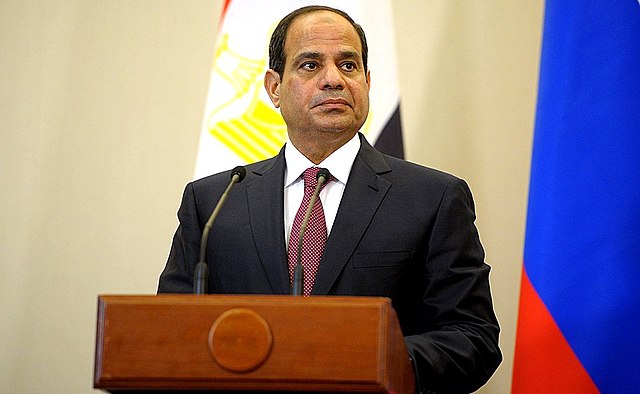
President Abdel Fattah al-Sisi of Egypt should immediately end a crackdown on freedom of association, independent groups, and peaceful dissent, 63 organizations, including the ICJ, said today.
هذا البيان الصحفي متوفر باللغة العربية أيضاً
The groups issued the following public statement recommending a series of actions Egypt should take to make tangible improvements in the human rights situation in Egypt and to ensure that Egypt complies with its international obligations:
We the undersigned 63 organizations call on the Egyptian authorities, including President Abdel Fattah al-Sisi, to take immediate action to end the Egyptian authorities’ wholesale crackdown on independent organizations and peaceful dissent.
More than 30 countries at the United Nations Human Rights Council issued a joint statement on 12 March 2021 expressing their deep alarm over “the trajectory of human rights in Egypt and share[d] the concerns expressed by the [UN] High Commissioner for Human Rights and [UN] Special Procedure mandate holders.”
Our organizations have been calling for the establishment of a monitoring and reporting mechanism on Egypt at the Human Rights Council and will continue to do so until there is meaningful and sustained improvement in the country’s human rights situation.
We remain greatly concerned over the arbitrary arrest, detention, and other judicial harassment of human rights defenders. Those held unjustly include NGOs directors Mohamed al-Baqer and Ezzat Ghoniem, human rights researchers Patrick George Zakiand Ibrahim Ezz el-Din, and lawyers Mahienour al-Massry, Haytham Mohamdeen, and Hoda Abdelmoniem. The founder and director of the Cairo Institute for Human Rights Studies (CIHRS) Bahey Eldin Hassan was handed down an outrageous 15-years imprisonment sentence in absentia.
Other attacks against human rights defenders include travel bans, asset freezes, additions to the “terrorists list” in arbitrary proceedings, protracted criminal investigations under case No. 173 of 2011, and reprisals for their engagement with UN mechanisms. We share concerns by seven Special Procedures mandate holders – United Nations experts – about Law No. 149/2019 on Non-Governmental Organizations, as it fails to meet Egypt’s international obligations to ensure the right to freedom of association.
We also have serious concerns over the overly broad definition of terrorism in Law No. 94 of 2015 on counterterrorism and in the Penal Code that contravenes international standards and allows for the criminalization of acts falling within the scope of the rights to freedom of expression, association and peaceful assembly, as well as the misuse of “terrorism circuits” of criminal courts and the Supreme State Security Prosecution to target human rights defenders and other peaceful critics in order to silence dissent.
We are also deeply concerned over the crackdown on independent journalists and media, as hundreds of websites remain blocked and at least 28 journalists remain behind bars for simply doing their work or expressing critical views, including Esraa Abdelfatah and Ismail Iskandarani.
We share the assessment of the UN Working Group on Arbitrary Detention that arbitrary detention is a systematic problem in Egypt. Since President al-Sisi came to power, Egyptian security forces, with the complicity of prosecutors and judges, have arbitrarily arrested and detained thousands of people on the basis of unfounded terrorism-related charges. They include human rights defenders, religious minority rights activists, peaceful protesters, journalists, academics, artists, lawyers, opposition politicians, and relatives of dissidents forced into exile.
Egyptian security forces routinely subject those in custody to enforced disappearance and torture, which the UN Committee against Torture concluded to be “a systematic practice in Egypt.” Those disappeared and tortured are then routinely convicted in grossly unfair mass trials, in some cases before military courts.
Since 2014, hundreds have been sentenced to death and dozens executed after trials that rely on torture-tainted “confessions.” Thousands of others are being held in prolonged pretrial detention without the opportunity to meaningfully challenge the lawfulness of their detention, sometimes for periods exceeding the two-year maximum permissible under Egyptian law.
Even when prosecutors and judges order their release, the National Security Agency (NSA), with prosecutors’ complicity, routinely accuse them of similar charges in new cases to keep them detained indefinitely without trial, in the practice known as ”rotation.”
We also share the UN experts concerns over cruel and inhuman prison conditions, and the deliberate denial of adequate medical care that has led or contributed to preventable deaths in custody and serious damage to prisoners’ health. In 2020 alone, at least 35 people died in custody or shortly after following medical complications. The health and human rights crisis in prisons was further exacerbated by the authorities’ failure to adequately address Covid-19 outbreaks.
We share the High Commissioner’s concerns regarding worrying patterns in the Sinai peninsula of forcible displacement, enforced disappearances, and torture and other ill-treatment of detainees. We note her call to the Egyptian authorities “to recognise that, as in all countries facing security challenges and violent extremism, depriving people of their rights will not make the State safer, but more unstable.”
Discrimination against women and girls remains entrenched in law and practice. The authorities have not only failed to address pervasive sexual and gender-based violence, but have also targeted women’s human rights defenders and campaigners against sexual violence and harassment through arrests, harassment, threats, and other reprisals. The authorities have also used morality and debauchery laws to arbitrarily arrest, detain, and prosecute survivors and witnesses of sexual and other gender-based violence, women social media influencers, and LGBTQI+ people and activists.
This catalog of serious violations continues as a result of endemic impunity that prevails in Egypt, as highlighted by UN experts and the UN Committee against Torture.
We urge President al-Sisi to order and ensure full implementation of the following recommendations in order to secure tangible improvements in the human rights situation in Egypt and to ensure that Egypt complies with its international obligations:
- Immediately and unconditionally release anyone held solely for peacefully exercising their rights to freedom of expression, association and assembly; and release others detained arbitrarily, including those held in prolonged pretrial detention without trial or the possibility to challenge the lawfulness of their detention; cease the practice commonly called “rotation”, and protect those in custody from torture and other ill-treatment and ensure their regular access to their families, lawyers of their choosing, and adequate medical care;
- Publicly condemn and order independent, impartial, thorough, and effective investigations into extrajudicial executions and other unlawful killings, enforced disappearances, torture, and other serious human rights violations and crimes under international law, including those committed in custody and in the context of counterterrorism operations in Sinai, with a view to bringing those responsible to justice; and guarantee the victims’ rights to truth, justice, and reparation;
- Establish a moratorium on executions, pending the abolition of the death penalty;
- Create a safe and enabling environment for human rights defenders, including by effectively protecting them from arbitrary arrest, detention, and other forms of reprisal or harassment; instructing the public prosecution to close Case No. 173 of 2011; removing all arbitrary measures including travel bans and asset freezes against human rights defenders and their families; quashing verdicts against human rights defenders including those sentenced in their absence; and removing human rights defenders from the “terrorists list”;
- Prevent sexual and gender-based violence and prosecute offenders; put a stop to the policing of women’s bodies and behavior as well as prosecutions over vague charges of “indecency”, “violating family principles and values”, and “debauchery”;
- End arbitrary arrests and prosecutions against LGBTQI+ people, including police entrapment of LGBTQI+ through dating apps or social media and quash the verdicts of anyone already convicted; instruct officials to end forced anal examinations and sex determination tests as they can amount to torture; and
- Amend Law No.94 of 2015 on counterterrorism, Law No.8 of 2015 on terrorist entities, Law No.175 of 2018 on cybercrime, and Law No. 149 of 2019 on NGOs to bring them in line with Egypt’s international obligations.
Signatories:
Access Now
Amnesty International
ANKH (Arab Network for Knowledge about Human rights)
Association Beity (Tunisia)
Association for Juridical Studies on Immigration (ASGI)
Association for the Defense of Human Rights in Morocco (ADDHOM)
Baytna
Cairo Institute for Human Rights Studies (CIHRS)
CELS Centro de Estudios Legales y Sociales
Center for Reproductive Rights
Center of Studies and Initiatives for International Solidarity (CEDETIM, France)
CNCD-11.11.11
Committee for Justice
Committee for the Respect of Liberties and Human Rights in Tunisia (CRLDHT)
DefendDefenders (East and Horn of Africa Human Rights Defenders Project)
Democratic Association of Tunisians in France (ADTF)
Democracy for the Arab World Now (DAWN)
Dignity – Danish Institute Against Torture
Egyptian Human Rights Forum
Egyptian Initiative for Personal Rights (EIPR)
EgyptWide (Egyptian-Italian Initiative for Rights and Freedoms)
English PEN
EuroMed Rights
Freedom House
Front Line Defenders
Geneva Bridge Association
Global Voices
Gulf Centre for Human Rights (GCHR)
Hassan Saadaoui Association for the Defense of Democracy and Equality (Tunisia)
humanrights.ch
Human Rights Watch (HRW)
Initiative Franco-égyptienne pour les Droits et les Libertés
International Commission of Jurists (ICJ)
International Federation for Human Rights (FIDH)
International Service for Human Rights (ISHR)
Karapatan Alliance Philippines Inc.
Lawyers for Lawyers (L4L)
Legal Resources Centre
Mawjoudin Initiative (Tunisia)
MENA Rights Group
Minority Rights Group International (MRG)
Mwatana for Human Rights
Nachez (Dissonance), Tunisia
The National Union for Tunisian Journalists (SNJT)
Odhikar, Bangladesh
PEN Norway
People in Need
Project on Middle East Democracy (POMED)
REDRESS
Réseau des Organisations de la Société Civile pour l’Observation et le Suivi des Élections en Guinée (ROSE)
Robert F Kennedy Human Rights
South East Europe Media Organisation (SEEMO)
The Freedom Initiative
Tunisian Association of Democratic Women
Tunisian Association for Democracy and Civic State (AVDDH)
The Tunisian Association for the Defense of Academic Values (ATDVU)
The Tunisian Association for the Defense of Individual Liberties (ATDLI)
Tunisian Center for Press Freedom (CTLP)
Tunisian Coalition Against Death Penalty
The Tunisian Federation for Citizenship on both Shores (FTCR)
The Tunisian Human Rights League (LTDH)
UIA-IROL (Institute for the Rule of Law of the International Association of Lawyers)
Vigilance for Democracy in Tunisia (Belgium)
Contact:
Said Benarbia, Director, ICJ Middle East and North Africa Programme, t: +41-22-979-3817; e: said.benarbia(a)icj.org
Asser Khattab, Research and Communications’ Officer, ICJ Middle East and North Africa Programme, e: asser.khattab(a)icj.org
May 7, 2021 | News
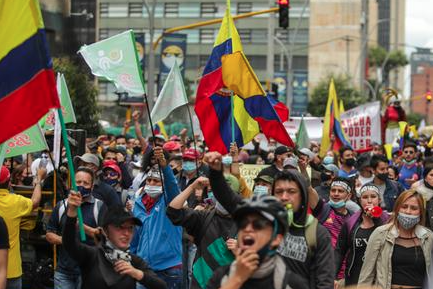
The Colombian Commission of Jurists (CCJ) and the ICJ have called upon national and local authorities to respect the right of peaceful assembly and cease all use of unlawful force against protestors immediately.
Beginning 28 April, thousands of people have taken to the streets in towns and cities throughout Colombia to protest and the social and economic policies of the current national government. As of this writing the protests continue.
The CCJ and the ICJ have expressed their concern about widespread and serious human rights violations committed during the protests.
There are multiples reports from civil society organizations that document incidents where police officials have opened fire with live ammunition against protestors.
Although full and precise figures are unavailable, as of 6 May 2021, according to the Ombudspersons’ Office at least 26 people had lost their lives. In at least 11 cases, police officials were allegedly responsible for the killings.
The NGO Temblores has documented 37 killings and the NGO Indepaz has information of more than 1.200 people injured during the protests. In addition, a number of cases of sexual violence have been reported.
The organizations are especially concerned that there are substantial number of people whose whereabouts are unknown. Complete figures on possible disappeared persons are not available. Even more worrisome, there are substantial differences among the figures provided by different sources.
In this regard, for instance, the Ombudspersons’ Office said that it has received information about the possible disappearance of 145 people. The Ombudspersons’ Office has established the whereabout of 55 people.
For its part, the civil society platform Mesa de Trabajo sobre Desaparición Forzada en Colombia has informed that it has information of 471 potential cases of enforced disappearances. According to the platform, the whereabout of 92 people have been determined.
The violent acts committed in Valle del Cauca are particularly serious. In this region, it has been reported that at least 17 people have died, and an undetermined number of people are seriously wounded.
Similarly, in Cali, some members of human rights organizations and the Office of the United Nations High Commissioner for Human Rights in Colombia alleged that they had been subject to verbal attacks and physical assault when there were verifying the situation of detained people.
The CCJ and the ICJ urge Colombian authorities to acknowledge act to address the allegations of human violations committed during the protests. They must conduct, independent, impartial, prompt, thorough, effective, and transparent investigations in accordance with Colombian law and its obligations under the International Covenant on Civil and Political Rights.
Furthermore, the investigation must take place within the ordinary criminal jurisdiction and under no circumstances should there be resort to military jurisdiction. Under international law and standards, cases that may constitute arbitrary deprivation of life or enforced disappearances cannot be considered to be connected with military duties.
Additionally, there is information that some police officials have been wounded, and at least one was allegedly unlawfully killed. The CCJ and the ICJ condemn these and other violent acts and urge judicial authorities to investigate and sanctions those responsible.
On the other hand, the CCJ and the ICJ recall that the use of force by police officials should must only be deployed in accordance with international standards. In particular, any such action must comply with the UN Basic Principles on the Use of Force and Firearms by Law Enforcement Officials.
These Principles establish that the use of force should be exceptional, necessary and proportional. Especially, authorities should faithfully comply with principle 9 that sets out that lethal force should be not used “except in self-defence or defence of others against the imminent threat of death or serious injury”.
Finally, the CCJ and the ICJ express their great concern about the national government’s decision to involve the military forces for the contention of the violence under the legal figure of “military assistance” (asistencia militar). The decision does not respect the international human rights law standards on the use of force and the right of peaceful assembly.
It should be remembered that military forces are not trained or designed to protect and control civilians during protests or scenarios of disruption of public order.
Therefore, the participation of military forces should be exceptional in situations of necessity, for example to confront immediate extreme violence and temporally limited, as affirmed by international bodies such as the UN Committee on Human rights and the Inter-American Court of Human Rights.
Contacts:
Ana María Rodríguez, Deputy Director of the Colombian Commission of Jurists, anarodriguez(a)coljuristas.org
Rocío Quintero M, Latin American Legal and Policy Adviser, International Commission of Jurists, rocio.quintero(a)icj.org