Sep 27, 2018 | News
Today’s decision by the UN Human Rights Council to create an ‘independent mechanism’ to collect evidence of crimes in Myanmar, is a significant step toward accountability for gross human rights violations, the ICJ said.
“The creation of this evidence-gathering mechanism is a welcome concrete step towards justice,” said Matt Pollard, Senior Legal Adviser for the ICJ.
“But this is a stopgap measure, effectively creating a prosecutor without a court, that only underscores the urgent need for the Security Council to refer the entire situation to the International Criminal Court, which was created for precisely such circumstances,” he added.
The Council’s decision follows on conclusions and recommendations by the Independent International Fact-Finding Mission on Myanmar (FFM).
The FFM’s 444-page full report described large-scale patterns of grave human rights violations against minority groups in the country, particularly in Rakhine, Kachin and Shan States.
It also highlighted the need for criminal investigations and prosecutions for crimes under international law, something the FFM concluded that national courts and commissions within Myanmar could not deliver.
“National justice institutions within Myanmar lack the independence, capacity and often also the will to hold perpetrators of human rights violations to account, particularly when members of security forces are involved. The latest government-established inquiry in Rakhine State also seems designed to deter and delay justice,” Pollard said.
The Human Rights Council resolution did not create a new international court or tribunal.
Evidence held by the independent mechanism could be made available to international or national proceedings, whether at the International Criminal Court (ICC) or another ad hoc international tribunal, or to national prosecutors asserting jurisdiction over the crimes under universal jurisdiction or other grounds.
While there is no realistic prospect of effective national prosecutions within Myanmar in the near future, evidence held by the mechanism could also be available in future should national institutions eventually become sufficiently impartial, independent, competent, and capable to do so.
A preliminary examination of the situation of Rohingyas, being conducted by the ICC, may also lead to criminal proceedings but will likely be limited to those crimes that have partially occurred within Bangladesh, such as the crime against humanity of deportation.
Bangladesh is a State Party to the Rome Statute of the ICC whilst Myanmar is not.
The Security Council also has authority to refer the entire situation to the International Criminal Court.
“The Myanmar government should stop denying the truth and should work with the international community, and particularly the United Nations, to improve the horrific conditions facing the Rohingya and other ethnic minorities whose rights have been violated so brutally by the security forces, as documented by the Fact Finding Mission,” Pollard said.
“Myanmar’s international partners, including neighbours like India, China, and members of the Association of Southeast Asian Nations (ASEAN), should exercise their influence to help ensure that Myanmar addresses this serious threat to the stability of the country and the region, by ensuring respect, protection and fulfillment of the full range of civil, cultural, economic, political and social rights of the affected minorities,” he added.
The Council resolution makes several other substantive recommendations, including a call on the Government of Myanmar to review the 1982 Citizenship Law, and a recommendation for the United Nations to conduct an inquiry into its involvement in Myanmar since 2011.
Contact:
Matt Pollard, ICJ Senior Legal Adviser (Geneva), e: matt.pollard@icj.org, +41 79 246 54 75.
Frederick Rawski, ICJ Asia Pacific Regional Director (Bangkok), e: frederick.rawski@icj.org
Read also:
Why an IIIM and Security Council referral are needed despite the ICC ruling relating to Bangladesh (13 September 2018)
Government’s Commission of Inquiry cannot deliver justice or accountability (7 September 2018)
ICJ releases Q & A on crime of genocide (27 August 2018)
Myanmar: reverse laws and practices that perpetuate military impunity (16 January 2018)
Summary report of the Fact Finding Mission (12 September 2018)
Full report of the Fact Finding Mission (published 18 September 2018)
Text of the Resolution (unofficial version tabled in advance of the vote)
Myanmar-IIIM statement-Advocacy-2018-BUR (Full story in Burmese)
Sep 26, 2018 | Advocacy, Non-legal submissions
The ICJ today highlighted the steep decline for human rights and the rule of law in Cambodia, at the UN Human Rights Council in Geneva.
The statement, made during an interactive dialogue with the Special Rapporteur on the situation of human rights in Cambodia, read as follows:
“Mr President,
The findings reported by the Special Rapporteur on the situation of human rights in Cambodia (A/HRC/39/73; A/HRC/39/73/Add.1), detailing the steep decline for human rights and rule of law in Cambodia prior to and during the 2018 national elections, demonstrate the utter inadequacy of the Human Rights Council’s current focus on technical assistance and capacity-building in Cambodia.
The elections, neither free nor fair, resulted in the ruling party winning all seats in the National Assembly. Post-election, the Government continues to misuse laws to violate rights and harass journalists, human rights defenders, political opposition members and ordinary individuals, as evidenced by the following updates to cases highlighted by the Special Rapporteur.
Unjustified espionage charges hang over two journalists, who spent eight months in detention before being released pending trial.[1] A filmmaker, sentenced to imprisonment for alleged espionage after flying a drone over an opposition rally, was only released by royal pardon after more than a year in jail.
Days after release from two years in jail for conducting a peaceful protest, a land rights activist was handed a six-month suspended sentence for a politically-motivated charge from 2012.[2] Following his release after 18 months in prison for alleged defamation and incitement offences, a political commentator fled Cambodia when fresh politically-motivated charges were mounted against him.[3]
Treason charges remain active against Kem Sokha, leader of the now-dissolved main opposition party, now under house arrest.[4]
A barber and a school principal remain imprisoned for allegedly sharing information online in breach of a lese-majeste law.[5] A woman remains imprisoned for alleged insult and incitement offences for throwing a shoe at a ruling party billboard.[6]
Today, four senior staff from a prominent civil society organization and a National Election Committee official were convicted under politically-motivated charges and handed five-year suspended imprisonment sentences.[7]
Madam Special Rapporteur, what approach should the Council, governments and civil society take to ensure human rights and the rule of law in Cambodia, given that technical assistance and capacity-building alone seem clearly not to be having the necessary effect?
Thank you.”
[1] A/HRC/39/73/Add.1, para 42.
[2] A/HRC/39/73, para 13.
[3] A/HRC/39/73/Add.1, para 35.
[4] A/HRC/39/73/Add.1, paras 18 and 19.
[5] A/HRC/39/73/Add.1, para 46.
[6] A/HRC/39/73/Add.1, para 30.
[7] A/HRC/39/73, para 13; A/HRC/73/Add.1, para 35
Sep 26, 2018 | Advocacy, Non-legal submissions
The ICJ today emphasised the continuing failure of domestic accountability mechanisms to ensure proper accountability for crimes under international law in Libya, speaking at the UN Human Rights Council in Geneva.
The statement, made during an Interactive Dialogue with the UN High Commissioner for Human Rights on her oral update on the situation in Libya, at the Human Rights Council in Geneva, read as follows:
“Mr President,
The International Commission of Jurists (ICJ) remains concerned by the scale and magnitude of the human rights violations that continue in Libya, and the failure of domestic accountability mechanisms to address them.
Impunity prevails for crimes under international law committed during and after the 2011 uprising, including extrajudicial killings, torture and other ill-treatment, and enforced disappearances. Broad amnesty laws allow those responsible to avoid prosecution.
Even in the rare cases where former officials of the Gadhafi regime have faced trial,[1] the integrity of the justice process has been compromised by failures to respect international fair trial standards, including the right to legal counsel and the right to call and examine witnesses.
On August 15, 2018, following an unfair mass trial, 99 defendants were convicted for the killing of 146 anti-Gaddafi protesters in Tripoli during the 2011 uprising.[2] 45 were sentenced to death, violating the right to life.
Such unfair trials and unlawful sentences not only violate the human rights of the accused: they deprive the victims of the crimes of the right to know the truth about the legacy of past violations and the legitimate and untainted justice to which they are entitled. New, fair trials are required.
Political and security instability in Libya undermines the ability of the judiciary to administer justice independently and impartially, including with a view to combating impunity. Judges and prosecutors are threatened, intimidated, abducted and in some instances killed, particularly when attempting to address crimes by members of armed groups.
The ICJ would like to ask the High Commissioner, how can other States and civil society help ensure that Libya, while fully cooperating with the International Criminal Court, implements an effective legal and practical framework to address crimes under international law and eradicate impunity?
Thank you.”
[1] Case 630/2012.
[2] https://www.hrw.org/news/2018/08/22/libya-45-sentenced-death-2011-killings.
Sep 18, 2018 | Events, Multimedia items, News, Video clips
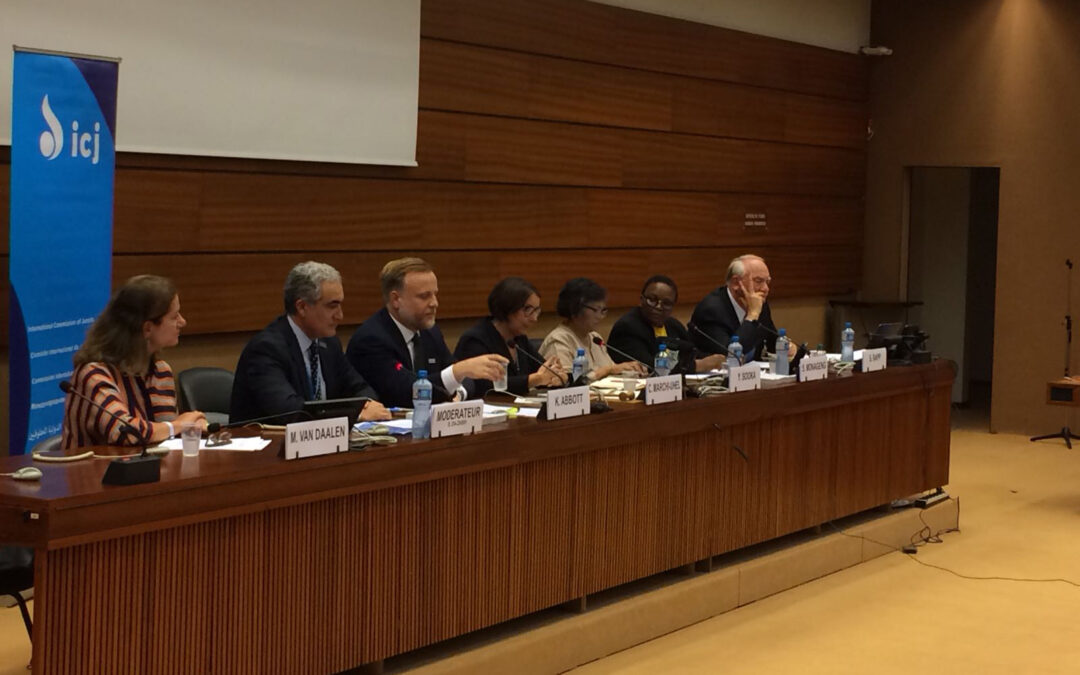
The ICJ organized this side event today (Tuesday 18 September 2018), in cooperation with the Permanent Mission of the Netherlands, at the Human Rights Council.
https://www.facebook.com/ridhglobal/videos/1005764152964172/
Background
Particularly when crimes under international law are perpetrated on a large scale in situations of crisis, there is an urgent need to preserve evidence for use in eventual criminal proceedings, whether at the International Criminal Court or other national or international tribunals
Too frequently, obstacles prevent immediate direct recourse to international courts and prosecutors. One response has been the creation of mechanisms to collect and preserve the evidence in the meantime. Examples include the International Independent and Impartial Mechanism (IIIM) for Syria, and the Commission on Human Rights in South Sudan.
At the current session of the Human Rights Council, the Fact-Finding Mission on Myanmar has called for establishment of an IIIM pending referral to the ICC or an ad hoc tribunal.
Opening Remarks:
Ambassador Monique T.G. van Daalen, Permanent Mission of the Netherlands
Moderator:
Saman Zia-Zarifi, Secretary General, International Commission of Jurists
Panelists:
- Catherine Marchi-Uhel, Head, International, Impartial and Independent Mechanism (IIIM) for Syria
- Yasmin Sooka, Chairperson, Commission on Human Rights in South Sudan
- Sanji Monageng, former Judge/Vice-President of the ICC, and Commissioner of the ICJ
- Stephen Rapp, Chair, Commission for International Justice & Accountability (CIJA), Distinguished Fellow, US Holocaust Memorial Museum, and former United States Ambassador-at-Large for Global Criminal Justice
- Kingsley Abbott, ICJ Senior Legal Adviser (Global Accountability), formerly with the Extraordinary Chambers in the Courts of Cambodia and the Special Tribunal for Lebanon
Universal-ICJ-NL-Side event-News-events-2018-ENG (flyer of the event in PDF)
Sep 18, 2018 | Advocacy, Non-legal submissions
The ICJ today put the spotlight on serious threats to the rule of law in Hungary, Poland and Turkey, speaking at the UN Human Rights Council in Geneva.The statement, made during general debate on situations that require the Council’s attention, read as follows:
“The International Commission of Jurists (ICJ) would like to bring to the Council’s attention the serious threats to the rule of law in Hungary, Poland and Turkey.
In Poland, the Government has adopted legislation to arbitrarily force into involuntary “retirement” one third of its Supreme Court Justices, delivering a fatal blow to the independence of the judiciary, already strained by past reforms.
In Hungary, multiple legal reforms have weakened judicial independence and effectively criminalized the activities of certain human rights NGOs and curtailed their financing.
Finally, in Turkey, consolidation of emergency measures in ordinary law, regressive constitutional reforms, and the mass dismissal of judges and prosecutors have removed essential protection for the independent functioning of the judiciary.
The ICJ is further concerned by the protest ban against the Saturday Mothers to hold weekly protests in memory of their disappeared family members, in breach of their right to freedom of assembly.
The ICJ is alarmed at the escalation of such threats to the very basic tenets of the rule of law in Europe, without specific action being taken by this Council to address them.
The ICJ urges the Council to give attention to these developments, which indeed form part of a broader global attack on the rule of law,[1] and to keep under observation the human rights situation in these countries.”
[1] See ICJ, “The Rule of Law under Global Threat” (statement in general debate on the oral update of the High Commissioner), 11 September 2018: https://www.icj.org/hrc39-gd2-hc/