UN Statement: Abuse of counter-terrorism measures against human rights defenders; no role for Egypt on UN expert mandate
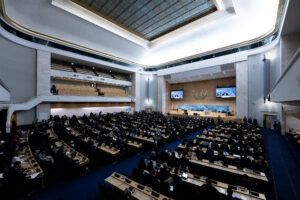
The ICJ today delivered a joint oral statement to the UN Human Rights Council, addressing the abuse of counter-terrorism measures to repress human rights defenders and other civil society actors, and highlighting deep concerns about possible moves to allow Egypt a significant role over the UN’s independent expert on human rights and counter-terrorism.
The statement was delivered in an interactive dialogue with the UN Special Rapporteur on the promotion and protection of human rights and fundamental freedoms while countering terrorism. The ICJ made the statement jointly on behalf of Amnesty International, Article 19, Cairo Institute for Human Rights Studies, CIVICUS, Human Rights Watch, International Federation for Human Rights (FIDH), International Service for Human Rights (ISHR), and Privacy International.
The organisations had earlier sent a joint letter to all States’ delegations to the Council in Geneva, highlighting Egypts appalling record of abuse of counter-terrorism measures, and urging States to strongly oppose any attempts to weaken the mandate of the Special Rapporteur, whether by diluting or distorting it by importing the flawed Egyptian-led approach into the Mexican-led resolution for its renewal, or any moves by longstanding leader Mexico to share co-leadership of the mandate renewal resolution with Egypt or other States with such an appalling record in relation to the very issues the mandate is to address.
The joint oral statement to the Council read as follows (check against delivery):
“Madame Special Rapporteur,
Our organizations welcome your report on the impacts of counter-terrorism and counter-extremism measures against civil society and human rights defenders (A/HRC/40/52).
We strongly concur with your findings regarding the deliberate and targeted abuse of overly broad and vague definitions of terrorism and violent extremism to criminalize and otherwise suppress human rights defenders and other civil society actors. We also appreciate your highlighting the need to prevent indirect impacts on civil society.
Among those States with a particularly appalling record of deliberate and targeted abuse, Egypt, which is mentioned in your report (paras 53 and 56), is a prominent example. As Human Rights Watch recently stated: “Using counterterrorism as a guise to crush all forms of dissent could be Egypt’s hallmark of 2018… There’s simply not much room left to peacefully challenge the government without being detained and unfairly prosecuted as a ‘terrorist’.”[1] Other examples from the reports before the Council include Turkey (para 53), Saudi Arabia (A/HRC/40/52/Add.2 paras 21-29), and China particularly as regards Uyghurs and Kazakhs (paras 55 and 57).
We share your concern about the elements lost from the previous Human Rights Council and General Assembly resolutions on “protection of human rights and fundamental freedoms while countering terrorism” in their March 2018 merger with the deeply flawed Egyptian-led initiative on “effects of terrorism” (para 29). We reiterate our call from March 2018 for future versions of the resolution to address the relevant issues exclusively and comprehensively from the perspective of the effective protection of human rights.[2] We strongly oppose any attempts to dilute your mandate, including by importing the flawed Egyptian-led approach into the resolution for its renewal, or any sharing of co-leadership of the mandate renewal resolution with States that have such an appalling record in relation to the very issues the mandate is to address.
Madame Rapporteur, beyond the particular cases mentioned in your report (para 53), what are your views on the broader situation within Egypt in terms of abuse of counter-terrorism measures and what can States, the United Nations, civil society, and other stakeholders do to stop such abuses in the name of counter-terrorism in Egypt and other egregious situations?
Thank you.
[1] https://www.hrw.org/news/2019/01/17/egypt-new-moves-crush-dissent (17 January 2019). See also among others: Human Rights Watch World Report 2019, https://www.hrw.org/world-report/2019/country-chapters/egypt; EuroMed Rights, Egypt – Finding Scapegoats: Crackdown on Human Rights Defenders and Freedoms in the Name of Counter-terrorism and Security (Feb 2018) https://euromedrights.org/wp-content/uploads/2018/03/EuroMed-Rights-Report-on-Counter-terrorism-and-Human-Rights.pdf; Joint NGO Statement, Egypt: Civil society faces existential threat (23 June 2016) https://www.icj.org/wp-content/uploads/2016/06/Egypt-Advocacy-JointNGOStatement-2016.pdf.
[2] Joint NGO end-of-session statement (23 March 2018) https://www.icj.org/hrc37-endofsession/.”
The statement can be downloaded in PDF format here: HRC40-JointOralStatement-SRCTHR-2019-EN
For more information email un(a)icj.org.