Sep 17, 2021 | Advocacy, Non-legal submissions
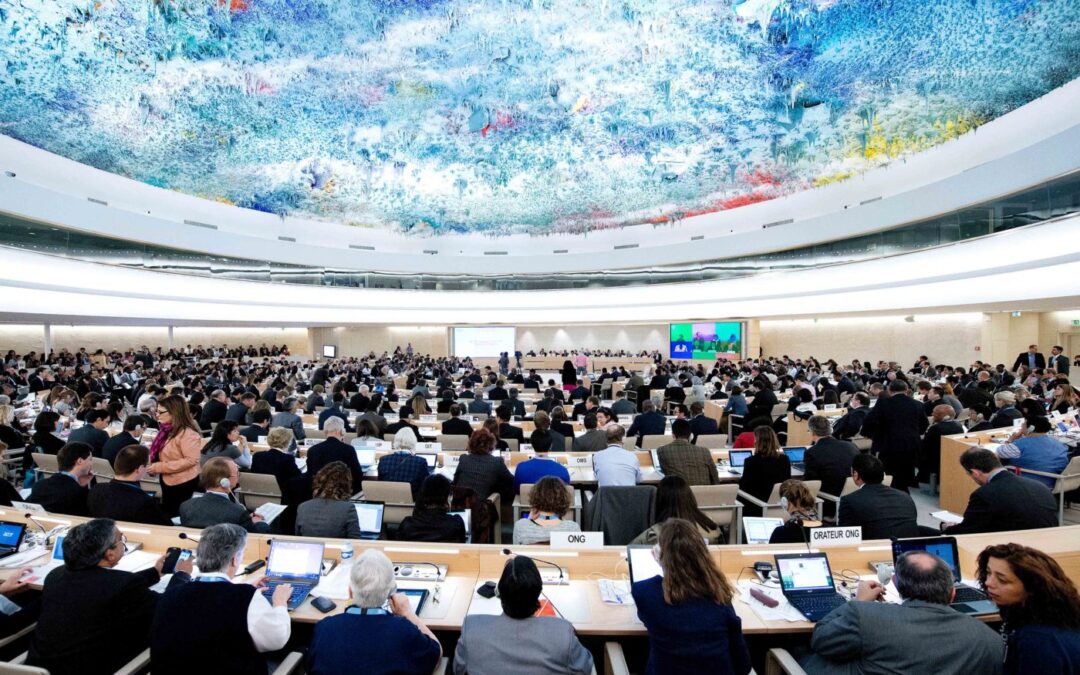
The ICJ warned the UN Human Rights Council of the dramatic deterioration of women’s and girls’ rights in Afghanistan and called it to act by establishing a monitoring and investigative mechanism.
Jun 29, 2021 | Advocacy, Non-legal submissions
The ICJ today addressed the UN Human Rights Council in the Interactive Dialogue on the Report of the Special Rapporteur on violence against women, its causes and consequences.
Jun 18, 2021 | Agendas, Events, News
On 22 June, the ICJ, Human Rights Watch, the Cairo Institute for Human Rights Studies, the Center for Reproductive Rights and the International Planned Parenthood Federation, with the co-sponsorship of the Kingdom of Spain, organize an online event on the 10th anniversary of the Council of Europe’s Convention on preventing and combating violence against women and domestic violence (Istanbul Convention).
This side event at the margin of the 47th regular session of the UN Human Rights Council has convened expert speakers to illustrate the situation of human rights protection to combat and prevent violence against women in Europe, how the Istanbul Convention has crucially contributed to this goal and the obstacles to its effective implementation.
Preventing and combating violence against women, as well as its causes and consequences, are a priority of the UN Human Rights Council. While UN standards are central to achieving this goal, regional standards have to date provided a key contribution in this field. The Council of Europe’s Istanbul Convention is the most far-reaching international treaty specifically designed to counter violence against women.
On 11 May 2021, the Istanbul Convention turned 10 years old. It is now time to take stock of the achievements that this Convention has contributed to as well as the challenges ahead, including countering the spread of misinformation about the Convention and ensuring states continue to champion its principles and standards.
Women and girls are still suffering the aftermaths of the COVID-19 crisis. The pandemic effects have shown a worrying increase on violence against women. The universalization of the Istanbul Convention is more important than ever because the pandemic has unveiled the “permanent shadow pandemic” that women and girls are suffering around the world.
When: Tuesday June 22nd, 13:00 – 14:00 CEST
Where: Zoom
Language: English
Panelists
- María Isabel Sanchís, Senior Advisor, Office of the Commissioner on Violence against Women of the Government of Spain
- Dubravka Šimonović, UN Special Rapporteur on violence against women, its causes and consequences
- Dame Silvia Cartwright, former Governor General of New Zealand, former CEDAW member, Commissioner of the International Commission of Jurists
- Professor Feride Acar, former chairwoman of CEDAW and GREVIO
- Hillary Margolis, Senior Researcher, Women’s Rights Division, Human Rights Watch
Moderator Massimo Frigo, UN Representative, ICJ
To confirm your participation and receive connection details, please RSVP to Massimo Frigo, email: Massimo.Frigo@icj.org .
Event-Invitation-Side Event-IstanbulConvention-UN-HRC47-final-2021-eng (download the event leaflet)

May 19, 2021 | News
The International Commission of Jurists (ICJ) and the Libyan Women’s Platform for Peace (LWPP) on 19 May 2021 convened a webinar on ‘Advancing women’s human rights in the constitutional reform process in Libya’.
The webinar was moderated by Zahra’ Langhi, co-founder and director of LWPP, with speakers: Jaziah Shaitier, Professor at the Criminal Law Department, University of Benghazi; Ibtisam Bahih, member of the Constitution Drafting Assembly; Nahla Haidar, Vice-Chair of the UN Committee on the Elimination of Discrimination against Women and an ICJ Commissioner from Lebanon; and Azza Maghur, a Libyan lawyer.
In her opening remarks, Zahra’ Langhi stressed that advancing women’s rights in in the constitutional reform process should not be limited to the protections of women’s rights in the draft Constitution, which were any way inadequate, but also the effective the participation of women in the entire constitutional-making process
Jaziah Shaitier focused her remarks on the limitations the Constitution:
“I had hoped that the constitutional process that followed the Revolution would state clearly that any person born to a Libyan father or a Libyan mother would be Libyan.”
“Libya needs gender-inclusive constitutional provisions, and implementing laws that would protect women against all forms of violence”, Shaitier said.
Langhi pointed out that Libyan women who are married to non-Libyans cannot even access essential COVID-19 vaccines.
Nahla Haidar spoke of the importance of states to comply with their obligations under the Convention on the Elimination of All Forms of Discrimination against Women (CEDAW), a treaty to which Libya is a party:
“Sharia’s place within the Constitution should be made clear, otherwise there would be no need for a Constitution at all.”
Haidar also stressed the need to address problematic provisions in the Libyan Draft Constitution, including draft discriminatory provisions and provisions perpetuating stereotypes about the role of women and men in society and in the family. “Women may also choose not to start a family at all, and that should not have any bearing on the enjoyment of their rights.”
Azza Maghur highlighted the inadequate representation of women in the Libyan constitutional process:
“Libyans dreamed of a Constitution that is theirs, one that guarantees rights and liberties. The representation of women was not adequate.”
A member of the Constitution Drafting Assembly herself, Dr Ibtissam Bahih, highlighted how the process had failed Libyan women, and how the need for reform was as urgent as ever.
You can watch the full webinar here.
Contact:
Said Benarbia, Director, ICJ Middle East and North Africa Programme, t: +41-22-979-3817; e: said.benarbia(a)icj.org
Asser Khattab, Research and Communications Officer, ICJ Middle East and North Africa Programme, e: asser.khattab(a)icj.org