40 organizations, including bar associations, lawyers’ groups, judges’ associations and human rights organizations, condemn the Tunisian authorities’ escalating and systematic campaign of intimidation, obstruction and retaliation against lawyers, judges, the Bar Association, magistrates’ associations and independent civil society organizations in the country.
Since President Saïed’s consolidation of executive power in 2021 and the summary dismissal of 57 judges and prosecutors by presidential decree in 2022, Tunisia has witnessed a sustained deterioration in the rule of law and respect for human rights. The authorities have resorted to using criminal proceedings, suspension orders, travel bans, administrative obstruction and smear campaigns against those who defend human rights, against those who challenge executive interference in the judiciary, document human rights violations and defend or otherwise support victims of such violations.
The attacks described in this statement form part of a broader pattern of interference with the independence of the legal profession, the judiciary and civil society in Tunisia. The deterioration of judicial independence, the targeting of lawyers and the restrictions imposed on civil society have serious implications for the rule of law and for access to justice. These attacks strike directly at the right to fair trial, including the right to a defence, and undermine access to justice, due process, freedom of expression, freedom of association and the rule of law.
The authorities’ attack on the Tunisian National Bar Association
The undersigned organizations are particularly alarmed by the Tunisian authorities’ escalating attacks on the Tunisian National Bar Association (ONAT) and the legal profession as a whole. An independent, self-governing legal profession is key to the proper administration of justice for victims of human rights violations. ONAT aims to protect the professional integrity of its members, ensures access to legal services, upholds fair trial guarantees and works to protect the rule of law. Therefore, interference with the ONAT undermines not only the interests of the legal profession but also access to justice for all and the integrity of the justice system as a whole.
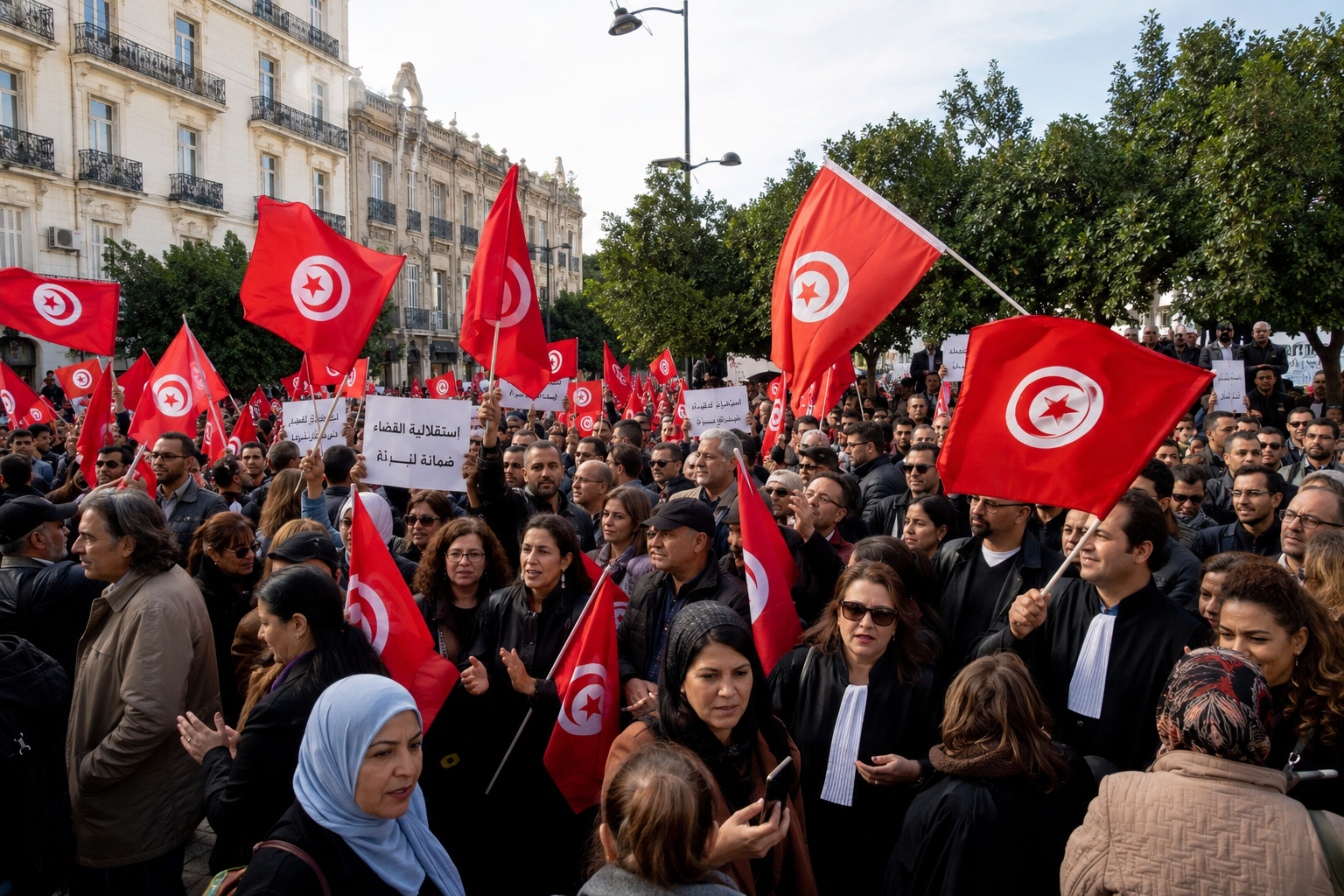
Over the past months, the ONAT has urged the authorities to address deteriorating working conditions in the courts, including the lack of basic equipment and shortages of judicial and administrative staff. It has also denounced unjustified remote trials, violations of fair trial guarantees, attacks on judicial independence and executive interference in the justice system. Following a failure by authorities to provide any meaningful response, the Bar convened an extraordinary general assembly on 1 May 2026 to address both lawyers’ professional grievances and the broader crisis in the justice system. Rather than engaging with the ONAT’s demands, the authorities challenged the procedures of the assembly and continued to disregard the substance of the concerns raised. The ONAT subsequently announced a mobilisation plan, including regional strikes, red-armband protests in courts and a nationwide general strike planned for 18 June 2026.
The ONAT has made clear that its mobilisation is not limited to professional grievances. It aims to defend the legal profession, safeguard the justice system and uphold fair trial guarantees. The authorities’ refusal to meaningfully engage with these demands, together with subsequent attempts to challenge or obstruct the ONAT’s collective action, raise serious concerns about deliberate interference with the legal profession’s independent institutional role in defending judicial independence, fair trial guarantees and the rule of law. The Tunisian authorities’ attempt to delegitimize, obstruct or retaliate against the Tunisian National Bar Association’s mobilisation is therefore an attack on the legal profession’s institutional role in defending judicial independence, fair trial guarantees and the rule of law.
According to Principle 14 of the UN Basic Principles on the Role of Lawyers (UN Basic Principles), in protecting the rights of their clients and promoting the cause of justice, lawyers must seek to uphold human rights. They shall at all times act freely and diligently, in accordance with the law and recognized standards and ethics of the legal profession. Principle 23 protects lawyers’ right to take part in public discussion on matters concerning the law, the administration of justice and the promotion and protection of human rights. Principles 24 and 25 recognise the role of self-governing professional associations of lawyers in protecting the professional integrity of their members and cooperating to ensure effective and equal access to legal services.
Lawyers are ‘essential agents of justice’, and by obstructing their work, the Tunisian authorities undermine the right to a fair trial and the rule of law. Lawyers, as other individuals, are entitled to the full range of human rights, including the rights to freedom of expression, association, and peaceful assembly guaranteed under the International Covenant on Civil and Political Rights (ICCPR) and the African Charter on Human and Peoples’ Rights to which Tunisia is a State party.
Targeting lawyers for their professional duties
The attack on the ONAT is part of a wider and systematic assault on lawyers who defend political opponents, journalists, judges, human rights defenders and victims of human rights violations. Lawyers in Tunisia have faced prosecution, arbitrary detention, travel bans, unfair trials and other forms of retaliation because of the cases they undertake and the clients they represent. Such an assault violates not only the human rights of the lawyers, but also those of their clients, and has a serious chilling effect on the right to a defence. This constitutes a violation of Principle 16 of the UN Basic Principles on the Role of the Lawyers, which requires governments to ensure that lawyers are able to perform all of their professional functions without intimidation, hindrance, harassment or improper interference. It also violates Article 14 of the International Covenant on Civil and Political Rights (ICCPR), which protects the right to access a legal representative of one’s own choosing.
The case of Ayachi Hammami illustrates this pattern. Hammami is a prominent lawyer and human rights defender. He vocally opposed measures taken by the President that undermine judicial independence and the rule of law, including the summary dismissal of judges and prosecutors in June 2022. Hammami was the spokesperson for the defence committee of the dismissed judges. In January 2023, he was charged under Decree Law 54 based on statements he made to the media as spokesperson of the dismissed judges’ defence committee. He acted as defence lawyers for journalists, political opposition members, activists and HRDs, including in the so-called conspiracy against state security case in 2023. He was subsequently added to the list of suspects of the “conspiracy case”, charged under counter-terrorism law, banned from travelling and appearing in public places, and imprisoned to serve a five-year sentence. UN experts have expressed their shock at his conviction as a result of his work defending those accused in the abovementioned conspiracy against state security case and warned that prosecuting legal professionals for performing their duties threatens the integrity and fairness of legal proceedings in Tunisia.
Hammami is among dozens of lawyers facing judicial harassment and serious risk of reprisal for exercising their professional duties and right to freedom of expression. They include:
- Sonia Dahmani, a lawyer and media commentator, was arrested on 11 May 2024 at the premises of the Tunisian National Bar Association (ONAT) by masked security forces and charged under five criminal cases under Presidential Decree-Law No. 54 for public statements on television and radio concerning prison conditions and racial discrimination. She was convicted and sentenced on appeal to 8 and 18 months in September 2024 and January 2025, respectively, and released on 27 November 2025 after 18 months in detention, but criminal proceedings against her remain pending; following her release, she was convicted with two further convictions: 18 months on appeal in April 2026 for her statements on racism in Tunisia, and two years handed down on 25 May 2026 by the Tunis court of first instance for statements on prison conditions. Her lawyer has appealed the most recent conviction and sentence.
- Chawki Tabib, a lawyer and former President of the ONAT and former head of the National Anti-Corruption Authority (INLUCC), faces two sets of proceedings: the first, an ongoing judicial investigation into money laundering and related offences, which have led to a travel ban since January 2024, and the issuance of a pre-trial detention order; and a second set of proceedings, recently concluded at first instance, for forgery and use of forged documents for which he was convicted on 21 May 2026 to 10 years According to his defence team, the accusations against him are not substantiated by any evidence. His assets were frozen by a decision dated 14 April 2026. International organizations have expressed concern about the politically motivated nature of these prosecutions.
- Lawyer Dalila Msaddak, who is currently subject to seven separate investigations under Decree-Law No. 54, all arising from her work as defence counsel in the conspiracy case and the legitimate exercise of her freedom of expression.
These cases illustrate the broader pattern of identifying lawyers with their clients or their clients’ causes and attempting to silence the legal profession. In line with Principle 18 of the Basic Principles, lawyers must never be identified with their clients or their clients’ causes. Nor may they be punished for the cases they take, the legal arguments they present, or their public defence of fair trial rights, judicial independence and human rights. The criminalisation of lawyers for carrying out their professional duties is a direct attack on the right to a defence and on the independence of the legal profession, which deters lawyers from taking on sensitive cases and risks leaving certain sectors of the population without legal representation, denying access to justice.
Reprisals against judges defending judicial independence
We also condemn the Tunisian authorities’ reprisals against judges and magistrates’ associations that have opposed executive interference in the judiciary. Recent actions have occurred in the context of a systematic dismantling of judicial independence safeguards in Tunisia since 2022: the dissolution of the Independent High Judicial Council, replacing it with a Temporary council whose members were appointed by the President, the summary dismissal of judges by presidential decree and the ongoing subordination of the judiciary to executive power.
Judge Anas Hmedi, President of the Association of Tunisian Magistrates, has become a central target of this repression. Criminal proceedings against him stem from actions taken in his capacity as head of the association and from the judges’ legitimate mobilisation against the summary dismissal of 57 judges by presidential decree in 2022. Following his trial in criminal proceedings “plagued with irregularities”, Judge Hmedi was convicted and sentenced to one year in prison on charges of obstruction of work and risks imprisonment if the verdict is confirmed on appeal. His prosecution and conviction contravene the UN Basic Principles on the Independence of the Judiciary, including Principle 1, which requires States to respect and observe the independence of the judiciary, and Principles 8 and 9, which protect judges’ rights to freedom of expression and association, respectively.
The UN Special Rapporteur on the independence of judges and lawyers has described the proceedings against Judge Hmedi as an “evident reprisal” for defending judicial independence, raising serious concern about reprisals against judges who oppose executive interference in the justice system, the misuse of criminal law to silence them, and the message of intimidation that it sends to the entire judiciary and the public.
Repression of rights organizations and obstruction of access to justice
The authorities’ growing repression campaign has also targeted independent civil society organizations, including organizations providing legal aid, monitoring human rights violations, defending women’s human rights, opposing racism, protecting media freedom and supporting victims of abuse – activities that support access to justice and provide an essential check on abuses of power.
Over the past year, Tunisian courts have issued 30-day suspension orders against at least 25 organizations, including Avocats Sans Frontières, Mnemty, the Tunisian Association of Democratic Women, Aswat Nissa, Nawaat, the International Commission of Jurists, the World Organisation Against Torture (OMCT) and the Tunisian League for the Defence of Human Rights – one of Africa’s oldest human rights organizations – Mnemty’s president, Saadia Mosbah, remains arbitrarily detained. The organizations that challenged the suspension orders in court lost their appeals and now face the threat of dissolution.
These measures not only restrict the right to freedom of association but also directly obstruct access to justice. The suspension order against Avocats Sans Frontières, issued on 5 May 2026, despite being subsequently lifted, has already affected people who rely on legal aid and support, including victims of gender-based violence. By targeting human rights organizations, legal aid providers and independent associations, the authorities are cutting off essential support for victims of police violence, gender-based violence, racial discrimination, political persecution and other human rights violations.
Taken together, such suspension of civil society organizations, the prosecution of lawyers, the reprisals against judges and the obstruction of the ONAT, undermine the institutional safeguards that protect individuals against human rights violations.
Calls to the Tunisian authorities
The undersigned organizations call on the Tunisian authorities to:
- Immediately end all acts of intimidation, harassment, prosecution, arbitrary detention, retaliation and improper interference targeting lawyers, judges, prosecutors, bar associations, lawyers’ associations, judges’ associations and human rights defenders; and immediately and unconditionally release lawyers, human rights defenders and all others solely detained for exercising their human rights;
- fully and effectively guarantee that lawyers can carry out their professional duties freely and independently, including when representing detainees held for politically motivated reasons, journalists, judges, activists, opposition figures or victims of human rights violations, and ensure that they are not identified with their clients or punished for the cases they undertake, the clients they represent, or their clients causes or the legal arguments they present or their public defence of human rights and the rule of law;
- immediately drop all criminal, disciplinary and administrative proceedings brought against lawyers and judges solely for carrying out their professional duties, defending judicial independence, or exercising their human rights to freedom of expression, association and peaceful assembly;
- quash the conviction and sentencing of Judge Anas Hmedi and ensure that no judge is punished for defending judicial independence or for participating in the legitimate activities of a professional association;
- immediately release Ayachi Hammami and Chawki Tabib and stop the arbitrary trials of all lawyers, including Sonia Dahmani, Dalila Msaddak, judges, political detainees, journalists, human rights defenders and civil society actors arbitrarily detained for exercising their human rights or carrying out legitimate professional work;
- lift suspension orders against civil society organizations and end all attempts to dissolve, obstruct or criminalise human rights groups, legal aid organizations and independent associations;
- reverse measures undermining judicial independence, including executive interference in the judiciary, and comply with the administrative court rulings to reinstate dismissed judges;
- ensure full respect for fair trial guarantees, due process, access to counsel, equality of arms and the independence of courts;
- bring Tunisian law and practice into conformity with Tunisia’s obligations under international human rights law and relevant international standards on the independence and protection of lawyers and judges, including the UN Basic Principles on the Independence of the Judiciary, the UN Basic Principles on the Role of Lawyers, and international standards on judicial independence and the independence of the legal profession; and
- restore the independence of the legal profession and the judiciary, guarantee the free and lawful work of civil society organizations and uphold the human rights of everyone in the country.
Contact
Saïd Benarbia, Director, ICJ Middle East and North Africa Programme; t: +41 22 979 3800, e: said.benarbia@icj.org
Nour Al Hajj, Communications & Advocacy Officer, ICJ Middle East and North Africa Programme; e: nour.alhajj@icj.org