Aug 8, 2017
Transitional justice mechanisms must undergo serious reform in line with international human rights standards and the directives of Nepal’s Supreme Court in order to provide justice for victims of conflict-era human rights violations and abuses, the ICJ said in a discussion paper released today.
ICJ’s discussion paper Nepal’s Transitional Justice Process: Challenges and Future Strategy summarizes the key challenges faced by Nepal’s transitional justice process as identified by conflict victims, representatives of human rights organizations, lawyers and other stakeholders during consultations held in Pokhara, Biratnagar and Nepalgunj and a national roundtable meeting in Kathmandu in May and June 2017.
The discussion paper concludes with the identification of the strategies for civil society organizations and victims’ representatives to address the challenges of Nepal’s transitional justice process.
“The voices heard in our consultations provide a stark reminder that more than ten years after the end of the conflict and over two years since the Commissions of Inquiry were established, victims of serious human rights violations and abuses are still searching for justice,” said Frederick Rawski, ICJ’s Director for Asia and the Pacific.
The discussions reaffirm ICJ’s own assessment that the transitional justice mechanisms, the Truth and Reconciliation Commission (TRC) and the Commission on Investigation of Disappeared Persons (CoID), have fallen short of international standards, both in constitution and operation, despite the repeated reinforcement of such standards by the Supreme Court of Nepal.
The Commissions have a deeply flawed legal mandate, which, among other problems, allows them to recommend amnesties for serious human rights violations and abuses.
In addition, their non-consultative, uncoordinated and opaque approach to their work has also created distrust with all major stakeholders, including conflict victims and members of civil society.
The key challenges identified by the participants include:
- Lack of political will to address past human rights violations and abuses;
- Inadequate legislative framework to address conflict-era human rights violations and abuses;
- Lack of adequate human, financial and technical resources for the TRC and COID;
- Failure of the TRC and COID to take measures to gain confidence of conflict victims and other stakeholders;
- Inadequate procedures to ensure confidentiality and security for victims and witnesses;
- Lack of coordination among the Commissions and other state institutions responsible for addressing conflict-era human rights violations and abuses; and
- The failure of the Commissions to adopt credible and transparent processes for their work.
As of July 2017, the TRC has received 58052 complaints of human rights violations, and the CoID has received 2874 complaints of alleged enforced disappearances.
Since the ICJ held its consultations on the operation of the transitional justice mechanisms, the Commissions have started preliminary investigations in some of the cases.
However, according to information received by the ICJ, these investigations also suffer from the flaws described above: the investigation teams have inadequate human and financial resources to handle the large number of cases; there are concerns about the opacity of the appointment process of the investigators; and the Commissions have taken no measures to ensure confidentiality and security of victims and witnesses who participate in the investigations.
Victims have also expressed concern that the investigators in many districts have asked them about their interest in reconciliation, even where there complaints are of serious conflict-era crimes.
This is despite the Supreme Court ruling out any possibility for reconciliation in cases of serious crime in Madhav Kumar Basnet v the Government of Nepal (2014).
“As the Commissions start preliminary investigations into complaints of human rights violations and abuses, they must ensure both victims’ access to justice, as well as the security and confidentiality of victims and other witnesses,” added Rawski.
Contact:
Frederick Rawski, ICJ’s Asia Pacific Regional Director (Bangkok), e: frederick.rawski@icj.org
Nepal-TJus Process-Advocacy-2017-ENG (Full paper in PDF)

Jul 3, 2017
The ICJ and other organizations call on the Vietnamese authorities to immediately order an independent, impartial and effective investigation into the circumstances surrounding the death of Hoa Hao Buddhist Nguyen Huu Tan, who died in police custody on 3 May 2017.
Vietnam-Death in custody-Advocacy-Open letters-2017-ENG (full text, in PDF)
Jun 22, 2017 | News
Pakistani authorities need to ensure a prompt, impartial and effective investigation into a barrage of assaults and threats against lawyers in the premises of the Lahore High Court, the ICJ, Human Rights Watch and Amnesty International said today.
The Government needs to defend the rule of law and prosecute those responsible for any criminal conduct.
On 20 June, during proceedings of a case involving the alleged abduction and subsequent “disappearance” of a 26-year old woman and her two-year old son, supporters of the accused, a prominent lawyer, physically assaulted the complainant’s counsel Shabbir Hussain and Usama Malik, and made abusive remarks and threats against another member of the complainant’s legal team, Noor Ejaz Chaudhry.
The attackers were mostly lawyers and members of the local bar association.
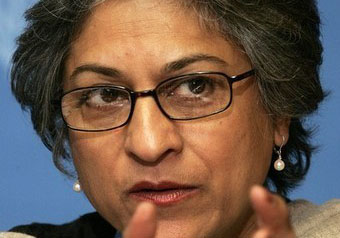
The attackers also made abusive and threatening remarks against Asma Jahangir (photo), a notable human rights lawyer, Honorary Commissioner of the ICJ, and former President of the Supreme Court Bar Association.
Asma Jahangir was not present in the court but was represented by her legal team comprising of Shabbir Hussain, Usama Malik, Mian Liaquat Ali and Noor Ejaz Chaudhry.
“The legal profession is one of the pillars of the administration of justice. It is deeply worrying that instead of discharging their responsibility to uphold the rule of law, certain lawyers would resort to threats and violence in a clear attempt to obstruct justice,” said Ian Seiderman, ICJ’s Legal and Policy Director.
Under international standards, including the UN Basic Principles on the Role of Lawyers, Pakistan has an obligation to ensure that lawyers are able to perform all of their professional functions without intimidation, hindrance, harassment or improper interference.
Where lawyers are threatened as a result of discharging their functions, authorities must ensure they are adequately safeguarded.
“Lawyers must be able to go to court without fearing violent assaults and abuse,” Brad Adams, Asia director at Human Rights Watch said. “That such assaults take place with increasing frequency in Pakistan and without accountability represents a serious failure of the Pakistani authorities to ensure rule of law.”
It is the responsibility of the bar councils and associations to ensure that allegations of professional misconduct against their members are promptly, independently and impartially investigated, and if lawyers are found in breach of their codes of conduct after a fair hearing, disciplinary action is taken against them.
Any disciplinary action must be subject to an independent judicial review.
Threatening and assaulting opposing counsel is not just against the law, but also in breach of lawyers’ professional code of ethics,” said David Griffiths, Amnesty International’s Senior Adviser on South Asia. “The respective Bar Councils must take notice of the allegations, and use this condemnable incident as an opportunity to tackle the culture of impunity which impacts even the legal profession in Pakistan.”
Background
In May 2017, Bilquis Zareena filed a habeas corpus petition in the Lahore High Court for the recovery of her daughter Ayesha and grandson Alyan Ali, who have allegedly been missing since November 2016.
According to Bilquis Zareena, her daughter had secretly been married to Maqsood Buttar, a prominent lawyer and member of the Pakistan Bar Council, the highest regulatory body for lawyers in the country.
Bilquis Zareena claims her daughter and grandson’s lives could be in danger as Maqsood Buttar had previously threatened and even attempted to kill Ayesha.
The next hearing in the case is on Friday, 23 June 2017.
Contact:
Ian Seiderman, ICJ Legal and Policy Director, e: ian.seiderman(a)icj.org
Reema Omer, ICJ International Legal Adviser (South Asia), e: reema.omer(a)icj.org
Jun 5, 2017 | Advocacy, Non-legal submissions
The ICJ has made a submission to the UN Human Rights Committee in advance of its forthcoming examination of Pakistan’s initial report under International Covenant on Civil and Political Rights (ICCPR).
In its submission, the ICJ has brought to the Committee’s attention concerns in relation to the following issues:
- The compliance of Pakistan’s counter-terrorism laws with the State’s obligations under Articles 6, 9 and 14 of the Covenant, particularly in the context of its “military justice” system;
- Shortcomings in the legal framework relevant to torture and other ill-treatment;
- The continuing practice of enforced disappearances and, in this context, the ongoing impunity of law enforcement and military agencies;
- The compliance of Pakistan’s blasphemy laws with Articles 14, 18, and 19 of the Covenant; and
- The compatibility of Pakistan’s “International Non-Governmental Organizations Policy” with the State’s obligations under Article 22 of the Covenant.
The Human Rights Committee will examine Pakistan’s initial report during its 120th session, which will be held in Geneva from 3-28 July 2017.
Following the review, the Committee will adopt Concluding Observations setting out recommendations to the Pakistani Government.
Pakistan -ICCPR submission-Advocacy-non legal submission-2017-ENG (full text in PDF)
May 27, 2017 | News
On 24 May 2017, States at the UN reached an agreement to prepare an “international regulatory framework” to protect human rights and ensure accountability for violations and abuses relating to the activities of private military and private security companies (PMSCs).
The agreement, reached at Working Group level, has still to be ratified by the full UN Human Rights Council.
It would be the first universal international instrument on human rights and private security companies negotiated and adopted at the UN.
This could pave the way to further developments towards increased monitoring and accountability of the private security industry.
The agreement constitutes a landmark achievement. The intergovernmental Working Group over the past six years have been mired in circular debates as to whether or not it is desirable to develop a legally binding instrument on PMSCs.
Last’s week agreement leaves aside for the moment the decision about the nature of the instrument and will instead allow for a constructive focus on the contents of the future instrument.
Activities of private and military security companies became the object of heightened international scrutiny particularly after events in the context of the armed conflict in Iraq over the past decade.
These include unlawful killings at Nisoor Square and torture and ill-treatment at Abu Graib prison.
A Working Group of experts on mercenary activity appointed by the UN Human Rights Council started to look at the issues in 2007, generating proposals for international instruments to fill perceived regulatory gaps.
Many States have now accepted that the absence of an international regulatory framework combined with limited or non-existent regulation at national level offers a “breeding ground” for human rights abuses committed by PMSCs.
The main clients of these companies are governments that contract them to carry out specific functions, including some that many believe should remain firmly in the hands of public officials.
One key issue that the future instrument should address is the circumstances under which PMSCs can be considered to act on behalf of the State when they are contracted to perform functions that are typically State functions.
International law already governs some aspects of PMSC activity. International human rights law provides for a general obligation of States to protect against the adverse consequences of PMSC activity.
There has also been other international regulatory activity outside of UN auspices in this area.
In 2008 a select group of mostly Western States led by the Government of Switzerland and the International Committee of the Red Cross (ICRC) elaborated the Montreux Document on pertinent obligations for States regarding PMSCs.
Other initiatives such as a Code of Conduct for the PMSCs themselves followed suit. But many States and civil society organizations regard these initiatives as insufficient and lacking the universality afforded by UN processes.
One notable weakness in current approaches is the dearth of standards and mechanisms squarely addressing accountability of private security industry and to ensure access to remedy for those victims of abuse.
Experience shows that States legal frameworks have limited effectiveness when abuses occur at the cross-border level, involving more than one company in more than one jurisdiction, especially in conflict or post-conflict environments.
The prospective international regulatory framework should surely build on existing initiatives, research and findings.
To that end, broad participation by all stakeholders should be ensured.
In this regard, participation of civil society and NGOs specialized in human rights has not been optimal so far.
States leading this new process should make all and every effort to fill that gap, ensuring that international and national civil society receive timely information and facilities for meaningful participation.