Mar 8, 2019 | Advocacy, Non-legal submissions
Speaking at the UN, the ICJ today urged all States from all regions to participate actively in the process towards a treaty on business and human rights.
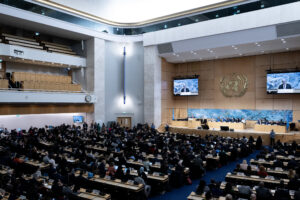
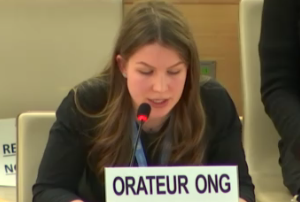
The statement, delivered during a general debate on thematic issues at the UN Human Rights Council in Geneva, read as follows:
“Mr President,
The report on the Fourth session of the Intergovernmental Working Group to establish a legally binding instrument in the field of business and human rights opens opportunities for States and the international community to build a multilateral legal framework in this field.
We continue to urge all States from all regions – especially those that have been reluctant to engage- to actively participate in this process.
The ICJ considers that this draft should be based on transparent consultation and participation and respect standards of clarity and precision.
Recent dramatic events in Brazil and South Sudan show the central place that a system of legal responsibility for businesses, including for complicit participation in abuses, should have in an international treaty.
The dam collapse in the Brazilian locality of Brumadhino and the evidence pointing to oil industry complicity with serious human rights violations in South Sudan show the global scale of the problem and the involvement of companies from all corners of the world.
A treaty should also provide to all states a set of common standards effective collective action to guarantee access to justice in a transnational setting.
The creation of an international legally binding framework for States to maximize action and cooperation regarding human rights abuses in the context of business operations remains a compelling necessity of our times.
I thank you.”
The statement may be downloaded in PDF format here: HRC40-OralStatement-GDitem3-2019

Jan 23, 2019
The ICJ and Amnesty International–Canada, have intervened in appeal proceedings before the Supreme Court of Canada in the Case Araya et al versus Nevsun Resources Ltd on appeal from the British Columbia Court of Appeal.
This case concerns a civil suit by Eritrean refugees against Nevsun for its involvement in the commission of forced labour, slavery, torture and other serious breaches of international law against them and many other victim. It is being heard today (23 January).
The joint intervention sets out the basis of the right to an effective remedy under international law and the importance of giving effect to that right in the proceedings of the case and in the development of common law in Canada.
The proceedings before the Supreme Court originate in an appeal by the defendant company Nevsun Resources Ltd against the British Columbia Court of Appeal’s judgment of 2017 which upheld the rights of claimants to sue in Canada.
The company argues that the “act of State” doctrine precludes Canadian courts from sitting to judge the lawfulness or validity of sovereign acts of foreign states, in this case the implementation of Eritrean National Service Programme, within the territory of that state.
The alleged forced labour, slavery and torture had been committed in this context. The company also contends that the claimants’ suit is based on allegations of breach of customary international law rules applicable only to States and which are not recognized under Canadian tort law as applicable to companies.
The ICJ and AI-Canada argue that the development of common law doctrines of judicial abstention and causes of action should be consistent with the right to an effective remedy for human rights violations as protected by international law and the Canadian Charter of Rights and Freedoms. In this line, the company’s grounds of appeal should be rejected or, if accepted, should be made consistent with the full respect to the right of the claimants to an effective remedy.
The claim filed in 2015 argues that Nevsun Resources was involved in various ways in the practice of forced labour, slavery, torture, cruel, inhuman or degrading treatment, and crimes against humanity at the Bisha mine against hundreds of Eritreans who were conscripted into the Eritrean National Service Programe and forced to working in the mine operated jointly by Nevsun and Eritrean State companies.
The claimants, Gize Yebeyo Araya, Kesete Tekle Fshazion and Mihretab Yemane Tekle, three of those who were forced to work in the Bisha mine and fled the country to find refuge in Canada, sued Nevsun alleging private law torts and breaches of peremptory principles of international law (forced labour, slavery, torture, inhuman or degrading treatment, and crimes against humanity).
Contact:
Carlos Lopez, ICJ Senior Legal Adviser, t: +41 22 979 38 16 ; e: carlos.lopez(a)icj.org
Canada-Nevsun AB-Advocacy-Legal submissions-2019-ENG (full text of appeal, in PDF)

Jan 15, 2019
The ICJ and CORE argue that mining giant Vedanta has a duty of care to villagers affected by its Zambian subsidiary’s copper mining activities.
The UK Supreme Court is to hear an appeal on 15 and 16 January from mining giant Vedanta Resources, in a case brought by 2,000 Zambian villagers who claim that their water and land have been poisoned by the firm’s operations.
The Court will consider evidence from the ICJ and corporate accountability group CORE, that under existing law and international standards, Vedanta owes a legal duty of care to the Zambian villagers. Acceptance of this principle would make the merits of the case arguable before UK Courts and allow for their jurisdiction to hear the case in future proceedings.
Vedanta is seeking to overturn a Court of Appeal ruling from last year, which upheld the High Court’s view that UK Courts would have jurisdiction to hear the case in significant part on the basis that a UK parent company may owe a duty of care to third parties affected by its subsidiaries’ activities.
The CORE and the ICJ submission to the Court argues that the Court of Appeal’s conclusion is supported by international standards on companies’ human rights and environmental responsibilities; UK government publications aimed at implementing those standards, including its Business & Human Rights Action Plan; and comparative law jurisprudence.
Vedanta has stated that its “sustainable development agenda” has been developed in line with the international standards to which the submission refers.
These standards are therefore relevant to the factual question of whether Vedanta controlled and/or had assumed responsibility for the activities of its Zambian subsidiary, Konkola.
The case is a pivotal test for the development in the UK, and across common law and possibly other jurisdictions of parent company liability for human rights and environmental harm.
Victims of corporate human rights abuses face multiple barriers in holding companies to account and securing access to justice.
A clear statement from the UK Supreme Court affirming the duty of care principle would assist communities who have been harmed by corporate activities, and would provide an important affirmation of the scope of parent companies’ obligations.
Contact
Carlos Lopez, ICJ Senior Legal Adviser, t: +41 22 979 3816 ; e: carlos.lopez(a)icj.org
UK-Intervention-ICJ-CORE-Advocacy-legal submission-2019-ENG (full submission in PDF)
Jan 11, 2019 | Incidencia, Noticias
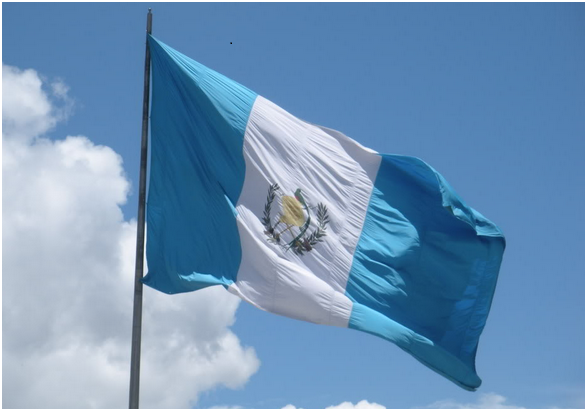
La CIJ envió una carta sobre la coyuntura actual en Guatemala al Secretario General de la Organización de Estados Americanos.
El contenido de la carta:
Señor Secretario General
El Secretario General de la Comisión Internacional de Juristas (CIJ) desea expresarle su preocupación por la crisis política que se está presentando en Guatemala. Los actos del Gobierno de Guatemala en contra de la Comisión Internacional contra la Impunidad en Guatemala (CICIG), organización de las Naciones Unidas que cuenta con el apoyo decidido de la Comunidad Internacional, tanto en lo que se refiere al apoyo financiero, como en recursos humanos, socavan el Estado de Derecho y constituyen una alteración del orden constitucional de Guatemala.
Las últimas decisiones del Presidente de la República, Sr. Jimmy Morales, están repercutiendo negativamente en el Estado de Derecho y en la lucha contra la Impunidad. Por ello, la Comisión Internacional de Juristas (CIJ), ha llevado a cabo un análisis de coyuntura que permita comprender mejor la situación actual en Guatemala; cómo ésta afecta al Estado de Derecho y la Democracia y además, dicho análisis proporciona elementos para una posible evaluación colectiva de dicha situación, de conformidad con la Carta Democrática Interamericana.
Por ello, me pemito entregarle por este medio, el documento “La coyuntura actual en Guatemala. Análisis de la comisión Internacional de Juristas (CIJ)” de fecha 29 de diciembre de 2018. De esta forma, esperamos facilitar procesos de discusión orientados a fortalecer el Estado de Derecho en Guatemala, así como la discusión sobre una posible aplicación de la carta Democrática Interamericana. Sabemos que otros guatemaltecos y guatemaltecas están mandando información a la Secretaría de Asuntos Políticos de la Organización de los Estados Americanos, incluido el jurista Francisco Villagrán de León y esperamos que todo ello, contribuirá a una mejor comprensión de esta difícil situación.
Sin más por el momento, quedo de Usted con las muestras de mi más alta consideración y estima,
Sam Zarifi
Secretario General
Comisión Internacional de Juristas
Guatemala-advocacy-open letter-2019-SPA Carta (en español)
Guatemala-threats to democracy-advocacy-analysis-2019-SPA Análisis completo de la coyuntura actual (en español).

Dec 21, 2018 | News
CORE and the ICJ have been granted permission to intervene in an appeal before the United Kingdom Supreme Court (Vedanta Resources PLC and another v. Lungowe and others).
The two organizations will provide evidence on comparative law and international standards regarding the responsibilities of companies in relation to human rights and environmental protection, in particular the recognition of a duty of care of parent companies in relation to the communities living in the surrounding of companies operations.
In August 2015, 1800 Zambian villagers launched a legal action in the UK against mining company Vedanta Resources Plc and its Zambian subsidiary, Konkola Copper Mines, claiming that their water sources and farming land were poisoned from the copper mining operations of both companies.
Last year, the Court of Appeal upheld a High Court ruling that the Zambian claimants had a legal right to bring a claim through the courts in the UK and that a parent company may owe a duty of care to third parties affected by its subsidiary. Vedanta is appealing this ruling in the Supreme Court.
CORE and the ICJ have been lead participants in the elaboration processes of all major international instruments in the field of businesses’ human rights responsibilities in the last decade and are also specially situated to provide information on the state of the law in various jurisdictions.
Our submission is that the Court of Appeal’s conclusion that Vedanta arguably owed a duty of care to the claimants is supported by: international standards regarding the responsibilities of companies in relation to human rights and environmental protection; material published by the UK government with the aim of implementing those international standards; and comparative law jurisprudence.
The hearing will take place on 15-16 January 2019.