Apr 25, 2019 | Advocacy, Non-legal submissions
The ICJ draws attention to instances of alleged human rights abuses by the private military and security companies in all regions and analyses the challenges related to the accountability frameworks and access to justice.
The ICJ contribution is in response to the call by the UN Working Group on the use of mercenaries, which also has a mandate on private security companies, for written information to assist in its deliberations on “private military and security companies in extractive industries – impact on human rights”.
Private Military and Security Companies (PMSCs) are hired by companies engaged in extractive operations in all geographic regions of the world, but their activities or operations that give rise to allegations of human rights violations and abuses seem to be prevalent regions where abundance of natural resources and the favorable environment for foreign investment are propitious to the establishment of extractive companies in, many times, fragile contexts.
In this regard ICJ suggests the Working group to consider the following recommendations:
- States should ensure that their domestic legal framework provides for real access to effective remedies for victims of human rights abuse by PMSCs and extractive companies.
- Provide guidance to States to establish effective legal accountability frameworks of criminal or civil nature that pay due consideration to the inherently dangerous nature of the mining activity and the security services operating in that context.
- Recommend that States establish legal frameworks that require meaningful reporting/disclosure of company policies and practices in relation to human rights, including their use and effectiveness of grievance mechanisms at the operational level.
- Both extractive and security companies should respect all human rights in accordance with international standards, including the UN Guiding Principles on Business and Human Rights, the Voluntary Principles on Security and Human Rights and other sectorial guidance applicable to PMSCs.
- Security companies, whatever their structure or ownership, should carry out enhanced processes of due diligence consistent with international best practices, and participate in remediation schemes.
Universal-ICJ Submission PSC and extractive industries-Advocacy-non legal submissions-2019-ENG (full text of the report, in PDF)
Apr 10, 2019 | News
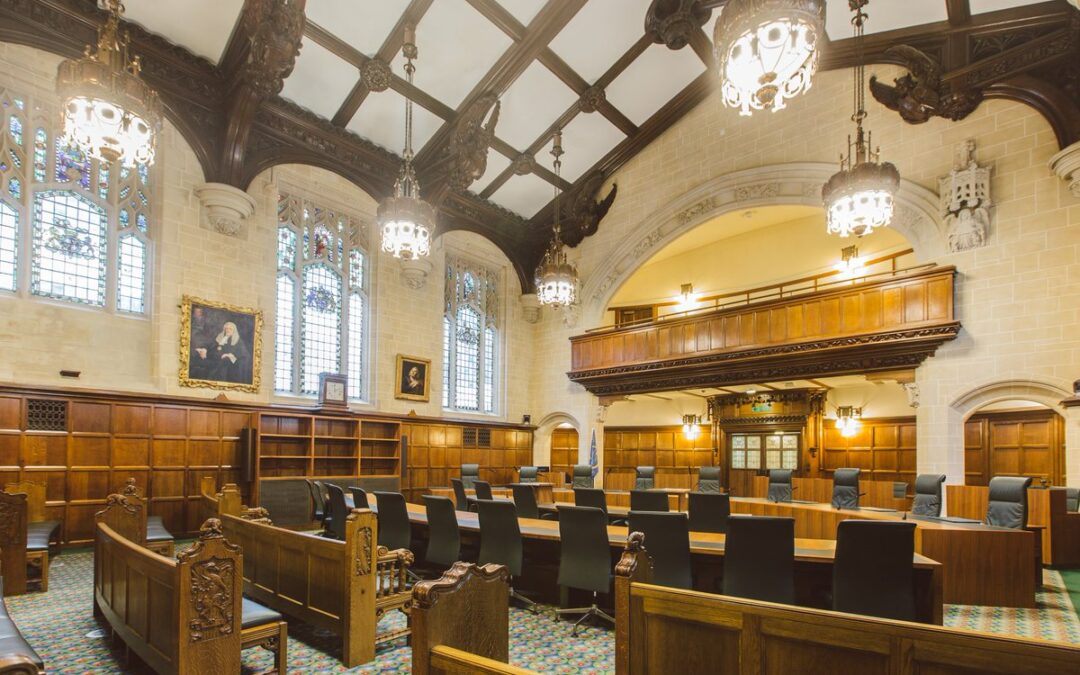
Today, the ICJ and the CORE Coalition welcomed the decision of the United Kingdom Supreme Court to allow a complaint to proceed against Vedanta Resources Plc and its Zambian subsidiary Konkola Copper Mines (KCM), alleging serious harm from extraction activities in Zambia.
The damage to health and livelihood was allegedly caused to local communities living in the Chingola District by the discharge of toxic waste from the Nchanga Mine operated by KCM.
The companies challenged the jurisdiction of the UK courts to hear the complaint for negligence and breach of statutory duty, saying there was no case against them arguable in a UK court and, in relation to KCM, that Zambia was the proper forum where any case would have to be heard.
The judgment, confirming the decision of lower courts, dismissed the appeal by the companies, allowing the case to now proceed to trial on the merits. The ICJ and CORE Coalition acted as interveners in the case.
“Today’s Supreme Court decision will make it possible for the Zambian claimants to find justice, even so long after events took place,” said ICJ Senior Legal Adviser Carlos Lopez.
“The ruling makes clear that, from available evidence at this stage, it is arguable in trial that a parent company like Vendanta owes a duty of care in relation to people living in the vicinity of their subsidiaries and this decision will have important implications to similar cases concerning parent company duties around the world,” said Lopez.
Although access to justice for alleged victims harm from subsidiaries of parent companies has been elusive, the UK Supreme Court clarified that the principles applicable to these cases were “not novel at all.”
“Many other victims face insurmountable hurdles in their efforts to hold companies to account. The case is a reminder of the urgent need for legislation to require companies to take action to prevent human rights abuses, and to make it easier to hold them to account when they fail to do so,” said Marilyn Croser, Director of CORE.
The judgment regarded published material in which Vedanta fairly asserted assumption of responsibility for the maintenance of proper standards of environmental control over activities of its subsidiaries. The Court said that this was “sufficient on their own to show that it is well arguable that a sufficient level of intervention by Vedanta in the conduct of operations at the Mine may be demonstrable at trial.”
Today’s Supreme Court judgment also made clear that Zambian courts could not be necessarily relied on to address claims against KCM and that there was a real risk that the claimants would not obtain “substantial justice” in Zambia.
Contact:
Marilyn Croser, Director CORE Coalition, t: + 44 203 752 5712
Carlos Lopez, Senior Legal Adviser, ICJ, t: + 41 22 9793816
Mar 18, 2019 | Advocacy, Non-legal submissions
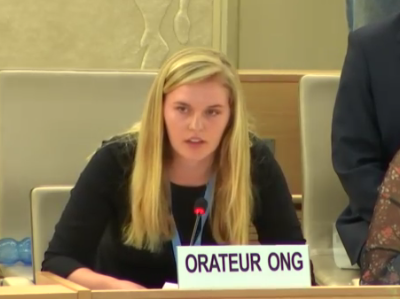
The ICJ today called for prompt release of a database of businesses involved in certain activities in the Occupied Palestinian Territory, that has been prepared by the UN Office of the High Commissioner for Human Rights (OHCHR).The statement, delivered in a general debate, read as follows:
“Regarding the Database of business enterprises involved in listed activities in the settlements on the Occupied Palestinian Territory, the ICJ recognizes the important work that has been done, but is deeply concerned at OHCHR’s failure to publicly release it.
All States, including the home States of the companies involved, have a responsibility to prevent companies from operating in breach of international law. Businesses themselves should see the database as an opportunity to more proactively incorporate respect for human rights within their policies and operations.
The prompt publication of the database should contribute to global efforts to hold all business enterprises accountable for their role in violations of human rights and humanitarian law and to give them an incentive to cease in such behaviour. The ICJ urges all States, including those that have supported the creation of this database, to redouble efforts to prevent business complicity in serious human rights abuses and to hold businesses legally accountable when abuses occur in their own territories as well as in the global operations of businesses for which they are the home State.”
Mar 15, 2019
Today, ICJ and Human Rights Lawyers’ Association (HRLA) submitted recommendations to the Ministry of Justice on Thailand’s draft National Action Plan on Business and Human Rights (‘draft NAP’), dated 14 February 2019, scheduled for public consultation between 15 February 2019 and 15 March 2019.
The organizations called for modifications to the draft NAP to ensure adequate legal and other protections for human rights defenders and their work, which was indicated as the identified as one of the NAP’s key priority areas.
The ICJ and HRLA welcomed the overall commitment expressed by the Thai Government, including the Ministry of Justice’s, to implement the United Nations Guiding Principles on Business and Human Rights (UNGPs) through the NAP.
The organizations expressed concern, however, at the removal of a commitment that had been included in earlier versions of the NAP to “push for an Anti- Strategic Litigation against Public Participation (SLAPP) law” from the current draft NAP.
This removal was justified in the draft NAP on the grounds that the Court of Justice had already introduced legal amendments to prevent SLAPP lawsuits, in particular by enacting revisions of the Criminal Procedure Code (Articles 161/1 and 165/2). The draft NAP also refers to certain powers of a public prosecutor as another means of preventing SLAPP lawsuits.
ICJ and HRLA indicated that these laws were inadequate to prevent judicial harassment of human rights defenders and called for the draft NAP to include concrete action with the force of law to protect individuals, and in particular human rights defenders, from judicial harassment, including through SLAPP lawsuits.
Background
Thailand is among the first countries in the ASEAN region to have begun the elaboration of a NAP. The UN Human Rights Council has stressed the importance of the development of National Action Plans by States to implement the UN Guiding Principles on Business and Human Rights, which include the obligation to provide protections for persons from any adverse human rights impact of business activity.
On 15 February 2019, the Ministry of Justice circulated a final draft of the NAP for public consultation.
Upon finalization of the draft following the consultation, the draft will be forwarded to the Office of the National Economics and Social Development Council for their consideration before being sent to the Cabinet for approval.
The draft NAP sets out 4 key priority areas including (1) labour; (2) land, environment and natural resources; (3) human rights defenders; and (4) cross border investment and multi-national enterprises.
The draft NAP has set out several action points aimed to address concerns regarding the above-noted key priority areas for the period of 5 years (2019-2023).
Thailand-SLAPP Analysis-Advocacy-Analysis brief-2019-ENG (analysis in English, PDF)
Thailand-SLAPP Analysis-Advocacy-Analysis brief-2019-THA (analysis in Thai, PDF)
Mar 12, 2019 | Advocacy, Non-legal submissions
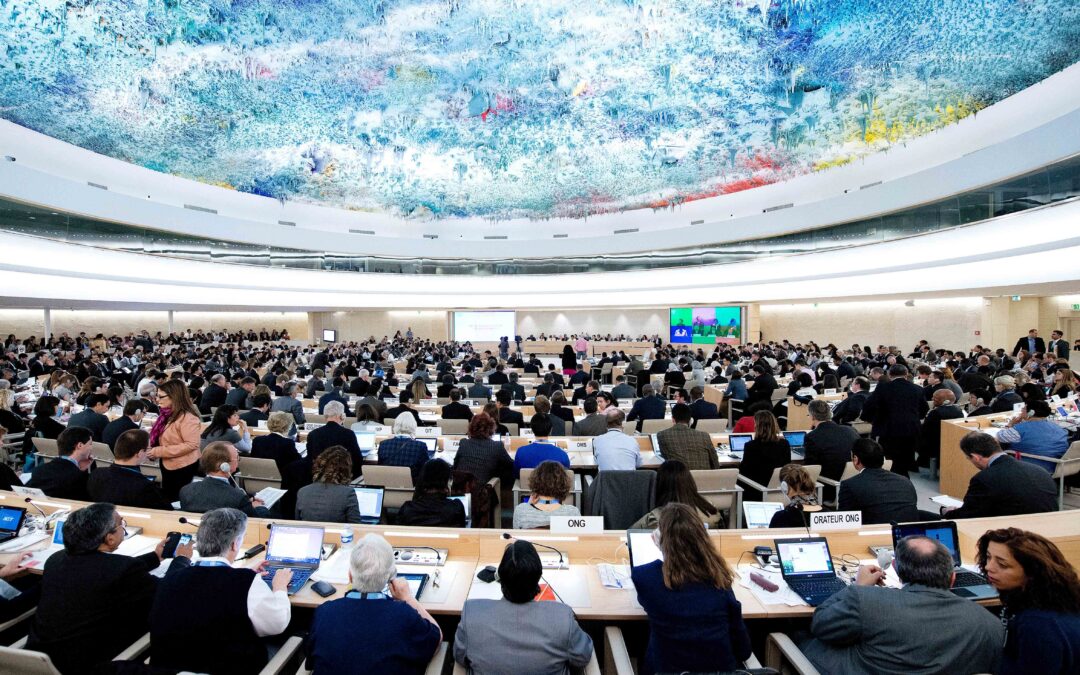
The ICJ today highlighted threats to the rule of law in Turkey, Poland, Hungary and Azerbaijan, and the need to address corporate complicity in South Sudan, at the UN Human Rights Council in Geneva.The statement, delivered during general debate, read as follows:
“The situation remains grave for the rule of law and legal protection of human rights in Turkey and Poland.
In Turkey, constitutional reforms in 2017 that undermined the independence of the judiciary should be abolished. Civil society members are prosecuted under overbroad and vague terrorism offences.
In Poland, the Legislature is trying arbitrarily to remove one third of the Supreme Court, a measure that is on hold only temporarily. Unjustified disciplinary proceedings are also being pursued against Polish judges for having sought a ruling of the Court of Justice of the EU.
Elsewhere, in Hungary civil society is ostracized and subject to legislation that risks criminalizing their legitimate activities. In Azerbaijan, as one example of a broader pattern of interference with lawyers and other human rights defenders, lawyer Elchin Sadigov was reprimanded for advising in a confidential manner to his client in detention to complain about torture to which he allegedly had been subjected.
The ICJ is also concerned at the findings by the Commission on Human Rights in South Sudan (A/HRC/40/69, A/HRC/40/CRP.1) that point to the oil industry as a “major driver” in the continuation of the armed conflict and resulting human rights violations. Potential corporate complicity with crimes under international law demand investigation and a strong monitoring mechanism for the use of oil revenues should be established.”