Dec 18, 2023 | Attacks on Justice, Publications
In a briefing paper published today, the ICJ called on the Tunisian authorities to immediately end their attacks on independent judges and prosecutors, drop any criminal charges against them, and reinstate all those arbitrarily dismissed.
التقرير بالغة العربية
On 1 June 2022, President Kais Saied granted himself, via decree, absolute power to fire judges and prosecutors summarily, and [on the same day] promptly dismissed 57 of them. The President had earlier pledged to “cleanse” the judiciary on spurious accusations of widespread political bias and corruption.
The ICJ analysis of the cases of 18 dismissed judges and prosecutors, as well of another judge subjected to disciplinary and criminal proceedings, establishes a pattern of arbitrary disciplinary and criminal processes effectively aimed at purging the judiciary of those who asserted their independence and challenged the dismantling of the institutional independence of the judiciary.
“The ongoing arbitrary criminal prosecutions against independent judges and prosecutors for the legitimate exercise of their professional functions or of their right to freedom of expression is an affront to the rule of law and judicial independence in Tunisia,” said Said Benarbia, ICJ MENA director. “The authorities must immediately end such prosecutions and reinstate all judges and prosecutors who have been dismissed without legitimate grounds or due process”
In the aftermath of his speech on 25 July 2021 announcing exceptional measures, the President promised to “cleanse” and “purify” the judiciary, which he accused of complicity with political parties in power before July 2021, as well as of inefficiency, corruption and political bias. He also targeted the High Judicial Council and its members, limiting certain of their financial benefits. Since then, the President has followed up on his rhetoric with successive decisions and measures aimed directly at dismantling the judiciary’s institutional independence.
The ICJ’s analysis examines the process of arbitrarily dismissing and prosecuting judges and prosecutors in Tunisia since the adoption of these measures in light of the country’s obligations under international human rights law.
The ICJ’s analysis is primarily based on: (i) a review of 20 criminal cases opened by the authorities against 18 dismissed magistrates and of the case of Anas Hmedi, the President of the Association of Tunisian Magistrates (AMT), which is directly linked to his support of the dismissed judges and proseuctors; (ii) 15 interviews with judges, prosecutors and their lawyers; (iii) an analysis of the First President of the Administrative Court’s decisions to suspend the dismissal of 49 magistrates and to dismiss the request for suspension of seven others; and (iv) an analysis of decisions and reports by the General Inspection Service, the High Judicial Council and the Temporary High Judicial Council.
The ICJ considers that the conduct of the dismissed judges and prosecutors, on the basis of which they have apparently been subject to criminal proceedings, did not amount to recognizably criminal offences under general principles of criminal law and international human rights law and standards.
On the contrary, the ICJ’s analysis of these cases establishes that these judges and prosecutors were arbitrarily dismissed and then subject to criminal proceedings in relation to serious offences solely for three types of conduct, none of which is a legitimate basis for criminal prosecution:
- for the exercise of their prosecutorial and judicial functions in compliance with the law and ethical standards, and
- for the exercise of human rights protected by international human rights law, including the rights to freedom of expression and freedom of association
- for private conduct, unrelated to their performance of their duties, which, in any event, was not criminal in nature.
Contact
Said Benarbia, Director, ICJ Middle East and North Africa Programme, t: +41-22-979-3800; e: said.benarbia(a)icj.org
Download:
Download ICJ briefing on Attacks on Judges and Prosecutors in Tunisia in English: Here
Download ICJ briefing on Attacks on Judges and Prosecutors in Tunisia in Arabic: Here
Nov 24, 2023
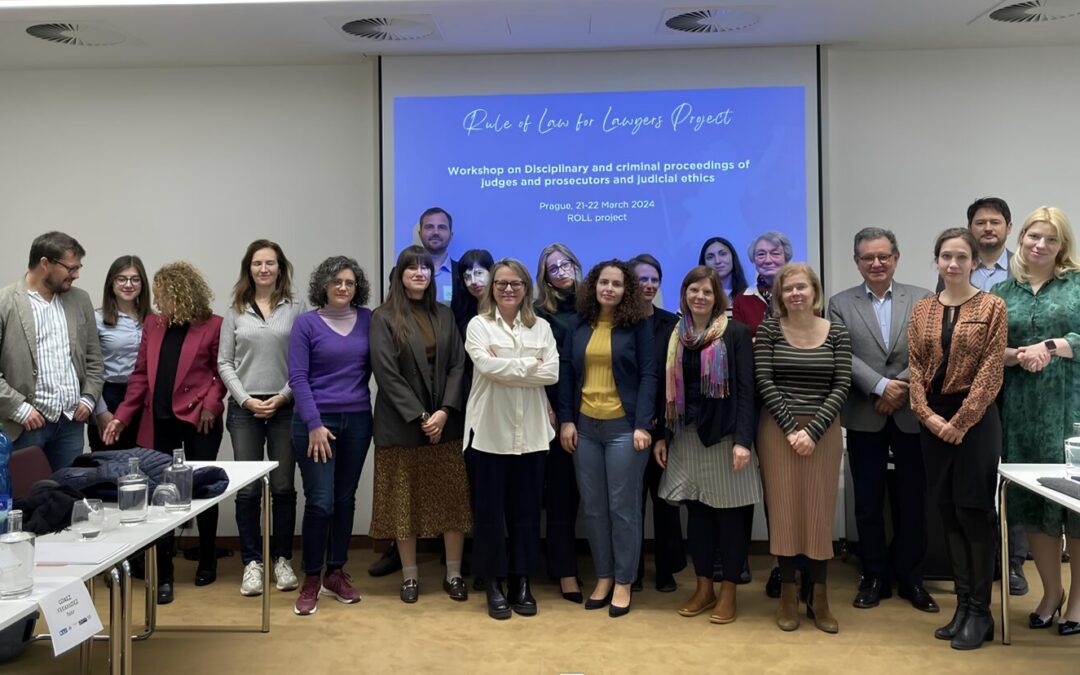
The International Commission of Jurists (ICJ), in collaboration with aditus, Human Rights in Practice, Forum for Human Rights, Free Courts organized a workshop for lawyers on judicial independence and strategic litigation in Malta on 23 and 24 November 2023. The event focused on critical issues of judicial independence, including, appointment procedures, administration of justice, and freedom of expression and association of judges.
Judicial independence is essential for democracy and human rights protection, yet it is frequently under attack or pressure. Judicial independence is possible only with independent organisation and governance, and when judges’ human rights are guaranteed. This includes strict selection criteria and transparency in the appointment of judges and prosecutors, and it implies respect of freedom of expression and association of judges.
The participants discussed the challenges in guaranteeing both institutional and individual independence of judges, and in ensuring fairness and transparency in the appointment procedures. The workshop also focused on the possible limitations of the freedom of expression and association of judges. It was noted that judges often fear repercussions for expressing their opinions and participating in associations or protests.
The workshop brought together experts and practitioners from six EU Member States – the Czech Republic, Hungary, Malta, Poland, Romania and Slovakia – to discuss their experiences. The participants discussed the international legal framework and the possible ways to protect judicial independence focusing on the role of strategic litigation.
The event was the second of a series of workshops, each considering different aspects of judicial independence. These workshops aim to contribute to the development of the Final Mapping Report with recommendations on strategic litigation for practitioners in the EU, as part of the ROLL (Rule of Law for Lawyers) project.
Please see the workshop agenda here.
Please find recordings of some of the workshop presentations here.
Nov 14, 2023
Today, the International Commission of Jurists (ICJ) and partners have called on the EU General Affairs Council to make full use of procedure under Article 7.1 in addressing concerns about Hungary and Poland. They advocate for strong stance in defending EU values.
The International Commission of Jurists, Amnesty International , Human Rights Watch, International Federation of Human Rights, Open Society Foundations, Reclaim, Reporters Without Borders and Transparency International EU are sharing specific points in their letter this time especially on Hungary, expressing a regret that a state of play is being organized instead of a hearing and highlighting some serious recent shortcomings.
Read the full letter here.
Nov 6, 2023 | News
Today, the African Court of Human and Peoples’ Rights (AfCHPR) opens its 71st Ordinary Session. To mark the occasion, the International Commission of Jurists (ICJ), in collaboration with inkyfada, looks back at AfCHPR’s September 2022 judgement against Tunisia, in which it ordered the republic to return to constitutional democracy and establish an independent constitutional court. The ICJ examines the impact of the judgement on human rights in Tunisia, and how individuals can operationalize the AfCHPR to challenge the curtailment of fundamental freedoms, judicial independence and rule of law in Tunisia.
ICJ’s questions and answers:
It has been more than a year since the African Court on Human and People’s rights issued its judgment in case No. 017/2021, “Ibrahim Ben Mohamed Ben Brahim Belguith v. Republic of Tunisia”, of 22 September 2022. The case was brought by Mr. Belguith, a national of Tunisia and a lawyer, who complained of violations of his rights under the African Charter on Human and Peoples’ Rights and other human rights instruments as a result of the promulgation of several Tunisian presidential decrees adopted under the “state of exception” pursuant to article 80 of the 2014 Constitution since 25 July 2021. In this judgment, the African Court ordered Tunisia to repeal these decrees, to return to constitutional democracy within two years and to ensure the establishment and operation of an independent constitutional court within the same period.
What does this judgment mean and why is it important for the rule of law and human rights in Tunisia? The ICJ provides answers in the Q&A below:
-
- What is the African Court on Human and Peoples’ Rights?
* The African Union
* The African Charter on Human and Peoples’ Rights
* The African Commission on Human and Peoples’ Rights
* The African Court on Human and Peoples’ Rights
* Tunisia’s adherence to the African Human Rights System
-
- Why was the African Court seized of the situation in Tunisia? Contextual overview
* President Kais Saied’s power grab of 25 July 2021
* The absence of a Constitutional Court
-
- What did the 22 September 2022 judgment rule?
* How the African Court came to rule on the matter: the application
* What the judgment ruled:
-
- What are the next steps?
* Implementation
* Other complaints against Tunisia pending before the African Court
Download the full Q&A in English here
Download the full Q&A in French here
Download the full Q&A in Arabic here
Oct 27, 2023 | News
Today, the International Commission of Jurists (ICJ), in collaboration with the Supreme Court of the Republic of Tajikistan the Office of the High Commission of Human Rights (OHCHR) Regional Office for Central Asia (ROCA), and the Organization for Security and Cooperation in Europe (OSCE)in Dushanbe, has convened a round to discuss the application of international law by national courts. The event aimed to enhance the capacity of the judiciary to apply international standards in Tajikistan.
The discussions at the round table were focused on international human rights mechanisms and instruments, the binding nature of international treaties, and the current use of international law in Tajik courts. The participants examined these standards in relation to Tajikistan’s international treaty obligations, with the objective of improving the judiciary’s ability to effectively apply international jurisprudence and principles.
The event provided a platform for participants to discuss the practical implementation of international legal norms in the adjudication process in other national contexts and to share strategies to address the challenges of such integration. The round table also facilitated a critical analysis of the reforms necessary for effective use of international standards in national legal procedures.
The event addressed the broader implications of applying international law, considering its impact on the rule of law and public trust in the justice system. There was a clear consensus on the need to draft recommendations that could guide the judiciary in applying international law.
The round table discussions were notably informed by a recent ICJ report calling for comprehensive judicial reform in Tajikistan. Published in December 2020, the report titled “Neither Check nor Balance: the Judiciary in Tajikistan,” provided an in-depth analysis of the organisation and functioning of the judiciary in Tajikistan and its capacity to administer justice and uphold human rights.
The ICJ report’s conclusion that acquittals in criminal trials are exceedingly rare underscored a systemic failure to ensure judicial independence, thereby highlighting the urgency of the reform. It was recognized that for Tajikistan to fulfil its international legal obligations and to provide effective remedies for human rights violations, reforms must be initiated and practically implemented to safeguard against practices that undermine the independence of the judiciary.
Attachment: Briefing paper on RT for judges on Oct 27 2023 in Dushanbe