Sep 20, 2019 | News
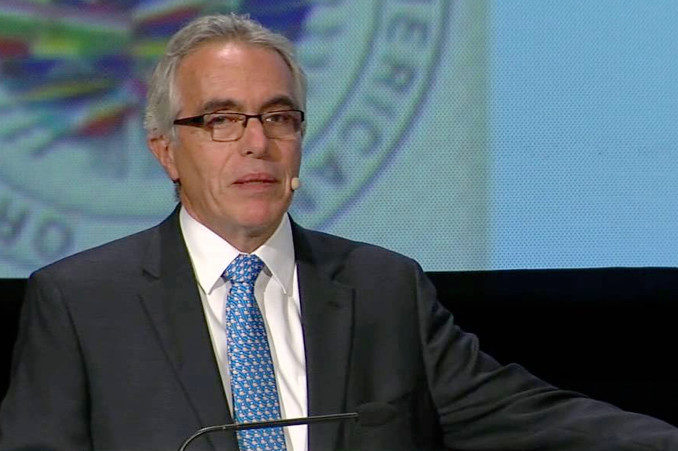
The ICJ welcomes this week’s visit to Uzbekistan of the UN Special Rapporteur on the independence of judges and lawyers, Diego García-Sayan, during which he will assess reforms of the judicial system, the independence of the judiciary and the independence and role of lawyers.
“The visit of the Special Rapporteur to Uzbekistan, at the invitation of the government, is an indication that the Uzbekistan authorities are serious about the ongoing reforms of the justice system. This visit is only a starting point for the deep reforms needed to establish an independent and fair justice system in Uzbekistan. Realising these reforms will require sustained commitment of all institutions of government, lawyers and civil society,” said Temur Shakirov, Senior Legal Adviser of the ICJ Europe and Central Asia Programme.
The ICJ, along with other NGOs and IGOs, met with the Special Rapporteur in Tashkent yesterday on the first day of his visit, and drew his attention to issues concerning the independence of judges and lawyers in Uzbekistan.
“The visit will be followed by the report of the Special Rapporteur containing findings and recommendations. These recommendations should be effectively implemented and the ICJ is committed to provide expert and other support in the Uzbekistan’s effort to bring its justice system in line with the recommendations,” Shakirov added.
Background
The visit of the UN Special Rapporteur on independence of judges and lawyers takes place from September 19-25, 2019.
The Special Rapporteur will hold meetings with representatives of the government, judiciary, prosecutors, lawyers and civil society and is expected to issue a report analyzing the independence of judges and lawyers in Uzbekistan, following his visit.
The Special Rapporteur on the independence of judges and lawyers is one of the special procedures of the United Nations Human Rights Council, appointed as an independent expert to monitor the compliance of UN Member States with international standards on the independence of judges and lawyers.
Sep 17, 2019 | Events, News
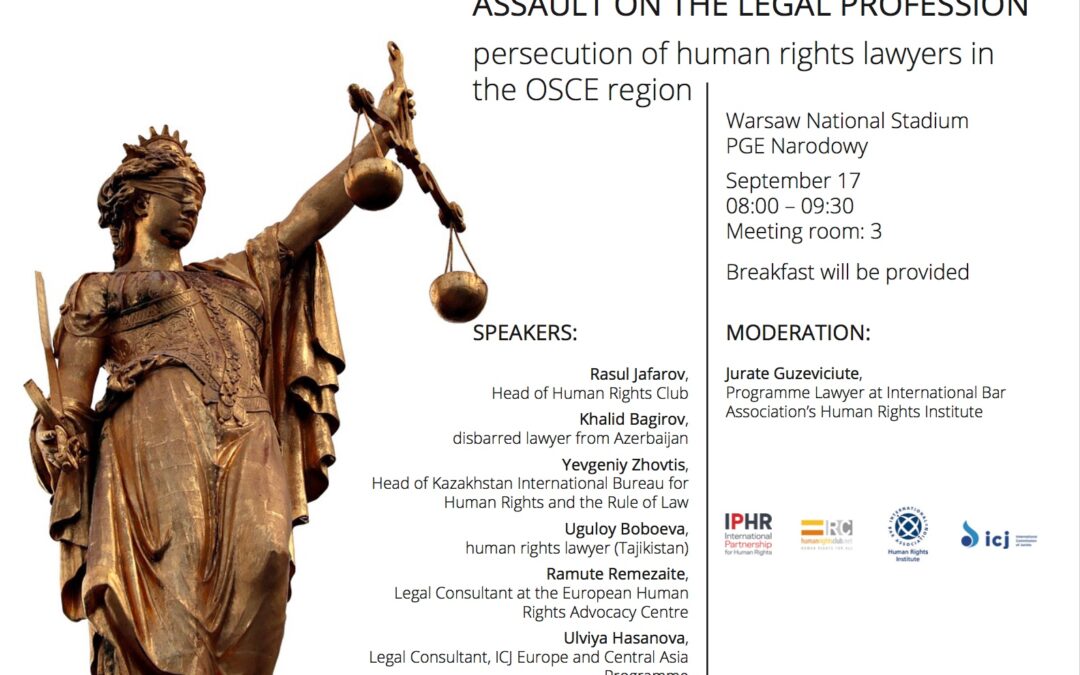
This event held in Warsaw, Poland, will provide an overview of the ongoing challenges human rights lawyers in the OSCE region are facing in their daily work.
A flyer for the event is available here.
Sep 9, 2019
At the opening of the 42nd session of the UN Human Rights Council in Geneva, the ICJ and other NGOs call on States and intergovernmental organisations to address systemic failures of the rule of law in China.
Key concerns include lack of due process, lack of an independent and impartial judiciary, unjustified restrictions on freedom of expression, association and assembly, and on the freedom of lawyers to practice their profession, and other restrictions on civic space.
The letter reads as follows:
Open letter on the rule of law in China
9 September 2019
Across the People’s Republic of China, human rights violations are a systemic reality. Over the past year, the UN has once again documented legal and policy frameworks that fail to protect against discrimination; stigmatise Islam and stifle freedom of religious belief; undermine a wide range of socioeconomic rights and those who defend them; and permit gross violations of due process, including secret trials and arbitrary and incommunicado detention.
Over the past year, UN High Commissioner for Human Rights Michelle Bachelet and other international human rights experts, as well as governments have pressed for access to China, in particular to Uyghur, Tibetan and other ethnic areas. The High Commissioner has urged dialogue and a de-escalation of violence in Hong Kong, following allegations of excessive use of force by police to disperse massive public protests and the criminalisation of demonstrators.
Independent experts of the UN Human Rights Council have requested information and prompt action from the government regarding a broad range of alleged violations and especially the criminalisation of human rights defenders and civil society, such as citizen journalists, lawyers, democracy movement leaders, religious leaders, workers’ rights activists, social workers, public health advocates and students.
In June of this year, more than two dozen governments informed the High Commissioner and the Human Rights Council president of their concerns about the use of re-education camps to target Uyghur and other Muslim minority groups in western China. They reiterated the need for prompt, independent and unfettered access.
Despite these efforts at engagement, the Chinese government has refused to allow independent visits of relevant human rights experts, including the Special Procedures of the UN Human Rights Council; refused constructive dialogue, sowed disinformation and stoked violence in Hong Kong; used a push for sinicisation to eliminate cultural and religious diversity; and continued a fierce campaign against critics within China and many abroad, including other States. Chinese officials have stated, clearly and forcefully in public and in private, that ‘China is a country of rule of law’ and ‘will not accept interference in its internal affairs’.
This is patently misleading.
The Communist Party of China uses China’s laws to maintain state power, not to ensure justice. Overly broad charges that do not comply with the principle of legality are used to wrongfully detain, prosecute, and convict individuals for the peaceful exercise of internationally protected rights and participation in public affairs. In effect, any person who expresses views that differ from the Party narrative, or who seeks to highlight negative impacts of Party and government policies, can be caught in the crosshairs of criminalisation.
The Chinese government has refined and replicated a practice of characterizing all difference or dissent as terrorism, subversion, or a threat to national security. The tactics deployed in Hong Kong are regularly used against Uyghur and Tibetan peoples to justify a hard-line crackdown on the legitimate exercise of human rights. This is a dangerous departure from international human rights standards.
Furthermore, the Chinese government’s human rights record is no longer an issue limited by its borders. The government has actively used laws and practices to disappear and detain foreign nationals, restrict access to information overseas, conduct surveillance of Chinese nationals and other exile communities, embolden its law enforcement outside Chinese borders, and impede public participation, sustainable development and transparency in third countries where China has political and economic interests.
Human rights defenders of all kinds have been specifically targeted. The silence of the international community has not only allowed this to decimate civil society within China, but also to endanger civil society, defenders and other individuals critical of the Chinese government wherever they may be, including in the halls of the UN.
The same laws that allow the arbitrary deprivation of liberty of lawyers, public interest advocates, housing rights activists, and Christians in China’s wealthy eastern areas are further refined and weaponised against ethnic and religious minorities in the west of the country, including Tibet, where international access is a significant concern. The large-scale detention program in Xinjiang, which has detained Uyghurs and other minorities, may amount to crimes against humanity.
Read and download the full letter here, in PDF format: UN-Advocacy-OpenLetter-China-2019
Aug 5, 2019 | News
The ICJ today raised concerns that the proposed Zambian Constitutional Amendment Bill 2019 may negatively impact the independence of the judiciary in Zambia.
The proposed amendments to provisions regarding disciplinary measures and processes against judges and the composition of the Supreme Court and Constitutional Court are particularly concerning, according to a statement by a group of organisations including the ICJ.
“The ICJ implores the President of Zambia and the Zambian legislature to ensure the alignment of all constitutional amendments with international human rights standards on the independence of the judiciary, the rule of law and the separation of powers,” said Arnold Tsunga, the ICJ’s Africa Director.
The joint statement calls upon the President of Zambia and the Zambian legislature to ensure that the proposed constitutional changes are in line with international human rights standards.
According to such standards, individual judges ‘may be dismissed only on serious grounds of misconduct or incompetence, in accordance with fair procedures ensuring objectivity and impartiality set out in the constitution or the law’. Examples include ‘incapacity or behaviour that renders them unfit to discharge their duties’ and ‘physical or mental incapacity that prevents them from undertaking their judicial duties.’
Moreover, disciplinary proceedings regarding judicial officers must be held by an institution independent of the executive and the legislature to secure the independence of the judiciary.
Article 143 (a) of the Zambia Constitution currently provides that ‘a judge shall be removed from office on the following grounds: (a) a mental or physical disability that makes the judge incapable of performing judicial functions; (b) incompetence; (c) gross misconduct; or (d) bankruptcy.’
However, the Amendment Bill worryingly replaces subsection (a) and allows for removal when a judicial officer is ‘legally disqualified from performing judicial functions.’
Furthermore, the proposed amendment does not set out the circumstances or infractions that could lead to the ‘legal disqualification’ leaving the provision open to abuse and in violation of the principle of legal certainty and the rule of law.
“The amendment introduces unnecessary obscurity and vagueness to the Constitution, which, in turn, increases the risk of judges being removed on politically motivated grounds and threatens the rule of law,” Tsunga added.
Another worrying aspect of the proposed amendment is the suggested changes to Article 144 of the Constitution transferring the authority to determine whether judicial officers are removed from the Judicial Complaints Commission to a Tribunal Appointed by the President.
The amendment allows for the possibility of a Tribunal staffed by members of the executive and the legislature, further heightening concerns about threats to judicial independence.
“It is vital that the processes and procedures for the removal of judicial officers in Zambia are constrained in terms of tightly defined constitutional provisions, overseen by independent decision makers without improper influence by the executive and the legislature,” said Tsunga.
The full statement is available here.
The statement is signed by:
Commonwealth Lawyers Association (CLA)
Commonwealth Magistrates’ and Judges’ Association (CMJA)
International Bar Association’s Human Rights Institute (IBAHRI)
International Commission of Jurists (ICJ)
Judges for Judges (J4J)
Lawyers’ Rights Watch Canada (LRWC)
Southern Africa Litigation Centre (SALC)

![Smoke rises after an Israeli air strike on the village of Taybeh in southern Lebanon [Source: Al Jazeera]](https://www.icj.org/wp-content/uploads/2026/03/Screenshot-2026-03-20-at-15.56.24-300x200.png)