Nov 16, 2017 | Artículos, Informes, Noticias, Publicaciones
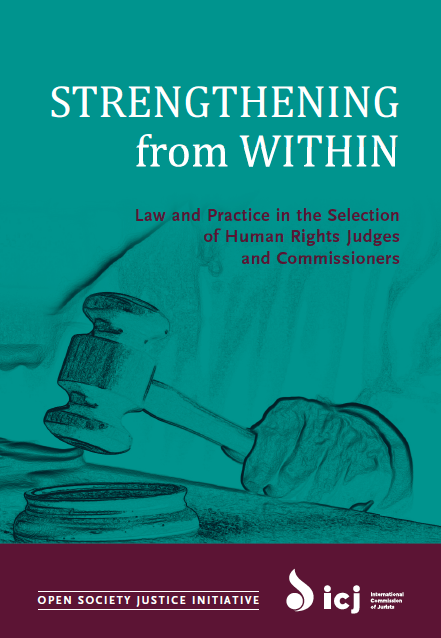
Los procedimientos nacionales para la selección de los jueces de los tribunales regionales de derechos humanos frecuentemente no cumplen con los estándares de imparcialidad, inclusión y transparencia, concluye un informe conjunto de OSJI y de la CIJ publicado hoy.
Universal-Fortaleciendo desde Dentro-Publications-Reports-2017-SPA (el informe en español, PDF)
Nov 16, 2017 | Articles, Nouvelles, Publications, Rapports
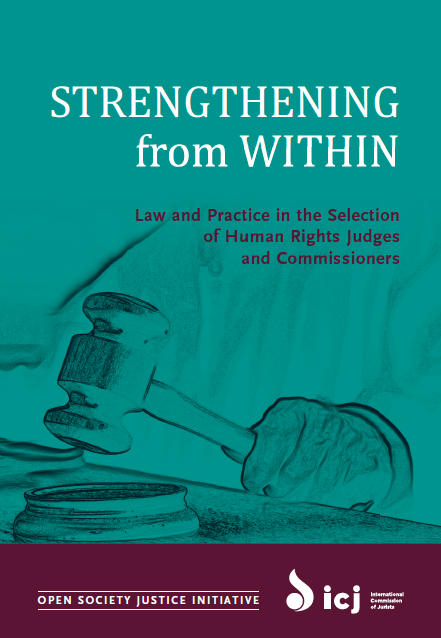
Les procédures nationales de sélection pour les magistrats des cours régionales des droits de l’Homme ne respectent que trop rarement les standards d’équité, d’intégration et de transparence, selon les conclusions d’un rapport publié aujourd’hui par la CIJ et l’Open Society Justice Initiative.
Ce rapport fait des recommandations visant à assurer la sélection des meilleurs candidats comme magistrats des cours régionales des droits de l’Homme.
Les cours et commissions régionales des droits de l’Homme, y compris la Cour africaine des droits de l’Homme et des peuples, la Cour européenne des droits de l’Homme et la Commission interaméricaine des droits de l’Homme, sont des défenseurs essentiels de l’état de droit.
Pourtant, malgré leur importance, le processus de sélection des magistrats et commissaires qui siègent dans ces organes, c’est-à-dire la façon dont ils sont nominés, contrôlés et in fine sélectionnés, demeure largement inconnu et bien souvent organisé de manière opaque.
Associée à des efforts politiques répétés pour éroder les institutions de droits internationaux, cette opacité souligne le besoin crucial de se concentrer sur le renforcement de ces systèmes depuis l’intérieur.
Ce rapport, consolidé depuis l’intérieur, répond justement à ce défi.
Il met en lumière les processus qu’utilisent les Etats pour nominer et sélectionner les magistrats et commissaires des droits de l’Homme.
En analysant les pratiques de nominations de 22 pays, ce rapport documente la façon dont les procédures de nominations ne respectent pas assez souvent les cadres légaux et les standards internationaux qui seraient censés les guider.
Ce rapport identifie également les pratiques prometteuses et propose des recommandations fondées sur l’expérience.
Un pouvoir judiciaire indépendant est essentiel à l’état de droit: pour les cours nationales, les procédures de sélection du pouvoir judiciaire doivent être équitables, transparentes et basées sur le mérite.
Ainsi que que le fait remarquer ce rapport, les cours et tribunaux internationaux du monde entier sont à la même enseigne.
Universal-Strengthening from Within-Publications-Reports-2017-FRA (rapport complet en français, PDF)
Nov 7, 2017 | Advocacy, News
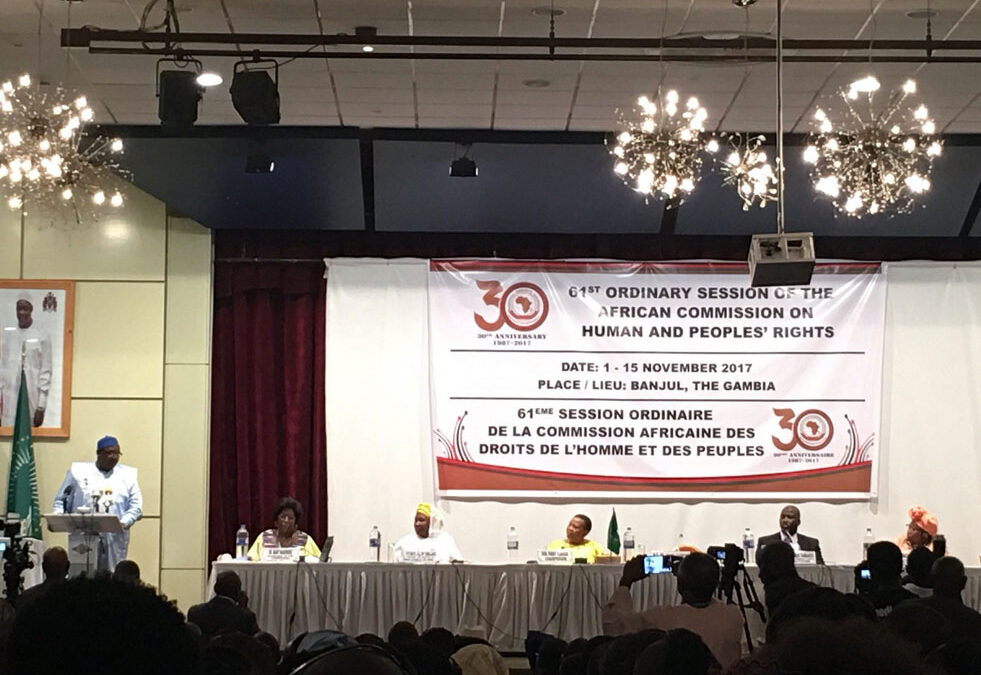
The ICJ today called for the African Commission on Human and Peoples’ Rights (“African Commission”) to establish a special mechanism for the protection and promotion of the independence of judges and lawyers in Africa.
The ICJ made the call in a statement during the public session of the 61st Ordinary Session of the African Commission in Banjul.
The call comes amidst growing threats to the independence of justice in Africa.
In African Union (AU) Member states across the continent, judicial officers and legal practitioners have been targeted for violence and intimidation, or unjustified interference or sanctions.
Recent cases include Burundi, Botswana, Egypt, Lesotho, Libya, Kenya, Swaziland, Zambia, the DRC, Cameroon and Zimbabwe.
The frequency and seriousness of such incidents prompted the ICJ working with the Africa Judges and Jurists Forum to convene a round table meeting in Harare in 2016 to discuss practical steps that could be adopted to minimize the plight of jurists in distress.
The Harare meeting identified the need for a special mechanism for the protection and promotion of judicial independence in Africa, similar to the existing United Nations’ Special Rapporteur on the Independence of Judges and Lawyers.
“It is chilling when a judge is shot in Lubumbashi in the DRC, or a deputy chief justice’s security personnel and driver is shot in Nairobi, Kenya ahead of an important case, or the offices of the Law Association are besieged by militias in Lusaka, Zambia. These are real cases,” said Arnold Tsunga ICJ’s Africa Regional Director.
“An independent, impartial, competent and accountable judiciary and independent and free legal profession are pre-requisites for effective protection of human rights and entrenchment of the rule of law in Africa,” he added.
The ICJ noted that the African Commission have already set out an excellent framework of standards to guarantee independence of the judiciary and access to justice in Africa in the 2003 Principles and Guidelines on the Right to a Fair Trial and Legal Assistance in Africa.
What is needed now is to put in place machinery for their implementation.
The Commission must now to take steps towards establishing a special mechanism for the protection and promotion of judicial independence, including the appointment of a Special Rapporteur on the Independence of Judges and Lawyers, and establishing a Working Group on the Independence of Judges and Lawyers.
Contact
Arnold Tsunga, Director of ICJ’s Africa Regional Programme, t: +27716405926, e: arnold.tsunga(a)icj.org
Banjul- Independence Judges and Lawyers-Advocacy-2017-ENG (Statement in English, pdf)
Nov 2, 2017
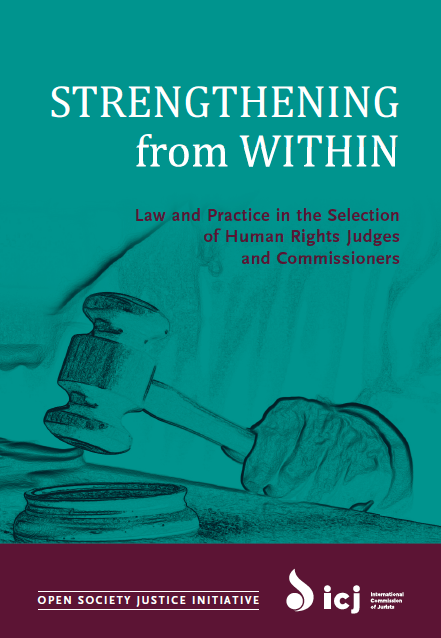
National procedures for the selection of regional human rights court judges too often fail to meet standards of fairness, inclusiveness and transparency, a joint Open Society Justice Initiative (OSJI) and ICJ report published today concludes.
The report makes recommendations aimed at ensuring that the best qualified candidates are selected as judges of regional human rights courts.
Regional human rights courts and commissions—including the African Court of Human and Peoples’ Rights, the European Court of Human Rights, and the Inter-American Court of Human Rights—are essential safeguards for the rule of law.
Yet despite their importance, the process of selecting the judges and commissioners who sit on these bodies—how they are nominated, vetted, and ultimately selected—remains largely unknown and often shrouded in secrecy.
Coupled with broader political efforts to erode international judicial institutions, this secrecy underscores the pressing need to focus on strengthening these systems from within.
This report, Strengthening from Within, responds to that challenge.
It shines a light on the processes that states use to nominate and select human rights judges and commissioners.
By analyzing the nomination practices of 22 countries, the report documents the ways in which nomination procedures often fall short of the legal frameworks and international standards that should guide them.
It also identifies promising practices and offers recommendations for improvement grounded in experience.
An independent judiciary is essential to the rule of law: for national courts, procedures for judicial selection must be fair, transparent, and merit-based. As this report makes clear, the world’s international courts and tribunals are no different.
Universal-Strengthening from Within-Publications-Reports-2017-ENG (Full report in English, pdf)
Nov 2, 2017 | News
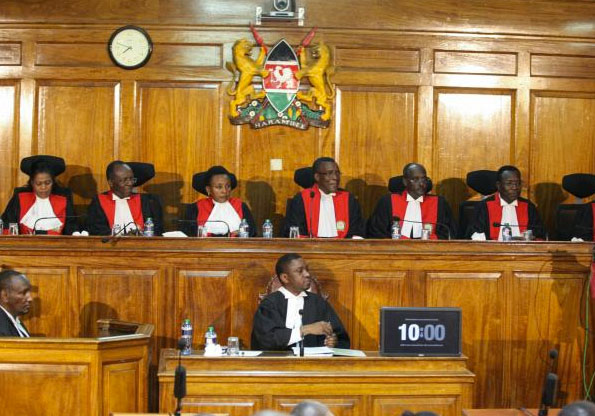
The ICJ notes that a number of threats and intimidating statements aimed at members of the judiciary, including the Supreme Court, were made during the election campaign period in Kenya.
Now that the elections ordered by the Supreme Court after nullification of the initial elections in Kenya have been concluded, it is important for Kenyan authorities to reaffirm commitment to separation of powers and guarantee the security of judges and the independence of the judiciary in the country, the ICJ says.
On Monday, 30 October 2017, the Indepedent Electoral Boundaries Commission (IEBC) in Kenya declared President Uhuru Kenyatta as the winner of the October 26 repeat polls.
President Uhuru Kenyatta is widely reported to have been heavily critical of the Supreme Court for annulling the 8 August 2017 presidential election on a “technicality”.
It is also reported that he promised to “fix” the bench if re-elected.
The President is also reported to have said he would deal with Chief Justice Maraga, but did not however define the form of action he would take.
Similar sentiments have been attributed to Deputy President William Ruto. It’s unclear at this stage whether these statements should be dismissed as political rhetoric on the campaign trail or warrant further consideration.
However such utterances and threats on the judiciary by senior government officials may be inferred as an attempt to intimidate or unduly influence the bench.
“These threats coming from the highest authorities hinder the ability of the courts to perform their duties, which are indispensable for the rule of law and fair administration of justice in the country,” said Arnold Tsunga, ICJ’s Africa Regional Programme Director.
“Judges must be able to exercise their duties freely, independently and impartially, or else the rule of law in the country will be eroded, and with it, effective protection of the human rights of the Kenyan people,” he added.
The ICJ recalls that the UN Basic Principles on the Independence of the Judiciary provide that judges must be able to perform their professional duties “without any restrictions, improper influences, inducements, pressures, threats or interferences, direct or indirect, from any quarter or for any reason” and that governments have a responsibility to secure this guarantee.
Article 26 of the African Charter on Human and Peoples Rights also imposes an obligation on Kenya to establish an independent judiciary.
Contact
Arnold Tsunga, Director of ICJ’s Africa Regional Programme, t: +27716405926, e: arnold.tsunga(a)icj.org

![Smoke rises after an Israeli air strike on the village of Taybeh in southern Lebanon [Source: Al Jazeera]](https://www.icj.org/wp-content/uploads/2026/03/Screenshot-2026-03-20-at-15.56.24-300x200.png)