May 5, 2017 | Nouvelles, Plaidoyer
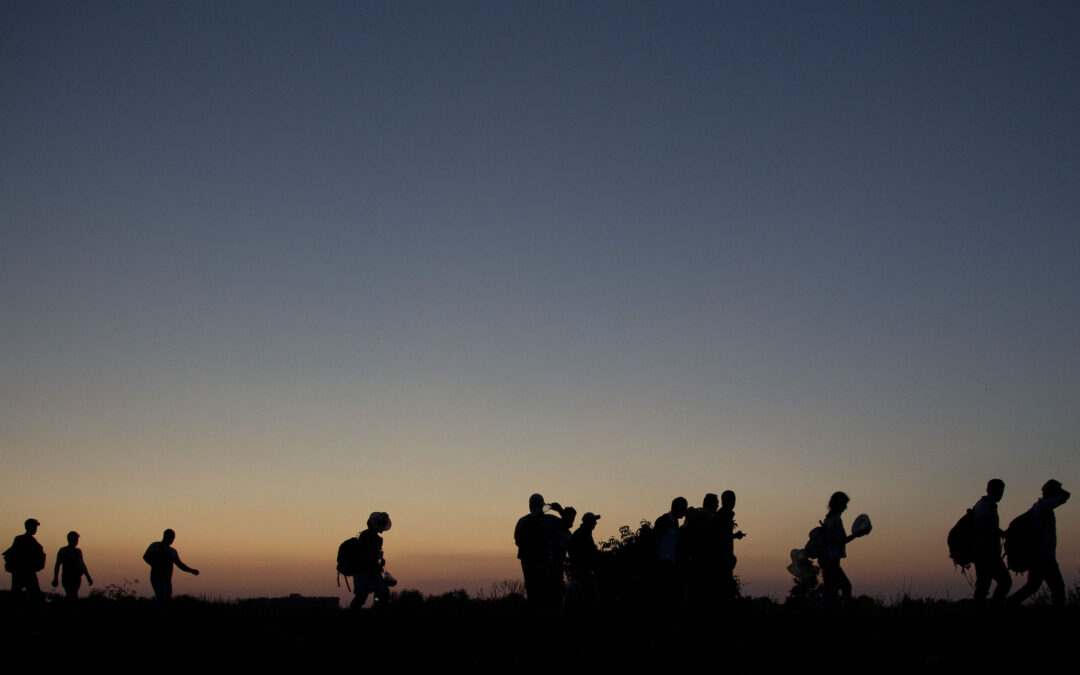
La CIJ a publié une série de principes sur le rôle des magistrats et des avocats en relation avec les réfugiés et les migrants.
Ces Principes ont été élaborés par la CIJ, à la suite de consultations, dont le Forum de Genève 2016 des magistrats et avocats et la session du Conseil des droits de l’Homme de l’ONU en mars 2017, et sur la base des études mondiales, de l’expérience et des compétences de la CIJ.
Bien que la CIJ entende traduire, à travers les Principes, le soutien le plus large possible des personnes consultées, ces Principes ne reflètent pas nécessairement le point de vue de tous les participants à la consultation.
Ils traitent essentiellement du rôle des magistrats et des avocats, y compris des procureurs. Toutefois, la CIJ exhorte les législateurs, les représentants de l’exécutif et toutes les autres personnes exerçant d’autorité publique de jure ou de facto (en tant que fonctionnaire, par mandat de l’État ou par contrat), à mettre en œuvre, à maintenir et à respecter le rôle des magistrats et des avocats dans la protection des droits des réfugiés et des migrants, notamment ceux énoncés ci-après.
Les Principes devraient être renforcés par un cadre juridique, des politiques et des pratiques plus larges qui garantissent et appliquent les droits de l’Homme et l’état de droit au sein des États ainsi qu’à l’échelle régionale et nationale.
Dans ces principes, l’expression « réfugiés et migrants » doit être interprétée au sens large et prise dans son ensemble. Elle inclut, sans s’y limiter, les demandeurs d’asile, les apatrides, les victimes de trafics d’êtres humains, les enfants non accompagnés ou séparés ainsi que toute autre personne en situation de migration.
Elle s’applique même si l’arrivée, la présence ou la résidence d’une personne est considérée comme irrégulière par le droit national.
Les Principes visent à compléter et orienter l’application d’instruments internationaux existants relatifs à la protection des réfugiés et des migrants, y compris et sans limitation :
- la Déclaration universelle des droits de l’Homme,
- la Convention relative au statut des réfugiés et son protocole,
- le Pacte international relatif aux droits civils et politiques et le Pacte international relatif aux droits économiques, sociaux et culturels,
- la Convention internationale sur la protection des droits de tous les travailleurs migrants et des membres de leur famille,
- la Déclaration de New York pour les réfugiés et les migrants ainsi que l’ensemble des traités et des normes régionales en la matière.
Les Principes traitent du rôle des juges et des avocats en lien avec les aspects suivants, parmi d’autres:
- Détermination du droit en protection internationale;
- Privation de liberté
- Expulsions
- Recours effectifs et accès à la justice
- Indépendance, impartialité et égalité devant la loi;
- Conflits entre droit national et international;
Les Principes, avec commentaires, peuvent être téléchargés en français et au format PDF: Principes sur le rôle des magistrats et avocats en relation avec les réfugiés et les migrants
May 2, 2017 | News
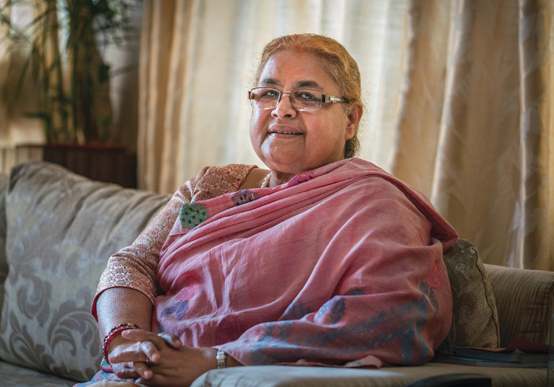
The Nepali legislature should immediately reject the unprecedented motion filed on 30 April 2017 to impeach Chief Justice Sushila Karki because it threatens the independence of the judiciary and the rule of law, said the ICJ today.
“This impeachment motion, the first against a sitting Chief Justice in Nepal’s history, raises very serious concerns about the independence of Nepal’s Supreme Court and the separation of powers in the country,” said Matt Pollard, who heads the ICJ’s Center for the Independence of Judges and Lawyers.
“The impeachment motion seems timed to suspend Chief Justice Karki just as she was scheduled to hear a politically controversial case,” he added.
The impeachment motion comes in the wake of the decision of the full bench of the Supreme Court, chaired by Justice Karki, to revoke the Cabinet’s 12 February decision to appoint a new Inspector General of Nepal Police evidently in violation of existing processes and regulations.
The motion to impeach Chief Justice was sponsored by two ruling parties, Nepali Congress and Nepal Communist Party (Maoist Center), pursuant to Article 101(2) of Nepal’s 2015 Constitution.
This provision allows for an impeachment motion against the chief justice to be moved by one-fourth of the members of the Legislature–Parliament on the grounds of “serious violation of the Constitution and law, his or her incompetence, misbehavior or failure to discharge the duties of his or her office in good faith or serious violation of code of conduct.”
Justice Karki is scheduled to retire on 7 Jun 2017, when she reaches the mandatory retirement age.
“The timing of the impeachment action, so close to the Chief Justice’s scheduled retirement, gives credence to suspicions that it is aimed at preventing her participation in judicial activity during the next few weeks,” Pollard said.
Filing the impeachment motion immediately resulted in the suspension of the Chief Justice from her duties, pursuant to Article 101(6).
“The impeachment process under Article 101 does not comply with international standards on the independence of the judiciary, as the ICJ has pointed out repeatedly in its analysis of the 2015 Constitution,” Pollard added, referring to the ICJ’s Briefing Paper on the Constitutional Draft. “This recent motion starkly demonstrates the problems with the Constitutional provision.”
Nepal’s judiciary, including the Supreme Court, had also recently been criticized by officials in the ruling parties and the military in relation to a number of high profile human rights cases.
“Nepal’s Judiciary has been instrumental protecting human rights, rule of law and enforcement of the Nepal’s obligation under international law,” Pollard said.
“The Nepali judiciary as an institution has strengthened and has gained international respect for its independence, so it should be celebrated and strengthened, instead of being subject to this kind of legislative attack,” he added.
The ICJ calls on the Government of Nepal and ruling parties to withdraw the impeachment motion against the Chief Justice in order to ensure judicial independence and the appropriate separation of powers under the rule of law in the country.
May 2, 2017 | News
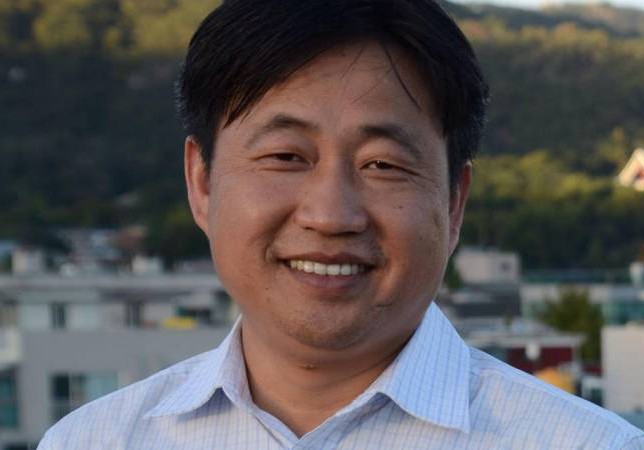
The ICJ today called on the Chinese government to release immediately Xie Yang, a prominent human rights lawyer who was arrested during the crackdown on human rights defenders in July 2015. Authorities have now canceled his scheduled trial without giving a reason.
He was charged on 16 December 2016 with inciting subversion of State power and disrupting court order. He is detained at an undisclosed location.
“Xie Yang’s arrest and prosecution seem to be in connection with his performing legitimate professional functions as a human rights lawyer,” said Sam Zarifi, ICJ’s Secretary General.
“No lawyer should ever be subject to persecution for carrying out their professional duties. Lawyers in China like Xie Yang are indispensable in ensuring human rights protection and upholding the rule of law in China,” he added.
Xie Yang had served as counsel of the family of Xu Chunhe, who was alleged to have been shot dead by police authorities in May 2015 in Heilongjiang Province.
He also acted as counsel for persons alleging religious persecution, alleged victims of unlawful land seizures, and outspoken critics of the government.
The ICJ emphasized that in the absence of evidence that he has committed a cognizable offence, the criminalization of which is consistent with international human rights law, Xie Yang should be immediately released.
In January 2017, the lawyers of Xie Yang alleged that he had been subjected to prolonged sleep deprivation, forced into stress position for more than 20 hours a day, verbally harassed and threatened, and subjected to regular beatings and other forms of torture and ill-treatment.
“The government should release Xie Yang immediately and conduct a prompt, thorough, and impartial investigation on the allegations that he has been subjected to torture,” Zarifi said.
The ICJ received information that Xie Yang has not been able to communicate with his lawyers ever since he reported to them his torture allegations by police authorities.
He has now been assigned State-appointed counsel.
The ICJ further called on the government to bring to justice any persons found to be responsible for the torture of Xie Yang.
Under no circumstances must any statement he may have made during his interrogation under torture or ill-treatment be admitted into evidence at his trial.
Contact:
Emerlynne Gil, ICJ’s Senior International Legal Adviser, t: +66 840923575 ; e: emerlynne.gil(a)icj.org
Additional information
Following his arrest, Xie Yang was detained for the first six months in an undisclosed location, but was subsequently transferred to the Changsa City No. 2nd Detention Center.
He was again transferred to an undisclosed location where he remains detained to this day.
The date and the reason for the transfer are unknown.
Xie Yang’s treatment comes amidst a much wider attack on lawyers and human rights defenders in China.
Since 9 July 2015, the government has launched an unprecedented nationwide crackdown – now commonly referred to as the “709 Crackdown” to mark the start of the crackdown – which resulted in the interrogation, detention, and/or criminal indictment of nearly 250 human rights lawyers and activists.
Photo credit: ChinaChange.com
May 1, 2017 | News
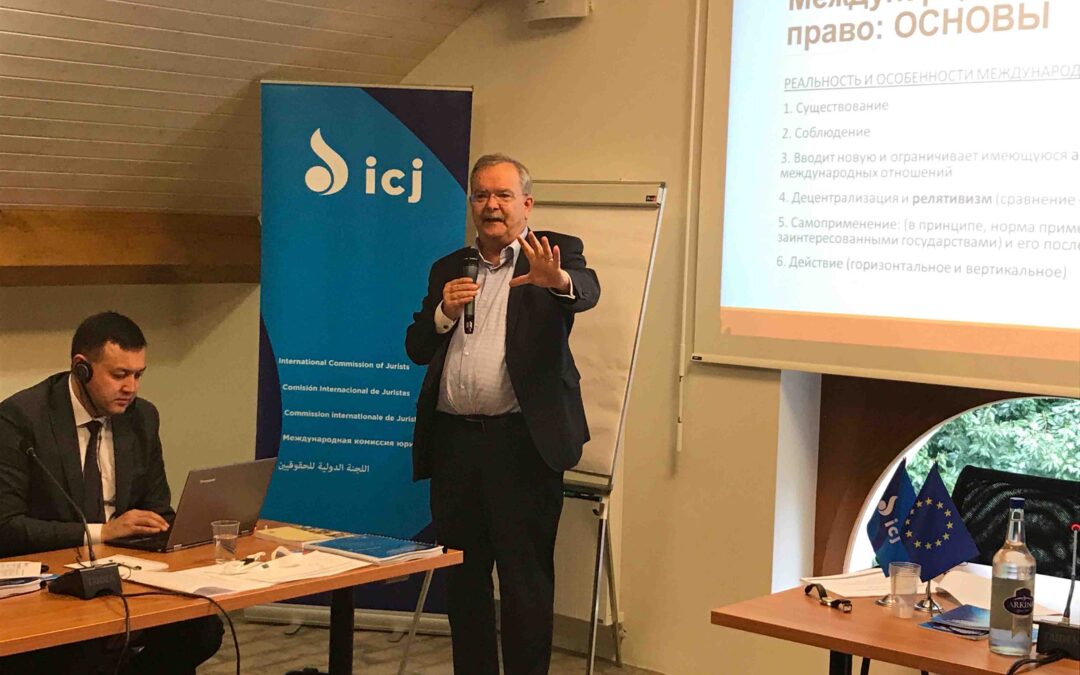
Today, the ICJ begins its third International Human Rights Training Programme for Lawyers from Central Asia.
The objective of this programme is to train Central Asian lawyers on application of international human rights law in criminal proceedings.
In the course of the programme, the participants will learn how to use international human rights law in national courts and to make effective use of international human rights mechanisms.
Leading international experts and practitioners will share their insights with the participants of the training programme on how to interpret key concepts of international human rights law and apply them in practice, both nationally and internationally.
The training programme is built around the study of the relevant international jurisprudence on the right to fair trial, right to liberty, freedom from torture and other ill-treatment, and associated rights, including cases originating from Central Asian region considered by UN treaty bodies, such as the UN Human Rights Committee.
“Lawyers are on the frontline of implementing international human rights law in practice, and this remains an enormous challenge in Central Asia,” said Róisín Pillay, Director of the ICJ Europe and CIS Programme.
“The programme presents a unique opportunity for lawyers from the region to meet key experts in international human rights law, officials from the UN Secretariat and other lawyers from the ICJ network, and to develop practical expertise on how to apply international human rights law in the defence of their clients,” she added.
In the course of the training programme, the participants will attend one of the meetings during the 60th session of the UN Committee Against Torture (CAT) that will take place in Geneva on 18 April–12 May 2017.
The 25 participants have been selected through a rigorous process from among 150 applications from across the region, which testifies to the growing interest of lawyers from the region in applying international human rights standards in their practice.
The ICJ is grateful to the European Union for its support of this initiative.
Download training materials in Russian:
Central Asia-Arbitrary arrest and detention-Training Modules-2017-RUS
Central Asia-CIS lawyers training-Training Modules-2017-RUS
Central Asia-Master file caselaw-GTP-Training Modules-2017-RUS
Central Asia-NRefpresMFICJ-CIS training-Training Modules-2017-RUS
Central Asia-PIL and HRL_Sassoli-Training Modules-2017-RUS
Central Asia-PPT Right to life-Training Modules-2017-RUS
Central Asia-Torture Pollard-Training Modules-2017-RUS

Apr 6, 2017
Today, the ICJ and the Guatemalan Association of Judges for Integrity, with the support of the Norwegian Association of Judges, launched two studies (in Spanish) on the state of justice in Guatemala.
The first study Judicial Independence in Guatemala evaluates judicial independence in the country, making reference both to international standards and Guatemalan law.
The study also analyses various domestic rulings related to judicial independence.
The second study Good Practices in Specialised Justice in Guatemala looks as the advances made and challenges faced by the Femicide and Major Risk Tribunals of Guatemala.
The study analyses the “Siekavizza” and “Plan de Sanchez” cases, amongst others.
Three Norwegian judges, who form part of the Norwegian Judges Human Rights Committee, attended the event.
These judges make two annual trips to Guatemala to assess the situation of judicial independence and impunity in Guatemala.
The following speakers made presentations: Guatemalan judge, Yassmín Barrios; Guatemalan Supreme Court of Justice Magistrate, Maria Eugenia Morales Aceña; Honduran Judge and ex-President of the Association of Judges for Democracy, Rubenia Galeano; vice-President of the Guatemalan Association of Judges for Integrity, Miguel Ángel Gálvez; and President of the Guatemalan Association of Judges for Integrity, Haroldo Vásquez.
La CIJ y la Asociación Guatemalteca de Jueces por la Integridad, con el apoyo de la Asociación de Jueces de Noruega, presentaron dos estudios sobre el estado actual del sistema de justicia en Guatemala.
El primer estudio La Independencia Judicial en Guatemala se centra en una evaluación de la independencia judicial en el país haciendo referencia a la normativa nacional e internacional.
El estudio lleva a cabo un análisis de sentencias nacionales relacionadas con la independencia judicial.
El segundo estudio Buenas Prácticas en la Justicia Especializada se centra en los avances y hallazgos de los Tribunales de Mayor Riesgo y los Tribunales de Femicidio.
Incluye un análisis de los casos “Siekavizza” y el “Plan de Sánchez”, entre otros.
En el foro estuvieron presentes una delegación de tres jueces Noruegos del Comité de Derechos Humanos de la Asociación de Jueces de Noruega, quienes realizan la primera de dos visitas anuales al país, para dar seguimiento a la situación de jueces independientes en Guatemala.
Además comentaron los estudios la jueza guatemalteca Yassmín Barrios; la Magistrada de la Corte Suprema de Justicia, María Eugenia Morales Aceña; el juez guatemalteco y Presidente de la Asociación Guatemalteca de Jueces por la Integridad, Haroldo Vásquez; y la jueza hondureña y Ex Presidenta de la Asociación de Jueces por la Democracia, Rubenia Galeano.
Guatemala-Independencia Judicial-Publications-Thematic reports-2016-SPA (Report in Spanish, PDF)
Guatemala-Feminicidio y Riesgo-Publications-Thematic Reports-2016-SPA (Report in Spanish, PDF)

![Smoke rises after an Israeli air strike on the village of Taybeh in southern Lebanon [Source: Al Jazeera]](https://www.icj.org/wp-content/uploads/2026/03/Screenshot-2026-03-20-at-15.56.24-300x200.png)