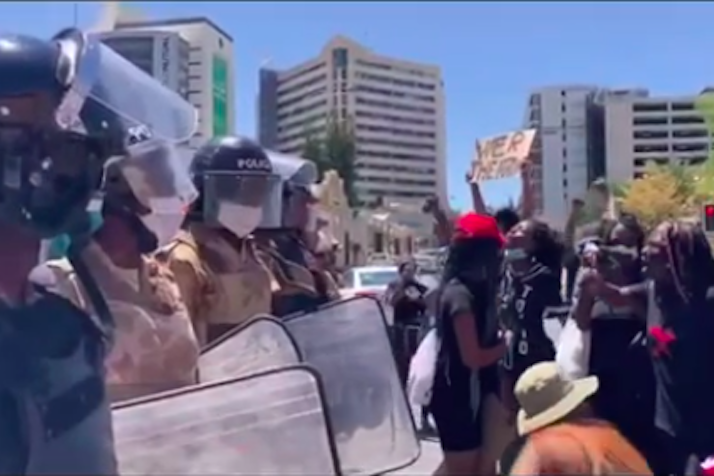
Today the ICJ condemned the apparent widespread ill-treatment and arbitrary arrest of peaceful demonstrators protesting gender based violence on Saturday 10 October in Windhoek.
The demonstrators were allegedly met with tear gas, and a number of them were subject to serious beatings by police forces.
Some 25 persons, including journalists, were arrested during the demonstrations. They were initially charged with breaching a law forbidding the public gathering of more than 50 people, though the charges were dropped on Monday.
The ICJ is calling for a prompt, thorough, impartial and effective investigation into the alleged police abuse, in line with Namibian law and the countries international legal obligations.
Officials responsible should be held accountable.
“Instead of taking seriously the demands made by the protestors and to take steps to ensure that gender based violence is addressed in a meaningful and constructive way, the police themselves appeared to have engaged in violent action against those exercising their rights to peacefully assembly and express their view,” said Kaajal Ramjathan-Keogh, ICJ Africa Regional Programme Director.
The ICJ also called on the authorities to protect the right of individuals in the country to peacefully and protest, rights which are protected under Namibia’s Constitution and international law.
The ICJ said that thePublic Gatherings Proclamation Act, requiring prior permission for assemblies of more than 50 people in public spaces, should be repealed or revised, as incompatible with its international legal obligations.
The ICJ has also called on Namibia to address the underlying concerns raised by the protests, notably that during the COVID-19 pandemic, gender-based violence has been exacerbated during lockdown restrictions.
In Namibia, reports of femicide and gender based violence steadily increasing and on average “three rape cases were reported to the Namibian police every day for 18 months.”
Background
The recent #ShutItAllDown and #ShutitAllDownNamibia movements, spontaneously started on social media after the killing of a young woman, Shannon Wasserfall, have led to a series of protests against government’s failure to adequately address the scourge of gender based violence in Namibia.
The protestors, predominantly young women, last week handed over a petition to government which includes a list of 24 demands. raising concerns about the poor State response to gender-based violence in Namibia.
The protestors allege that Namibian police are “negligent and nonchalant” with investigating violent crime committed against women. They are demanding that government do more to protect women against such violence, including by ensuring that survivors of gender-based violence have access to justice.
The rights to freedom of assembly and expression, freedom from ill-treatment, and prohibitions on arbitrary arrest are guaranteed under the international human rights treaties to which Namibia is a party, including the African Charter on Human and Peoples Rights and the International Covenant on Civil and Political Rights, and the Convention against Torture,as well as the Namibian Constitution.
Contact
Kaajal Ramjathan-Keogh, Director of ICJ’s Africa Regional Programme, c: +27845148039, e: kaajal.keogh(a)icj.org
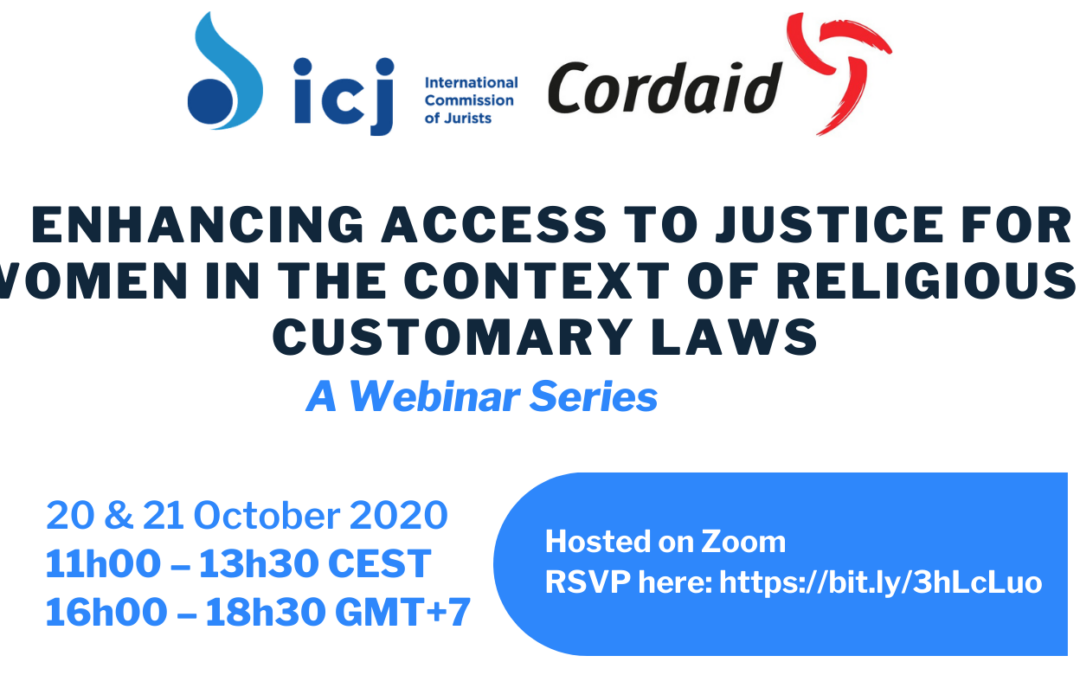
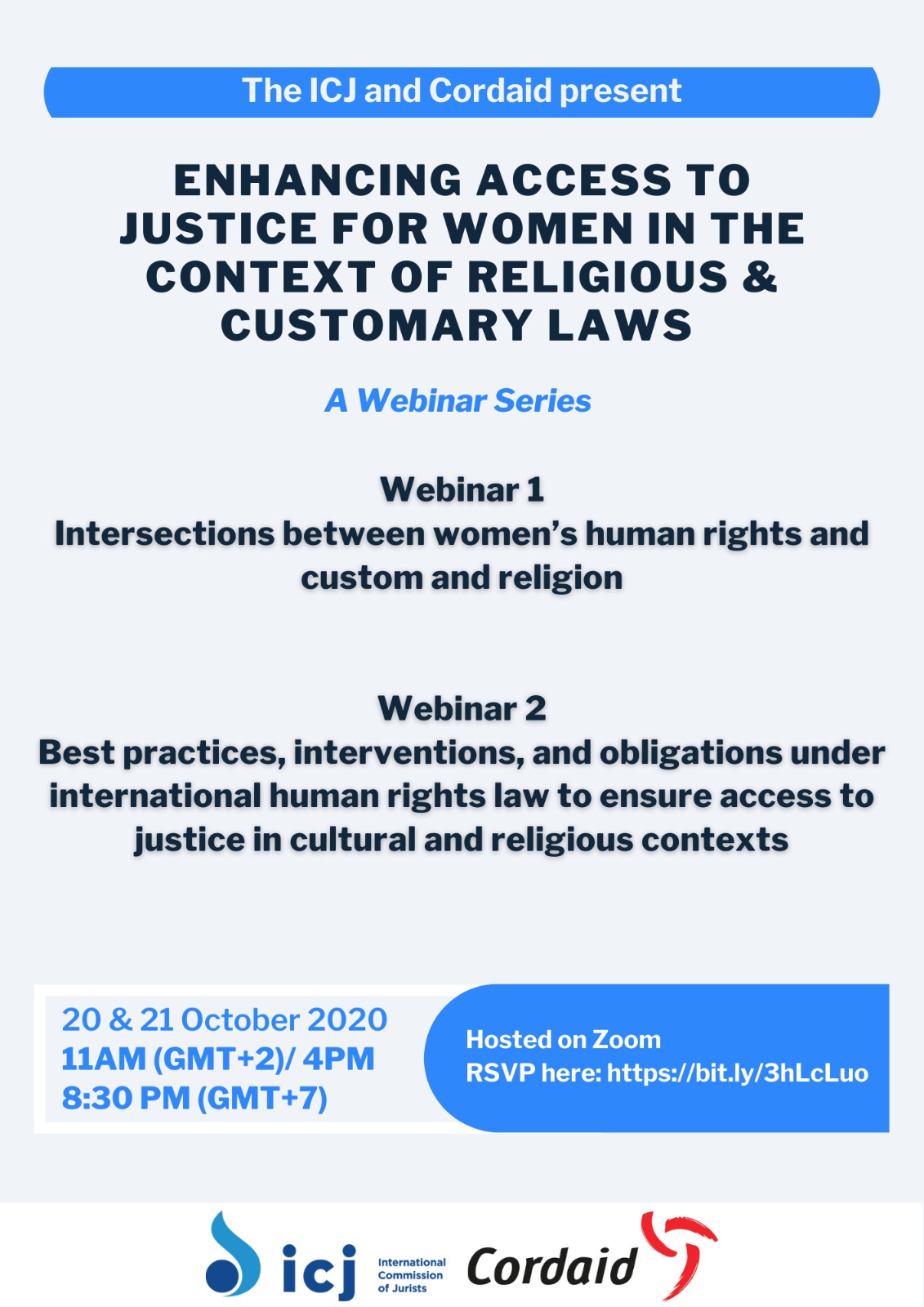
The ICJ and Cordaid are convening a webinar series to foster dialogue among women human rights defenders and religious and customary justice actors.
This public online event takes place 20 & 21 October 2020 11:00-13:30 (CEST) / 16h00 – 18h30 GMT+7
Women’s empowerment in every aspect of their lives is reliant upon ensuring that systems of law and justice work for women. Over the years, many countries have seen an expansion of women’s legal entitlements and enhancement of their right to access justice; however, in many contexts, there is also a growing trend of invoking religion and custom to violate women’s human rights. It is in these contexts where laws and policies exist that expressly discriminate against women, posing a continuing serious challenge to women’s ability to access justice.
In response, Cordaid and the ICJ will convene a webinar series to foster dialogue among women human rights defenders (WHRDs) and religious and customary justice actors.
The focus of the exchange will be on ensuring the protection of women’s human rights and access to justice in contexts where religious and customary laws are prevalent, within a framework of rule of law and international human rights standards. Diverse WHRDs and religious and customary justice actors from Asia, Africa, and the Middle East and North Africa will come together in two consecutive sessions:
Webinar 1 (Oct 20): Intersections between women’s human rights and custom and religion
Webinar 2 (Oct 21): Best practices, interventions, and obligations under international human rights law to ensure access to justice in cultural and religious contexts
Both sessions will be held on Zoom with simultaneous translation in Bahasa, Dari, English and French.
During the first webinar, the discussion will be focused on responding to the questions below:
How do custom and religion shape the ability of women to access justice?
Do pathways to justice based in custom and religion promote women’s human rights?
Do you perceive a clash between women’s human rights and pathways to justice based on custom and religion? If so, how?
Are there religious and cultural practices, which have an impact of exacerbating inequalities between men and women, and negatively affect women’s ability to defend their human rights?
How have women created space within customary and religious law to advocate for women’s human rights?
During the second webinar, the discussion will be focused on responding to the questions below:
What are the best practices and interventions, which can be adopted by States, international organisations and civil society to support positive impacts of custom and religion on women’s access to justice?
What practical measures can be adopted by States, international organisations and civil society to eliminate practices, which exacerbate women’s inequality and are barriers to pathways to justice?
What are the obligations of these actors when customary and religious law discriminate against women and prevents them from being able to defend their rights?
How have women successfully created space for advocacy within customary and religious contexts?
Documents:
Cordaid Publication: Diverse Pathways to Justice for All: Supporting Everyday Justice Providers to Achieve SDG16.3
ICJ Publication: Indigenous and other Traditional or Customary Justice Systems – Selected International Sources
IDLO report: Navigating Complex Pathways to Justice: Women and Customary and Informal Justice System
ICJ Publication: Access to Justice Challenges Faced by Victims and Survivors of Sexual and Gender-Based violence in Eswatini
Human Rights Council: Report of the Special Rapporteur on freedom of Religion or Belief
Report of the 2017 Geneva Forum on traditional and customary justice systems
Report of the 2018 Geneva Forum on indigenous and other traditional or customary justice systems in Asia
Report of the 2020 Geneva Forum on indigenous and other traditional or customary justice systems in Africa
2019 Report of the UN Special Rapporteur on the rights of indigenous peoples, on indigenous justice
Obstacles to Women’s and Girls’ Access to Justice for Gender-based Violence in Morocco (June 2019), in English and in Arabic
Gender-based Violence in Lebanon: Inadequate Framework, Ineffective Remedies (July 2019), in English and in Arabic
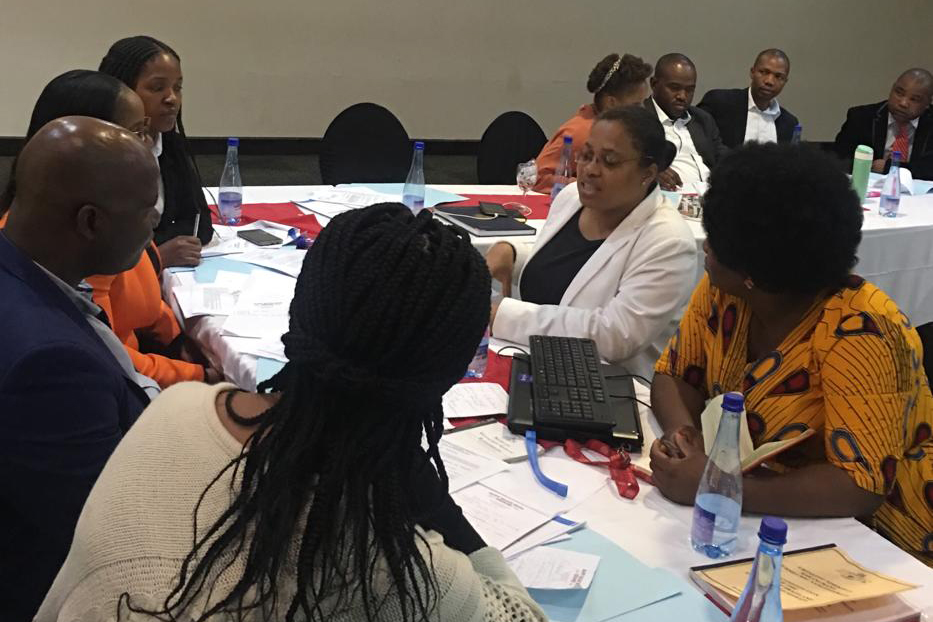
To assist in efforts to combat gender-based violence, the ICJ and Swaziland Action Group Against Abuse (SWAGAA) collaborated to create a guide on reporting gender-based violence for media practitioners in Eswatini.
The guide, designed by SWAGA, was launched on 2 October 2020 in a webinar attended by media practitioners from Eswatini.
Media practitioner, lecturer and trainer Pontsho Pilane gave an introduction to and answered questions about reporting gender-based violence. Her own interests include the intersection between health, race and gender.
Pilane said it was important for journalists to find different ways of presenting accounts in ways that are empowering to survivors and to readers and uphold the dignity of the most important people in the story: the survivors.
In her address, Pilane also highlighted the need for “solutions-based journalism” or reporting that focuses on adequate responses to social issues in addition to describing the problems themselves.
“Supporting survivors is crucial, as well as including things like how a survivor can find help and move forward from experiences with SGBV in our reporting,” she said.
It is also important to connect readers and survivors to NGOs like Swagaa who have the necessary tools to assist them.
In an effort to combat the various challenges presented by SGBV, the Kingdom of Eswatini introduced the Sexual Offences and Domestic Violence (SODV) Act in 2018.
Executive director of Swagaa Nonhlanhla Dlamini said the journey to enacting the SODV Act was a consultative one and that she was impressed with efforts by journalists in reporting on the Act.
“We hope that this manual will help journalists to improve their reporting on gender-based violence,” Dlamini said.
The Guide is intended as a valuable tool and resource as editors and journalists in Eswatini in supporting their collective efforts to contribute towards reporting which is respectful of survivors of gender-based violence, consistent with the law and contributes to ensuring a non-discriminatory public discourse on gender-based violence in Eswatini.
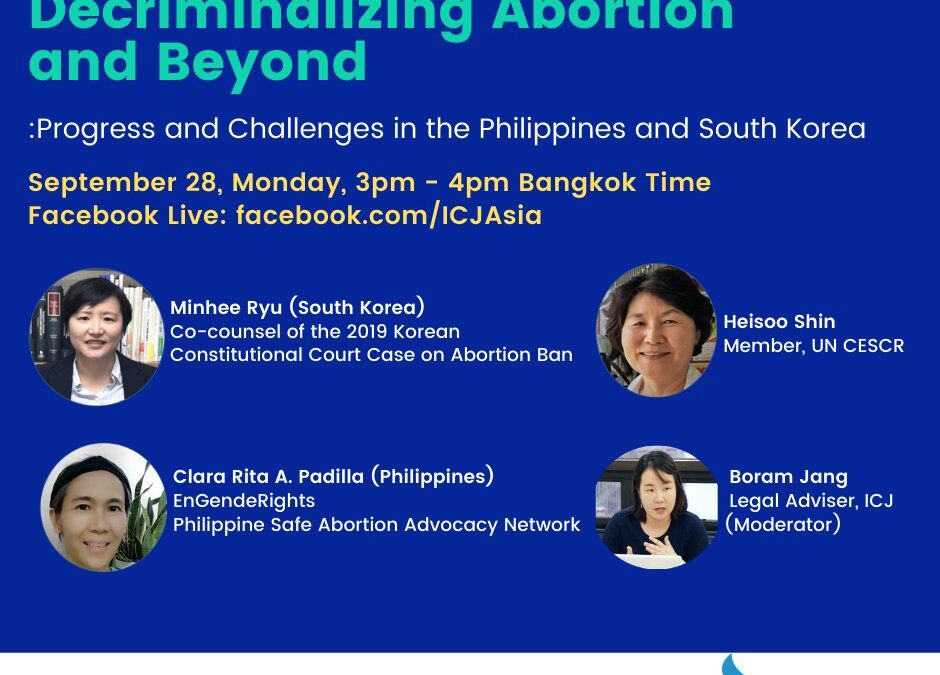
On the International Safe Abortion Day, the ICJ held a webinar on the decriminalization of abortion in the Philippines and the Republic of Korea.
The webinar focused on the legal provisions criminalizing abortion and on women human rights defenders’ struggle to decriminalize abortion in the Philippines and in the Republic of Korea. In addition, the participants highlighted States’ legal obligation to guarantee access to legal, safe and affordable abortion and post abortion care for all persons under international human rights law and standards.
Ms. Clara Rita A. Padilla from the Philippines’ Safe Abortion Advocacy Network; Ms. Minhee Ryu, Co-counsel in the 2019 Korean Constitutional Court case on the country’s criminal ban on abortion; and Dr. Heisoo Shin, member of the UN Committee on Economic, Social and Cultural Rights (CESCR) participated as speakers.
“The law imposing penalties on women who have an abortion and those assisting them only endangered the lives of women forced to seek unsafe abortion,” said Ms. Padilla. “Today, the Philippine Safe Abortion Advocacy Network introduced a draft bill, An Act Decriminalizing Induced Abortion to Save the Lives of Women, Girls, and Persons of Diverse Gender Identities, and we will continue advocating the repeal of the current discriminatory law against women and eliminate harmful stigma against women due to the restrictive abortion law and imposition of judgmental religious beliefs.”
Ms. Minhee Ryu talked about the women human rights defender’s movement in the Republic of Korea, including the work of the Joint Action for Reproductive Justice. She also highlighted the legal strategy to draw the Constitutional Court’s attention to the experience of girls, migrant women and women with disabilities in the context of the case that resulted in the Court holding that the criminalization of abortion was unconstitutional in April 2019.
“It is the core obligations of States to ensure the repeal of laws, policies and practices that criminalize, obstruct or undermine access by individuals or a particular group to sexual and reproductive health facilities and services,” said Dr. Heisoo Shin. “Denial of abortion often leads to maternal mortality and morbidity, which, in turn, constitute violations of the rights to life, dignity, autonomy, security, equality and non-discrimination, equality before the law and equal protection of the law without discrimination, privacy, physical and mental health, and the right to freedom from ill-treatment.”
The participants agreed that international human rights law and standards, such as the Human Rights Committee’s General Comment 36 on the right to life, and the CESCR’s General Comment 22 on the right to sexual and reproductive health, are instrumental in worldwide efforts to ensure access to legal, safe and affordable abortion and in advocating for its complete decriminalization.
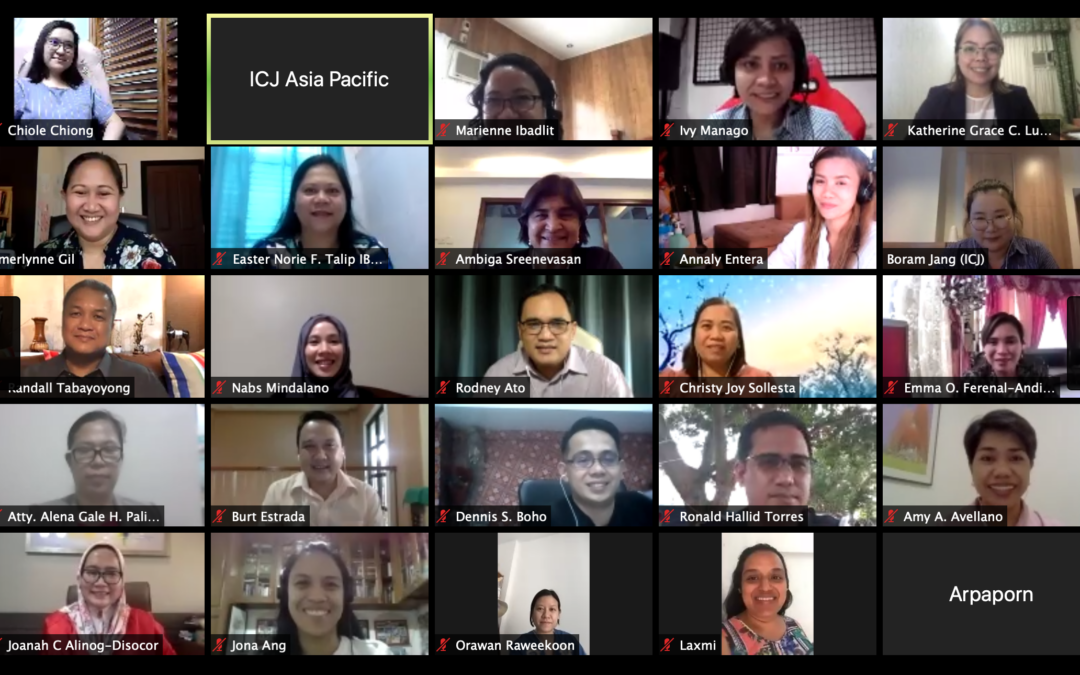
On 29 August and 5 September, the ICJ collaborated with the Integrated Bar of the Philippines (IBP) to hold a webinar series for legal aid providers in the Philippines on eliminating gender discriminatory attitudes and behaviors towards women.
Members of IBP’s legal aid committees from the Eastern and Western Mindanao Regions participated in these webinars, focused on gender stereotypes and discriminatory practices that exist in the legal profession and in the work of legal aid providers who directly engage with women when they seek justice.
Dato Ambiga Sreenevasan, ICJ’s Commissioner from Malaysia, addressed the promotion and protection of women’s human rights in the context of the legal profession: “While conditions for women have improved, there is still work to be done to achieve equality between men and women in the legal profession. At the entry level, things appear to be going well, but we must look also at women’s opportunities throughout their legal career and question why it is the case that some areas are still male-dominated.”
Mikiko Otani, ICJ’s Commissioner from Japan and a member of the UN Committee on the Rights of the Child, spoke about how gender stereotypes and gender discrimination hinder women from accessing justice. “The Bar should be at the forefront of advocating for improvement in legal structures that would help eliminate gender discrimination,” she said.
The Philippines had previously featured as one of the top ten performers in addressing gender disparities, as measured by the World Economic Forum’s Global Gender Gap Index. However, it has recently fallen to rank 16th out of 153 countries. Emerlynne Gil, ICJ Senior International Legal Adviser, acknowledged various measures adopted by the Philippines to implement the Convention on the Elimination of All Forms of Discrimination Against Women (CEDAW), such as the adoption of the Anti-Violence Against Women and Children Act and the Magna Carta for Women. She noted, however, that the Philippines still must do a great deal more.
“The existing culture of impunity and lack of effective remedies for women to access the justice system are just some of the difficult challenges the country faces that prevent it from achieving this goal,” Emerlynne Gil said.
The webinar series also featured a discussion on specific challenges faced by women when accessing justice during the COVID 19 pandemic and in the context of the “drug war” in the Philippines. The lawyers discussed their role and also that of the Bar as an institution to immediately identify and eliminate these gender stereotypes to ensure their clients’ right to access to justice.
Judge Amy Alabado Avellano, a Regional Trial Court judge in the Philippines led this discussion. Attorney Burt Estrada, IBP Executive Vice President, and Attorney Marienne Ibadlit, former IBP Governor for Western Visayas, also held a dialogue with the lawyers on how the IBP as a professional association for lawyers in the Philippines could contribute towards enhancing access to justice for women in the country.
Contact
For questions and clarifications, please contact Ms. Emerlynne Gil, Senior International Legal Adviser, t: +662 619 8477 (ext. 206); e: emerlynne.gil(a)icj.org.
🍪 We use cookies on our website to improve your experience. By clicking "Accept all", you consent to the use of all the cookies. If you'd like to control which cookies we use, please visit "Cookie settings". To find out more, read our privacy policy and cookie policy.
Functional
Always active
The technical storage or access is strictly necessary for the legitimate purpose of enabling the use of a specific service explicitly requested by the subscriber or user, or for the sole purpose of carrying out the transmission of a communication over an electronic communications network.
Preferences
The technical storage or access is necessary for the legitimate purpose of storing preferences that are not requested by the subscriber or user.
Statistics
The technical storage or access that is used exclusively for statistical purposes.The technical storage or access that is used exclusively for anonymous statistical purposes. Without a subpoena, voluntary compliance on the part of your Internet Service Provider, or additional records from a third party, information stored or retrieved for this purpose alone cannot usually be used to identify you.
Marketing
The technical storage or access is required to create user profiles to send advertising, or to track the user on a website or across several websites for similar marketing purposes.