Jun 9, 2016 | News
The ICJ welcomes the landmark decision issued today by the UN Human Rights Committee in the case of Amanda Mellet v. Ireland under the Optional Protocol to the International Covenant on Civil and Political Rights.
The Committee found that, by forcing Amanda Mellet to choose either to carry her foetus to term, despite its fatal fœtal abnormality, or to travel abroad to seek an abortion, Ireland had subjected her to cruel, inhuman or degrading treatment and discrimination, in violation of its obligations under the Covenant.
The ICJ considers that in light of the Committee’s decision Ireland must provide reparation to Amanda Mellet and reform its laws to prevent future violations.
Otherwise, Ireland will be in breach of its legal obligation to provide Amanda Mellet with an effective remedy – including in the terms set out in the Committee’s decision – for the human rights violations she suffered.
Related readings:
Full text of Human Rights Committee’s decision (download in PDF)

Jun 8, 2016
In a memorandum published today, the ICJ called on the Tunisian authorities to implement a comprehensive set of measures to fully realize women’s right of access to justice.
Despite some progressive legislation protecting women’s human rights, and the recent adoption of institutional and legal reforms of the justice system, the ICJ identified significant remaining obstacles undermining women’s access to justice in breach of Tunisia’s obligations under international human rights law.
“Women in Tunisia face numerous barriers accessing justice. While some are specific to their status as women, such as explicitly discriminatory laws, others are common to men and women but affect women and men differently or are predominantly experienced by women,” said Shirin Abu Fannouneh, Legal Researcher for the ICJ Middle East and North Africa Programme.
The ICJ memorandum analyzes some of the main obstacles to women’s effective access to justice in Tunisia, including inadequate laws failing to fully protect women’s human rights, such as the Criminal Code’s flawed, discriminatory definitions of rape and sexual harassment; laws perpetuating gender discrimination, such as certain child custody provisions of the Personal Status Code; structural and practical obstacles related to the administration of justice; gender stereotypes and norms undermining women’s ability and/or willingness to seek justice; and economic and social barriers.
“Obstacles in the way of women exercising the right of access to justice take various forms in Tunisia. Even if certain legal provisions were to be reformed in line with international human rights law, other hurdles – such as the biased attitudes of justice-sector actors and women’s own disadvantaged social and economic realities – would, if unaddressed, continue to undermine women’s ability to claim and obtain respect for their human rights,” added Abu Fannouneh.
The ICJ stresses that, under international human rights law, Tunisia is not only required to adopt a wide range of legislative, administrative, educative and practical measures to realize the right of access to justice for all, but it must also take specific steps to address women’s experiences and the numerous, specific obstacles they face when seeking to exercise their right of access to justice.
“Effective access to justice for women is not merely a matter of the right to access a mechanism to claim their rights. It also requires prohibiting all forms of discrimination and ensuring that men and women enjoy equal rights, including equality before the law and equal protection of the law, in law and in practice,” said Abu Fannouneh.
The ICJ identified a wide range of measures Tunisia must implement to eliminate these obstacles. These reforms include:
- amending existing legislation, including through the Draft Law on Violence against Women, to ensure that certain violations of women’s human rights are adequately criminalized, such as rape, including marital rape, sexual assault and sexual harassment;
- providing adequate legal aid and protection measures, for example to victims of domestic violence;
- training for judges, prosecutors, police officers and lawyers in addressing and overcoming discriminatory attitudes and gender stereotypes within the administration of justice; and
- taking steps to address certain social and practical realities, such as women’s disadvantaged status in society, their lack of financial independence and societal gender-based stereotypes and prejudices that ultimately impede the effective exercise by women of their right of access to justice.
“If women’s effective access to justice is to become a reality, women must be fully empowered to seek and obtain respect for their human rights. The Tunisian authorities for their part must adopt and implement comprehensive reforms to address all types of obstacles to making women’s right of access to justice a reality so that legislative advancements are not nullified by persisting discriminatory attitudes and practices,” added Abu Fannouneh.
Contact
Theo Boutruche, ICJ Legal Adviser, Middle East and North Africa Programme, t: +96 170 888 961, e: theo.boutruche(a)icj.org
Tunisia-Memo WA2J-Advocacy-Analysis brief-2016-ENG (full Memo in English, PDF)
Tunisia-Memo WA2J-News-Press releases-2016-ARA (full news in Arabic, PDF)
Tunisia-Memo WA2J-Advocacy-Analysis brief-2016-ARA (full Memo in Arabic, PDF)

Jun 6, 2016
ICJ Practitioners Guide No. 13 on Judicial Accountability addresses mechanisms and procedures to ensure accountability for serious judicial misconduct, such as corruption or complicity in human rights violations, while preserving the independence of the judiciary. (Available in English, Burmese and Nepali)
It focuses on international standards on accountability mechanisms and procedures, illustrated by practical examples. The Guide addresses the need for all countries to ensure effective judicial accountability, while also including special chapters on situations of transition and developing countries.
The Guide updates and expands on previous guidance contained in the ICJ publication, Practitioners Guide No. 1: International Principles on the Independence and Accountability of Judges, Lawyers and Prosecutors, as well as Practitioners Guide No. 7: International Law and the Fight Against Impunity. It also builds on earlier work of the ICJ on the theme of judicial corruption, including Strengthening Judicial Independence, Eliminating Judicial Corruption.
This Guide addresses not only the accountability of individual judges, and the accountability of judiciary as an institution, but also State responsibility under international law, particularly in relation to harm caused to victims of violations by judges.
The Guide has been greatly informed by the contributions of outside experts, including the participants to a consultation on judicial accountability in developing countries, convened by the ICJ Centre for the Independence of Judges & Lawyers in Tunisia 8-9 October 2015, as well as the 2015 CIJL Geneva Forum of Judges & Lawyers, 14-15 December 2015.
Among the topics covered by the Guide are:
- The international legal frameworks for the obligation to ensure an independent, impartial and accountable judiciary.
- The forms of judicial accountability, including:
- Remedy and reparation for victims,
- The responsibility of the State,
- Removal from office, disciplinary sanctions, and other administrative measures,
- Criminal responsibility, and
- The right to the truth.
- The structure and elements of accountability bodies, such as:
- Review of decisions through appeal or judicial review,
- Judicial councils,
- The ordinary courts,
- Parliamentary procedures,
- Ad hoc tribunals,
- Anti-corruption bodies,
- Civil society monitoring and reporting,
- National human rights institutions,
- Professional associations,
- International accountability mechanisms.
- Procedural issues, including:
- Necessary powers for accountability mechanisms,
- Procedural rights of the judge,
- Procedural rights of complainants and victims,
- Publicity and transparency,
- Procedures for lifting judicial immunity,
- Temporary suspension during proceedings, and
- Selective enforcement for improper purposes.
- Mechanisms in exceptional circumstances, such as transitions from undemocratic or authoritarian regimes, including:
- Truth commissions,
- Vetting, and
- Mass removal and re-application.
- Particular challenges in relation to developing countries.
(An online compilation of international standards on independence and accountability of judges, as well as independence of lawyers and prosecutors, is available here.)
The ICJ Practitioners Guide on Judicial Accountability, and the research and consultations on which it is based, would not have been possible without the financial support of the Republic and Canton of Geneva and the Ministry of Foreign Affairs of Finland.
Universal-PG 13 Judicial Accountability-Publications-Reports-Practitioners Guide-2016-ENG (full guide in English, in PDF format)
Universal-PG13 Judicial-Accountability-Publications-Reports-Practitioners Guide-2016-Burmese (full guide in Burmese, in PDF format)
Universal-PG13 Judicial-Accountability-Publications-Reports-Practitioners Guide-2016-Nepali (full guide in Nepali, in PDF format)
To provide feedback on the Guide please respond to this online survey: https://www.surveymonkey.com/r/Q5VKMRM
To order printed copies, or for other queries, please contact Matt Pollard (matt.pollard(a)icj.org).

Jun 6, 2016
The ICJ has urged the ASEAN Intergovernmental Commission on Human Rights (AICHR) to ensure that civil society organizations that apply for consultative status with the AICHR are provided with notice and an opportunity to respond to any objections before a decision is taken.
The AICHR was established in 2009 to promote human rights within the ASEAN region. As part of its mandate, the Commission regularly enters into formal consultative relationships with civil society organizations.
These consultative relationships allow civil society organizations to engage in dialogue with the AICHR in order to keep the AICHR apprised of human rights issues in the ASEAN region and to work jointly to advance human rights.
However, the ICJ is concerned that the AICHR, unlike other human rights bodies, has not explicitly provided in its procedures that civil society organizations should have an opportunity to respond to objections prior to any decision being taken, and in practice AICHR has denied consultative status to organizations (including the ICJ), without providing such an opportunity.
As a result, key voices may be excluded from contributing to important discussions on human rights, the ICJ says.
“Engagement with civil society organizations is central to the AICHR’s mandate,” said Prof. Sir Nigel Rodley, President of the ICJ.
“When the AICHR decides whether to extend consultative status to a civil society organization, it should make its decision based on all available information,” he added.
In a letter to the AICHR, the ICJ called on the human rights body to create a fairer and more effective process by granting civil society organizations applying for consultative status the right to respond to any objections made against them.
The ICJ noted that many intergovernmental organizations already provide this right to civil society organizations.
The United Nations Economic and Social Council, the Organization of American States and the Council of Europe all permit civil society organizations to respond to objections.
The ICJ also noted that a process of response would allow the AICHR to make more informed decisions regarding its consultative relationships and would reduce the administrative costs and increase the efficiency of the AICHR.
Under the current system, civil society organizations that are denied consultative status with the AICHR must submit a full revised application, and the AICHR must review the revised application in its entirety.
In its letter, the ICJ observed that this process is unnecessarily burdensome for both civil society organizations and the AICHR.
The ICJ’s letter comes after the AICHR denied an earlier request by the ICJ for reconsideration. On 16 February 2016, the ICJ received notice that its application for a consultative relationship with the AICHR had been denied.
On 24 March, the ICJ submitted a request for reconsideration addressing comprehensively the concerns raised by the AICHR. On 3 June 2016, the ICJ received a letter from the AICHR stating that the AICHR process does not provide an appeal procedure.
The ICJ has therefore clarified in its latest letter that it is not seeking an appeal but rather for the AICHR to enhance and adapt its existing working methods to incorporate a fairer and more transparent practice of notice and opportunity to respond, and to reconsider its decision concerning the ICJ in line with such working methods.
Contact:
Emerlynne Gil, ICJ’s Senior International Legal Adviser for Southeast Asia, t: +66 840923575; e: emerlynne.gil(a)icj.org
ASEAN-Letter to AICHR-Advocacy-Open Letters-2016-ENG (full text of letter, in PDF)
Jun 5, 2016
An opinion piece by Kingsley Abbott, ICJ Senior International Legal Adviser for Southeast Asia and Sutharee Wannasiri, a Thailand Human Rights Specialist with Fortify Rights.
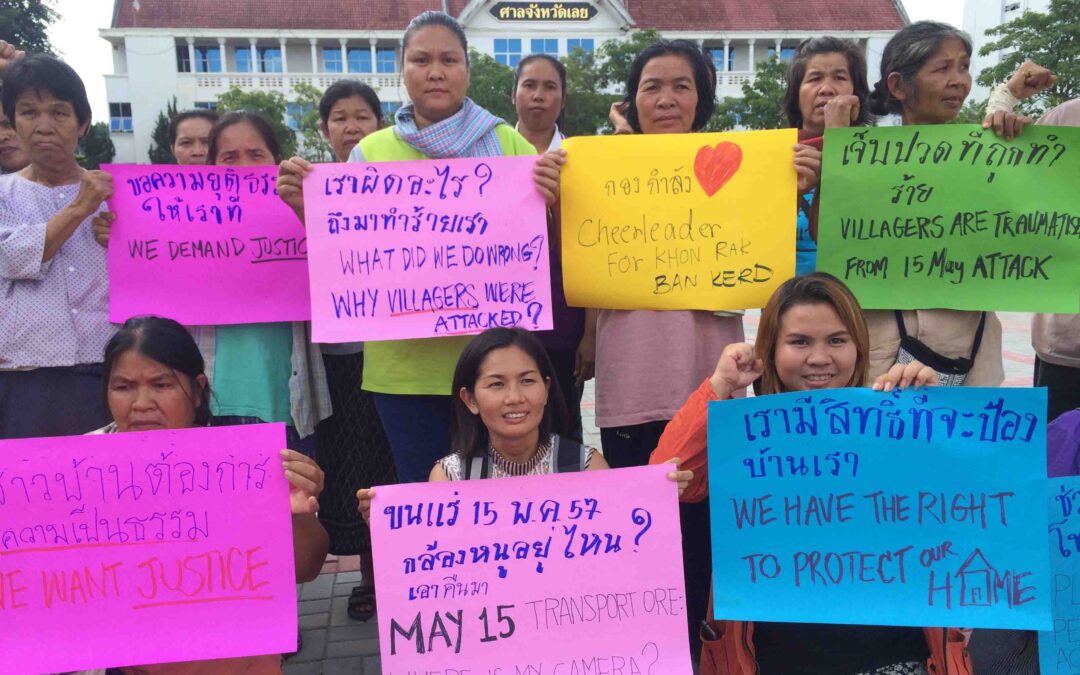
Late in the evening of 15 May 2014, more than 100 men, most of them armed and wearing black masks, stormed a small village in Loei Province, northeast Thailand and assaulted more than a dozen men and women who oppose a local copper-gold mine.
After testing in 2007 showed contamination of the local water supplies, villagers in six communities surrounding the mine in Loei Province formed a network—Khon Rak Ban Kerd Group (KRBKG)—to advocate for the mine’s closure and rehabilitation of the local environment.
The communities went so far as to barricade the road to the mine in 2014. That’s when the armed men arrived, unlawfully detaining scores of villagers and injuring at least a dozen in a fit of violence that lasted six hours.
Despite the villagers’ calls for help, no police intervened.
Only two of more than 100 assailants were brought up on criminal charges for the attack: a retired Royal Thai Army officer and his son, who is still serving in the Army.
On 31 May 2016, the Loei Provincial Court convicted the two military personnel on criminal charges including causing bodily harm, deprivation of liberty, and the unnecessary use of firearms in public.
They were sentenced to just under two years and three years’ imprisonment, respectively, and ordered to pay nine villagers more than 160,000 Thai Baht (US$4,475) in compensation. The two men have been released on bail.
The company operating the gold mine—Tungkum Ltd.—has vehemently denied wrongdoing and has brought at least 19 criminal and civil complaints against villagers protesting the mine, including most recently a criminal defamation complaint against a 15-year-old girl who narrated a Thai PBS broadcast that touched on the question of the gold mine and the environment.
Sadly, this has been the pattern of “development” in Thailand. Throughout the country, communities face threats, violence, and judicial harassment.
Consider the situation in Surat Thani Province. In the early afternoon of 8 April 2016, an unidentified gunman opened fire on land-rights activist Supoj Kansong as he returned home in his vehicle in Chaiburi District.
He sustained serious injuries in the attack and was fortunate to survive.
But other land-rights activists have not been as fortunate.
Supoj Kansong is the fifth member of the Southern Peasant Federation of Thailand (SPFT)—a group advocating for the land rights of farmers who are in a dispute with the Government and a palm oil company operated by Thai-owned Jiew Kang Jue Pattana Co., Ltd–to have been attacked since 2010.
Four members were shot and killed. To date, only one man faced trial for one of the four killings. He was acquitted.
More recently, in March 2016, Akara Resources Public Company Limited, a Thai gold mining subsidiary of the Australian firm Kingsgate Consolidated Limited, filed complaints of criminal defamation against two human rights defenders who opposed the company’s mining operations in Pichit Province and allegedly posted negative comments about the company on Facebook.
On Thailand’s western border in Tak Province, on 15 May 2015, Thai authorities ordered members of the Mae Sot Rak Thin Group—a network of villagers in Mae Sot District—to vacate their land to make room for the Government’s plan to develop a Special Economic Zone.
Villagers told us that state security forces blocked them from submitting complaints about the eviction to the authorities on multiple occasions.
In all these cases, human rights defenders demanding justice are being sidelined and silenced.
But Thailand has a legal obligation to protect all human rights defenders from retaliation for exercising their rights.
On 17 December 2015, Thailand joined 127 other states at the UN General Assembly in adopting a UN Resolution on human rights defenders.
The Resolution calls upon states to refrain from intimidation or reprisals against human rights defenders and to allow for the peaceful and free expression of dissent.
It calls upon businesses to respect the rights of human rights defenders and to identify and address any adverse human rights impacts related to their activities through meaningful consultation with potentially affected groups and other relevant stakeholders.
In addition, in May 2016, Thailand accepted recommendations from six UN member states related to protecting human rights defenders during its Second Universal Periodical Review at the UN.
Thailand agreed to promptly and thoroughly investigate reports of intimidation, harassment, and attacks against human rights defenders and to hold perpetrators accountable.
Thailand’s support for these principles on the world stage is heartening, but it means little without concrete action at home.
Thailand has a long way to go to ensure its international obligations are met and human rights defenders are protected.
As a start, Thailand should guarantee access to effective remedies and reparations for individuals and communities whose rights have been violated.
The Government should ensure that meaningful legal frameworks are available and effectively implemented to facilitate the Free, Prior, and Informed consent of local communities with regard to development projects, and it should ensure companies are held accountable for any environmental damage and human rights abuses.