
Myanmar: authorities, courts complicit in eroding rule of law in Kachin State
An opinion piece by Vani Sathisan, ICJ International Legal Adviser, and Sean Bain, ICJ Legal consultant, in Yangon.
“The scale and severity of human rights violations in Kachin State is one of the worst in Myanmar,” a lawyer told the International Commission of Jurists during a meeting in Myitkyina last month.
Visitors walk along the riverbank at the Myitsone in Kachin State in December 2015.
Illegal large-scale land grabbing, harassment of landowners by government and business officials, and a lack of access to justice were the central complaints heard by the ICJ during the discussions with human rights defenders and civil society groups in Kachin State.
Senior state-level judicial officials signalled increased readiness to discuss ways to improve the effectiveness and independence of the courts.
Yet meaningful reform also requires revising laws to bring them in line with international human rights standards, respecting judicial independence by government officials, and securing corporate legal compliance through consistent application of the law and access to fair and effective judicial review.
The conflict in Kachin State and northern Shan State, where over 100,000 people remain displaced since fighting between the government and ethnic armed groups re-started in 2011, is partly fuelled by the abundant natural resources.
Eighty percent of Myanmar’s mining operations are located in Kachin State and neighbouring Sagaing Region. Timber, rubies and gold are plentiful.
A report by international watchdog Global Witness estimated the value of illegal jade mining at around US$31 billion in 2014 alone.
Yet hazardous mining practises are rampant while law enforcement is haphazard.
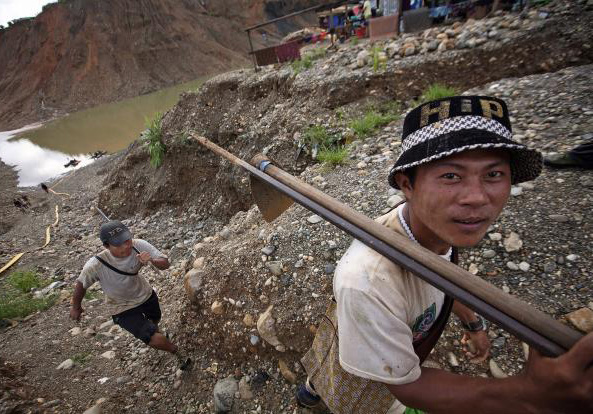
Last November, the jade-rich town of Hpakant made global headlines when over 100 itinerant miners died in a landslide of mine waste. Mining continues to be notoriously unregulated, leading to another accident this week, with a dozen more killed and many more reported missing after a downpour triggered the collapse of a massive slag heap.
At the same time, villagers near Uru Creek in Hpakant were protesting for the shutdown of a gold-mining operation, citing the dumping of waste, erosion of the riverbanks and obstruction of water flow.
The ICJ viewed photos taken in a jade-rich area of Mohnyin township, to Myitkyina’s southwest, purporting to show arson attacks on the homes of farmers.
Their lawyers say a local company mobilised thugs to attack property and physically assault farmers for refusing to vacate land earmarked for mining operations.
Local pro bono lawyers are putting together a case against the company, alleging it confiscated land in violation of Myanmar law and is responsible for the harassment of the farmers. The ICJ has provided lawyers in the area with training on strategic litigation for corporate abuse of human rights.
In the Hukawng Valley toward Myanmar’s northwest border, farmers are facing loss of livelihoods due to agribusiness initiated by a Yangon-based conglomerate.
Local activists told the ICJ that the courts have been reluctant to hear community allegations of forced displacement and intimidation by government and company officials.
They understand the company has received permissions at the Union level, but say that the actual activities do not comply with the laws, which are in any event not enforced.
Farmers allege that local police have threatened them with prosecution if they continue agricultural activities in the contested area.
Myanmar’s system for land regulation consists of overlapping laws that seek to prioritize investment but fail to protect the rights of all land users.
Rules governing acquisition of land exist, but are rarely followed. Insecure tenure rights, corruption and lack of enforcement means that farmers can find their land arbitrarily classified as “virgin” or “vacant” and then reallocated to companies or state enterprises.
For the local people, secure access to land is fundamental to the realization of a range of internationally recognized human rights, including to an adequate standard of living, food and water, housing and health.
These rights are enshrined in the International Covenant on Economic, Social and Cultural Rights, signed by Myanmar in 2015 but yet to be ratified or practised in the country.
The government has a duty to create a legal framework consisting of land acquisition laws that are compatible with international human rights standards, and to enforce regulations that require environmental and social impact assessments.
State Counsellor Daw Aung San Suu Kyi has stated that land reform would be a top priority for the National League for Democracy government.
Amendments to laws should be guided by principles of public participation and international human rights standards, including the United Nations basic principles and guidelines on development-based evictions and displacement, and the Voluntary Guidelines on the Responsible Governance of Tenure.
The law must also create a process for public purpose land acquisition – based on the UN guidelines on evictions and displacement – which ensures transparency and accountability in the process, and requires that all such acquisitions be demonstrably justified.
The framework should also be consistent with the National Land Use Policy finalized last year following consultations with farmer networks and civil society groups.
It should affirm the duty of companies to comply with laws and respect human rights. This is required to enable just and effective remedies for those affected by development projects.
As seen in Kachin State, the approval of investments without requisite checks and legal safeguards, along with substandard enforcement mechanisms, undermines democratic processes and human rights norms.
In Kachin State, as elsewhere, bold farmers and lawyers are challenging unjust laws and the arbitrary implementation of laws that violate human rights.
Many see these cases as unwinnable due to executive and administrative control over judges and prosecutors, in breach of international standards on the independence of the judiciary and the role of prosecutors.
But these cases do highlight issues with the content and application of law, with the aim of promoting regulatory change for public good.
At the moment, lawlessness and impunity continue to enable human rights abuses and environmental damage. Land grabbing results in human rights violations.
Local and foreign companies can, and do, flout domestic and international law without penalty.
And authorities are too often complicit in crimes while courts are used to intimidate and silence victims.
Strengthening the rule of law will be critical for enabling human rights and democracy in Kachin State.

Turkey: ICJ raises concerns at threats to the independence of judges, prosecutors and lawyers
In a briefing paper issued today, the ICJ raises concerns at measures eroding the independence of the judiciary, prosecution, and legal profession in Turkey, with serious consequences for protection of human rights.
The briefing paper Turkey: the Judicial System in Peril follows a research mission by the ICJ in December 2015.
It analyses developments in law and practice that have affected the independence of both the governing institutions of the judiciary and prosecution, and the security of tenure and independence of individual judges in practice. In particular:
- the independence of the High Council for Judges and Prosecutors (HSYK), the governing body of the judiciary, from executive influence has been substantially diminished;
- punitive measures against judges who act contrary to the putative interests of the executive have chilled the climate for independent exercise of the judicial function;
- prosecutions and dismissals of prosecutors, apparently related to their decisions in sensitive cases, have a damaging effect on autonomous decision making in the prosecution service; and
- attacks on and threats to lawyers, in particular those engaged in the defence of human rights, have further compounded the problems in the justice system.
The briefing paper makes recommendations for action to address these developments.
It urges the executive and legislative authorities to refrain from all actions and rhetoric contrary to the separation of powers, and emphasises the need to protect the safety of lawyers and other human rights defenders, and to undertake a prompt, thorough and independent investigation into the killing of the President of the Diyarbakir Bar Association, Tahir Elçi.
Turkey-Judiciary in Peril-Publications-Reports-Fact Findings Mission Reports-2016-ENG (full report in PDF)

End harassment of bloggers in Singapore
The ICJ is alarmed by the intimidation and harassment experienced by bloggers in Singapore recently, perpetrated by police authorities.
In the last few days, the homes of four bloggers were raided and their phones and laptops confiscated, without the legal process or justification required by international standards.
The ICJ strongly urges the Government of Singapore to stop this harassment and ensure that bloggers are protected against such unjustified interference with or reprisals for the exercise of their right to freedom of expression.
“By resorting to this kind of harassment and intimidation of bloggers, Singapore is showing complete disregard for human rights and the rule of law,” said Sam Zarifi, ICJ’s Regional Director for Asia and the Pacific.
“The Government of Singapore must stop intimidating citizens who express their political opinions openly. The actions taken by the Singaporean police against the four bloggers do not only constitute an attack on freedom of opinion and expression in the country, but also clearly violates their right to privacy,” he added.
On 27 May 2016, the Election Department of Singapore filed police reports alleging that bloggers Roy Ngerng and Teo Soh Lung, and The Independent Singapore, an independent news website, violated the rules against election advertising ahead of polling day.
Under Singapore’s election rules, campaigning is prohibited 24-hours prior to polling day, which is called the “Cooling-Off Day”.
Roy Ngerng and Teo Soh Lung were alleged to have written posts on their social media accounts expressing support for the opposition candidate, Mr. Chee Soon Juan.
The Independent Singapore, on the other hand, was alleged to have published articles that amount to election advertising.
The ICJ considers that provisions or interpretations of Singapore’s election laws that would impose a sweeping ban on all political expression in relation to particular candidates in a 24-hour period prior to polling day, including the expression of opinions by private individuals without remuneration, cannot constitute a demonstrably justified and proportionate restriction on freedom of opinion and expression under international standards.
Early this year, the delegation representing the Government of Singapore said as it went through the 2nd cycle of the Universal Periodic Review that “no one in Singapore is prosecuted for criticizing the government or its policies.”
The delegation emphasized that Singapore’s Constitution guarantees the right to freedom of expression.
The Government of Singapore also accepted recommendations made by other States at the Universal Periodic Review to “ensure the full enjoyment of the right to freedom of expression”.
It also accepted the recommendation to protect bloggers from persecution and harassment for the exercise of their human rights.
The ICJ urges the Government of Singapore to remain true to the commitments it made during the recent Universal Periodic Review and respect the right to freedom of expression of bloggers.
Contact:
Emerlynne Gil, ICJ’s Senior International Legal Adviser for Southeast Asia, t: +668 4092 3575 ; e: emerlynne.gil(a)icj.org
Additional information
On 6 May 2016, The Independent Singapore published two articles: 5 Highlights of DPM Speech and Workers’ Party and the Bukit Batok by-election – what WP members said.
The first article reported about the speech of the Deputy Prime Minister of Singapore at the rally of the ruling party, the People’s Action Party (PAP), wherein he expressed support for the PAP candidate.
The second article reported statements made by the Workers’ Party (WP) members on key issues relating to the elections.
On 7 May 2016, it published the article Tan Cheng Bock Denies involvement in posting by irrational group of PAP fans, where it reported on how the former Member of Parliament, Dr. Tan, disavowed statements he allegedly made and that were posted on the Facebook group which favor the ruling party.
On 31 May 2016, Roy Ngerng and Teo Soh Lung were interrogated for three hours by police. The two were interrogated separately. Teo Soh Lung was accompanied by her lawyer, while Roy Ngerng was not.
After the interrogation, the police accompanied the bloggers back to their respective homes. The police searched their homes without warrants or their consent, and confiscated their mobile phones, laptops, and hard disks. After the search, Roy Ngerng was taken back to the police station and interrogated for another few hours.
At the police station, law enforcement authorities intimidated Roy Ngerng into logging in and out of his social media accounts and his blog, The Heart Truths, in their full view and presence.
The publisher and editor of The Independent Singapore were likewise interrogated separately by the police, on 31 May 2016 and 1 June 2016. Their mobile phones and laptops were also confiscated by the police after their interrogation.

The ICJ writes to Philippine President about death penalty
Today the ICJ issued an open letter to Philippine President-Elect Rodrigo Duterte, expressing concern regarding statements he made in support of reinstating the death penalty.
In the letter, the ICJ noted that the resumption of executions would constitute a violation of international law under the 2nd Optional Protocol to the International Covenant on Civil and Political Rights (ICCPR), which the Philippines has ratified.
The ICJ also emphasized that there is no empirical evidence proving that the death penalty deters crime and called upon the president-elect to focus on more effective, evidence-based approaches to crime prevention.
Philippines-Letter to President Duterte-Advocacy-Open letters-2016-ENG (full text in PDF)
Recent News
 HRC63: ICJ and Partners Call on Cambodia to Halt Impunity for Human Rights Violations, Including Transnational Repression05 Oct 2026
 Africa Region: Human Rights Defenders and Lawyers Propose Means to Strengthen Access to Redress for Victims of Human Rights Atrocities02 Oct 2026
 Europe: Experts stress the role of intermediaries in access to justice for children with disabilities02 Oct 2026
 HRC63: ICJ and HRW Call for Protection of Black African Migrants, Refugees and Asylum Seekers in Tunisia and Libya30 Sep 2026