Nov 25, 2015 | News
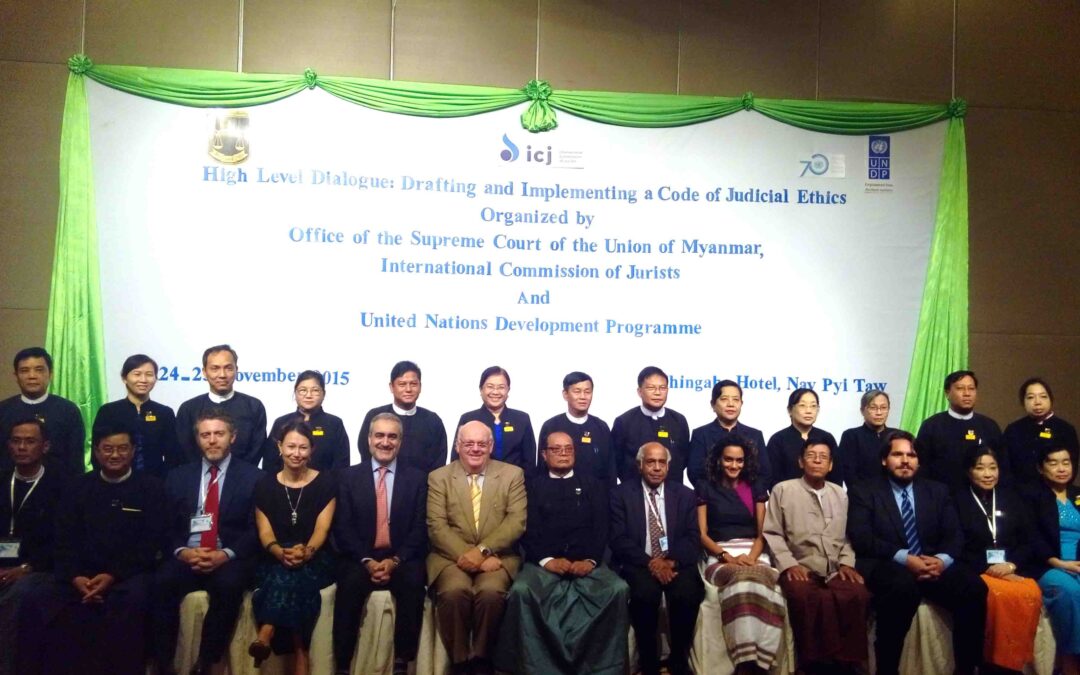
The ICJ, the UNDP and the Office of the Supreme Court of the Union (OSCU) held a High Level Dialogue on “Drafting and Implementing a Code of Judicial Ethics” in Nay Pyi Taw on 24-25 November 2015.
This followed on a commitment by the OSCU to create a new code and to work together with the ICJ and UNDP to ensure it is informed by and implemented in accordance with international best practice.
The Judicial Ethics Review Committee, Regional High Court Judges and other senior court administrators participated in the Dialogue.
The participants and their international counterparts from the ICJ and UNDP discussed the content of the Draft Code of Ethics, international standards on Judicial Codes of Ethics and accountability mechanisms.
In opening the Dialogue, the Honourable Supreme Court Justice of the Union, U Mya Thien explained that the new code reflecting international standards would enhance public trust and promote accountability in the Judiciary.
In his opening remarks, Sam Zarifi, the ICJ’s Regional Director for Asia and the pacific noted the historic occasion in which the world was watching transition in Myanmar.
During the Dialogue, former ICJ Commissioner and UN Special Rapporteur on the Independence of Judges and Lawyers, Dato Param Cumaraswamy, and Justice Murray Kellum of Australia shared their wealth of experience developing codes of ethics and accountability mechanims at the national and international levels.
Both explained that public perception of the Judiciary is key in a transition to the rule of law and human rights.
All participants agreed the Myanmar’s judiciary is not yet independent and that its current judicial code of ethics requires updating.
It was acknowledged that new code of ethics would develop the independence of the judiciary in Myanmar.
Sam Zarifi explained that, “in order for the Supreme Court to assert judicial independence it must demonstrate that it can hold itself accountable to a code of ethics.”
Both the UNDP and the ICJ congratulated the OSCU for following its Strategic Plan for 2015-2018 and engaging in a dialogue designed to further this process.
Both expressed willingness to continue working with Myanmar’s judiciary on the issues of judicial independence, the rule of law and human rights.
Nov 25, 2015 | News
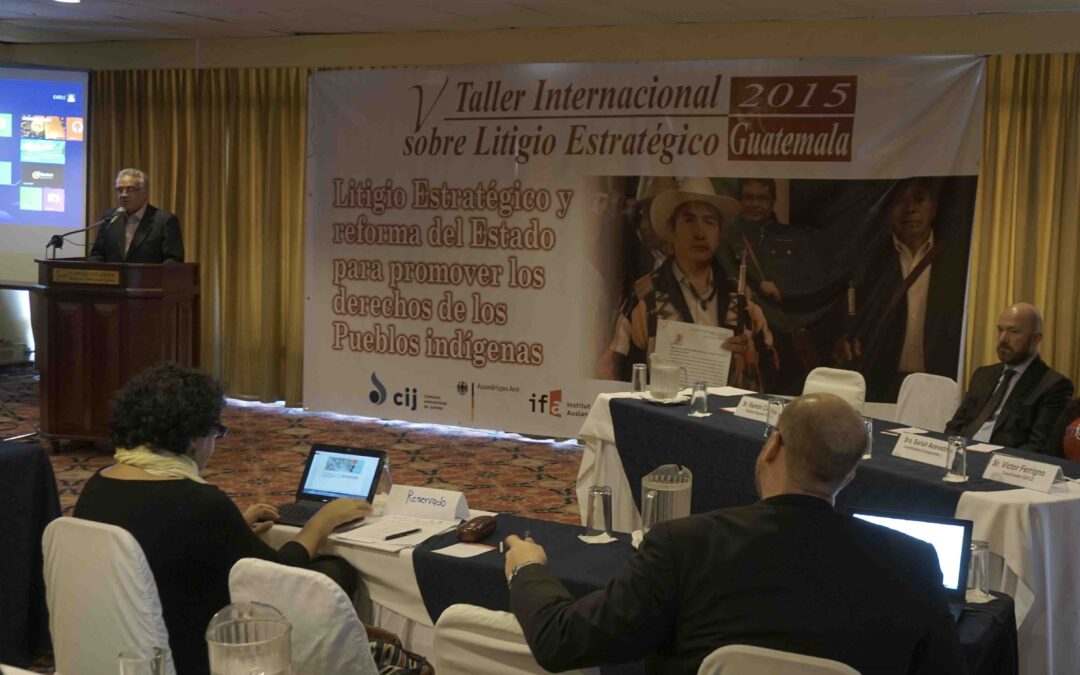
Inauguration of the 5th International Seminar on Strategic Litigation in Guatemala City.
On 25th November, Ramon Cadena, Director of the ICJ Regional Office in Central America, together with Alberto Brunori, Representative of the OCHCR in Guatemala and Victor Ferrigno, Coordinator of Support for Strategic Litigation in Guatemala, launched the event.
During the two-day seminar over 100 human rights defenders, lawyers and academics from the American continent will share experiences, good practices and achievements in the use of strategic litigation as part of a broader strategy to promote and defend human rights.
In addition to strategic litigation, other focal points for discussion include indigenous peoples’ land rights and the identification of priorities in legal and constitutional reform.
Nov 24, 2015 | News
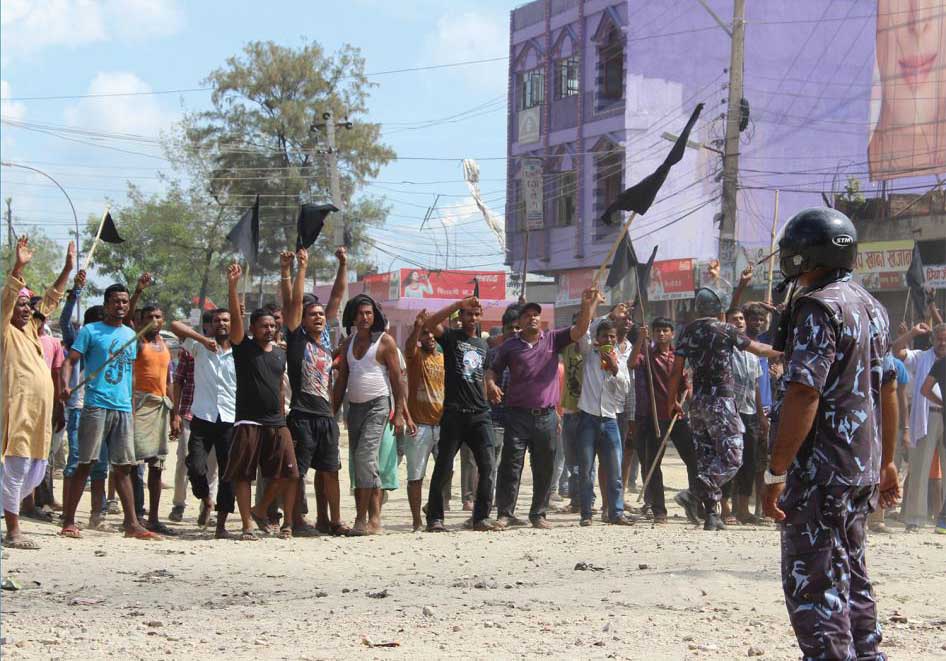
The government and all political parties, along with the country’s neighbors and international supporters, must act immediately to end the increasingly violent political crisis in the southern Terai region said the ICJ today.
The associated border blockade that has imposed severe shortages of necessary commodities throughout the country must also be ended, the ICJ added.
Over the weekend, three individuals were killed and at least another 28 individuals, including 15 police officers, were injured during clashes following an apparent impasse in talks among political parties trying to end the crisis over the newly adopted Constitution.
“Nepali authorities should promptly investigate and bring to justice the perpetrators – be they security forces or protesters – of any unlawful killings and other acts of violence committed during the ongoing protests in the Terai, and ensure that security forces refrain from the use of excessive force against civilians,” said Sam Zarifi, ICJ’s Asia-Pacific Director.
“At the same time, the Nepal government must address the severe shortage of commodities and the impact it has had on economic and social rights by prioritizing the most urgent needs while working to resolve the constitutional crisis,” he added.
The border blockade initiated nearly three months ago has had a deeply detrimental impact on the economic and social rights of the population countrywide, including the rights to food, water and sanitation, health and adequate housing, by causing severe shortages of essential commodities such as fuel, cooking gas and medical supplies throughout the country.
Madhesi groups have been demonstrating against Nepal’s new Constitution in the Terai since August 2015, protesting discriminatory aspects of the new Constitution that they argue would entrench marginalization, and have been staging a de facto blockade at the main border posts along the Nepal-India border since the Constitution was adopted on 20 September 2015.
India has been accused of imposing or collaborating in the blockade, an allegation which the Indian government has denied.
The ICJ has previously highlighted the lack of proper consultation in the drafting and adoption of the Constitution as well as the substantive human rights defects in its text, particularly the discriminatory provisions on the rights of women and some ethnic groups.
More than 45 persons, including 8 police personnel, have been killed during violent confrontations that have erupted between protesters and security forces since the demonstrations began, with allegations of excessive use of force by Nepali security forces as well as violent attacks by protesters against police personnel.
One Indian national was apparently killed by Nepali security forces at the Birgunj border last month.
“The Nepal government has a responsibility to protect the rights and security of its people and to re-establish the rule of law in the Terai,” said Zarifi. “However, Nepal must at all times respect the people’s right to peaceful protest and free assembly, and ensure that security forces exercise maximum restraint when responding to the demonstrations.”
The ICJ emphasizes that India and Nepal have an obligation to protect the human rights, including the economic and social rights, of persons impacted by their acts or the actions of those under their jurisdiction, and accordingly have an obligation to remove obstacles to the enjoyment of those rights.
“Nepal has an obligation to ensure that all available resources at their disposal have been mobilized to alleviate the human rights and humanitarian impact of the border blockade on the most vulnerable sections of the population,” Zarifi added. “The Nepal government must provide a clear plan to assess and address the impact of the blockade by prioritizing available supplies to the most urgently needed areas throughout the country, not just in Kathmandu.”
“The impact of the blockade is all the more acute because the country is still reeling from the 25th April earthquake and its ongoing aftershocks,” Zarifi said. “The international community, particularly neighboring India, should do all it can to ensure that urgent humanitarian assistance gets to the Nepali people.”
Contact
Nikhil Narayan, ICJ Senior Legal Adviser for South Asia, t: +977 9813187821 ; e: nikhil.narayan(a)icj.org
Photo credit: HRW
Nov 24, 2015 | Доклады, Новости, Публикации, Статьи, Тематические доклады
Сегодня МКЮ выпустила доклад о реформе юридической профессии в Российской Федерации.
«Юридическая профессия в России представляет собой комплексную картину. У неё однозначно есть сильные стороны и определённые достижения, однако её способности защищать принцип верховенства закона и права человека в рамках системы правосудия существенно ограничены и далеки от совершенства», – отмечено в докладе МКЮ, опубликованном сегодня Международной комиссией юристов на русском и английском языках.
«Более общие проблемы системы правосудия в целом, а также её хроническая неспособность защитить права человека – в частности, право на справедливое судебное разбирательство, включая принцип равенства сторон, – существенно усложняют задачи адвокатов при выполнении их профессиональных обязанностей», – приходят к выводу докладчики.
Доклад МКЮ «Становление сильной адвокатуры в Российской Федерации» был подготовлен по результатам миссии в Российскую Федерацию в мае 2015 года.
Ранее вышли в свет три доклада, посвящённые различным аспектам и проблемам судебной системы в Российской Федерации. Теперь, в рамках проведённой миссии и настоящего доклада, МКЮ обратилась к проблемам адвокатуры в тот самый момент, когда обсуждаются важные изменения, затрагивающие профессию.
В докладе содержится анализ нормативной базы, регулирующей адвокатуру в Российской Федерации, и рассматриваются практические вопросы, которые затрагивались в ходе миссии.
Он анализирует законодательство и правоприменительную практику в свете международного права и стандартов в области прав человека, включая право на справедливое судебное разбирательство, а также международные стандарты независимости юридической профессии.
Данные стандарты посвящены организации и функционированию юридической профессии, включая регулирование профессии, допуск к профессии, этику и дисциплинарную ответственность адвокатов, гарантии защиты от вмешательства в их работу, а также гарантии, необходимые для защиты ими прав доверителей.
Несмотря на то, что стандарты могут быть сформулированы в самых общих терминах, что позволяет национальным системам по-разному подходить к их толкованию, они являются авторитетным и общепризнанным руководством, на которое следует опираться национальным системам и практикам.
В докладе излагается история и описывается текущий контекст, в рамках которого действует адвокатура в Российской Федерации. В нём также описывается организация, органы и процедуры Федеральной палаты адвокатов и региональных адвокатских палат и содержится анализ вопросов, связанных с допуском к профессии.
Кроме того, авторы рассматривают проблемы, связанные с этикой и дисциплинарной ответственностью, вопрос о профессиональных гарантиях адвокатов, а также ключевые аспекты текущей реформы адвокатуры.
Наконец, на основании международного права и стандартов даются рекомендации относительно юридических и практических мер, которые следует принять для усиления независимости юридической профессии в Российской Федерации, а также её эффективности при защите прав человека.
Контакты:
Роушин Пиллей, директор Региональной программы МКЮ по Европе, roisin.pillay(a)icj.org
Тимур Шакиров, правовой советник Региональной программы МКЮ по Европе, temur.shakirov(a)icj.org
Документы:
Russia-Towards-a-Stronger-Legal-Profession-Press-Release-2015-RUS (Пресс-релиз на русском, PDF)
Russia-towards-a-stronger-legal-prof-publication-2015-RUS (Полная русская публикация, PDF)
Nov 24, 2015
The ICJ and Human Rights Watch have expressed concerns regarding the detention of non military persons in a military base facility and the deaths of two detainees held there.
In an open letter to the Permanent Mission of Thailand to the United Nations in Geneva, the ICJ and Human Rights Watch today raised their serious concern at the establishment of a detention facility holding non-military persons named the Nakhon Chaisri temporary remand facility (“the Facility”) inside the 11th Army Circle military base in Bangkok, and the recent deaths of two detainees who were held there.
The ICJ and Human Rights Watch concluded the letter by making six urgent recommendations to the Royal Thai Government, including to:
1. Immediately transfer all non-military persons detained at the Facility to an officially recognized civilian place of detention that complies with international law and standards and ensure no further non-military prisoners are detained at this Facility or any other similar facility; and
2. Carry out a prompt, impartial, and effective investigation into the recent deaths of Suriyan Sucharitpolwong and Prakrom Warunprapa,prosecute and bring to justice any party found responsible, and ensure the victims’ families have access to effective remedies and reparation.
The letter was also copied to the Prime Minister of Thailand, the Director General of the Department of Corrections and the Minister of Justice.
Contact:
Wilder Tayler, Secretary-General, wilder.tayler(a)icj.org
Open letter:
Thailand-Detention-Advocay-OpenLetter-2015-ENG (English – in PDF)
Thailand-Detention_Advocacy-OpenLetter-2015-THAI (Thai – in PDF)