Nov 3, 2015 | News
The ICJ and 26 other civil society organizations called today upon the Vietnamese government to comprehensively revise the draft Law on Religion to conform with the country’s obligations under international human rights law.
The groups are concerned that Vietnam’s draft Law on Belief and Religion is inconsistent with the right to freedom of religion or belief.
In its current form, the draft Law places limitations on freedom of religion or belief that extend beyond those permitted under international human rights law that is binding on Vietnam, they say.
Article 18(3) of the International Covenant on Civil and Political Rights (ICCPR), to which Vietnam is a state party, requires the authorities to ensure that the freedom to manifest one’s religion or belief is subject only to such limitations as are prescribed by law and are necessary and proportionate to protect public safety, order, health, or morals or the fundamental rights and freedoms of others.
While the draft Law purports to acknowledge “the right to freedom of religion and belief” and proclaims that the “government respects and protects the freedom of religion and belief of everyone,” the provisions of the draft Law, if passed, would act as a powerful instrument of control placing sweeping, overly broad limitations on the practice of religion or belief within Vietnam, perpetuating the already repressive situation.
Contact:
Kingsley Abbott, ICJ International Legal Adviser, (Bangkok), t:+66 944701345, e-mail: kingsley.abbott(a)icj.org
Vietnam-Draft Law on Religion-Advocacy-2015-ENG (full statement, in PDF)
Nov 2, 2015
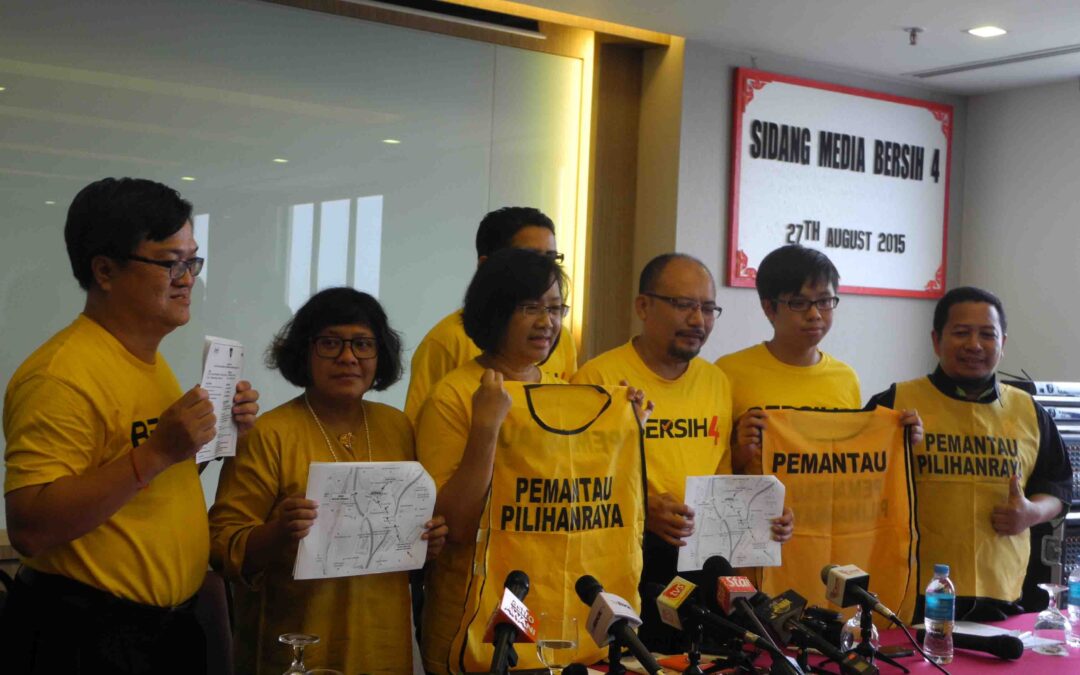
In a letter to Prime Minister Najib Razak, the ICJ today called on the Government of Malaysia to discontinue investigations of the organizers of Bersih 4.0 (photo) and drop all charges against Maria Chin Abdullah and Jannie Lasimbang.
The ICJ also called on the Government of Malaysia to amend the Peaceful Assembly Act of 2012 to ensure conformity with international standards, and to protect the right of Malaysians to organize and participate in peaceful assemblies.
Malaysia-Bersih letter-Advocacy-open letters-2015-ENG (full text in PDF)
Oct 29, 2015 | Comunicados de prensa, Informes, Noticias, Publicaciones
Hoy, la CIJ hizo público su informe Venezuela: El ocaso del Estado de Derecho.
Este informe es el resultado del seguimiento que la CIJ viene haciendo desde hace varios años sobre la situación del Poder judicial y de los derechos humanos en Venezuela, así como de la Misión in situ liderada por Alejandro Salinas, realizada en agosto de 2015.
Desde su anterior Informe, Fortaleciendo el Estado de Derecho en Venezuela (2014), la CIJ ha constatado una vertiginosa degradación de la situación de los Derechos Humanos, un grave y sistemático menoscabo de la independencia e imparcialidad del Poder Judicial, y la total erosión del Estado de Derecho en Venezuela.
“Hay un claro divorcio entre el deber ser establecido en la Constitución y los compromisos internacionales y por otro lado lo que se refleja en la realidad,” dijo Alejandro Salinas, el autor del informe.
“Esta situación ya observada en años anteriores, se ve agravada por una serie de medidas del Gobierno venezolano que han significado ceder soberanía en favor de organizaciones criminales,” añadió.
En las últimas semanas, la CIJ ha constatado una acelerada escalada de los ataques contra los defensores de derechos humanos y toda forma de oposición social y política.
“La situación en Venezuela es, sin lugar a duda, configura una grave y persistente crisis de los derechos humanos, la democracia y del Estado de Derecho. La Comunidad internacional está en mora y debe reaccionar bajo del derecho internacional,” dijo Wilder Tayler, Secretario General de la CIJ.
La CIJ ha visto agravada la situación de la falta de independencia de la justicia en general, en virtud no sólo de la falta de independencia del Poder Judicial dada la inexistencia de estabilidad de la gran mayoría de los jueces y de la casi totalidad de los fiscales del Ministerio Público; así como también, la falta de garantías para el ejercicio de los defensores de derechos humanos y en algunos casos de la profesión de abogado.
En este sentido, la CIJ manifiesta su preocupación frente las consecuencias representadas en los altísimos niveles de impunidad judicial en los casos de violaciones de derechos humanos y de las víctimas de delitos comunes en general, lo cual contrasta con la inusual prontitud con la que se abren juicios, se dictan medidas cautelares restrictivas y se condenan a miembros activos de la sociedad civil, líderes sociales y a opositores políticos.
Entre los casos que más representativos de esta situación se encuentran, entre otros, la reapertura del juicio penal contra la jueza María Lourdes Afiuni; la detención preventiva para someter a juicio al abogado Tadeo Arrieche; la orden de captura contra los miembros directivos y de los consejos editoriales de “El Nacional”, “Tal Cual” y “La Patilla”; y la condena de Leopoldo López a casi 14 años de prisión.
Finalmente, la CIJ desea llamar la atención sobre la gravedad que significa que desde el mes de agosto del presente año 2015, 23 municipios en Venezuela hayan estado siendo sometidos a estados de excepción con la restricción de varios de los derechos consagrados en el Pacto Internacional de Derechos Civiles y Políticos, sin que estén claramente cumplidos los requisitos internacionales como la gravedad de la situación que no pueda ser enfrentada con los poderes ordinarios del estado, la estricta necesidad y proporcionalidad de las medidas.
Es de gran preocupación para la CIJ las medidas arbitrarias tomadas contra nacionales colombianos que han sido deportados masivamente, incluidos menores de edad; y además, que estando por darse inicio a la campaña política para las elecciones de diputados a la Asamblea Nacional el próximo 6 de diciembre, se hayan restringido – sin justificación – los derechos de reunión pública y de manifestación pacífica, por el efecto restrictivo que ello implica para el ejercicio libre de los derechos políticos en una sociedad democrática.
Contact:
Wilder Tayler, Secretario General de la CIJ, t: +41 22 979 3825 ; e: wilder.tayler(a)icj.org
Alejandro Salinas, autor del informe, e: alejandro.salinasrivera(a)gmail.com
Venezuela-OcasoEstadoDerecho-Publications-Reports-2015-SPA (Informe en PDF)
Oct 29, 2015
A report launched today by the ICJ highlights a significant degradation in recent years of the situation of human rights and independence of the judiciary in Venezuela.
In its report, Venezuela: The Sunset of the Rule of Law, the ICJ underlines that since the publication of its June 2014 report– Strengthening the Rule of Law in Venezuela – there have been accelerated, serious and systematic attacks on the independence and impartiality of the judiciary, and a severe erosion of the rule of law.
“There is a clear disconnect between what is contained in the country’s Constitution and international obligations, and what happens in practice,” said Alejandro Salinas, the author of the report, who led a fact-finding mission for the ICJ in August 2015.
“This already grave situation has been aggravated by the fact that the Government has now effectively ceded a part of its sovereignty and authority to criminal organizations, through the establishment of so called ‘peace territories’,” he added.
As a result, there has been recently a clear escalation of attacks against human rights defenders and any form of social and political opposition, the ICJ says.
The high level of legal impunity for perpetrators of human rights violations and common felonies stands in stark contrast to the robust manner in which preventive and restrictive measures and prosecutions have been deployed to silence members of civil society, social activists and political opponents, the ICJ further notes.
“Without a doubt, there is a severe and persistent crisis of human rights, democracy and the rule of law in Venezuela. The international community has a duty to urgently address the situation in accordance with international law,” said Wilder Tayler, ICJ Secretary General.
The report also shows a worsening of the state of independence of the judiciary due to the lack of security of tenure enjoyed by most judges and prosecutors, and the failure of the State to guarantee human rights defenders and lawyers the full exercise of their rights and professional functions.
Some of the representative cases highlighted in the report include the reopening of the criminal trial against judge María Lourdes Afiuni; the preventive detention of lawyer Tadeo Arrieche; the arrest warrant against the executive members of the editorial board of the media “El Nacional”, “Tal Cual” y “La Patilla”; and the sentencing of the political opposition figure Leopoldo López to almost 14 years’ imprisonment.
In addition, the ICJ expressed concern at the state of emergency declared in 23 municipalities since August 2015. Persons in these municipalities have been subject to unjustified and unlawful restriction of certain of their rights guaranteed under the International Covenant on Civil and Political Rights.
The ICJ in its report also underscored the arbitrary measures taken against Colombian citizens, including children, who have been subject to deportation, as well as the unjustified restriction of rights, such as freedom of assembly and peaceful demonstration, ahead of the elections for the National Assembly scheduled for 6 December.
Contact:
Wilder Tayler, ICJ Secretary General, t: +41 22 979 3825 ; e: wilder.tayler(a)icj.org
Alejandro Salinas, author of the report, e: alejandro.salinasrivera(a)gmail.com
Venezuela-Ocaso Estado Derecho-News-Press releases-2015-SPA (full press release in PDF, Spanish)
Venezuela-Sunset of Rule of Law-Publications-Reports-2015-ENG (full report in PDF, English)
Venezuela-OcasoEstadoDerecho-Publications-Reports-2015-SPA (full report in PDF, Spanish)

Oct 29, 2015 | News
The Singaporean government should halt the imminent execution of Kho Jabing and commute his death sentence, said the ICJ today.
In 2010, Kho Jabing was convicted and sentenced to death, after having been found guilty of murder.
Amendments made to its laws on the death penalty in 2012 allowed for persons who had been subjected to the death penalty the option to elect to be considered for re-sentencing under the new rules.
Kho Jabing, under this process, was re-sentenced to life imprisonment and 24 strokes of the cane.
The prosecution, however, appealed the re-sentencing, and the case was brought to the Court of Appeal.
On 14 January 2015, the Court of Appeal decided to reinstate the death penalty in the case.
Kho Jabing filed a clemency appeal and the Court of Appeal rejected this on 19 October 2015.
The authorities have not released the date of Kho Jabing’s execution, but it is believed that he is likely to be executed during the first week of November 2015.
“Singapore has obscured the extent and nature of its execution practices and its record on respect for the right to life”, said Sam Zarifi, ICJ’s Regional Director for Asia and the Pacific.
“Failure to be transparent about its use of the death penalty, flies in the face of international human rights standards,” he added.
The ICJ opposes the death penalty in all circumstances and considers the imposition of the death penalty to constitute a denial of the right to life and a form of cruel, inhuman and degrading punishment.
The view that the death penalty is never justifiable is shared by the overwhelming majority of States, United Nations institutions, and numerous civil society organizations.
In December 2014, the UN General Assembly, by a very wide majority, adopted a Resolution repeating its call for all States retaining the death penalty to institute a moratorium on the practice, with a view to abolition.
The ICJ has also received information that Singapore carried out two executions in October 2015. The authorities, however, have not issued an official statement regarding these executions.
To date, the Singapore government has not released the exact number of executions undertaken in the country.
In 2004, UN Special Rapporteur on extrajudicial, summary, or arbitrary executions emphasized the importance of transparency wherever the death penalty is applied.
According to the UN Special Rapporteur, “Secrecy as to those executed violates human rights standards.”
In addition, a “full and accurate reporting of all executions should be published, and a consolidated version prepared on at least an annual basis.”
The ICJ calls on the Singapore government:
- to stop the execution of Kho Jabing and commute his sentence, to one that does not include caning, which constitutes a form of cruel, inhuman or degrading punishment
- to institute an immediate moratorium on executions
- to take all necessary measures to abolish the death penalty in law
- to make public a full and accurate report of all executions in the country
Contact:
Emerlynne Gil, ICJ Senior International Legal Adviser for Southeast Asia, (Bangkok), t: +66840923575, e: emerlynne.gil(a)icj.org