Sep 15, 2015 | News
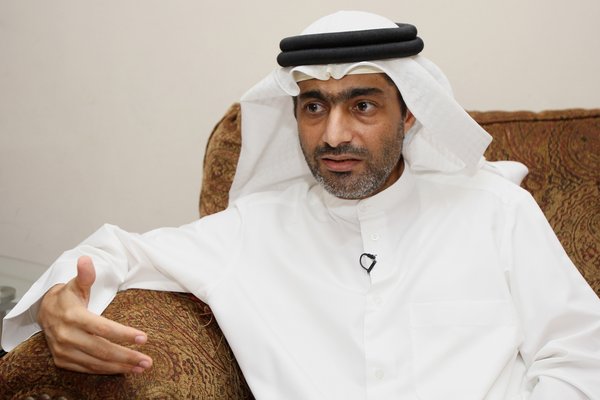
Ten human rights groups, including the ICJ, represented in the Jury, today called on the United Arab Emirates authorities to lift the travel ban imposed on Ahmed Mansoor, one of the three human rights defenders nominated for the 2015 Award, and to issue him a passport.
Widely respected as one of the few voices within the United Arab Emirates (UAE) to provide a credible independent assessment of human rights developments in the country, Ahmed Mansoor regularly raises concerns regarding arbitrary detention, torture or degrading treatment, and failure to meet international standards of fair trial.
He also draws attention to other human rights abuses, including against migrant workers.
As a result, Ahmed Mansoor has faced repeated intimidation, harassment, and death threats from the UAE authorities or their supporters, including arrest and imprisonment in 2011 following an unfair trial.
He and four other activists who called for democratic rights in the UAE were jailed in 2011 on the charge of “insulting officials”.
Although pardoned and released later that year, Ahmed Mansoor has been banned from travel and had his passport confiscated.
As a result of his courageous work, Ahmed Mansoor was selected as one of the three finalists of the Martin Ennals Award who will be recognized at a ceremony hosted by the city of Geneva on October 6th.
The Award is usually handed out by the United Nations High Commissioner for Human Rights.
As matters stand, however, Ahmed Mansoor will be prevented from attending the ceremony because the UAE authorities have arbitrarily imposed a travel ban on him and have refused to return his passport.
Both the travel ban and the confiscation of his passport violate Ahmed Mansoor’s right under international human rights law to freedom of movement, as these measures were taken to punish him for his peaceful human rights activism.
The Martin Ennals Award Jury today noted with concern : “Ahmed Mansoor’s absence at the ceremony would mark a very disappointing position for the UAE, which is a country that prides itself as one of the hubs of international business and tourism in the Middle East, as well a safe haven in the region. As a member of the UN Human Rights Council, which is running for a second term, we expect the UAE authorities to honour their obligations to uphold human rights and protect human rights defenders. The UAE government must match its rhetoric on the international stage with meaningful actions at home, starting with immediately lifting the travel ban on Ahmed Mansoor, to returning and renewing his passport, and allowing him to travel to Geneva for the ceremony.”
Ahmed Mansoor is a member of the Advisory Committee of Human Rights Watch’s Middle East and North Africa Division, as well as the Advisory Board of the Gulf Centre for Human Rights.
The following organizations are represented in the Martin Ennals Award Jury: International Commission of Jurists, Amnesty International, FIDH, Human Rights First, HURIDOCS, International Service for Human Rights, EWDE Germany, Front Line Defenders, Human Rights Watch, World Organisation Against Torture.
Contact:
Michael Khambatta, Director, Martin Ennals Foundation, t +41 79 474 8208 ; e: khambatta(a)martinennalsaward.org
UAE-MEA Jury Joint Statement Ahmed Mansoor-News-Press releases-2015-ARA (full text of press release in ARABIC, pdf)
Sep 15, 2015 | Events, News
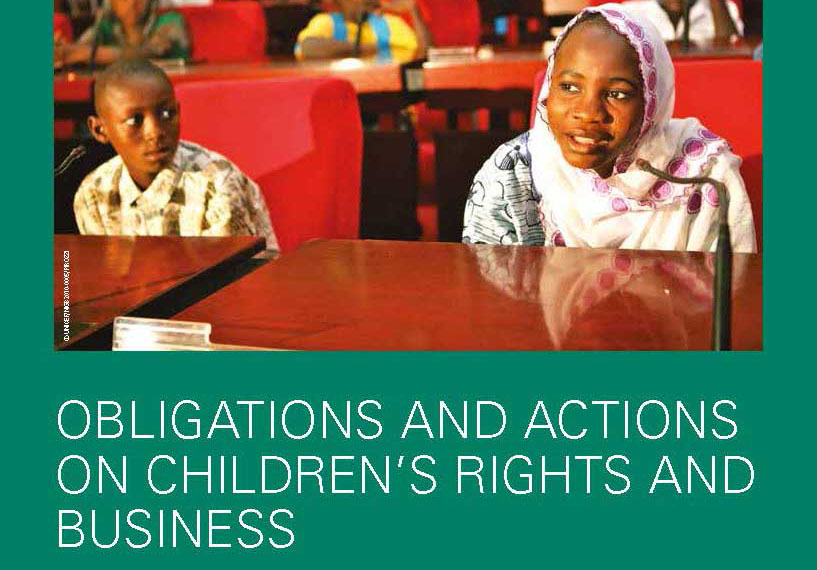
Organized by UNICEF and the ICJ, this side event takes place on Thursday 17 September 2015, from 12:00-14:00, Room XXVII, Palais des Nations, Geneva.
More than ever before, business enterprises have an impact on children’s lives.
Children are consumers of businesses’ products and services, workers in their factories and fields, family members of their employees, and residents of the communities that host their operations.
Some of these interactions can benefit children. Companies have, for instance, created new technologies that enrich children’s education, enhance medical care, and connect families around the world.
Yet at the same time, businesses can also have detrimental impacts.
Companies can make and sell unhealthy and unsafe goods to children, pollute the environments in which children live and play, and expose them to serious dangers including in the workplace.
As children are still growing and developing, they are especially vulnerable to negative business impacts and can be severely and permanently affected by infringements of their rights.
Child consumers can be more easily convinced to buy and use inappropriate or unsuitable products, and children are much more susceptible than adults to the harmful physical effects of toxic chemicals, manual labour and poor diets.
Young workers can never fully make up for time spent out of education, and missed opportunities are rarely restored.
Many of these impacts remain unnoticed, and businesses rarely involve or seek the input of children on decisions that will profoundly affect them.
Children may not understand that their rights are in jeopardy, and, even when they do, often face tremendous challenges in making their voices heard.
All too frequently, child victims lack the confidence, resources and legal authority to demand accountability from those who violate their rights.
For these reasons, it is imperative that governments take action to protect and promote children’s rights in the context of business operations.
In February 2013, the UN Committee on the Rights of the Child adopted General Comment 16 on State obligations regarding the impact of the business sector on children’s rights to assist States to ensure that businesses respect children’s rights as envisioned in the Convention on the Rights of the Child.
The ICJ and UNICEF, at the request of the Committee, have elaborated a Guide to offer to States practical examples and best practices on how to protect and ensure the realization of the rights of the child in the context of business operations.

Sep 15, 2015 | Advocacy, Non-legal submissions
The ICJ today made an oral statement at the UN Human Rights Council, welcoming the presentation of UN Basic Principles and Guidelines on the right to challenge detention, and a report on forced labour and slavery in supply chains.
The statement was made during an Interactive Dialogue with the Working Group on Arbitrary Detention and the Special Rapporteur on contemporary forms of slavery.
The ICJ said that the implementation of the Basic Principles and Guidelines would help prevent governments from depriving people of liberty solely for exercising freedoms of opinion and expression; peaceful assembly and association; thought, conscience and religion; or on the basis of discrimination. Such violations are often achieved by circumventing or suspending essential legal procedural protections such as habeas corpus.
The ICJ noted that the right to challenge detention is also a key safeguard against incommunicado or secret detention, enforced disappearance, and torture and other cruel, inhuman or degrading treatment.
The ICJ welcomed the attention the Working Group has given to the challenging contexts of counter-terrorism and armed conflicts, where such concerns are particularly acute.
The ICJ also welcomed the report of the Special Rapporteur on contemporary forms of slavery, addressing the issue of modern slavery and forced labour in supply chains, and the Rapporteur’s emphasis on the right to an effective remedy. In addition to the international legal and policy frameworks and continuing efforts by States and businesses outlined in the report, the ICJ noted that UN treaty-bodies have produced useful guidance and recommendations, such as the General Comment adopted by the Committee on the Rights of the Child in 2013, on State obligations regarding the impact of the business sector on children’s rights.
The full statement may be downloaded in PDF format here: UN-Advocacy-Oral statementWGADandSRslavery-2015
Earlier in the week, the ICJ published a legal commentary on certain aspects of the Principles and Guidelines, related to situations of armed conflict. The commentary is available here.
Sep 14, 2015 | News
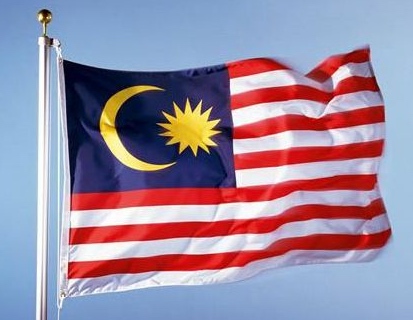
The ICJ expressed disappointment over the decision made today by the Malaysian Federal Court to refer human rights defender Lena Hendry for trial, after dismissing the constitutional challenge on section 6(1)(b) of the Film Censorship Act 2002.
The ICJ said this provision is being applied in a manner inconsistent with the right to freedom of expression, which includes the right to seek and impart information of all kinds.
“The decision by the Federal Court is incompatible with the commitment to the rule of law and respect for human rights which was expressed by Malaysia during its last Universal Periodic Review at the UN Human Rights Council in 2013,” said Sam Zarifi, ICJ’s Regional Director for Asia and the Pacific.
“Lena Hendry is clearly a human rights defender and Malaysia has the special duty not only to respect her right to freedom of expression, but to protect her exercise of this right through the exposure of human rights violations in Sri Lanka,” he added.
The constitutional challenge was brought by the lawyers of Lena Hendry who was charged under section 6(1)(b) of the Film Censorship Act 2002 for screening the film “No Fire Zone: the Killing Fields of Sri Lanka” on 3 July 2013.
Authorities allege that she violated section 6(1)(b) of the law for showing a film that had not been approved by the Board of Censors.
The lawyers of Lena Hendry are now preparing for the trial before the Magistrate’s Court.
The ICJ calls on the Government of Malaysia to drop all charges against Lena Hendry and to undertake steps to make its laws consistent with the country’s obligations and commitments under international law.
Background:
Section 6(1)(b) of the Film Censorship Act 2002 states that “No person shall circulate, exhibit, distribute, display, manufacture, produce, sell, or hire any film or film publicity material, which has not been approved by the Board [of Censors].”
On 14 September 2015, the Federal Court of Malaysia dismissed the constitutional challenge on Section 6(1)(b) of the Film Censorship Act 2002. The question posed to the Federal Court was: “Whether section 6(1)(b) of the Film Censorship Act 2002 read together with section 6(2)(a) violates Article 10 read together with Article 8(1) of the Federal Constitution and therefore should be struck down and void for unconstitutionality.”
The Federal Court answered the question in the negative and ordered that the case be sent back to the High Court. The High Court, in turn, will transfer the matter back to the Magistrate’s court for trial. The Magistrate’s Court is where the matter initially originated.
If convicted, under section 6(2)(a) Lena Hendry could be fined up to RM30,000 (approximately US$6,900) and/or sentenced to up to three years imprisonment.
The right to freedom of expression is guaranteed in the Federal Constitution of Malaysia under Section 10(1)(a), which states that “every citizen has the right to freedom of speech and expression.”
The Universal Declaration of Human Rights and the UN Declaration on Human Rights Defenders also affirm the duty of all states to respect and facilitate freedom of expression, particularly as regards information or opinions about human rights.
Contact:
Emerlynne Gil, Senior International Legal Adviser of ICJ for Southeast Asia, t: +66 840923575 ; e: emerlynne.gil(a)icj.org

Sep 14, 2015
The UN Working Group on Arbitrary Detention will today present to the Human Rights Council its “Basic Principles and Guidelines on remedies and procedures on the right of anyone deprived of their liberty to bring proceedings before a court” (UN Doc A/HRC/30/37 (2015)).
“The Basic Principles and Guidelines act to reflect important elements necessary to preserve and protect the right to liberty,” said Wilder Tayler, Secretary-General of the ICJ.
“The document assists States, international organization and civil society to enhance, in law and in practice, respect for the right to challenge the lawfulness of detention by habeas corpus or equivalent procedures,” he added.
As concluded by the ICJ’s Eminent Jurists Panel on Terrorism, Counter-terrorism and Human Rights, there has been a progressive erosion of international law principles since the so-called ‘war on terror’.
Along with many other aspects of the Basic Principles and Guidelines, the ICJ has therefore welcomed the attention given to the application human rights standards alongside international humanitarian law and the related provisions of the document pertaining to detention in armed conflict.
“In light of some recent State practices, including in the context of unlawful rendition and secret detention programmes, there is an especially important value in this aspect of the Basic Principles and Guidelines, including for the combating of incommunicado and secret detention, enforced disappearance and torture and other cruel, inhuman or degrading treatment,” Tayler said.
“It is for this reason that the ICJ has produced a Legal Commentary on elements of the Basic Principles and Guidelines pertaining to detention in armed conflict,” he added.
The ICJ’s Legal Commentary supports the general approach adopted by the Working Group in its formulation of the Basic Principles and Guidelines as they pertain to detention in armed conflict.
It provides further explanation and justification for the Working Group’s approach, with particular reference to international law and standards, showing why the Basic Principles and Guidelines – as they apply to detention in armed conflict – should be scrupulously followed.
Background
Under its resolution 20/16 (2012), the UN Human Rights Council requested the Working Group on Arbitrary Detention to prepare draft basic principles and guidelines on remedies and procedures on the right of anyone deprived of his or her liberty.
The Basic Principles and Guidelines were adopted by the Working Group in April 2015, following a two-year process of deliberations and open consultations.
The Working Group set out a first draft set of principles and guidelines ahead of its global consultation on the subject in September 2014.
From 2 to 5 February 2015, the Working Group met to continue its elaboration of the Basic Principles and Guidelines, resulting in the adoption of a second draft.
The Working Group adopted its final iteration of the document at the conclusion of its session on 29 April 2015.
The ICJ engaged in all stages of the Working Group’s elaboration and consultations.
It made written submissions in November 2013, April 2014 and March 2015.
Its staff, Matt Pollard and Alex Conte, gave panel presentations at the September 2014 global consultation.
Contact:
Alex Conte, Senior Legal Adviser at ICJ, t: +41 22 979 3838 ; e: alex.conte(a)icj.org
Universal-Commentary-WGAD-PrincGuideArmedConflict-Advocacy-2015-ENG (full text in PDF)