Jun 18, 2015 | News
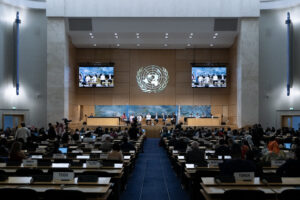
Today, the ICJ expressed concern at the attempt to initiate criminal proceedings against the President of the Constitutional Court of Ukraine, following interrogations of judges of the Constitutional Court and seizures of documents from the Court earlier this year.
On 16 June, the Chair of the Security Council of Ukraine, Valentin Nalivaychenko, is reported to have filed evidence alleging criminal offences by the President of the Constitutional Court of Ukraine, Jury Baulin.
The documents allege that he abused his office in violation of Article 364(2) of the Criminal Code of Ukraine, leading to the usurpation of power by the former President, Victor Yanukovich.
The allegations relate to a decision of the Constitutional Court of 30 September 2010, No 20-rp/2010, which overturned the adoption of the Constitution of 2004.
The initiation of the criminal proceedings is therefore based entirely on a ruling of the Constitutional Court on a question of constitutional law.
“It is inherent in the judicial function that courts issue rulings concerning matters on which public opinion may be divided. Prosecution of judges in relation to such decisions undermines judicial independence and erodes the rule of law,” said Wilder Tayler, ICJ Secretary General. “In all times but particularly in times of transition, such as at present in Ukraine, it is crucial that the executive refrain from any interference with the independence of the judiciary”.
The ICJ stressed that such attempts to initiate criminal proceedings against the President of the Constitutional Court are contrary to international law and standards on the independence of the judiciary, including the UN Basic Principles on the Independence of the Judiciary.
“Changes to the law or Constitution, must be sought and brought about through proper constitutional processes in the legislature and courts, not through prosecutions of judges. Criminal investigations and prosecutions against Constitutional Court judges must be discontinued and the government must ensure that the Court can operate without threats or interference,” Tayler added.
Following the change of government in early 2014, the ICJ expressed concern at the dismissals of judges of the Constitutional Court by the Verkhovna Rada (the Ukrainian Parliament) and called on the authorities to ensure the security of tenure of judges and non-interference with judicial independence.
Earlier this year, the Security Service of Ukraine interrogated sitting judges of the Constitutional Court in regard to the same case.
According to the State Security Service, at least 10 judges of the Constitutional Court have been interrogated. Moreover, the Security Service of Ukraine seized documents from the Constitutional Court in May 2015.
These investigations and prosecutions of Constitutional Court judges are taking place at a time when the Court is considering a number of highly significant cases, including the constitutionality of the Law “On cleansing of power”, the Law “On condemnation of the communist and national-socialist (nazi) regimes in Ukraine and prohibition of propaganda of their symbols” and the Law on an “All-Ukrainian referendum”.
The ICJ recalls that Article 1 of the UN Basic Principles on the Independence of the Judiciary clarifies that all governmental and other institutions must respect and observe the independence of the judiciary.
The principles further stipulate that [t]he judiciary shall decide matters before them impartially, on the basis of facts and in accordance with the law without restrictions or improper influences, inducements, pressures threats or interferences, direct or indirect, from any quarter or for any reason” (Article 2).
Recommendation No. R(94) 12 of the Committee of Ministers to Members States on the Independence, Efficiency and Role of Judges elaborates on this principle, stipulating that “judges should have unfettered freedom to decide cases impartially, in accordance with their conscience and their interpretation of the facts, and in pursuance of the prevailing rules of the law. Judges should not be obliged to report on the merits of their cases to anyone outside the judiciary”.
Contact:
Róisín Pillay, Director, Europe Programme, e: roisin.pillay(a)icj.org
Temur Shakirov, Legal Adviser, Europe Programme, e: temur.shakirov(a)icj.org
External link: Official information about the criminal procedure
Jun 18, 2015
An opinion piece by Leong Tsu Quin, ICJ Associate International Legal Adviser.
From 4 to 5 June 2015, the ICJ held a workshop with Indonesian lawyers that we would much rather not have had at all: discussing how to handle death penalty cases in light of the country’s resumption of executions.
Until President Widodo Jokowi suddenly embraced the death penalty, its horrific practice seemed to be on its way out in Indonesia: between 1999 and 2014, only 27 executions took place in the country, and in 2012 Indonesia even dropped its formal opposition to a United Nations General Assembly resolution calling for a moratorium on the use of the death penalty (Indonesia had since 2007 been voting ‘no’; in 2012 it abstained).
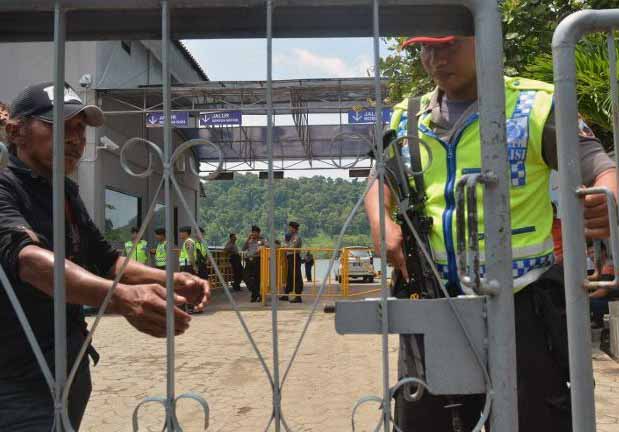
All this has changed under President Jokowi, as he has allowed 14 persons to be executed by firing squad since he took power.
All those executed this year had been convicted of drug-related offenses.
Indeed, President Jokowi says that the death penalty is needed to address drug use, claiming in an Al Jazeera interview this year that 4.5 million Indonesians require rehabilitation, and 50 persons die each day from drugs.
Even if this shocking estimate of the scale of the drug problem were accurate, any argument that the death penalty is therefore lawful and justified would be categorically wrong, for reasons we explain later.
But it is becoming more and more urgently clear that President Jokowi’s numbers themselves are deeply flawed and simply unreliable.
A coalition of Indonesian academics and experts, writing in the world’s most prominent medical journal The Lancet earlier this month, had expressed “serious concerns about the validity of” the government’s estimates, and called on the government to “invest in the collection of better quality data on the scale and nature of drug use in Indonesia” through a transparent, peer-reviewed process.
The flimsiness of the numbers that President Jokowi has been using to justify a growing number of executions was really brought home to us by one of the participants in our workshop, Claudia Stoicescu, a PhD candidate at the University of Oxford.
She explained that the Jokowi administration’s claims were based on faulty research, reportedly a 2008 study by the National Narcotics Agency (BNN) and the University of Indonesia.
She told us that the study used poorly-defined classifications, inappropriate recruitment methods, and definitions of addiction that are inconsistent with accepted criteria for drug dependence.
The number of deaths per day, for instance, was determined by surveying 2,143 students, workers and general households who were asked questions such as: ‘how many friends use drugs’ and ‘how many died because of drugs’, rather than the more accurate method of extrapolating based on existing mortality data such as overdose or AIDS-related deaths.
The Lancet article also called on President Jokowi to establish a drug policy based on empirical evidence, rather than resorting to forced rehabilitation and punitive measures.
According to the group, existing studies assessing drug policies and reform proposals showed that a punitive law-enforcement approach is not effective in reducing the prevalence of drug use.
It is equally important, though, to underscore that not only do President Jokowi’s arguments for the death penalty lack any reliable evidence, they are simply irrelevant to and incompatible with Indonesia’s obligations under international law.
Governments, leading UN and other legal experts, and civil society organizations, from around the world, have concluded that the death penalty constitutes a denial of the right to life and is a form of cruel, inhuman or degrading punishment, and is therefore never justified.
Even those who disagree accept that the death penalty is prohibited for anything other than “the most serious crimes” (murder and the like), and then only after a trial meeting the highest international standards of fairness.
In this regard, in 2013 Indonesia was reviewed by the UN Human Rights Committee, which assesses states’ compliance with a key human rights treaty ratified by Indonesia, the International Covenant on Civil and Political Rights (ICCPR).
The Committee confirmed that Indonesia’s use of the death penalty for drug offences violated the treaty as such offences do not meet the “most serious” threshold.
The Committee called for a halt to all executions in Indonesia, but emphasized that at minimum the law should be changed to ensure that crimes involving narcotics were not amenable to the death penalty. It further urged Indonesia to consider commuting all death sentences imposed on persons convicted for drug crimes.
Participants in our workshop highlighted grave failings in trial processes in Indonesia, such as failing to provide translation to allow the accused to understand the proceedings, a fundamental requirement under the ICCPR.
Further examples of how executions in Indonesia violate human rights included authorities proceeding with execution despite their client having been diagnosed with mental illness; and, frightfully, that some individuals shot by firing squad experienced minutes of pain and suffering before finally passing away.
Indonesia is now one of the outliers in the global community for being one of the few countries in the world that continues to apply the death penalty to drug-related offences.
President Jokowi’s stance on drug traffickers is at odds with the facts, with the law, and with global trends – approximately 160 Member States of the United Nations that have either abolished the death penalty or introduced moratoriums.
Jokowi must immediately reverse this unlawful and ineffective approach by halting all scheduled executions and moving Indonesia back toward abolishing this dreadful practice.
Jun 18, 2015 | News
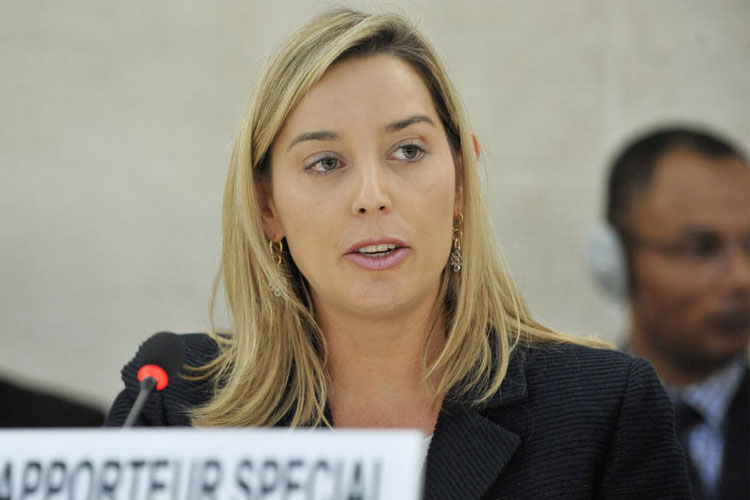
Mrs Gabriela Knaul (Brazil) today participated in an Interactive Dialogue with the Human Rights Council. Topics included children in the justice system, her visits to Qatar, United Arab Emirates, Tunisia and Portugal, and the need more generally for better implementation of relevant UN standards.
Mrs Knaul’s appearance before the Human Rights Council will be her last before her term in the mandate comes to an end in the coming months.
Her successor as UN Special Rapporteur on the independence of judges & lawyers is to be appointed at the end of the Council session, on 3 July 2015.
Following an initial presentation by the Special Rapporteur, the concerned countries responded, followed by discussion by other states, and civil society.

Jun 17, 2015 | Events, News
Head of ICJ’s Centre for the Independence of Judges & Lawyers, Matt Pollard, today moderated a side event on “Securing the independence and effectiveness of the Judiciary: European initiatives and perspectives in global context” at the UN Human Rights Council.
At the event, representatives of the Council of Europe highlighted the work of the European Commission for the Efficiency of Justice (CEPEJ) and the Consultative Council of European Judges (CCJE). The UN Special Rapporteur on the Independence of Judges and Lawyers, Ms Gabriela Knaul (from Brazil) reflected on the global relevance of European initiatives and institutions during her six years in the mandate.
Matt Pollard discussed the impact of Council of Europe standards and jurisprudence, both within Europe and in terms of global influence, from the perspective of civil society, as well as highlighting that standards and jurisprudence developed in other regions also present a rich source that European institutions should do more to draw on in their own work.
The interactive Panel discussion included extensive questions and comments from state delegations and civil society representatives in attendance at the event.
Panelists:
Mr. Georg Stawa, President of the European Commission for the Efficiency of Justice, Council of Europe
Mr. Bart van Lierop, President of the Consultative Council of European Judges
Mrs. Gabriela Knaul, UN Special Rapporteur on the Independence of Judges and Lawyers
Mr. Matt Pollard, Centre for the Independence of Judges and Lawyers, International Commission of Jurists (moderator)
This side event was organised by the Permanent Delegation of the Council of Europe to the UN Office in Geneva, with the co-sponsorship of Australia, Botswana, Hungary, Mexico as the main sponsors of the resolution on the independence of judges and lawyers

Jun 16, 2015 | News
The ICJ deplores the decision of the Cairo Criminal Court to confirm the death sentences for over 100 persons following a grossly unfair trial.
The ICJ is calling upon the Egyptian authorities to desist from carrying out the executions and to provide an effective remedy for the human rights violations.
On 16 May, the Cairo Criminal Court had already recommended deaths sentences for more than 120 accused persons.
Today, having received the opinion of the Grand Mufti of Egypt (whose secret, non-binding opinion must be sought in all death sentence cases before they are confirmed) the Cairo Criminal Court confirmed the death sentences of more than 100 accused, including former President Mohamed Morsi and numerous other senior officials from the outlawed opposition group, the Muslim Brotherhood.
“Egypt must immediately end the imposition of mass death sentences and halt all executions of all individuals sentenced to death following unfair trials,” said Said Benarbia, Director of the ICJ’s Middle East and North Africa Programme.
“Egyptian judges are once again contributing to egregious violations of the right to life instead of protecting against, preventing and punishing arbitrary deprivation of life,” he added.
The sentence was imposed following convictions on various charges in two separate cases, including “murder”, “carrying out acts that compromise the independence of the country”, “abduction of police officers”, “collusion with a foreign organization to carry out terrorist activities in Egypt” and “carrying heavy weapons to resist the Egyptian state”.
As previously noted by the ICJ, the trial of the convicted persons violated numerous basic fair trial guarantees.
Many of the accused were denied access to counsel during detention, with some being held incommunicado for months.
Defendants had rights of defence violated, including denial of the right to call and to cross-examine witnesses.
The accused were convicted despite a lack of substantial and credible evidence of proof beyond reasonable doubt of the individual guilt of each accused.
Furthermore, the accused will not have the opportunity to have their conviction and sentence reviewed by a higher tribunal.
Under Egyptian law decisions of felonies courts can only be challenged before the Cassation Court, which examines the proper application of the law by the lower court only and cannot review the merits of the case.
This decision is one of a string of cases in which mass death sentences have been meted out against perceived opponents of the regime. Other cases are ongoing.
The Cairo Criminal Court is currently hearing the “Ansar Beit Al Maqdis” case in which more than 200 accused are charged with serious crimes, including the murder of 50 police officers, the attempted assassination of the interior minister and espionage on behalf of the foreign organization Hamas.
According to one of the defence lawyers, the majority of the accused were held incommunicado for between four and six months and were denied access to counsel.
Information allegedly extracted using torture and other ill-treatment has been relied on as evidence in court. If found guilty, the accused could be sentenced to death.
Egypt has carried out the death sentence against at least 12 people in 2015 despite calls by the African Commission on Human and Peoples’ Rights to refrain from carrying out the death penalty.
The recent issuance of mass death sentences in the country has been condemned by UN human rights experts, who called them “a profound disgrace”.
The ICJ opposes the use of the death penalty in all circumstances as a violation of the right to life and a form of cruel, inhuman and degrading punishment.
The UN General Assembly has called repeatedly, by a large majority, for all retentionist States to impose a moratorium on the use of the death penalty, with a view to abolishing the practice. The ICJ urges the Egyptian authorities to heed this call and desist from carrying out further executions.
Contact:
Alice Goodenough, Legal Adviser of the ICJ Middle East and North Africa Programme, tel: 44 7815 570 834, e-mail: alice.goodenough(a)icj.org
Nader Diab, Associate Legal Adviser of the ICJ Middle East and North Africa Programme, tel: 41 229 793 804, e-mail: nader.diab(a)icj.org
Egypt-Morsi confirmation of sentence-News-Press release-2015-ENG (full text of press release, Arabic)