Feb 17, 2015 | News
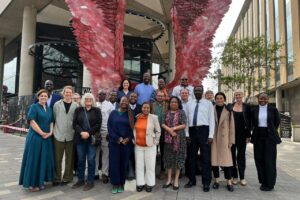
Alleging a range of human rights violations by Swaziland in the cases of Thulani Maseko and Bheki Makhubu, leading legal advocates today filed a petition with the UN Working Group on Arbitrary Detention (UNWGAD) in Geneva.
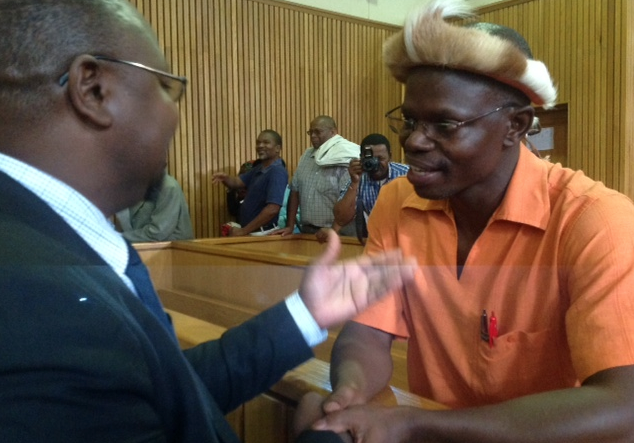
The American Bar Association’s Center for Human Rights, the global law firm Hogan Lovells and the ICJ jointly produced a petition calling for the UNWGAD to issue an opinion regarding the lawfulness of the continued incarceration of Thulani Maseko, an internationally recognized human rights lawyer and feature writer for The Nation magazine.
“The consequences of this arbitrary action against Thulani Maseko have not only violated his rights and exacted a heavy personal toll, but have also highlighted the rule of law deficit in Swaziland,” said Wilder Tayler, ICJ’s Secretary General. “Thulani Maseko has been denied his right to express an opinion on public affairs and the administration of justice, guaranteed under international law and affirmed in the UN Basic principles on the Role of lawyers.”
Thulani Maseko and journalist Bheki Makhubu were charged with two counts of contempt of court emanating from articles published in February and March 2014, in which they questioned circumstances surrounding the arrest of a government vehicle inspector.
They were sentenced to two years of imprisonment, without the alternative option of a fine at the end of a trial largely condemned by leading international rights groups as unfair and not complying with international standards on the right to a fair trial.
Some of the fair trial guarantees that have been breached, according to the legal petition filed with the UNGWAD, include the right to be tried by an independent and impartial tribunal; right to a public hearing; right to a legal counsel; right to the presumption of innocence; right to bail; and right to protection of the law.
“The use of contempt of court proceedings to suppress the right to freedom of expression is a violation of international human rights law,” said Marc Gottridge, partner at Hogan Lovells. “The right to freedom of expression is guaranteed in the Swazi constitution and international law, including treaties to which Swaziland is a party.”
“The general failings of the Swazi judiciary with respect to independence and impartiality makes it reasonable to conclude that there cannot be an effective domestic remedy for Thulani Maseko,” he added.
Contact:
Arnold Tsunga, Director, ICJ Africa Regional Programme, t +27 716 405 926 or +41 762 399 032, e arnold.tsunga(a)icj.org,
Matt Pollard, Senior Legal Adviser, ICJ, Centre for Independence of Judges and lawyers, t +41 22 979 38 12, e matt.pollard(a)icj.org
Marc Gottridge, Partner Hogan Lovells, t +1 212 918 3000, e marc.gottridge(a)hoganlovells.com
Ginna Anderson, Senior Counsel, Center for Human Rights, American Bar Association, t +1 202 442 3438, e ginna.anderson(a)americanbar.org
Background:
Thulani Maseko was arrested on 17th March 2014 following a warrant of arrest that was issued by the Chief Justice Michael Ramodibedi on his own motion.
This was after he had written an article titled “Where the Law Has No Place” criticising the courts for the way that a fellow Swazi citizen Mr Gwebu Bhantshana had been arrested and detained and the wider implications of that case on the rule of law in Swaziland.
Save for 3 days in April 2014 when he was released following Judge Mumcy Dlamini’s judgment declaring his arrest and detention wrongful and illegal, Thulani has been in custody since his initial arrest. Mr. Maseko was initially held at Sidwashini Correctional facility before he was taken to Big Bend Correctional facility, where he is currently lodged.
Further background material can be found here:
http://www.americanbar.org/news/abanews/aba-news-archives/2014/04/statement_of_jamesr.html
https://www.icj.org/swaziland-icj-condemns-the-harsh-prison-term-imposed-on-thulani-maseko-and-bheki-makhubu/
https://www.icj.org/swaziland-icj-condemns-the-conviction-of-celebrated-human-rights-lawyer-and-prominent-journalist-on-charges-of-contempt-of-court/
https://www.icj.org/swaziland-icj-concerned-at-detention-of-human-rights-lawyer-and-journalist/
Download the petition:
Swaziland-Maseko WGAD Petition-Advocacy-2015-Eng (full text in PDF)
The lawyers at Hogan Lovells US LLP who worked on this petition are Marc Gottridge, Dianne Milner, Allison Holt and Hans H. Hertell.
Feb 11, 2015
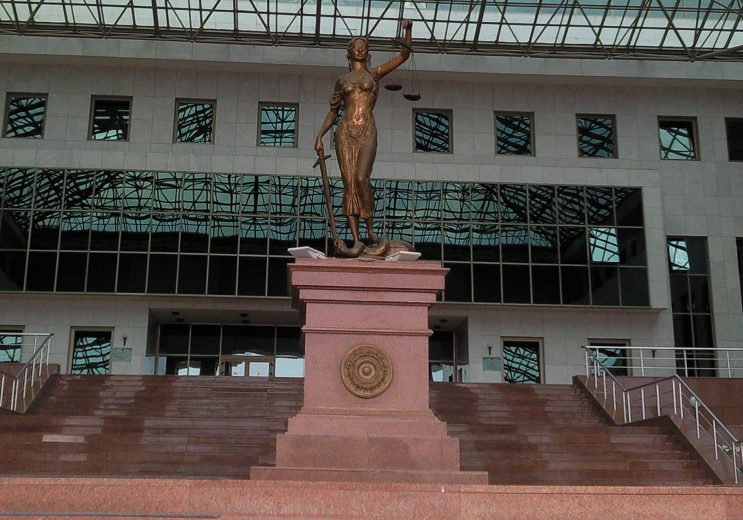
The ICJ presented its opinion in regard to the case of Oleg Evloev v. Kazakhstan. The underlying matters in the proceeding had been the subject of a decision by the UN Committee against Torture (CAT).
The ICJ outlined the States’ obligations under the UN Convention Against Torture, the Procedure under Article 22 of the Convention, as well as the National Courts’ role vis-a-vis the decisions of the CAT.
Contact:
Róisín Pillay, Director, Europe Programme, roisin.pillay(a)icj.org
Temur Shakirov, Legal Adviser, Europe Programme, temur.shakirov(a)icj.org
Russia-Evloev expert opinion-Advocacy-analysis brief-2015-eng (full text in PDF)
Russia-Evloev expert opinion-Advocacy-analysis brief-2015-rus (full text in PDF)
Feb 11, 2015 | Адвокаси, Краткий анализ
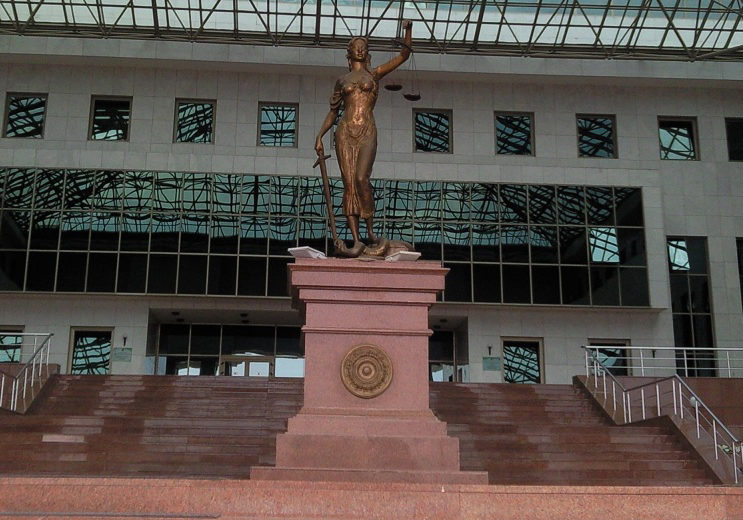
МКЮ предоставила экспертное заключение по процессу Олега Евлоева в Казахстане. В рамках производства по делу рассматриваются вопросы, ставшие предметом решения Комитета ООН против пыток («КПП ООН»).
МКЮ изложилa обязательства государств в соответствии с Конвенцией ООН против пыток, Процедурой согласно статье 22 Конвенции, а также роль национальных судов в отношении решений КПП.
Контакты:
Роушин Пиллей, директор Региональной программы МКЮ по Европе, roisin.pillay(a)icj.org
Тимур Шакиров, правовой советник Региональной программы МКЮ по Европе, temur.shakirov(a)icj.org
Russia-Evloev expert opinion-Advocacy-analysis brief-2015-rus (полный текст PDF)
Feb 10, 2015 | News
The ICJ today expressed deep concern over the ruling of the Federal Court upholding the conviction on “sodomy charges” of opposition leader Anwar Ibrahim by the Court of Appeal under the colonial-era Section 377B of the Penal Code.
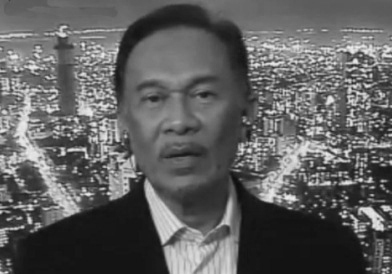
The decision today was on the final appeal against the March 2014 decision of the Court of Appeal, which overturned the 2012 High Court’s decision to acquit Anwar Ibrahim (photo) of “sodomy charges”.
The ICJ has called on Malaysia to repeal Section 377B, which criminalizes consensual same-sex relations.
The Federal Court also upheld the Court of Appeal’s decision to sentence Anwar to five years’ imprisonment.
“It is clear from the decision of the Federal Court today that the Government of Malaysia has once again inappropriately used Section 377B of the Penal Code against its political opponents,” said Justice Elizabeth Evatt, Commissioner of the ICJ who was in Putrajaya to observe the proceedings.
“This is deplorable, especially since Section 377B criminalizes consensual same-sex relations and thereby violates a range of international law and standards, including on the rights to privacy, non-discrimination and equal protection,” she added.
This relic of British law has long since been abandoned in the United Kingdom, but is still in force in Malaysia.
However, in the last few years, it has only been used against opposition leader Anwar Ibrahim.
The conviction today amounts to the second sodomy conviction for Anwar Ibrahim within the past 14 years.
His first conviction in August 2000 resulted in an imprisonment term of nine years. That decision was overturned by the Federal Court in September 2004.
The ICJ recalls that such “sodomy” charges cannot be considered recognizable criminal offences under international human rights law and standards.
“The criminalization of consensual same-sex conduct is in contravention of a number of human rights, including the right to dignity; equality before the law and equal protection of the law; non-discrimination; liberty and security of person; privacy; opinion and expression; association and peaceful assembly,” said Emerlynne Gil, ICJ’s International Legal Adviser for Southeast Asia, who also observed the hearings.
“Anwar Ibrahim should never have been investigated, charged with, tried, let alone convicted of and sentenced for such charges. The confirmation of his conviction and sentencing on these charges are an affront to human rights and the rule law,” she added.
The ICJ also noted with concern that the right to a fair trial of Anwar Ibrahim was violated in a number of respects, particularly his right to be presumed innocent.
Under international law, a person charged with committing a crime is considered innocent until proven guilty. Hence, this imposes upon the prosecution the burden to prove his guilt beyond reasonable doubt.
“In this case, however, it appeared that the Court of Appeal adopted an approach wherein the burden was on Anwar Ibrahim to prove that he had a credible defense, rather than raising reasonable doubt as to the prosecution’s case,” Justice Evatt said.
The ICJ says that by dismissing the final appeal of Anwar Ibrahim, the Federal Court has in effect adopted the same approach of the Court of Appeal to these issues.
This decision is a clear setback for the rule of law in Malaysia and is incompatible with the presumption of innocence principle, the Geneva-based organization adds.
Anwar Ibrahim has now exhausted all avenues of appeal and has immediately begun serving his sentence.
The ICJ observed the hearings in this case before the Court of Appeal in September 2013, February 2014, and March 2014, and before the Federal Court from 28 to 30 October 2014.
Elisabeth Evatt, a former judge of the Australian Federal Court and Commissioner of the ICJ, acted as the trial observer on behalf of the ICJ at the Court of Appeal and the Federal Court.
Contact:
Emerlynne Gil, International Legal Adviser, tel. +662 6198477 ext. 206 or email: emerlynne.gil(a)icj.org

Feb 9, 2015 | News
Myanmar should continue working with all stakeholders, including affected communities and civil society, to promote a legal framework that balances investors’ needs with human rights, said the ICJ today.
The call comes as the government enters a critical phase of establishing its new law governing investments in the resource-rich country.
“This is a critical moment for the economic development of Myanmar. The laws it implements now will shape investment, economic development and, in turn, human rights for the foreseeable future,” said Daniel Aguirre, ICJ International Legal Advisor. “It is imperative that drafting is not rushed and that laws take into account international human rights laws and standards.”
ICJ has been working directly with Myanmar’s Directorate of Investment and Company Administration (DICA), as well as with Myanmar civil society, on investment law and their potential impact on the human rights of all people in Myanmar.
The International Finance Corporation, in support of DICA, has produced a Draft Investment Law designed to consolidate the Foreign Investment Law (2012) and the Myanmar Citizen Investment Law (2013) to create a level playing field for both local and foreign investors. DICA has now opened the process to civil society consultation.
ICJ conducted a workshop with DICA on bilateral investment treaties in July of 2014. In November, the ICJ submitted feedback on the Draft Investment Law providing expert analysis and flagging issues of concern.
An initial consultation on the Draft Investment Law took place on 29 January 2015. The ICJ along with other civil society organizations met with the IFC and DICA.
“The ICJ is encouraged by DICA’s willingness to consult civil society, including international non-governmental organizations, and hear concerns about investment laws and their potential to curtail important regulations designed to protect, promote and fulfill human rights,” said Aguirre. “The ICJ looks forward to formal engagement in a consultation process that will include both national and international civil society.”
The ICJ remains concerned that the Draft Investment Law establishes significant rights for investors without protecting the rights of those affected by business activity.
The Draft Investment Law would require investors to follow national laws without acknowledging that the existing national legal framework does not adequately protect human rights or provide remedies for those whose rights have been violated.
Furthermore, the Draft Investment Law does not establish or protect Myanmar’s ‘right to regulate’ to protect human rights or other social or environmental needs.
Investment law should indicate Myanmar’s obligation to enact necessary regulations for the protection of human rights, including economic and social rights such as the right to health, in the future in order to avoid legal disputes when adopting these regulations.
“The Draft Investment Law’s proposed legal framework would provide all investors the right to be consulted and challenge any new national law or regulation that may impact their profits,” said Aguirre. “This framework would allow businesses to challenge government policies aimed at addressing legitimate needs within the country, and it could create a regulatory chilling effect in which Myanmar’s government would find itself in the troubling position of evaluating whether the passage of new social policies would lead to costly lawsuits from investors.”
“The draft Law as currently formulated runs the risk of hindering progressive regulation to protect human rights in Myanmar,” said Aguirre. “The ICJ is encouraged that DICA has begun meeting with non-governmental groups and believes that an effective and meaningful consultation will help address key concerns about the Draft Investment Law. The ICJ looks forward to working with the Myanmar Government, with the IFC, and with all other concerned groups in order to promote a law that balances investors’ needs with human rights.”