Apr 24, 2019 | News
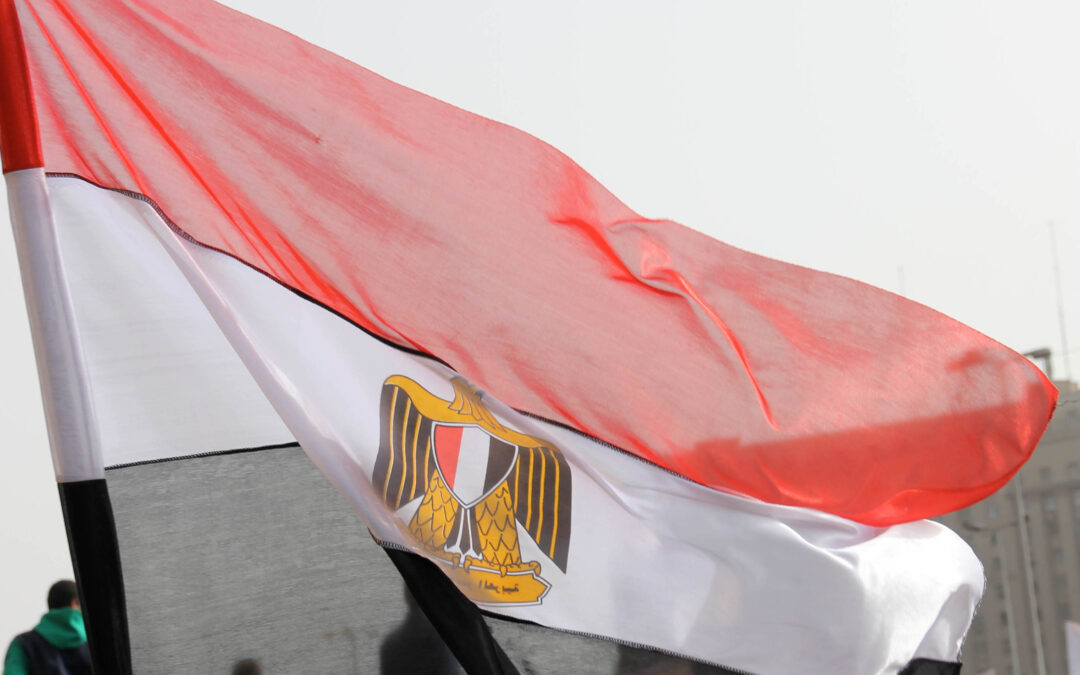
Egypt is hosting an Africa human rights summit meeting beginning April 24, 2019, while its government is presiding over the worst human rights crisis in the country in recent decades.
The 64th Ordinary Session of the African Commission on Human and Peoples’ Rights (ACHPR), the African Union’s top rights body, will take place from April 24 to May 14 in Sharm al-Sheikh.
In addition to its systematic failure to respect and protect human rights at home, Egypt has also led efforts to undermine the Commission’s independence. The Commission should strongly raise Egypt’s human rights abuses at the meeting.
“Egypt is trying to appear like a country open for human rights delegates and summits while, at the same time, crushing all dissenting voices and its once-vibrant human rights community,” said Michael page, Middle East and North Africa director at Human Rights Watch.
“We know that many Egyptian and international organizations are not allowed to work freely in Egypt and cannot voice concerns without severe retaliation from the government,” he added.
The commission should ensure that all government and non-government delegations are able to participate freely in the summit. It should also make clear that it will strongly address any measures of reprisals by the Egyptian authorities against criticism of its practices.
A senior staff member of a leading Egyptian rights organization told Human Rights Watch that only three Egyptian human rights groups were considering participating in the summit because most of the groups were concerned about retaliation by the government.
In recent years, the Egyptian authorities have relentlessly cracked down on non-governmental organizations, issued the 2017 draconian law that effectively bans all independent work by nongovernmental groups, and prosecuted scores of staff workers of Egyptian organizations.
It has also frozen the assets of the most prominent human rights defenders in the country and their organizations and issued travel bans against scores of them.
In April 2018, the government said it would repeal the abusive 2017 NGO law but the government has not made a new draft law public.
The Egyptian authorities have also taken reprisals against human rights defenders and activists for cooperating with regional and international human rights monitors, including United Nations agencies and experts.
In late 2018, Egyptian authorities detained several citizens who met with the UN special rapporteur on adequate housing during her official mission to Egypt, as well as demolishing their houses and banning their travel. The government denied any wrongdoing and accused the UN High commissioner on human rights and other UN officials of breaching UN standards and adopting the “lies” of “terrorist” organizations.
In September 2017, officials stopped Ibrahim Metwally, a lawyer and co-founder of the Associations of the Families of the Disappeared, from traveling for meetings with UN officials in Geneva. Security agencies arrested him at the airport and held him incommunicado for a few days. He is still held in “pretrial detention” for farcical charges.
The Egyptian government has tried to undermine the independence of the Commission through spearheading the adoption of African Union’s Executive Council’s Decision 1015, paragraph 5. The provision, which was passed in June 2018, undermines the Commission’s independence by subjecting its work to control by the African Union member countries.
The Egyptian government has ignored decisions and resolutions the Commission and its experts have made addressing several violations and abuses including the crackdown on civil society, restrictions on freedom of religion, unfair trials and mass death sentences, arbitrary arrests, and sexual violence.
The ACHPR session comes at a time when the Egyptian authorities have been severely oppressing dissent and obliterating any space for peaceful expression or gathering before the public vote held between April 19-22 on highly draconian constitutional amendments that will strengthen the military control of public and political life and further undermine the already weak judicial independence.
Egyptian human rights organization have documented the arrests of over 160 people, often in mass arrests, since February in relation to the ongoing crackdown on dissidents and perceived critics.
These amendments, and several other laws that President Abdel Fattah al-Sisi has approved in recent years, such as new media laws and laws to expand the use of military courts to try civilians, violate international law standards including the African Charter on Human and Peoples’ Rights.
Since al-Sisi secured a second term in elections that were largely neither free nor fair in March 2018, his security forces have escalated a campaign of intimidation, violence, and arbitrary arrests against political opponents, activists, and many others who have voiced even mild criticism of the government.
The Egyptian government and state media have framed this repression under the guise of combating terrorism, and al-Sisi has increasingly invoked terrorism and the country’s state of emergency law to silence peaceful activists.
In July 2013, the African Union Peace and Security Council suspended Egypt’s membership in all African Union activities following the forcible removal of former President Mohamed Morsy by the army, which was led by al-Sisi, then the defense minister. The suspension ended after al-Sisi was elected President in June 2014.
But Egypt has failed to effectively investigate or to hold any official or member of the security forces accountable for the mass killings of protesters in the summer of 2013 despite several national and international calls, including by the ACHPR, and despite incriminating evidence.
In August 2013, Egyptian security forces most likely killed at least 817 people in a few hours during its violent dispersal of the largely peaceful pro-Morsy sit-in in Cairo’s Raba’ Square. The killings likely amounted to crimes against humanity.
“Through such summits, Egypt is trying to whitewash its dire record of abuses,” George Kegoro, executive director of Kenya Human Rights Commission said. “The African human rights commission should take the opportunity of this meeting to vigorously engage the Egypt government on its own actions that threaten the rights, and the very lives, of many Egyptians.”
The co-signing organizations are:
Andalus Institute for Tolerance and Anti-Violence Studies
Belady Center for Rights and Freedoms
Cairo Institute for Human Rights Studies
Committee for Justice|
EuroMed Rights
Egyptian Front for Human Rights
Human Rights Watch
Kenya Human Rights Commission
The Egyptian Commission for Rights and Freedoms
The Freedom Initiative
The International Commission of Jurists
Egypt-African Rights Summit-News-2019-ARA (Press release, PDF, Arabic)
Contact:
Said Benarbia, Director of ICJ’s MENA Programme, t: +41-79-878-35-46 ; e: said.benarbia(a)icj.org
Apr 22, 2019 | Advocacy, News, Non-legal submissions
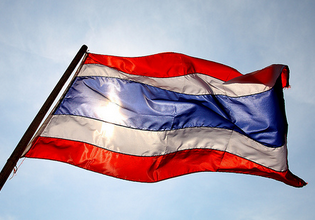
Today, the ICJ submitted recommendations to the Council of the State calling for the repeal or amendment of National Council for Peace and Order (NCPO) and Head of the NCPO (HNCPO) orders and announcements in line with Thailand’s international human rights law obligations.
The ICJ was informed by the Ministry of Foreign Affairs that the Council of the State had been tasked to review the necessity and relevance of announcements, orders, and acts of the NCPO and of the HNCPO in February 2019.
The review process is in line with Thailand’s declaration to the UN Human Rights Committee in its Follow-Up to the Concluding Observations of the Committee, submitted on 18 July and published on 10 August 2018.
In its submission to the Council of the State, the ICJ has called for the review process of HNCPO and NCPO announcements and orders to be carried out with increased public participation, openness, and transparency.
The ICJ has also made recommendations on the repeal and amendment of the following HNCPO and NCPO orders and announcements since they are clearly inconsistent with Thailand’s international human rights law obligations and the 2017 Constitution, and are neither necessary, nor proportionate, nor relevant to the current situation:
- Orders that provide the military with superior powers beyond civilian authorities;
- Orders that allow military courts to prosecute civilians;
- Orders that infringe on the rights to freedom of expression and assembly, restrict media freedom and the right to information; and
- Orders that infringe on community and environmental rights.
As main priorities, the ICJ has recommended that:
a) the exercising of law enforcement powers by military personnel to arrest and detain suspects in places not formally recognized as places of detention without judicial review should end;
b) all cases of civilians facing proceedings before military courts be transferred to civilian courts, and all civilians convicted of an offence in military courts be guaranteed a re-trial in civilian courts; and
c) all other HNCPO and NCPO orders and announcements should be repealed or amended to bring Thailand in compliance with its international human rights law obligations, and to ensure that the rights to freedom of expression, opinion and assembly, and environmental rights, among others, be respected.
Thailand-civilian prosecutions military courts-Advocacy-Non-legal submissions-2019-ENG (PDF in English)
Thailand-civilian prosecutions military courts-Advocacy-Non-legal submissions-2019-THAI (PDF in Thailand)
Further readings:
Post coup’s legal frameworks
Thailand: ICJ alarmed at increasing use of arbitrary powers under Article 44
Joint submission to the UN Human Rights Committee by the ICJ and Thai Lawyers for Human Rights
The ICJ and other groups made a joint follow-up submission to the UN Human Rights Committee
Thailand: statement to UN on situation for human rights
ICJ and Thai Lawyers for Human RIghts’ submission to the Universal Periodic Review (UPR) of Thailand
Military officers in law enforcement missions
Thailand: immediately end the practice of arbitrarily detaining persons in unofficial places of detention
Thailand: The ICJ and Human Rights Watch express concerns over detentions
The Use of Military Court
Thailand: transfer all civilians to civilian courts
Thailand: End prosecution of civilians in military tribunals
Thailand: ICJ welcomes Order phasing out prosecution of civilians in military courts but government must do much more
Freedom of expression and assembly
Thailand: lifting of the ban on political activities is welcome but more is needed
Thailand: Lift ban on political gatherings and fully reinstate all fundamental freedoms in Thailand
Thailand: misuse of laws restricts fundamental freedoms (UN statement)
Community and environmental rights
“Development” and its discontents in Thailand
Thailand: ICJ submission to the UN Committee on Economic, Social and Cultural Rights
Apr 20, 2019
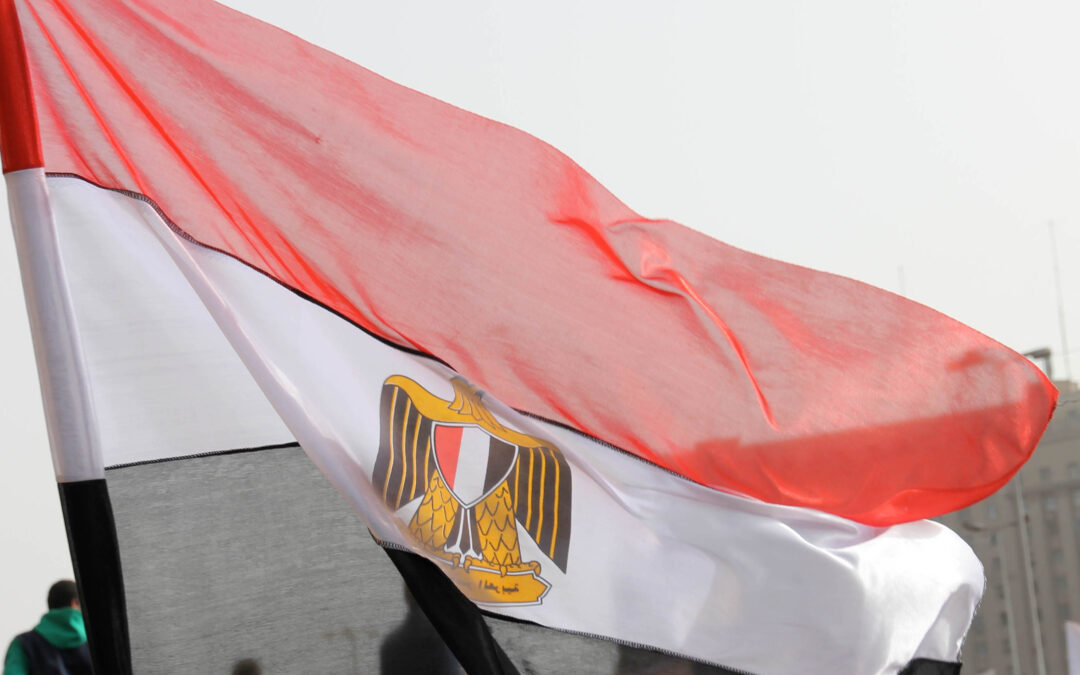
The Egyptian government should withdraw proposed constitutional amendments that will consolidate authoritarian rule, Human Rights Watch and the ICJ said today.
The amendments will undermine the Egyptian judiciary’s dwindling independence and expand the military’s power to intervene in political life.
On April 16, 2019, Parliament finalized and approved the amendments, which a pro-government bloc proposed in early February. On April 17, the National Election Authority said a public referendum was set for April 19-22. The official draft amendments were only published in the official Gazette on April 18.
The vote takes place amid ongoing mass arrests and a relentless crackdown on fundamental freedoms, including currently targeting those calling for boycotting or rejecting the amendments. Given the ongoing repression, and that political opposition in Egypt has dwindled to a nominal presence, a free and fair vote will be impossible.
“These amendments aim to smother Egyptians’ aspirations to live in dignity and under the rule of law,” said Michael Page, deputy Middle East and North Africa director at Human Rights Watch. “The authorities should immediately halt efforts to pass these amendments by threatening, disappearing, and persecuting peaceful critics and dissidents.”
The 596-seat Parliament, which is dominated by members loyal to President Abdel Fattah al-Sisi and which routinely rubber-stamps government decisions, passed the amendments by a vote of 531 to 22. During Parliament’s “societal dialogue” sessions, few critics were allowed be take part in the discussions about the amendments.
“The amendments are a flagrant assault on the rule of law and independence of the judiciary in Egypt. If adopted, they will effectively place the military above the law and the Constitution and cement the executive’s subordination of judicial and prosecutorial authorities,” said Said Benarbia, ICJ’s MENA Director.
The initial amendments would have allowed al-Sisi to run for two more six-year terms, after his current second term. The final amendments will permit him to run for one additional term and also extends his current term from four to six years, a move that attracted criticism inside Egypt.
The amendments are particularly troubling given the widespread suppression of fundamental freedoms, including freedoms of expression, association, and assembly and the right to political participation, all of which are essential to a free and fair public vote.
A coalition of 10 secular and leftist political parties called for rejecting the amendments. Local news reports say that the public prosecutor is investigating an opposition political figure, Hamdeen Sabbahy, for “instigating chaos” and insulting the state because of his opposition to the amendments.
The authorities have also started aggressive smear campaigns against several activists and award-winning actors, and are exploring the potential prosecution of them following their participation in public advocacy efforts about Egypt’s human rights situation in Washington, DC and European capital cities in March.
In February and March alone, authorities arrested or prosecuted over 160 dissidents or perceived dissidents, according to Egyptian rights lawyers who spoke with Human Rights Watch.
Authorities also briefly arrested another opposition figure, Mamdouh Hamza, a businessman, on February 16, accusing him of “publishing false news” and citing critical posts on his Twitter account. They released him on bail a few hours later. Al-Araby al-Jadeed newspaper said that other opposition figures have received telephoned “threats.”
On April 10, the authorities blocked an independent campaign website, “Batel,” which, in the context of the referendum, could be translated as “void.” Egyptians living abroad started the campaign, inviting Egyptians to register their “No” votes online. Access to the site was blocked in Egypt only hours after its launch, but the campaign still managed to amass tens of thousands of “No” voters in a few days.
The authorities blocked seven other alternative websites that the campaign made to circumvent the efforts to block access in Egypt.
In their efforts to block access to the campaign, the authorities have blocked about 34,000 websites, according to an internet-monitoring website.
Since mid-2017, the authorities have blocked access to hundreds of websites including most of the independent news websites and some for human rights organizations.
The independent news website Mada Masr reported on February 10 that security authorities instructed mainstream media in Egypt not to report on the amendments, and in particular not to give critics any coverage. Mada Masr also reported that, at least since December 2018, meetings between staff from al-Sisi’s office and intelligence officials have been held at the General Intelligence Agency “on a nearly daily basis,” coordinated by al-Sisi’s son Mahmoud, a senior intelligence officer, to push the amendments.
A few days after parliamentarians proposed the amendments, supportive placards, signs, and billboards were erected across the country.
On April 16, Mada Masr, quoting witnesses in East Cairo, reported that security authorities had pressed business owners to post the signs. The government denied imposing fines on those who refused, but the authorities refused to permit opposition protests on March 27, citing “security threats.”
The al-Mashhad website also published a leaked memo from judges of the State Council, the body that contains the Supreme Administrative Court, to the Parliament, which said that the amendments “demolish judicial independence.” The State Council’s deputy chief justice, Judge Samir Yousef, later confirmed that he drafted the memo.
In July 2013, then-defense minister al-Sisi led the forcible removal of Egypt’s first freely elected president, Mohamed Morsy. Al-Sisi was officially elected president in 2014 and re-elected in 2018, after his government arrested or intimidated all of the other potential candidates.
Al-Sisi has presided over a government that has committed widespread and systematic human rights violations, including mass killings of protesters, arbitrary arrests, enforced disappearances, extrajudicial killings of detainees, and torture and other ill-treatment in detention. Some of these crimes most likely constitute crimes against humanity.
The nationwide crackdown first targeted al-Sisi’s Islamist opponents but quickly expanded to include political dissidents, human rights lawyers and defenders, journalists, artists, gay men, lesbians, transsexuals, and virtually anyone expressing the mildest critical views. Government security forces, including the army, violate human rights with almost total impunity.
Since April 2017, the government has imposed a state of emergency, which has been used to justify undermining judicial independence, and used abusive counterterrorism and media laws to suppress fundamental freedoms.
President al-Sisi has apparently long opposed many of the human rights guarantees in the current constitution, saying in September 2015 that “the Constitution was written with good intentions. But countries cannot be built with good intentions.” The parliament speaker, Ali Abd al-Aal, said that a new constitution should be drafted in 5 or 10 years. Critics say this will happen when al-Sisi nears the end of his third and final term.
In an April 17 news conference, Judge Lasheen Ibrahim, the head of the National Elections Authority, called on Egyptians to vote and said that amending the constitution was justified because “it has to fit the [society’s] situation.”
“Egypt’s autocracy is shifting into overdrive to re-establish the ‘President-for-Life’ model, beloved by dictators in the region and despised by their citizens,” Page said. “But it’s a model that recent experience in Egypt and neighboring countries has demonstrated is not built to last.”
Egypt-Constitutional amendments-news-press release-2019-ENG (PDF, press release, Arabic)
For more information, please contact:
In Berlin, for Human Rights Watch, Amr Magdi (English, Arabic): +1-646-659-8020 (mobile); or magdia@hrw.org. Twitter: @ganobi
In New York, for Human Rights Watch, Michael Page (English): +1-617-453-8063 (mobile); or pagem@hrw.org. Twitter: @MichaelARPage
In Geneva, for the International Commission of Jurists, Said Benarbia: 0041798783546; or said.benarbia@icj.org
For more information about the abusive amendments, please read:
Egypt Constitutional Amendments: Unaccountable Military, Unchecked President and a Subordinated Judiciary
Egypt-Constitutional amendments-advocacy-analysis brief-2019-ENG (PDF, English)
Egypt-Constitutional amendments-advocacy-analysis brief-2019-ARA (PDF, Arabic)

Apr 12, 2019 | Advocacy, News, Open letters
The ICJ sent a letter urging Singapore’s government to refrain from passing into law the Protection from Online Falsehoods and Manipulation Bill 2019 (‘Online Falsehoods Bill’) in its current form.
The letter was sent to Singapore’s Prime Minister, Deputy Prime Ministers, Minister for Law and Speaker of the Parliament.
The bill is reportedly expected to be adopted and come into force in the second half of 2019.
The ICJ acknowledged the efforts of Singapore’s government to attempt to counteract potential infringements on human rights and fundamental freedoms which may emerge from abusive communications involving the spread of misinformation. It noted however that the bill may, contrary to the object and purpose of its introduction, result in far-reaching limitations on the rights to freedom of expression, opinion and information.
The ICJ indicated that its provisions present a real risk that it can be wielded in an arbitrary manner to curtail important discussion of matters of public interest in the public sphere, including content critical of the government. Critical dissent, free exchange and development of opinions, and free access to information are necessary to maintain an informed society and ensure transparency, accountability and informed debate on crucial matters of public interest.
The letter included a legal briefing highlighting the ICJ’s concerns regarding provisions of the bill which contravene international human rights law and standards.
Singapore-online regulation bill letter-advocacy-open letter-2019-ENG Letter (PDF)
Singapore-online regulation bill briefing-advocacy-open letter-2019-ENG Briefing (PDF)
See also
ICJ, ‘Singapore: Parliament must reject internet regulation bill that threatens freedom of expression’, 4 April 2019, https://www.icj.org/singapore-parliament-must-reject-internet-regulation-bill-that-threatens-freedom-of-expression/
Apr 12, 2019 | Plaidoyer
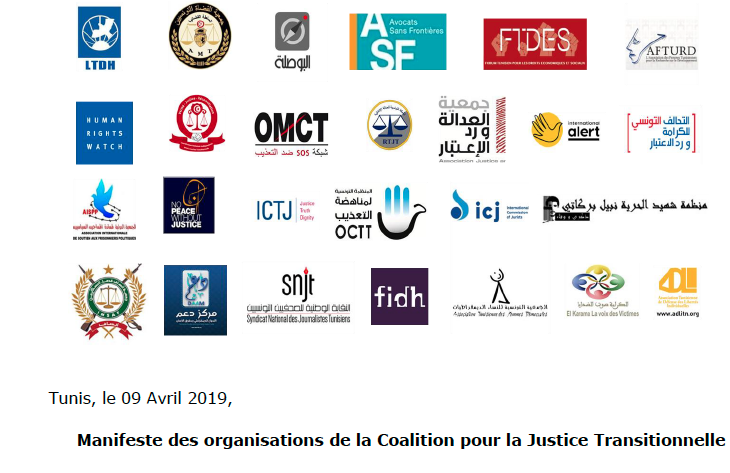
Le manifeste appelle les autorités tunisiennes à s’engager pour le suivi et l’application du processus de justice transitionnelle après la publication du rapport final de l’Instance Vérité et Dignité.
Le manifeste a été signé par la Commission Internationale de Juristes avec d’autres organisations membres de la Coalition pour la justice transitionnelle.
Il peut être téléchargé ici:
Tunisia-Manifeste coalition-Advocacy-2019-FRE (version française, en PDF)
Tunisia-Manifeste coalition-Advocacy-2019-ARA (version arabe, en PDF)