Nov 15, 2020 | News
The removal of Peru’s President Martin Vizcarra by the country’s Congress has undermined respect for the principle of separation of powers and precipitated a rule of law crisis, the ICJ said today.
On 9 November, Peru’s Congress used the seldom-used article 113(2) of the country’s constitution to ‘vacate’ Vizcarra’s term on the ground of “permanent moral incapacity” for office and swore in the President of the Congress, Manuel Merino, as President of the country.
The underlying justification for Vizcarra’s removal was allegations of corruption stemming from the time when he was Governor of Moquequa state in 2011-2014. Those allegations are already under investigation by the Office of the Prosecutor.
The ICJ notes that Peru’s Constitutional Court has a pending case to review the constitutional consistency of the use of the grounds of “permanent moral incapacity” clause for ordinary crimes. The Peruvian Constitution contemplates a separate procedure of impeachment that has not been followed in this case. Yet Congress applied the clause of “moral incapacity” in hasty proceedings with that decision pending.
“Peru’s congress has preempted the decision of the Constitutional Court and applied an overly expansive and highly contested legal interpretation of article 113(2) to oust a president, thus implicating the authority of the Judicial branch as well as the Executive,” said ICJ Secretary General Sam Zarifi.
“This overreach by the Legislative branch has launched the country into a rule of law crisis that also threatens respect for human rights in the country,” he added.
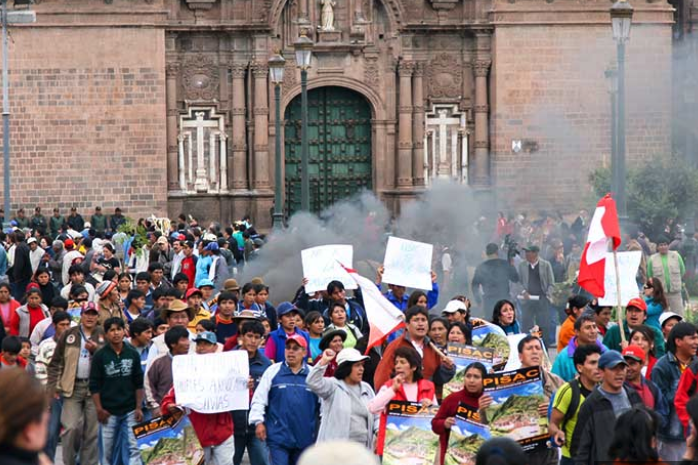
Protesters demonstrating against Vizcarra’s removal have faced ill-treatment and arbitrary arrest by police and security forces.
The ICJ calls on the Peruvian authorities to respect the right to freedom of assembly and peaceful protest and to desist from any form of unlawful use of force. Allegations of violations of ill-treatment and other human rights violations must be investigated promptly, thoroughly and impartially. The ICJ also urges respect of the independence of the judiciary, particularly as concerns the Constitutional Court and its functions.
Nov 14, 2020 | Advocacy, News
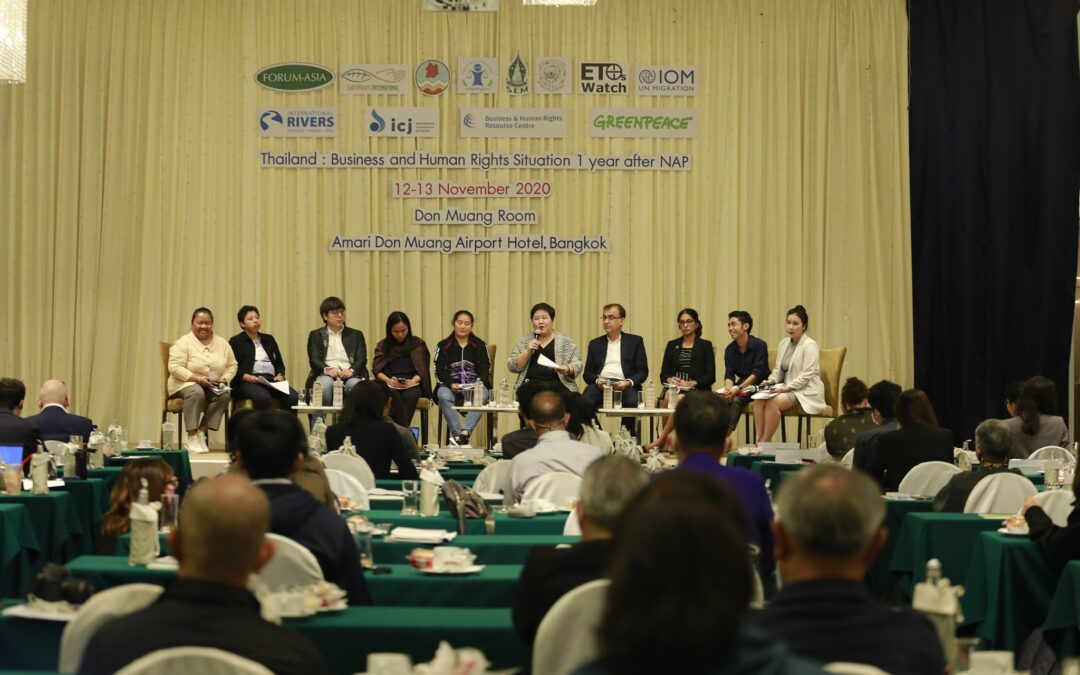
On 12-13 November 2020, the ICJ co-hosted a discussion on “Thailand’s National Action Plan on Business and Human Rights: 1-Year Progress Review” in Bangkok. The forum was co-organized with other 11 organizations.
Participants on the first day included some 95 individuals representing populations affected by business operations from all regions of Thailand and members of civil society organizations. The considered reviewed the progress that has been made by Thailand over the past year towards fulfilling its commitments in the four priority issues in its First National Action Plan on Business and Human Rights (NAP): (1) Labor; (2) Land, environment and natural resources; (3) Human rights defenders; and (4) Cross border investment and multi-national enterprises.
Several participants noted a lack of any evident and tangible progress in the NAP implementation and questioned the effectiveness of the NAP because it does not have the status of a law but is merely a resolution from the Council of Ministers. They further expressed concern at the lack of a comprehensive monitoring system in place to monitor NAP and its achievement according to the key recommendations aligned with the UN Guiding Principle on Business and Human Rights, and on legal harassment and intimidation faced by human rights defenders.
In the session regarding cross border investment and multi-national enterprises, the ICJ participants led the discussion regarding challenges to hold Thai companies accountable for human rights abuses which took place abroad. The participants looked into several obstacles to accessing to justice for victims of business-related human rights abuses in the context of cross-border investment. The discussion was based on the ICJ’s work and analysis in the draft report on the human rights legal framework of Thai companies operating in Southeast Asia, which is expected to be launched in December 2020.
Comments and recommendations raised by participants on the first day were presented to representatives from the Ministry of Justice, Thailand National Human Rights Commission, Global Compact Network Thailand and UN agencies, in the public seminar on the second day. The outcomes of the discussion and recommendations will also be submitted to the NAP Monitoring/Steering Committees, chaired by Director-General of Rights and Liberties Protection Department, Ministry of Justice.
Background
On 29 October 2019, the Cabinet approved and adopted the First National Action Plan on Business and Human Rights (2019-2022), making Thailand the first country in Asia to adopt the stand-alone NAP.
The NAP emphasizes the duties of State agencies to review and amend certain laws, regulations and orders that are not in compliance with human rights laws and standards and ensure their full implementation; ensure accessibility of mechanisms for redress and accountability for damage done to affected communities and individuals; overcome the barriers to meaningful participation of communities and key affected populations; and strengthen the role of businesses to “respect” human rights on a variety of key priority issues.
The event was co-hosted with:
- International Organization for Migration (IOM)
- Community Resource Centre Foundation (CRC)
- Asian Forum for Human Rights and Development (FORUM-ASIA)
- EarthRights International (ERI)
- The Mekong Butterfly (TMB)
- International River (IR)
- Spirit in Education Movement (SEM)
- Thai Extra-Territorial Obligations Working Group (Thai ETOs Watch)
- Green Peace Thailand
- Green South Foundation
- Business and Human Rights Resource Center (BHRRC)
Further reading
Thailand’s Legal Frameworks on Corporate Accountability for Outbound Investments
Thailand: ICJ co-hosts discussion on National Action Plan on Business and Human Rights
Nov 12, 2020 | Agendas, Events, News
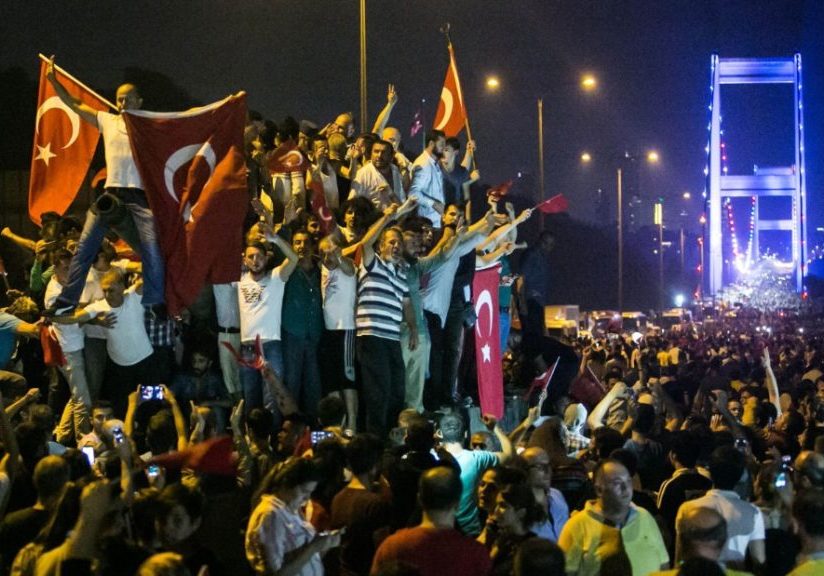
The International Commission of Jurists and the Human Rights Joint Platform (IHOP) invite you to a Zoom workshop where Turkish and international experts will discuss the legacy of the 2016-2018 state of emergency in Turkey for access to justice today.
To participate, please register by writing an email to ihop@ihop.org.tr (the Human Rights Joint Platform)
Join our great panel of speakers:
– Professor Sarah Cleveland, ICJ Commissioner
– Dr. Dilet Kurban, Hertie School
– Lawyer Ziynet Özçelik, Ankara Bar Association
– Dinçer Demirkent, Human Rights School
– Roisin Pillay, Director of ICJ Europe and Central Asia Programme
– Kerem Altiparmak, ICJ Turkey Legal Adviser
The workshop will address how state of emergency measures, such as dismissals and closures of legal entities, still impact on the human right of people in Turkey today.
The experts will discuss whether the remedies set up by Turkish authorities are up to standard with Turkey’s international human rights law obligations.
IHOPICJ-ZoomWorkshop-StateofEmergency-Agenda-2020-ENG (download the agenda in English)
IHOPICJ-ZoomWorkshop-StateofEmergency-Agenda-2020-TUR (download the agenda in Turkish)
The event is part of the REACT project: implemented jointly by ICJ and IHOP, this project seeks to support the role of civil society actors in turkey in ensuring effective access to justice for the protection of human rights. This project is funded by the European Union. The views expressed in the event do not necessarily reflect the opinion of the EU.
Nov 12, 2020 | News
The ICJ, the Cairo Institute for Human Rights Studies (CIHRS), the Defender Center for Human Rights (DCHR), Lawyers for Justice in Libya (LFJL) and the Libyan Women’s Platform for Peace (LWPP) have issued today a joint statement on the assassination of lawyer and political activist Hanan al-Barassi .
The undersigned human rights groups are appalled by the assassination of lawyer and political activist Hanan al-Barassi in Benghazi on 10 November 2020, and call on the competent authorities to launch an independent, impartial and effective investigation into the killing and bring those responsible to justice through fair trials.
On 10 November, a group of unknown armed men shot al-Barassi in Benghazi city centre in broad daylight. Al-Barassi was known for her political engagement and criticism of the human rights violations and abuses and corruption allegedly committed by authorities in Eastern Libya and their affiliated militias. Al-Barassi was active on social media, and often posted videos on Facebook in which she criticised the Libyan Arab Armed Forces (LAAF). Her last video was posted a few hours before her killing.
Al-Barassi’s murder follows a disturbing pattern in recent years of violent attacks against prominent women activists who are critical of the authorities and affiliated militias. In June 2014, gunmen assassinated prominent human rights activist and lawyer Salwa Bugaighis. This was followed by the killing of former Derna Congress member Fariha Al-Berkawi on 17 July 2014, and human rights activist Entisar El Hassari on 24 February 2015. Women’s rights defender and member of the Tobruk-based House of Representatives Seham Sergiwa was abducted from her home by armed men on 17 July 2019, and her whereabouts remains unknown.
The failure of Libyan authorities to effectively investigate these attacks, despite public commitments to do so, has created an environment of impunity, in which women are frequently targeted, both online and offline, with threats, smear campaigns and violence for their political or human rights views. Al-Barassi’s assassination is also a stark demonstration of how online violence against women can carry over to have lethal consequences on the ground.
Such atrocities are prevalent in Libya today. The pattern of violence including enforced disappearances and assassinations of activists, human rights defenders, judges and journalists across the country is alarming, and will only continue in the absence of any effective, independent and impartial investigations. Addressing these crimes by holding the perpetrators to account must be a priority, including within any political process.
Al-Barassi’s killing has taken place as the Libyan Political Dialogue Forum (LPDF) continues talks aimed at ending the conflict and preparing for national elections, underscoring the importance of ensuring accountability and justice in the country. There can be no meaningful democratic transition in Libya until the basic security and human rights of the population are guaranteed.
Given the absence of any real commitment to effectively investigating ongoing crimes under international law being committed in Libya, the newly established Independent Fact-Finding Mission (FFM) on Libya must be urgently provided with the necessary resources to begin its investigations and preserve evidence without delay. We urge the Libyan authorities to fully cooperate with the FFM, and UN Member States to swiftly provide the needed support and adequate resources.
Signatories
- International Commission of Jurists (ICJ)
- Cairo Institute for Human Rights Studies (CIHRS)
- Defender Center for Human Rights (DCHR)
- Lawyers for Justice in Libya (LFJL)
- Libyan Women’s Platform for Peace (LWPP)
Find the Joint Statement in Arabic and English here:
Lybia-Hanan_Albarassi -JointStatement-2020-ARA
Lybia-Hanan_Albarassi -JointStatement-2020-ENG

Nov 12, 2020
India’s Foreign Contribution (Regulation) Act, 2010, (FCRA) is unlawfully obstructing the critical work of non-governmental organizations in India, the ICJ said in a briefing paper released today.
The ICJ called for immediate action to repeal or revise the offending provisions in the law.
The briefing paper identifies the FCRA as “a tool to silence Indian Civil Society Organizations”. It shows how the FCRA – by its own terms and as applied by the authorities – fails to comply with India’s international legal obligations to respect and protect the rights to freedom of association, expression, peaceful assembly, and the right to take part in the conduct of public affairs.
The FCRA regulates access to foreign funds and prohibits their receipt for any activities purportedly “detrimental to the national interest”.
The ICJ underscores the imprecise and overbroad language of the FCRA, which has left it open to abusive and arbitrary application by the Indian authorities. Civil Society Organizations (CSOs) may be prevented from accessing foreign contributions when the groups or their activities are characterized as of a “political nature” or acting against “public interest”, or against “strategic, scientific or economic interest” or “security”.
“By restricting NGO access to foreign funds meant for the NGO sector, the Indian Government is using the FCRA selectively to silence critical voices,” said Ian Seiderman, ICJ’s Legal and Policy Director.
“As recognized by the UN Charter, international cooperation, including through financial assistance, is fundamental to the protection of human rights, and CSOs should be encouraged rather than prevented from engaging in such cooperation to facilitate their critical work,” said Ian Seiderman.
On 20 October 2020, UN High Commissioner for Human Rights, Michelle Bachelet, expressed concern that the FCRA was being used to “deter or punish NGOs for human rights reporting and advocacy”.
Since 2014, the Indian Government has cancelled the FCRA licenses of more than 19,000 NGOs, including high profile organizations such as the Lawyers Collective, Greenpeace India, People’s Watch, Compassion International, and Public Health Foundation of India. The grounds for these cancellations include “non-compliance with reporting requirements” and activities deemed “political” or against “national interest” and “economic security”. On 10 September 2020, India froze the accounts of Amnesty International India on the allegation that it had circumvented the FCRA. The action forced Amnesty International India to halt its India operations.
“We see the authorities continuing their clampdown on Indian human rights defenders through arbitrary arrests, restrictions on travel and other forms of harassment. We urge the Indian Government to protect rather than repress human rights defenders in India, whose work is vital to the rule of law in the country,” Seiderman said.
Contact
Osama Motiwala, ICJ Asia-Pacific Communications Officer, e: osama.motiwala(a)icj.org
Background
In the briefing paper, entitled “India’s Foreign Contribution Regulation Act: A Tool to Silence Indian Civil Society Organizations”, the ICJ answers the following questions:
- What is the Foreign Contribution Regulation Act? How does it affect NGOs?
- Which prohibitions in the FCRA are of concern to NGOs?
- What do the Indian Courts say about the overbroad restrictions on the receipt of foreign funds for NGOs in the FCRA?
- Is the FCRA compliant with India’s obligations under international human rights law?
- How have civil society organizations been targeted or adversely impacted by the FCRA?
- Is there a pattern of Indian Government targeting NGOs, lawyers and human rights defenders?
- How does the Government apply the prohibition on organizations of a political nature receiving foreign funding to political parties?
Further Reading
Download
India-FCRA-Briefing-Paper-2020-ENG (PDF)