Sep 11, 2020 | News
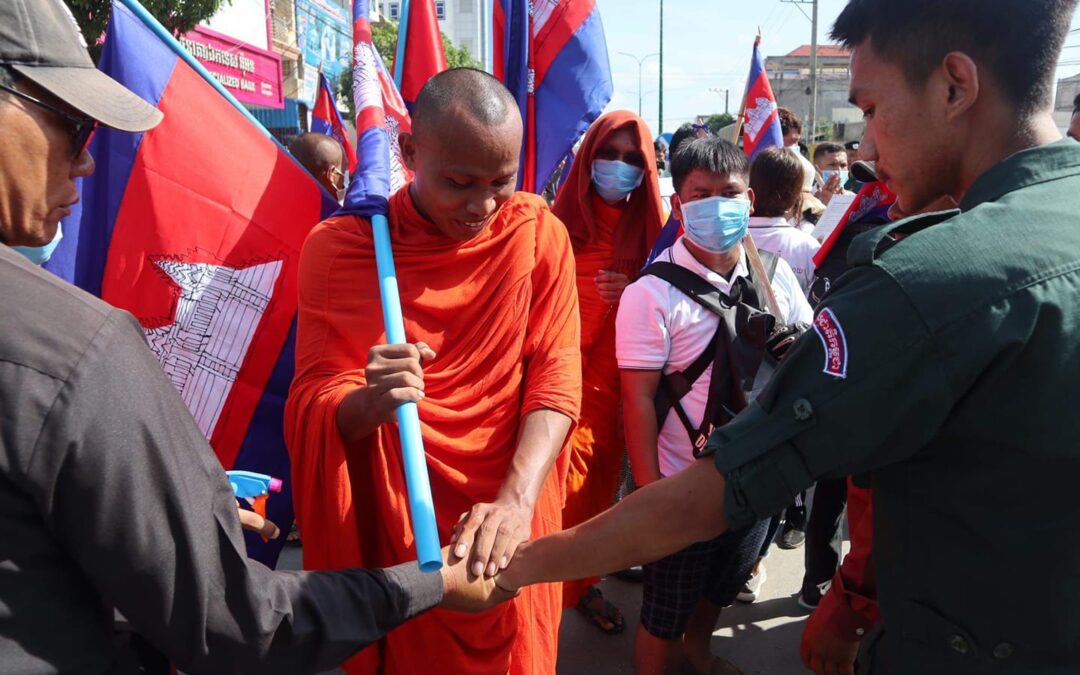
Today, the ICJ condemned an ongoing and heightened crackdown on civil society activists and human rights defenders in Cambodia, and called on the Royal Government of Cambodia (“RGC”) to cease arbitrary arrest and other harassment of individuals for merely exercising their human rights and fundamental freedoms.
From end-July to early this week, at least eleven activists have been arrested and detained on spurious charges in an invigorated attempt by authorities to silence critical dissent in the country.
“The Cambodian authorities in recent days have ratcheted up their abuse of domestic laws to target human rights defenders and perceived critics of the government. We fear that without a robust international response, the situation will only deteriorate further,” said Kingsley Abbott, ICJ Senior Legal Adviser.
“They are now targeting youth in particular, in an apparent bid to curtail their use of social media to amplify dissatisfaction with the ruling regime. Instead of attacking them, the government needs to stop and listen to their people,” he added.
Several arrests have been linked with the detention of prominent union leader, Rong Chhun. On 31 July, Rong Chhun, President of the Cambodian Confederation of Unions, was arrested at his home in suspected retaliation for comments he had made alleging loss of community land in relation to demarcation of the Cambodian-Vietnamese border. He was thereafter charged with “incitement to commit a felony or disturb social security,” under articles 494 and 495 of the Criminal Code. He is currently in detention in Phnom Penh’s Correctional Centre 1.
On 13 August, Hun Vannak and Chhouen Daravy, founding members of the Khmer Thavrak youth activist group, were arrested in relation to a rally they had held outside Phnom Penh Municipal Court in support of Rong Chhun. Daravy was reportedly slapped, then grabbed and hit before being pushed into a vehicle during her arrest. Security officials also reportedly beat and kicked at people in the rally to disperse the crowd, injuring about ten individuals.
On 6 September, Buddhist monk Venerable Koet Saray and Mean Prommony, Vice-president of the Khmer Student Intelligent League Association, were arrested in apparent connection with a rally they had been organizing to call for Rong Chhun’s release. On 7 September, Khmer Thavrak activists Tha Lavy and Eng Malai were arrested. Tha Lavy was arrested on arriving at a protest at Freedom Park. Eng Malai was arrested the day she had left the UN Office of the High Commissioner for Human Rights’ Cambodia office, where she had raised her security concerns.
Simultaneous arrests of environmental rights activists and a rapper evidence a wider crackdown beyond the case of Rong Chhun. On 4 September, three members of environmental rights group Mother Nature Cambodia, Thun Ratha, Long Kunthea and Phuong Keorasmey were arrested. They were thereafter charged with incitement under articles 494 and 495 of the Criminal Code. On the same day, rapper Kea Sokun was arrested in Siem Reap province and similarly charged with incitement, in apparent connection with a popular song he had released on YouTube, concerning land at the Cambodian-Vietnamese border.
On 7 September, the Ministry of Interior issued a statement denouncing Khmer Thavrak and Mother Nature Cambodia as unauthorized organizations, calling on the responsible authorities to prosecute them.
The ICJ is concerned that the groups are being targeted for allegedly operating without being registered in accordance with the Law on Associations and Non-Governmental Organizations. The requirements under this law are non-compliant with international law and standards that protect human rights and fundamental freedoms, as the ICJ has previously pointed out. The law impermissibly restricts the ability of civil society members to exercise their rights to freedom of association and expression.
The ICJ recalls the responsibility of Cambodia, as expressly stated in the UN Human Rights Defenders Declaration, to “take all necessary measures to ensure the protection by the competent authorities of everyone, individually and in association with others, against any violence, threats, retaliation, de facto or de jure adverse discrimination, pressure or any other arbitrary action as a consequence of his or her legitimate exercise of the rights referred to in the present Declaration.” These rights include, among others, freedoms of expression, opinion, peaceful assembly, association and political participation.
“Far from protecting these rights, the government has been systematically violating them,” said Abbott.
“The recent arrests signal yet another sign of further regression that needs to be called out by the international community, including by partners, missions, UN agencies and financial institutions.”
On 7 September, the UN Special Rapporteur on Cambodia expressed concerns about the recent arrests and also highlighted that she “has been closely following reports that seven different CSOs have been searched or informed of pending visits by the authorities since last week.” Similarly, over the past few days, the UN Special Rapporteur on Human Rights Defenders has expressed concern about the crackdown, stating “peaceful protest is not a crime”.
Contact
Kingsley Abbott, Senior Legal Adviser, ICJ Global Redress & Accountability Initiative e: kingsley.abbott(a)icj.org
See also
ICJ and 31 organizations jointly urge Governments to call for respect of human rights in Cambodia, 22 July 2020
Cambodia: State of Emergency bill violates the rule of law’, 8 April 2020
Misuse of law will do long-term damage to Cambodia, 26 July 2018
‘Cambodia: deteriorating situation for human rights and rule of law (UN statement), 27 June 2018
‘Cambodia: the ICJ condemns Senate’s approval of draft Law on Associations and NGOs, 24 July 2015
Sep 9, 2020
The ICJ has joined more than 300 other NGOs in urging the UN to establish a specific mechanism to systematically monitor and report on human rights violations by China.
The joint NGO letter follows a similar call made by 50 United Nations experts, and highlights human rights violations across China, including in Hong Kong, Tibet, and Xinjiang, as well as suppression of information in the context of the Covid-19 pandemic, and attacks on human rights defenders.
The joint letter also expresses concern about the global reach of China’s censorship, threats, surveillance, and misuse of UN processes to deny NGOs accreditation, attack UN experts, and undermine country resolutions at the UN Human Rights Council.
The text of the letter and the list of signatories is available here.
Sep 8, 2020 | Noticias
Jueces de seis países latinoamericanos constataron que existían serios obstáculos, pero también posibilidades de justicia, que enfrentan los poderes judiciales de la región en su trabajo de protección de los derechos humanos de quienes han sido afectados negativamente por la actividad de las entidades empresariales.
Los jueces debatieron en el contexto del Diálogo Judicial Regional sobre Empresas y Derechos Humanos organizado por la CIJ el 7 de septiembre.
El Diálogo, moderado por la profesora Mónica Pinto, comisionada de la CIJ, reunió a 17 jueces de Centro y Sudamérica para considerar el papel de los jueces en la garantía del derecho de acceso a la justicia y reparación. Los jueces también consideraron la necesidad de garantizar la independencia del poder judicial y la seguridad de los jueces, abogados y defensores de derechos humanos en el contexto de las actividades empresariales en la región.
La sesión contó con presentaciones de un miembro del Grupo de Trabajo de las Naciones Unidas sobre Empresas y Derechos Humanos y de la Oficina del Alto Comisionado de las Naciones Unidas para los Derechos Humanos. El Diálogo se desarrolló en el marco del V Foro Regional de Empresas y Derechos Humanos para América Latina y el Caribe que tuvo ligar entre el 7 y 11 de Setiembre 2020 de forma virtual.
En el debate sobre el acceso a la justicia y la reparación, los jueces compartieron experiencias y jurisprudencia en casos relacionados con delitos graves, incluidos los de lesa humanidad, cometidos durante el régimen militar argentino, así como casos de corrupción y malversación graves en Guatemala.
En Argentina, en un caso relativo al secuestro y tortura en 1976 de 24 trabajadores empleados por la rama local de la empresa Ford Motor en su fábrica de Buenos Aires durante la dictadura militar de 1976-83, un Tribunal Federal de Primera Instancia oral en lo penal condenó a tres personas, un ex militar y dos ex ejecutivos de Ford a prisión de entre 10 y 12 años, por su participación cómplice en los delitos.
Ex ejecutivos de Ford fueron acusados de brindar información detallada y apoyo logístico a agentes de seguridad que derivaron en el secuestro y tortura de las víctimas, y también permitieron que se instalara un centro de detención dentro de las instalaciones de dicha fábrica. Los tres magistrados del Tribunal en este caso asistieron a la reunión para compartir las lecciones aprendidas y reflexiones sobre la trascendencia del proceso penal en el contexto de los esfuerzos por hacer justicia y reparar los crímenes del pasado.
El proceso y la sentencia definitiva es un hito en la lucha contra la impunidad en Argentina y un mensaje importante a todos para que estos crímenes no se vuelvan a cometer. El caso esclareció las formas en que los particulares (ex ejecutivos de la empresa) participaron en la comisión de los delitos por parte de agentes del Estado (militares y agentes de seguridad), profundizando en las modalidades de atribución de los hechos a los autores accesorios.
También fue una innovación en la forma en que recopiló y evaluó el valor probatorio de las pruebas disponibles de los delitos cometidos hace más de 30 años para que aún pudieran atribuirse a los perpetradores.
La reparación ordenada por el Tribunal en este caso fue “simbólica e histórica”, consistente en el reconocimiento de los hechos por parte del Estado y de los actores privados. Las víctimas pueden exigir ahora otras formas de reparación al Estado, pero no a las personas. La empresa como tal no formó parte del proceso penal ni fue sancionada en sentencia firme, ya que la ley argentina no acepta la responsabilidad penal de las personas jurídicas como las corporaciones.
Un juez participante de un Tribunal de Alto Riesgo en Guatemala compartió un caso sobre delitos económicos de corrupción, fraude, asociación ilícita y lavado de activos en una ciudad provincial de Guatemala. Aquí, la experiencia y los resultados fueron algo diferentes. El caso involucró al alcalde de la ciudad y varios de sus familiares, así como a unas 20 empresas de las cuales casi 20 personas y siete empresas recibieron sanciones en la sentencia final.
El caso es de especial importancia en Guatemala como uno de los pocos casos de corrupción a gran escala que ha llegado a su etapa final con condenas. En la investigación y recolección de pruebas consideradas durante el juicio, participaron varias oficinas públicas y la entonces Comisión Internacional Contra la Impunidad en Guatemala (CICIG), que ya no funciona. Gracias a las recientes leyes sobre corrupción y blanqueo de capitales, es posible imponer sanciones a la empresa, en tanto persona jurídica.
En el presente caso, dichas sanciones consistieron en multas pecuniarias, pero no en la suspensión o disolución de la persona jurídica para permitir que prosigan otros procesos administrativos contra las mismas empresas. De acuerdo con las leyes nacionales y los estándares internacionales, los jueces ordenaron la reparación integral, incluyendo los daños, medidas de satisfacción como declaraciones públicas de disculpas y publicaciones a realizar por los condenados.
Citando una constatación gráfica contenida en la sentencia final, el juez Pablo Xitumul, quien presidió el Tribunal, dijo que “la corrupción y la impunidad son aún más letales que un cáncer o una pandemia, ¡y deben combatirse sin demoras ni excusas!”.
Para leer el artículo completo: Americas-Judges and BHR-News-Feature article-2020-SPA
Sep 8, 2020 | Feature articles, News
Judges from six Latin American countries revealed that there were serious obstacles, but also possibilities for justice, facing regional judiciaries as they try to protect the human rights of those who have been adversely affected by the activity of business entities.
The judges gathered as part of the Regional Judicial Dialogue on Business and Human Rights organized by the ICJ of Jurists on September 7.
The Dialogue, moderated by ICJ Commissioner Professor Monica Pinto, brought together 17 judges from Central and South America to consider the role of judges in guaranteeing the right of access to justice and remedy and reparation. The judges also considered the need to guarantee the independence of the judiciary and the security of individual judges, lawyers, and human rights defenders in the context of business activities in the region.
The session featured presentations from a member of the UN Working Group on Business and Human Rights and the Office of the UN High Commissioner for Human Rights. The Dialogue took place in the context of the 5th Regional Forum on Business and Human Rights for Latin America and the Caribbean.
Discussing access to justice and remedy and reparation, the judges shared experiences and jurisprudence in cases related to serious crimes, including against humanity committed during the Argentine military regime, as well as cases of serious corruption and embezzlement in Guatemala.
In Argentina, in a case concerning the 1976 kidnapping and torture of 24 workers employed by the local Ford Motor company at their factory in Buenos Aires during the 1976-83 military dictatorship, a Federal Trial Tribunal sentenced three persons, a former military officer and two former Ford executives to prison of between 10 and 12 years, for their complicit involvement in the crimes.
Former Ford executives were accused of providing detailed information and logistical support to security agents that led to the abduction and torture of the victims, and also allowed a detention centre to be set up inside the premises of that factory.
The three judges of the Tribunal in this case attended the meeting to share the lessons learned and the significance of the criminal proceedings in the context of efforts to bring justice and reparations for the crimes of the past.
The process and the final sentence is a landmark in the fight against impunity in Argentina and an important message to all so that these crimes are not committed again. The case clarified the ways in which private individuals (the former company executives) participated in the commission of the crimes by State agents (military and security agents), elaborating upon modalities of attribution of the acts to the accessory perpetrators.
It is also an innovation in the ways it gathered and assessed the probatory value of the available evidence of crimes committed more than 30 years ago so that the crimes could still be attributed to the perpetrators.
The reparation ordered by the Tribunal in this case was “symbolic and historical”, consisting on an acknowledgment of the facts by the State and the private actors. The victims may demand now other forms of reparation from the State, but not from individuals.
The company as such was not part of the criminal proceedings nor was it sanctioned in the final sentence, since Argentinian law does not accept the criminal responsibility of legal entities such as corporations.
A participant judge from Guatemala shared a case concerning economic crimes of corruption, fraud, illicit association and assets laundering in a provincial town in Guatemala. Here, the experience and outcomes were somewhat different.
The case involved the town major and several of his relatives as well as some 20 companies out of which nearly 20 individuals and seven companies received penalties in the final sentence.
The case is of special significance in Guatemala as one of the few, large scale, corruption cases that has reached its final stage with convictions. In the investigation and collection of evidence considered during the trial, participated several public offices and the then International Commission Against Impunity in Guatemala (CICIG), which is no longer in operation.
Thanks to recent laws on corruption and money laundering, it is possible to impose sanctions on the company, as a legal entity. In the instant case, those sanctions consisted of monetary fines but not suspension or dissolution of the legal entity to allow other administrative proceedings against the same companies to continue.
In accordance with national laws and international standards, the judges ordered full reparation, including for damages, measures of satisfaction such as public statements of apologies and publications to be made by the convicted.
Citing a graphic statement contained in the final sentence, the judge Pablo Xitumul who presided the Tribunal said “corruption and impunity are even more lethal than a cancer or a pandemic, and should be combated without delay or excuses!”
Read the full story here: Americas-Judges and BHR-News-Feature article-2020-ENG
Sep 8, 2020
The Commission of Inquiry on Enforced Disappearances (COIED) has wholly failed to address entrenched impunity, leaving victims and their loved without any redress, the ICJ said in a briefing paper released today.
Pakistan’s Federal Government constituted the COIED in March 2011, with a mandate to, among other things, “trace the whereabouts of allegedly enforced disappeared persons” and “fix responsibility on individuals or organizations responsible.” While the Commission has “traced” the whereabouts of “missing persons” in a number of cases, there has been no apparent effort made to fix responsibility for this heinous crime.
“This Commission has failed in holding even a single perpetrator of enforced disappearance responsible in its nine years,” said Ian Seiderman, ICJ’s Legal and Policy Director.
“A Commission that does not address impunity, nor facilitate justice for victims and their families, can certainly not be considered effective.”
Hundreds, if not thousands, of people continue to be “missing” in Pakistan following their apparent arrest or abduction by or with complicity of the state. The UN Working Group on Enforced Disappearance has described a “culture of entrenched impunity” regarding the practice.
Despite the COIED’s failure in meeting its given objectives, its mandate was extended multiple times without any consultation with victims’ groups as to whether or under what conditions its operations should be continued. Its present mandate is set to expire on 14 September 2020.
This briefing paper provides an assessment of the performance of the COIED since its formation. It also evaluates the legal framework under which the Commission operates in light of international law and standards.
Some of the concerns about the Commission highlighted in the paper include:
- Lack of structural and functional independence
- No transparent criteria or process for the selection of commissioners
- Questions about the impartiality of the Commission’s Chairperson
- Flawed definition of enforced disappearance
- Limited scope of inquiry
- Inadequate victim and witness protection
- Failure to hold perpetrators accountable
- No public report on its work
Enforced disappearances are crimes under international law. All States have an obligation to promptly, thoroughly, impartially and effectively investigate allegations of enforced disappearance to bring those responsible to justice.
“The Government has used the Commission to deflect criticism and claim it is serious about addressing enforced disappearances,” added Seiderman.
“In reality, however, the COIED has led to a compromised inquiry process where investigations do not lead to accountability, nor do they result in proper and adequate reparation for victims.”
In light of the above, the ICJ has called on the Government not to extend the tenure of the existing COIED. Rather, the Government should hold real and meaningful consultations with all concerned stakeholders – including victims’ groups and human rights organizations – on the need for a new statutory commission that meets international standards.
The ICJ has also made a number of recommendations to the Government of Pakistan to provide for accountability for enforced disappearances; prevent them from occurring in the future; and provide reparations for victims and their families.
Contact
Ian Seiderman: ICJ’s Legal and Policy Director, e: ian.seiderman(a)icj.org
Reema Omer: ICJ’s Senior Legal Advisor, South Asia e: reema.omer(a)icj.org, +447889565691
Additional information
The WGEID has received 1144 cases of allegations of enforced disappearances from Pakistan between 1980 and 2019, of which some 731 remained unclarified as of May 2019.
The COIED has received 6752 cases since March 2011. Out of the these, 4642 cases have been “disposed of” for various reasons, and 2110 cases are still pending.
Download
Pakistan-Commission of Inquiry-Advocacy-Analysis Brief-2020-ENG (PDF)